
How to Optimize Industrial Automation: Key Components and Their Relationships Explained

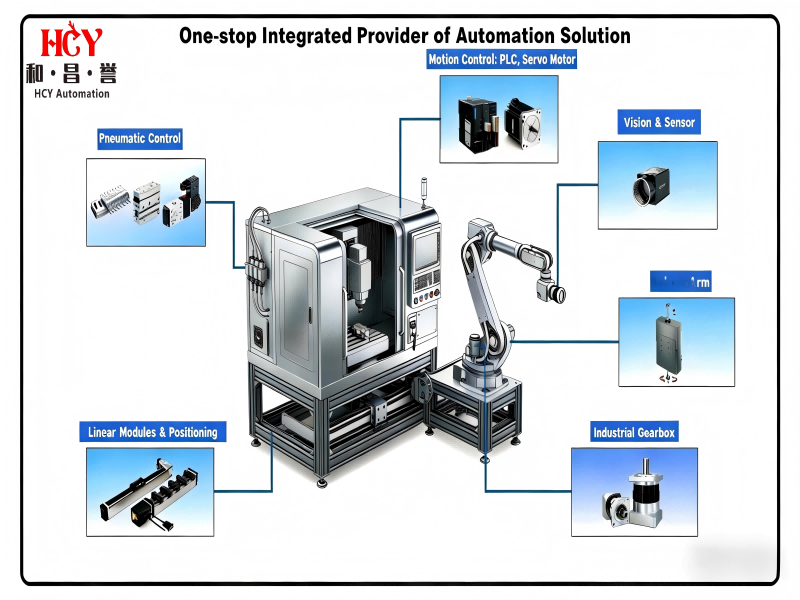
One Diagram to Understand the Relationship and Collaboration of Industrial Automation Components
🔑Understanding the Closed-Loop System in Industrial Automation: Key Components and Their Roles
In today’s competitive industrial landscape, achieving high efficiency and precision is essential. The backbone of this capability lies in an integrated closed-loop system that governs the interaction between various automation components. This system follows a strict logic: Perception → Control → Transmission → Execution → Feedback.
Each layer in this loop plays a critical role, from sensing the environment to executing precise movements. Let’s dive into the key automation components and explore their interdependent roles in driving automation forward.
1. Perception Layer: Vision & Sensor Systems 📸
Core Function:
The Vision & Sensor Systems collect critical data such as position, orientation, and environmental conditions, providing real-time feedback to the system.
Role in the Loop:
These sensors act as the “eyes” and “ears” of the system, gathering data that informs the control system’s decisions, ensuring accuracy and proper functioning throughout the automation process.
High-Frequency Keywords:
Industrial sensors for automation
Vision systems for manufacturing
Machine vision sensors
Proximity sensors for automation
Example Components:
Cameras and Imaging Sensors
Temperature & Pressure Sensors
2. Control Layer: Motion Control Components ⚙️
Core Function:
Motion control components receive input from sensors and process it to calculate motion paths and drive actuators accordingly.
Role in the Loop:
This layer serves as the “brain” of the automation system, orchestrating the movement and behavior of the system to execute precise actions based on real-time data.
High-Frequency Keywords:
Motion control systems
Programmable Logic Controllers (PLCs)
Industrial motion control
Automation motion controllers
Example Components:
Motion Controllers
Servo Drives
PLCs
3. Transmission Layer: Gearboxes, Linear Motion & Pneumatic Components 🔧
Core Functions:
Industrial Gearboxes: Provide torque amplification, speed reduction, and directional change to meet the system’s power requirements.
Linear Motion & Positioning: Ensure precision linear displacement, guidance, and positioning of the robotic arm or other moving parts.
Pneumatic Components: Offer lightweight, fast, and clean energy to control cylinders and actuators for rapid, high-performance movements.
Role in the Loop:
These components are responsible for converting and transmitting energy to create the motion required for precise automation actions, driving tools, or robotic arms.
High-Frequency Keywords:
Industrial gearboxes for automation
Linear motion systems
Pneumatic actuators
Pneumatic automation components
Gear reduction for industrial use
Example Components:
Industrial Gearboxes
Linear Actuators
Pneumatic Cylinders
4. Execution Layer: Robotic Arm 🤖
Core Function:
The robotic arm performs the physical tasks, such as assembly, pick-and-place, or welding, with the end effectors performing the final actions.
Role in the Loop:
The robotic arm is the “body” of the system, executing commands from the control system and performing the precise movements needed to complete tasks.
High-Frequency Keywords:
Robotic arms for industrial automation
Robotic arms for assembly
Automation robotic arm systems
Collaborative robotic arms
Example Components:
Industrial Robotic Arms
End Effectors (Grippers, Tools)
5. Feedback Layer: Real-Time Sensory Feedback 🔄
Core Function:
The feedback layer evaluates the results of the executed tasks and provides real-time feedback for continuous optimization.
Role in the Loop:
This phase ensures the system can adjust its actions based on sensor feedback to maintain precision and efficiency.
💡 Why Automation Accessories Matter
- Boost Efficiency: Automate processes for fewer errors and higher output.
- Improve Quality: Standardize operations for consistent product quality.
- Cut Costs: Reduce downtime, energy consumption, and maintenance.
- Scalable Solutions: Grow with flexible automation components.
- #ServoMotor #ServoMotorSolutions #PrecisionServoMotor #IndustrialServoMotor #CNCServoMotor #RoboticsServoMotor #AutomationServo #PackagingServoMotor #MedicalServoMotor #HighPrecisionServo #HighTorqueServoMotor #BrushlessServoMotor #PlanetaryGearbox #GearboxTechnology #PrecisionGear #HighTorqueGearbox #AutomationComponents #PlanetaryReducer #SpeedReduction #IndustrialGearbox #ACServoMotor #DCServoMotor #ServoDrive #EncoderServoMotor #ServoControlSystem #IndustrialAutomation #ManufacturingTech #EngineeringSolutions #MotionControl #FactoryAutomation