
How to Choose the Right Ball Screw Linear Module: A Complete Guide for Automation Engineers

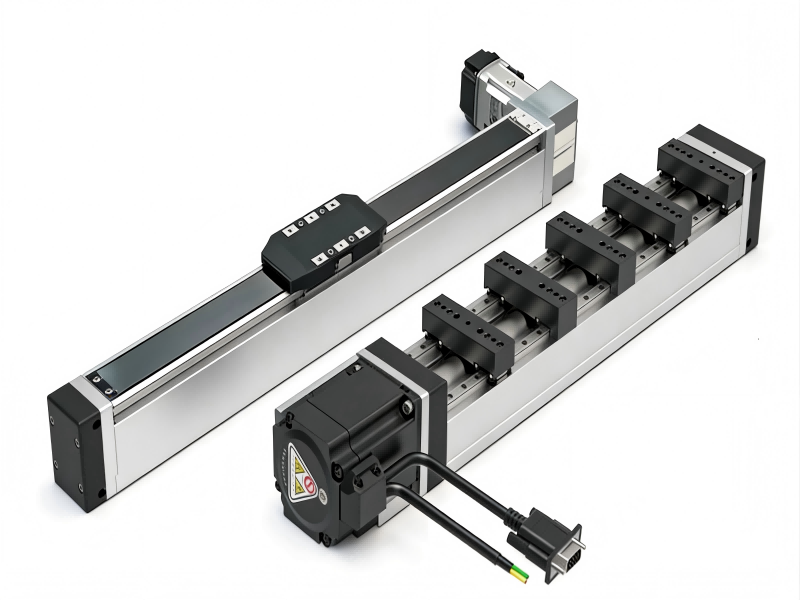
🔍 7 Critical Steps to Selecting the Perfect Ball Screw Linear Module
Are you struggling with how to choose a ball screw linear module for your automation project? Wondering about the differences between ball screw vs lead screw vs belt drive? Or maybe you’re asking: What size ball screw do I need? or How to calculate load capacity for my linear actuator? This comprehensive guide will walk you through the exact selection process used by professional automation engineers, covering load calculation, precision requirements, speed considerations, stroke length, environmental factors, motor selection, and cost optimization.
📌 Step 1: Define Your Load Requirements (The Foundation of Selection)
Key Questions to Answer:
- What is the static load (weight of workpiece + fixture)?
- What is the dynamic load (including acceleration forces: F = ma)?
- Are there radial or moment loads (eccentric forces)?
- What safety factor do you need (1.5x-2.0x is standard)?
Load Capacity Guidelines:
| Load Type | Recommended Ball Screw Solution | Typical Applications |
|---|---|---|
| Light Load (<15kg) | Miniature ball screw modules | 3D printers, small dispensing machines |
| Medium Load (15-50kg) | Standard ball screw modules (16-25mm diameter) | Pick-and-place, assembly stations |
| Heavy Load (>50kg) | Large diameter ball screws (32mm+) with reinforced guides | CNC machines, material handling |
| Vertical Loads | Anti-backlash designs + brake systems | Z-axis applications, lifting mechanism |
Critical Formula: L10 Life = (Ca / (fw × Fa))³ × 10⁶ revolutions (where Ca = dynamic load rating, Fa = applied load, fw = load factor)
🎯 Step 2: Precision & Accuracy Requirements
ISO 3408-3 Accuracy Grades Explained:
- C1-C3 (Ultra-Precision): ±0.005mm/300mm, for semiconductor equipment, surgical robots
- C5 (High Precision): ±0.01mm/300mm, for CNC machining, precision inspection
- C7 (General Purpose): ±0.05mm/300mm, for most industrial automation
- C10 (Economic): ±0.1mm/300mm, for basic positioning applications
Key Precision Metrics:
- Positioning Accuracy: Maximum deviation from target position
- Repeatability: Consistency of positioning over multiple cycles (often 1/3 of accuracy)
- Backlash: Clearance between screw and nut (critical for reverse motion)
Pro Tip: Over-specifying precision can increase costs by 30%+ without added value.
⚡ Step 3: Speed & Acceleration Parameters
Calculate Required Speed:
- Linear Speed (m/s) = Screw Lead (m/rev) × Motor RPM
- Critical Speed: Maximum rotational speed before screw deflection (increases with diameter, decreases with length)
Speed vs. Technology Comparison:
表格
| Technology | Max Speed | Best For |
|---|---|---|
| Ball Screw | ≤1.5m/s | Precision over speed |
| Belt Drive | ≤5m/s | Long strokes + high speed |
| Linear Motor | >5m/s | Ultra-high speed + acceleration |
Important: For speeds >1m/s, consider dynamic balancing and cooling systems.
📏 Step 4: Stroke Length & Installation Space
- Short Stroke (<500mm): Compact ball screw modules with integrated guides
- Medium Stroke (500-1500mm): Standard ball screw designs with proper support bearings
- Long Stroke (>1500mm): Consider belt drive or planetary roller screws for better rigidity
Space Constraints:
- Horizontal Installation: Standard horizontal mounting (most common)
- Vertical Installation: Requires anti-fall mechanisms and higher rigidity
- Compact Spaces: Inline motor designs or embedded ball screw modules
🌍 Step 5: Environmental Adaptability
Key Environmental Factors:
- Temperature: Standard modules (-10°C to +60°C); high temp options available
- Contamination: IP54 (dust protection) or IP65 (dust/water protection) ratings
- Corrosive Environments: Stainless steel screws + special coatings
- Clean Rooms: Lubricant-free options or food-grade lubricants
🤝 Step 6: Motor & Drive System Matching
Motor Selection Guide:
| Application | Recommended Motor | Why It Works |
|---|---|---|
| Low Precision + Low Cost | Stepper Motor | Cost-effective, simple control |
| High Precision + Dynamic Loads | Servo Motor | Closed-loop control, better torque |
| High Speed + High Acceleration | Brushless DC Motor | High power-to-weight ratio |
Critical Matching Parameters:
- Torque Requirement: Must overcome friction + load + acceleration forces
- Encoder Resolution: Matches required positioning accuracy
- Drive Compatibility: Ensure motor and controller communication protocol matches
💰 Step 7: Cost vs. Performance Optimization
Total Cost of Ownership Considerations:
- Initial Purchase Price: Ball screw (moderate) vs lead screw (low) vs linear motor (high)
- Maintenance Costs: Ball screws require periodic lubrication; lead screws have higher friction
- Energy Efficiency: Ball screws (90% efficiency) vs lead screws (30-50% efficiency)
- Service Life: L10 life calculation to prevent premature failure
Common Mistakes to Avoid:
- Over-specifying precision or load capacity (wastes money)
- Underestimating environmental factors (leads to early failure)
- Ignoring maintenance requirements (reduces service life)
- Mismatching motor and screw specifications (causes performance issues)
🛠️ Ball Screw vs. Lead Screw vs. Belt Drive: Which to Choose?
| Feature | Ball Screw | Lead Screw | Belt Drive |
|---|---|---|---|
| Efficiency | 90%+ | 30-50% | 95%+ |
| Precision | High (±0.005-0.05mm) | Low (±0.1-1mm) | Medium (±0.05-0.5mm) |
| Load Capacity | High | Medium | Low-Medium |
| Speed | Medium (≤1.5m/s) | Low (≤0.5m/s) | High (≤5m/s) |
| Self-Locking | No | Yes (acme thread) | No |
| Cost | Medium | Low | Medium-Low |
| Best Applications | Precision positioning, heavy loads | Low-cost vertical applications | Long strokes, high speed |
Final Recommendation: Choose ball screw modules when you need high precision, strong thrust, and stiffness for short to medium strokes (50-1500mm).
📈 Ready to Find Your Perfect Linear Module?
Still unsure about how to choose a ball screw linear module for your specific application? Our team of automation experts is here to help! We offer a full range of ball screw linear modules, stepper/servo motors, PLCs, and motion control systems to meet your exact requirements. Contact us today for a free consultation and personalized recommendation.