
How Pneumatic Components Drive Efficiency in Lithium-Ion Battery Production?

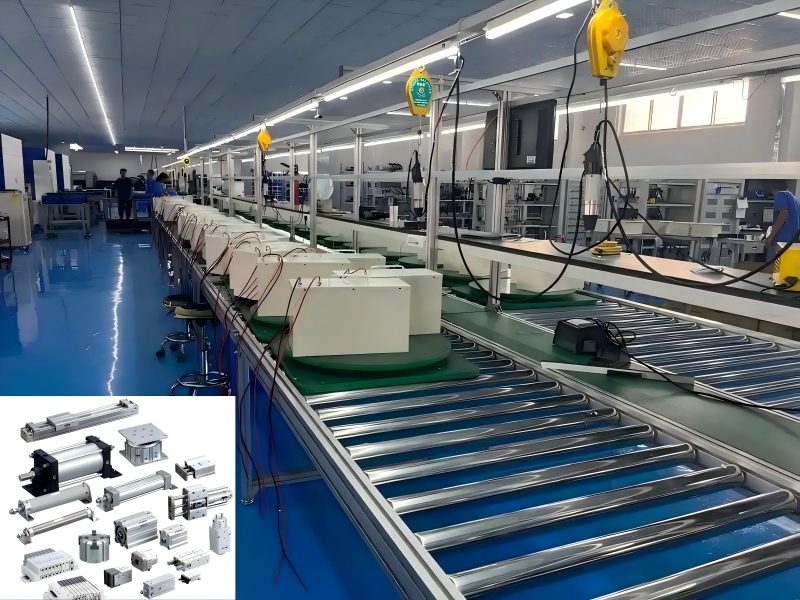
Core Applications of Pneumatic Components and Cylinders in New Energy Battery Production
The Role of Pneumatic Systems in Optimizing New Energy Battery Production
Pneumatic components and cylinders are the core execution units in the intelligent manufacturing of new energy batteries, primarily lithium-ion batteries. They span the entire production process and provide key advantages, such as fast response, cleanliness, safety, and cost control, making them essential for high-precision manufacturing in the battery industry.
1. Core Applications by Production Process
1. Electrode Preparation Stage
- Pneumatic Diaphragm Pumps & Ball Valves: Precisely deliver positive and negative electrode slurry with corrosion resistance and zero leakage.
- Servo Cylinders & Precision Control Valves: Real-time adjustment of coating width, with positioning accuracy of ±0.01mm.
- Pneumatic Air Knives & Ionizing Nozzles: Accelerate solvent evaporation and eliminate static, preventing dust adsorption.
2. Cell Assembly Stage (Key Application Area)
- Parallel Grippers & Vacuum Suction Cups: Millisecond-level electrode pick-up and transfer, preventing damage.
- Pneumatic Brakes: Control winding and stacking tension to avoid separator puncturing.
- Double-Acting Cylinders: Drive positioning fixtures to achieve precise electrode stacking.
- Cylinder-Driven Welding Electrodes/Grippers: Apply consistent pressure for uniform welding.
3. Electrolyte Injection and Sealing Stage
- Pneumatic Ceramic Pumps: Achieve microliter-level precision for injecting electrolyte, suitable for fluorine-containing electrolytes.
- Airbag-Type/Double-Acting Cylinders: Drive heat-sealing molds to ensure high sealing yield.
- Pneumatic Vacuum Valves: Control chamber vacuum to prevent moisture ingress.
4. Module and Pack Assembly Stage
- Hydraulic-Pneumatic Booster Cylinders: Provide 1-5 tons of pressure for module bundling and fixing.
- Rotary Cylinders & Multi-Axis Grippers: Complete busbar installation and bolt tightening.
- Cylinder-Driven Thermal Pad Bonding: Ensure even battery heat dissipation.
2. Key Selection Criteria
- Cylinders: Oil-free lubrication, corrosion resistance, Class 6 cleanliness (stainless steel/Teflon-coated).
- Grippers: Adjustable clamping force, anti-static, suitable for various cell sizes.
- Valves: Fast response, chemical resistance, low leakage (high-speed solenoid valves/fluorine-lined valves).
- Vacuum Components: Oil-free, high cleanliness, anti-static design.
3. Core Advantages and Trends
Advantages:
- Explosion-proof safety (no electrical sparks),
- Clean and pollution-free,
- Cost-effective (low investment and maintenance),
- Precise control (±0.01mm accuracy).
Trends:
- Integration of pneumatic and electric drives,
- Intelligent monitoring systems,
- Lightweight designs,
- Green and energy-efficient technologies.
Conclusion
Pneumatic components play a vital role in the entire production process of new energy batteries, ensuring efficiency and product quality. Their high safety, adaptability, and precision make them an ideal fit for the precise manufacturing needs of the battery industry. As technology continues to advance, pneumatic systems will continue to drive improvements in both production efficiency and product quality, supporting the future of sustainable and high-performance battery manufacturing.