
- Motion Control
- Leadshine IDM Series Integrated Smart Motor with Driver | Compact, Plug-and-Play, High Acceleration, Easy Installation
- ISV2 Series Intelligent Integrated Low Voltage Servo Motor – CANopen & RS485 Communication For Automation Solution
- Integrated Closed-Loop Stepper Motor Series Stepper motor + Drive + Controller
- Leadshine 5CM 5-Phase Stepper Motors Low Vibration for Optical Communication Modules
- Leadshine 57CME Series Closed Loop Stepper Motor | High Torque Low Heat High Stability & Consistent Performance for Precision Machine
- Leadshine 57CM Series NEMA23 Stepper Motor | High Torque Low Heat High Consistency 0.6-3.1Nm
- DM5-EC 5-Phase EtherCAT Stepper Motor Driver High Precision Low Vibration for Semiconductor, Medical & Industrial Automation Import Replacement
- Leadshine DM Open-loop Stepper Driver 32-bit DSP Motor Controller with Advanced Control Tech, Low Vibration High Reliability for Industrial Automation
- Leadshine DM3C EtherCAT Bus Stepper Driver, 32-bit DSP 100Mb/s High-speed CoE CiA402 Drive, Multi Control Mode, Anti-vibration No Step-loss, Cost-effective Industrial Multi-axis Motion Controller
- Leadshine L8 High Precision AC Servo Drive EtherCAT Support for Semiconductor Manufacturing
- Leadshine L7 Series Universal AC Servo System | EtherCAT Modbus Profinet Servo Drive with High Bandwidth, STO Safety & High-Precision Encoder for Robotics, Laser & Machine Tool Automation
- Leadshine ACM Series Compact AC Servo Motor 50W-1000W, 21bit Encoder, IP67, CE/UL Certified, High Overload Performance
- Leadshine MC500 PLC | EtherCAT 32-Axis Motion Controller with Dual-Core, IEC 6 Languages for 3C, PV, Lithium Battery, Logistics & Packaging Automation
- Leadshine LC Series Large PLC Controller – CODESYS Platform 256-Axis EtherCAT Motion Controller
- R Series EtherCAT Remote I/O Modules for Flexible and Scalable Industrial Automation
- Siemens AC Servo Motors | High Precision Closed-Loop Motion Control, Synchronous & Induction Motors for Robotics, CNC Machine Tools, Packaging and Semiconductor Equipment
- Panasonic MINAS A6/A7 Series AC Servo Motor 50W-22kW – 23bit Encoder, 3x Overload, IP67, 3.2kHz Response, PLC Compatible for High-Precision Industrial Automation
- Delta Servo Systems Delta PLC
- Linear Motion Module
- High Precision Ball Screw Slide Table Heavy Duty Linear Module for Industrial Automation CNC Equipment Parts
- Cleanroom Ball Screw Linear Module, Low Particle Release High Rigidity Dustless Linear Actuator for Semiconductor Medical Industrial Automation Equipment
- Embedded Screw Slide Table: Compact Integrated Linear Module with High Rigidity, Low Maintenance & Cost-Effective Design for Industrial Automation
- Industrial Gear Reducer
- High Precision Planetary Gear Reducer With Low Backlash, High Torque Density for Robotics & CNC Automation
- Helical Gear Reducer – Low Noise Heavy Duty Modular Design Industrial Gearbox with Easy Maintenance
- Industrial Modular Helical Gear Reducer – Smooth Transmission, Strong Overload Resistance & Flexible Mounting, Suitable for Chemical, Textile & Heavy-Duty Equipment
- Robotic Arm
- Vision & Sensor Systems
- SICK Vision Sensor for High-Precision Machine High Accuracy Detection & Positioning for Smart Factories & Robotics
- SICK Photoelectric Sensor Safety Light Curtains – IP67 Safety Protection for Machine Guarding
- Hikvision CU Series Cost-Effective Industrial Camera Built-in ISP Algorithm with WDR GigE Vision & USB3.0 Interface for Industrial Machine Vision
- Pneumatic Components
- Airtac Air Source Treatment Three-in-One Unit Preparation Units Filter Regulator & Lubricator for Industrial Automation Systems
- AIRTAC Solenoid Valve | Direct/Semi-Direct/Pilot Operated, Leak-Proof & Explosion-Proof DN50, Industrial Fluid Control for Automation, Chemical & Mechanical Piping
- Pneumatic Slide Table Cylinder – ±0.01mm Precision Compact Integrated High Rigidity Durable for Automation
Optical Communication Future Trends: How Stepper Motors & Precision Stages Reshape High-Speed Optical Industry

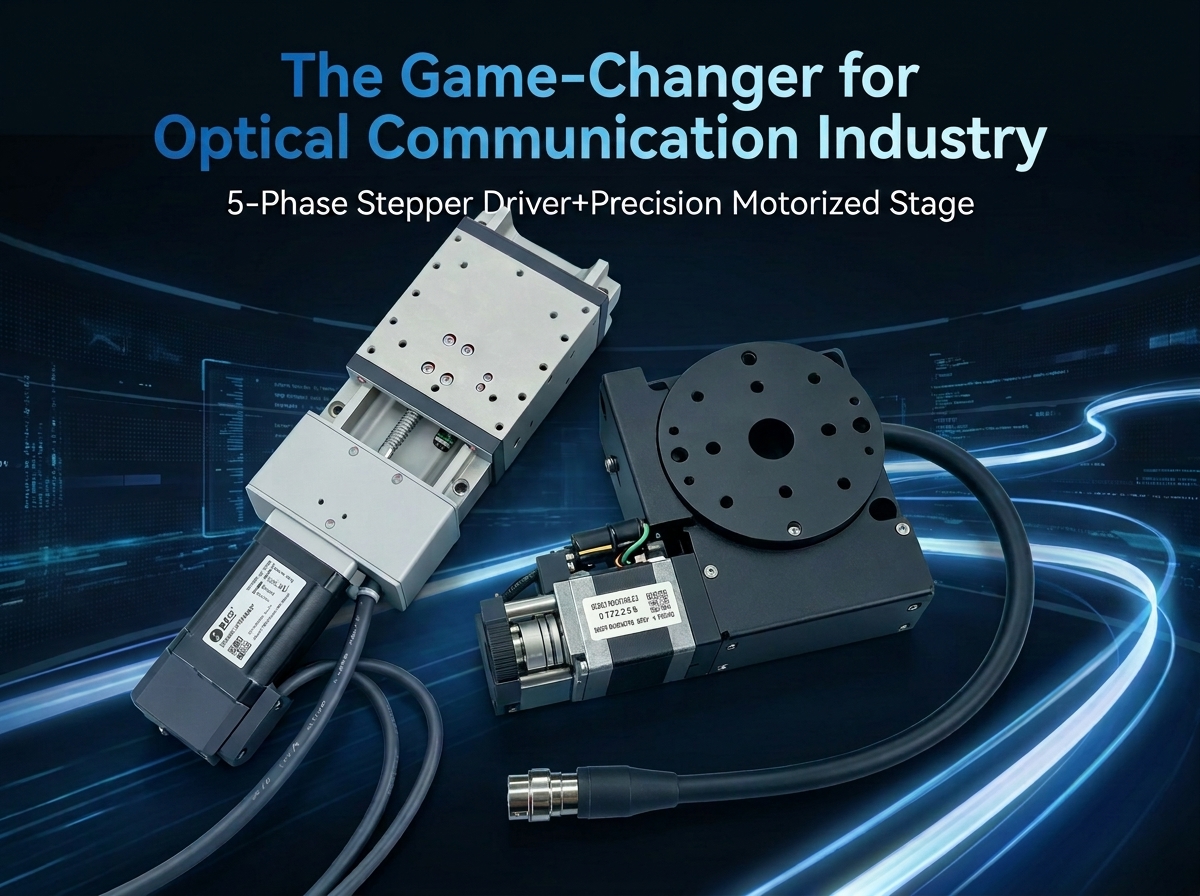
Optical Communication Industry Trends 2026: How Stepper Motors & Precision Stages Drive Next-Gen Connectivity
Explore 2026 optical communication trends, 800G/1.6T transceiver deployment, AI-driven networks, and why stepper motors & precision linear stages are critical for fiber alignment, silicon photonics packaging, and optical test equipment.
The Optical Communication Revolution Accelerates
The global optical communication industry is experiencing an unprecedented “optical interconnection super cycle” driven by the exponential growth of generative AI, cloud computing, and 5G-Advanced deployments. By 2026, the market for high-speed optical transceivers is projected to reach $16 billion, with 800G systems displacing 400G as the dominant technology in data center upgrades. By 2030, the global optical transceiver market is expected to surge to $28 billion with a CAGR of 15%.
At the heart of this transformation lies the demand for unprecedented precision in optical component manufacturing, assembly, and testing. This is where stepper motors and precision linear stages have emerged as indispensable technologies, enabling the nanometer-level positioning required for next-generation optical systems.
Key Optical Communication Industry Trends 2026-2030
1. Terabit-Speed Transceiver Dominance
- 800G & 1.6T Deployments: 800G shipments are growing at 100% YoY, with 1.6T solutions entering mass production by late 2026
- CPO (Co-Packaged Optics) Revolution: CPO technology reduces power consumption by 50% compared to traditional pluggable optics, becoming standard in AI data centers
- Silicon Photonics Integration: DSP ASIC integration for 3.2T coherent systems will achieve power consumption below 15W by 2029
2. AI-Driven Network Transformation
- Autonomous Optical Networks: AI algorithms optimize fiber optic routes in real-time, reducing latency by 30%
- Predictive Maintenance: Machine learning models predict component failures before they occur, increasing network uptime to 99.999%
- Optical Switching Innovation: OCS (Optical Circuit Switching) and NPO (Near-Photonic-Output) technologies gain traction for high-bandwidth, low-latency applications
3. Miniaturization & Energy Efficiency
- Compact “Plugged” Optics: Reduced physical footprint and power consumption in global communication hubs
- Low-Power Transceivers: Focus on developing energy-efficient solutions to support sustainability goals
- High-Density Data Centers: Hyperscale facilities drive demand for space-saving optical components with minimal heat generation
4. Emerging Applications Expansion
- 6G Pre-Deployment: Optical infrastructure preparation for terahertz communication systems
- LiDAR & Optical Sensing: Growth in automotive and industrial sensing applications requiring precision optical alignment
- Quantum Communication: Early-stage deployments demanding ultra-stable optical positioning systems
Critical Applications of Stepper Motors & Precision Stages in Optical Communication
1. Fiber Optic Alignment & Coupling (Most Demanded Application)
- Fiber-to-Chip Alignment: 6-DOF precision stages position fibers with sub-micron accuracy for silicon photonics packaging
- Fiber-to-Fiber Coupling: Stepper motor-driven micropositioners maximize coupling efficiency up to 99.9%
- WDM Component Alignment: Precise angular positioning of wavelength division multiplexing filters for optimal signal transmission
- Typical Setup: XYθ precision stages with closed-loop stepper motors achieving 0.025 μm repeatability and 1 nm resolution
2. Optical Transceiver Manufacturing
- Lens & Mirror Positioning: Stepper motor linear slides adjust optical elements in transceiver modules for beam shaping
- Laser Diode Mounting: High-precision stages ensure accurate placement of laser sources in 800G/1.6T modules
- Connector Assembly: Automated systems using 5-phase stepper motors for consistent, reliable fiber connector termination
- Quality Control: Inspection stations with motorized stages verify optical performance across temperature ranges
3. Optical Test & Measurement Equipment
- Variable Optical Attenuators (VOAs): Stepper motor-driven shutters precisely control light intensity for signal testing
- Optical Delay Lines: Linear stages with nanometer resolution adjust path lengths for time-domain reflectometry
- Spectrometer Calibration: Motorized positioning of diffraction gratings for wavelength accuracy
- OTDR (Optical Time-Domain Reflectometer): Stepper motor-controlled fiber switching for multi-port testing
4. Specialized Optical Components
- Mechanical Optical Switches: Stepper motors enable fast, reliable switching between multiple fiber paths
- Tunable Lasers: Precision stages adjust cavity length for wavelength tuning in coherent systems
- Optical Isolators: Motorized polarization controllers maintain signal integrity in high-speed networks
Why Stepper Motors & Precision Stages Are Ideal for Optical Module Production?
Because it solves manual optical alignment pain points, delivering nm-level accuracy, zero drift, and full automation for optical module manufacturing
1. Unmatched Positioning Precision
- Sub-Micron Accuracy: 5-phase stepper motors achieve 0.001° step angles, translating to nanometer-level linear motion
- High Repeatability: Closed-loop systems with optical encoders ensure positioning consistency within 0.02 μm
- No Position Drift: Stepper motors hold position without power, critical for long-duration optical experiments
2. Superior Motion Control Capabilities
- Incremental Motion: Pulse-based control enables precise, step-by-step adjustments ideal for alignment procedures
- High Resolution: Microstepping technology divides full steps into 256 microsteps, achieving smooth motion at low speeds
- Dynamic Response: Fast acceleration/deceleration profiles reduce alignment time by 40% compared to servo systems
3. Cost-Effective Performance
- Lower Total Cost of Ownership: Stepper systems cost 30-50% less than comparable servo solutions while maintaining precision
- Simplified Integration: No complex tuning required, reducing setup time in manufacturing environments
- Long Lifespan: Brushless design ensures reliable operation for 10,000+ hours in industrial settings
Conclusion: Precision Motion as the Foundation of Optical Innovation
The optical communication industry’s transition to terabit-speed networks and AI-driven architectures depends fundamentally on precision motion control. Stepper motors and precision linear stages provide the nanometer-level accuracy, repeatability, and reliability required for fiber alignment, transceiver manufacturing, and optical testing.
As we move toward 2030, these motion solutions will continue to evolve, integrating advanced feedback systems, smart connectivity, and miniaturized designs to meet the ever-increasing demands of the optical communication ecosystem. For manufacturers and system integrators, investing in high-quality stepper motor and precision stage technology isn’t just a choice—it’s a necessity to remain competitive in the rapidly expanding optical communication market.