How Do Variable Pitch Modules Work in High-Speed Automation?
Understanding Dynamic Pitch Adjustment, Synchronized Motion, and Precision Positioning in Automated Handling Systems
In high-speed automated production lines, moving multiple products from one station to another is rarely just a matter of picking them up and putting them down.
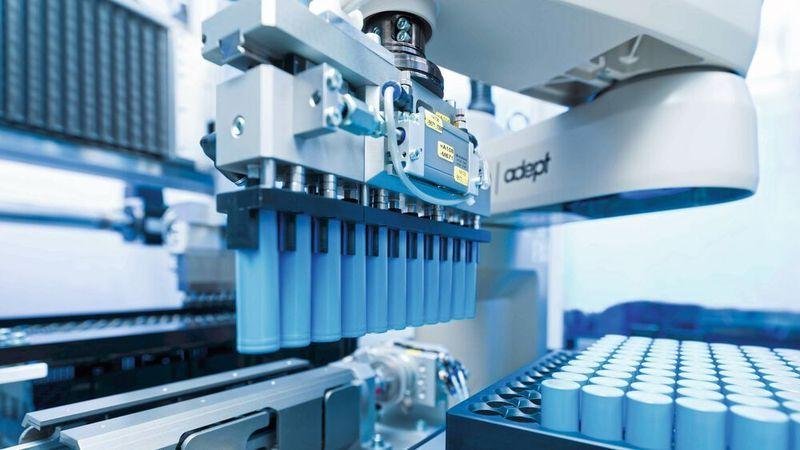
The spacing between products may change from one process to another. Components arranged closely together on an incoming tray may need to be transferred to a wider arrangement for inspection, assembly, or packaging. In other applications, multiple suction cups or grippers must adjust their positions simultaneously to match different product sizes.
This is where a variable pitch module becomes important.
By coordinating the movement of multiple sliders, a variable pitch mechanism can automatically adjust the distance between working positions without requiring operators to manually reposition each gripper or replace mechanical fixtures.
But how does this mechanism actually work? How does one motor drive several moving units? What roles do ball screws, synchronous belts, linear guides, and motion controllers play in the process?
At HCY Automation, we work with industrial linear motion and customized positioning systems. In this guide, we’ll break down the mechanical principles behind variable pitch modules and explain how dynamic spacing adjustment works in high-speed automation applications.
1. What Is Dynamic Spacing Adjustment in Industrial Automation?
Dynamic spacing adjustment refers to the automatic adjustment of the distance between multiple working positions according to different production requirements.
In industrial automation, this distance is commonly called pitch or center-to-center spacing.
For example, consider an automated pick-and-place system equipped with four vacuum suction cups.
At the pickup station, the four suction cups may need to be positioned at 30 mm intervals to match the arrangement of components on a tray.
At the placement station, however, the required spacing may be 60 mm.
Without an automatic variable pitch mechanism, the equipment would need to rely on manual adjustment, replaceable fixtures, or multiple independent positioning units.
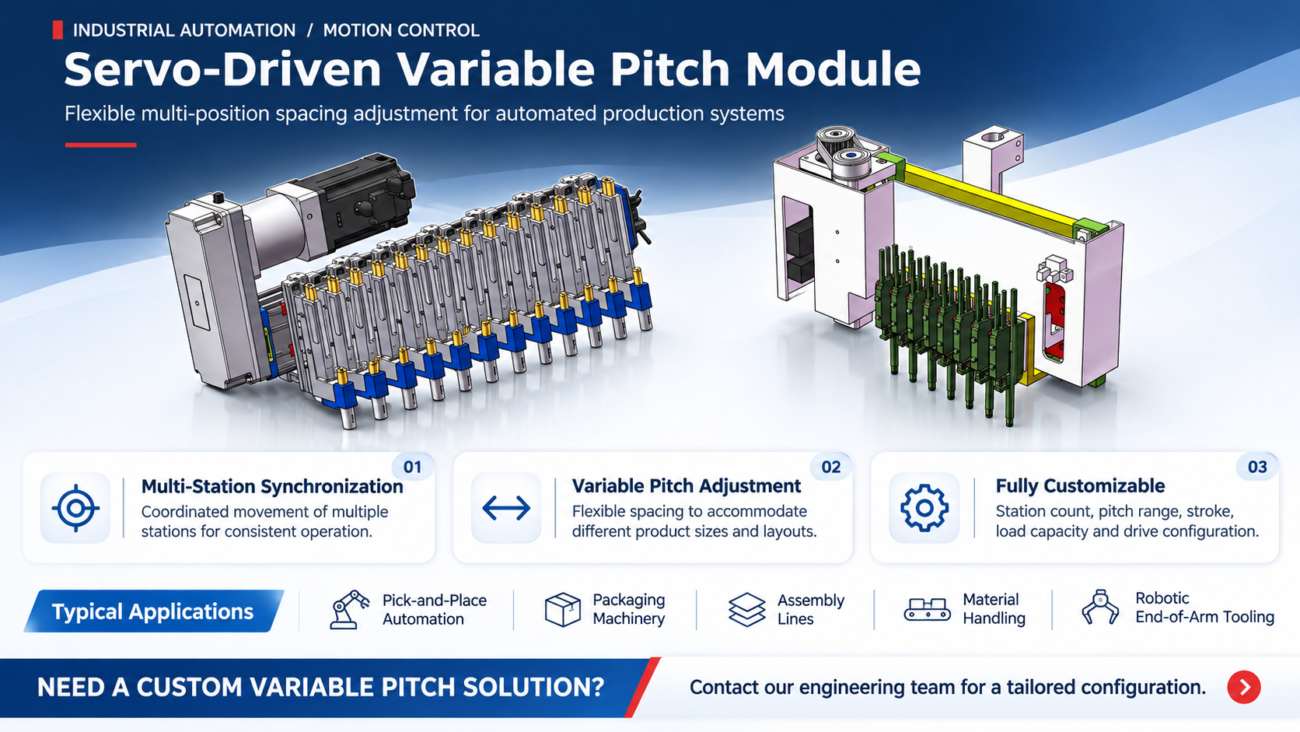
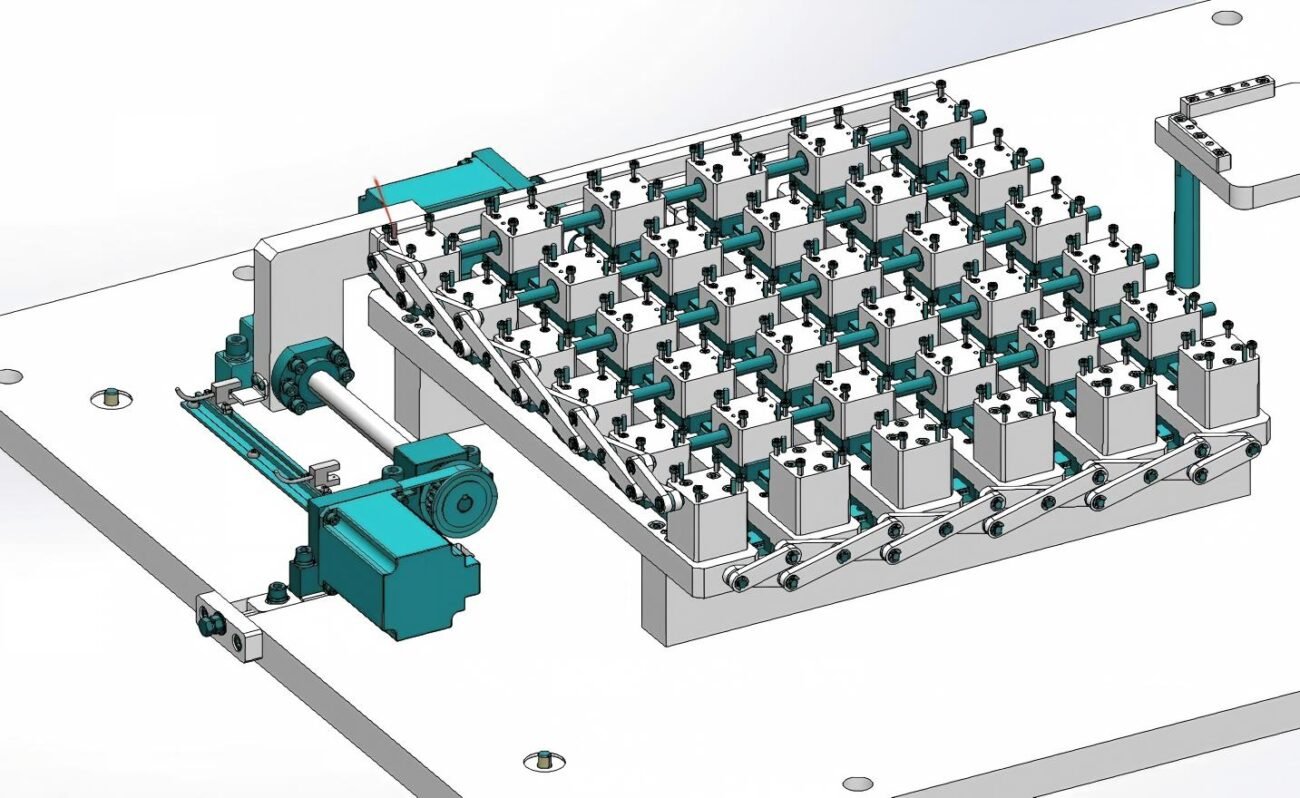
A variable pitch module provides another approach: multiple moving units are mechanically or electronically coordinated to change their spacing automatically.
Why Is Dynamic Pitch Adjustment Important?
Modern manufacturing increasingly requires equipment to handle different product sizes, layouts, and production batches.
A fixed-spacing handling mechanism may work well for one product but become a limitation when the production line needs to accommodate another.
Dynamic spacing adjustment offers several advantages:
Flexible production: One handling system can accommodate different product arrangements.
Higher handling efficiency: Multiple components can be picked up and transferred in one operation.
Reduced manual intervention: Operators do not need to repeatedly adjust mechanical fixtures.
Improved production consistency: Programmed spacing positions help maintain repeatable positioning.
Simplified equipment changeover: Different spacing requirements can be incorporated into the control program.
For equipment manufacturers, this means greater flexibility when developing automated loading and unloading systems, multi-point pick-and-place machines, and customized material handling equipment.
2. What Are the Main Components of a Variable Pitch Module?
Although variable pitch modules can have different mechanical configurations, most systems are built around several essential components.
Each component performs a specific function in achieving accurate and coordinated spacing adjustment.
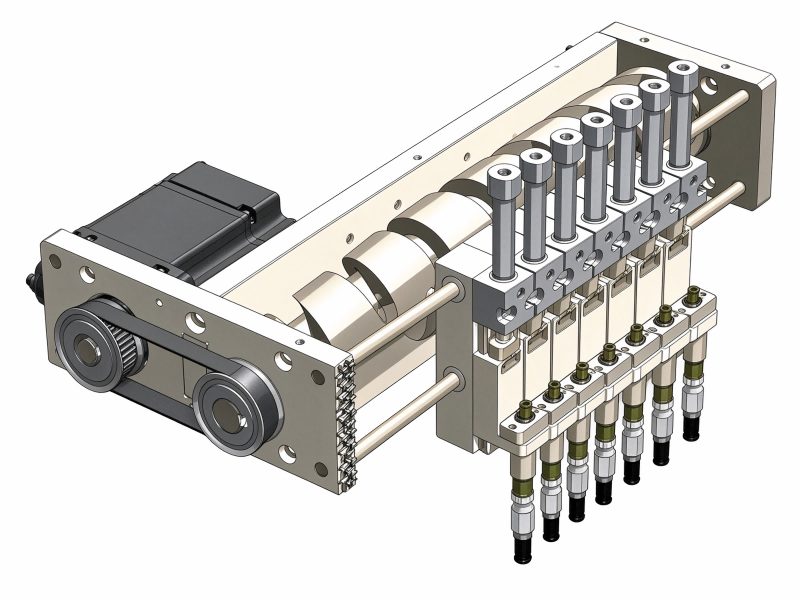
2.1 Servo Motor: The Driving Force
The servo motor provides the power required to move the variable pitch mechanism.
Unlike a conventional motor that simply rotates at a given speed, a servo system can control position, speed, and acceleration through a feedback-based control arrangement.
This makes it suitable for applications requiring:
Accurate positioning
Controlled acceleration and deceleration
Repeatable movement
Programmable spacing adjustment
Coordinated operation with other automation equipment
Depending on the mechanical design, one servo motor may drive several linked sliders through a shared transmission mechanism. Alternatively, multiple servo motors may be used when independent positioning is required.
2.2 Ball Screw and Nut: Converting Rotation into Linear Motion
A ball screw is commonly used in precision linear motion systems.
Its primary function is to convert the rotary motion of a motor into linear movement.
The working principle is straightforward:
The servo motor rotates the ball screw.
The ball nut moves along the screw shaft.
The nut transfers linear motion to the connected slider or mechanical assembly.
The slider moves along the linear guide.
The relationship between screw rotation and linear displacement depends on the screw lead.
For a ball screw with a 10 mm lead, one complete revolution theoretically produces 10 mm of linear travel.
This predictable motion relationship makes ball screws suitable for applications requiring controlled positioning and repeatable movement.
In a customized variable pitch mechanism, the ball screw transmission can be combined with additional mechanical structures to coordinate multiple moving positions.
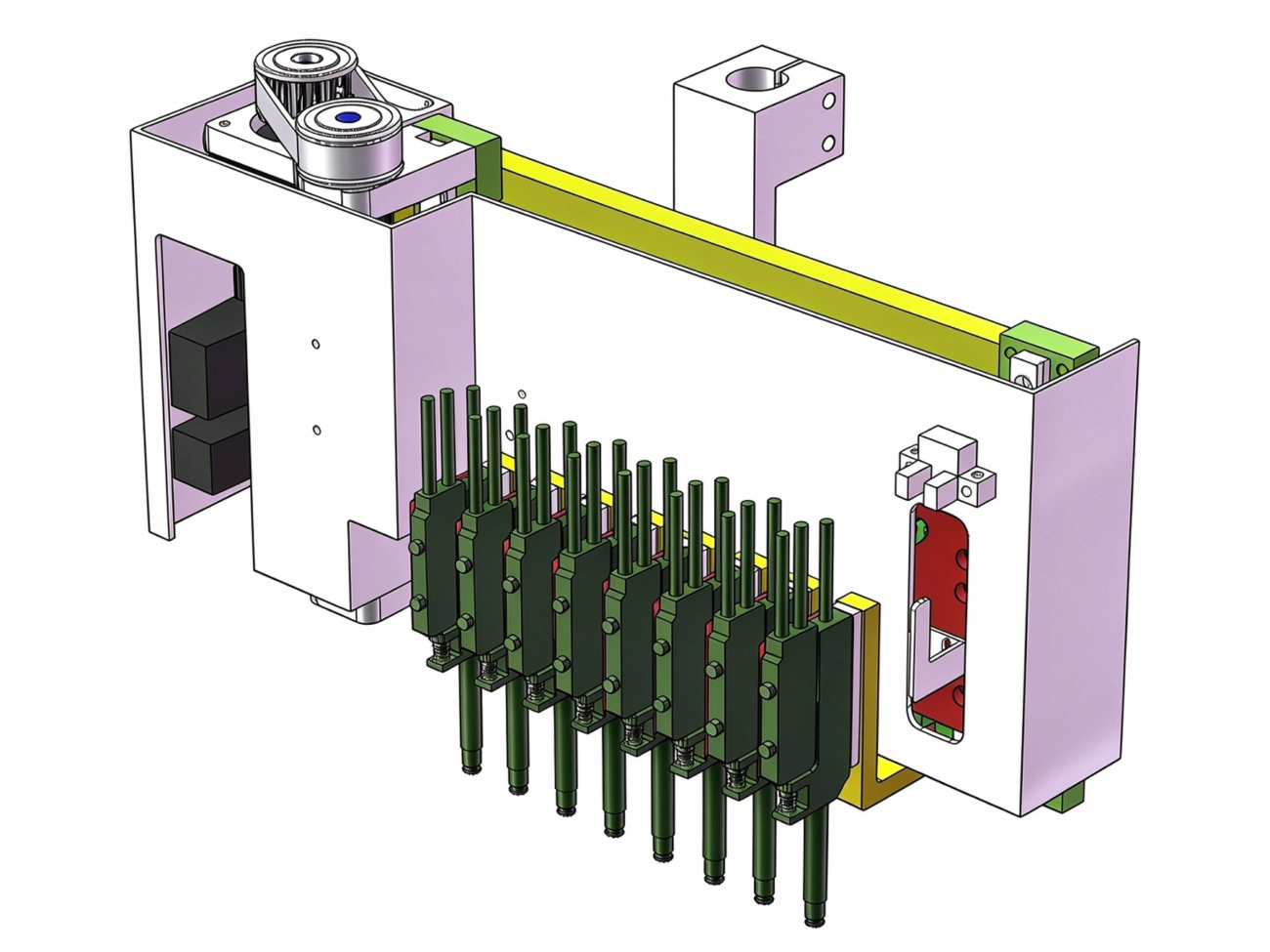
2.3 Synchronous Belt and Pulley: Transmitting and Coordinating Motion
Synchronous belt transmission is another common solution in linear motion equipment.
A synchronous belt engages with toothed pulleys to transmit rotary power without relying on friction alone.
Its main functions include:
Transmitting power between shafts
Coordinating the movement of connected components
Establishing defined movement relationships
Supporting relatively high-speed operation
The transmission ratio depends on the pulley tooth counts.
For example, when a 20-tooth driving pulley rotates, it drives the belt according to its pitch circumference. A different pulley tooth count changes the rotational relationship between the shafts.
However, an important point needs to be understood: different pulley diameters alone do not automatically create a variable pitch mechanism.
The actual spacing adjustment depends on how the belts, pulleys, sliders, and mechanical connections are arranged.
A properly designed transmission system establishes the required movement relationship between the moving units.
2.4 Linear Guide Rails and Sliders: Maintaining Smooth and Stable Movement
Linear guides support the moving components and ensure that they travel along a defined path.
A typical linear guide consists of a guide rail and one or more sliders.
In a variable pitch system, the sliders carry the working components, such as:
Vacuum suction cups
Mechanical grippers
Product positioning fixtures
Small handling platforms
Customized end-effectors
Guide rail rigidity, installation accuracy, and load capacity all influence the performance of the mechanism.
For high-speed applications, the guide system must also withstand acceleration forces and potential overturning moments without compromising movement stability.
2.5 Motion Controller: Coordinating the Movement
The motion controller manages the operating sequence of the variable pitch system.
Depending on the equipment architecture, control may be handled by a PLC, motion controller, or servo drive with suitable positioning functions.
The controller determines:
Target position
Movement distance
Speed and acceleration
Positioning sequence
Synchronization requirements
Communication with other equipment
For an integrated mechanical variable pitch system, the controller may only need to command the main drive axis.
For an electronically synchronized multi-axis system, multiple servo axes must be coordinated through the control program.
The choice depends on whether the application requires mechanically linked movement or independent positioning.
3. How Does a Variable Pitch Module Achieve Dynamic Spacing Adjustment?
Now let’s look at the actual working process.
A variable pitch module does not simply move several sliders randomly. Its mechanical transmission and control system establish a defined relationship between the positions of the moving units.
The system adjusts the spacing by controlling the relative displacement of each slider.
Step 1: Initial Positioning
Before operation, the moving units are positioned according to the initial pickup or processing requirements.
For example, a four-position system may start with four suction cups arranged at equal intervals of 30 mm.
At this stage, each suction cup is aligned with its corresponding workpiece.
Step 2: Servo Motor Starts the Movement
Once the controller receives the positioning command, the servo motor starts rotating.
The motor’s rotary output is transferred through the selected transmission mechanism.
Depending on the design, this may involve:
A ball screw and nut assembly
A synchronous belt and pulley system
A mechanical linkage
A customized combination of transmission components
The transmission mechanism converts or distributes the motor’s movement to the required moving units.
Step 3: Multiple Sliders Move According to a Defined Relationship
This is the key stage of variable pitch adjustment.
The sliders move according to the mechanical or electronic synchronization relationship designed into the system.
For example, in a symmetrical four-position mechanism, the outer sliders may move outward while the inner sliders move according to a corresponding movement pattern.
The objective is to increase or decrease the distance between adjacent working positions while maintaining the required arrangement.
Not every variable pitch system uses the same movement pattern.
Depending on the application, the mechanism may achieve:
Equal-distance adjustment
Symmetrical expansion and contraction
Sequential spacing adjustment
Non-uniform spacing adjustment
Independently controlled positioning
The actual movement relationship must be determined during mechanical design.
Step 4: Reaching the Target Pitch
Once the moving units reach their programmed positions, the servo system completes the positioning process.
For example, the initial spacing of 30 mm can be changed to 60 mm.
The system can then continue with the next handling operation, such as transferring products to another station or placing them into a different tray arrangement.
Step 5: Repeating the Cycle
After the placement operation, the mechanism can return to its original spacing or move to another programmed pitch.
This allows the equipment to handle different product arrangements within the same production process.
The actual cycle time depends on the movement distance, payload, acceleration, transmission structure, and control settings.
It is important to distinguish between the positioning command response and the complete mechanical movement time. A variable pitch system should not automatically be assumed to complete every spacing change within milliseconds.
4. Different Transmission Principles Used in Variable Pitch Modules
Not all variable pitch modules use the same mechanical design.
The transmission structure needs to match the required positioning accuracy, movement speed, load, and spacing range.
Three common design approaches are worth understanding.
4.1 Ball Screw-Driven Variable Pitch Mechanisms
Ball screw transmission is suitable for applications requiring controlled linear displacement and relatively high positioning accuracy.
The motor rotates the screw, and the ball nut converts rotary movement into linear motion.
When combined with a suitable mechanical linkage or coordinated slider arrangement, the system can drive multiple working positions.
Synchronous belt transmission is often considered when high-speed movement and relatively long travel distances are important.
Through a suitable belt routing and pulley arrangement, multiple sliders can be connected and driven according to a predefined movement relationship.
Advantages:
High-speed transmission capability
Relatively lightweight structure
Flexible mechanical arrangement
Suitable for longer travel distances
Considerations:
Belt tension and stiffness
Elastic deformation under load
Transmission accuracy
Pulley alignment and installation
4.3 Customized Mechanical Linkage Systems
Some applications require special spacing relationships that cannot be achieved efficiently using a conventional ball screw or belt arrangement alone.
In these cases, customized mechanical linkages may be incorporated into the design.
The linkage determines how the individual sliders move relative to one another.
This approach is particularly useful when several working positions need to expand or contract in a specific sequence.
The design can be customized according to the number of moving positions, required pitch range, stroke, and installation dimensions.
In practical automation projects, different transmission principles may also be combined to achieve the required performance.
5. Where Are Variable Pitch Modules Used in High-Speed Automation?
Variable pitch modules are used wherever multiple components need to be handled with changing spacing requirements.
Their applications extend across several major manufacturing industries.
5.1 3C Electronics Manufacturing
Electronic components, circuit boards, displays, and small precision parts often require accurate multi-point handling.
Variable pitch modules can adjust suction cup or gripper positions to match different component layouts.
Typical applications include:
PCB component handling
Electronic component transfer
Display and screen assembly
Precision tray loading and unloading
Multi-point pick-and-place systems
5.2 New Energy and Lithium Battery Manufacturing
Battery manufacturing processes often involve handling multiple cells or components simultaneously.
Variable pitch mechanisms can help adjust the spacing between suction cups or grippers when transferring battery cells between trays, conveyors, and processing stations.
Typical applications include:
Battery cell handling
Cell tray loading and unloading
Battery module assembly
Multi-position transfer systems
Automated battery sorting
The actual design needs to consider the dimensions, weight, surface characteristics, and handling requirements of the battery components.
5.3 Automotive Parts Manufacturing
Automotive production lines often require multiple parts to be positioned or transferred simultaneously.
Variable pitch modules can support multi-station handling and automated assembly processes.
Typical applications include:
Automotive component loading
Multi-point part transfer
Automated assembly
Inspection and positioning
Sorting and packaging
5.4 Packaging and Other Automated Production Lines
Variable pitch mechanisms are also useful in packaging, medical equipment, hardware, and plastic product manufacturing.
For example, multiple products may be picked up from a conveyor at one spacing and arranged into a different packaging layout.
Automated pitch adjustment helps reduce the need for manual fixture changes and supports flexible production.
6. How to Select the Right Variable Pitch Module for High-Speed Applications
A variable pitch module should never be selected based on motor power or maximum speed alone.
Its mechanical structure needs to match the actual operating conditions.
Before developing or selecting a customized variable pitch system, equipment designers should evaluate the following parameters.
Selection parameter
Key information to confirm
Number of positions
How many sliders, grippers, or suction cups are required?
Initial pitch
What is the starting center-to-center distance?
Target pitch
What spacing is required after adjustment?
Pitch adjustment range
What are the minimum and maximum pitch values?
Stroke
How far does each slider need to travel?
Payload
What is the weight of each moving unit and workpiece?
Movement speed
How quickly must the spacing change?
Positioning accuracy
What positioning tolerance is required?
Repeatability
How consistently must the system return to the same position?
Installation space
What are the available length, width, and height?
Control requirements
Will the system use a PLC, motion controller, or coordinated servo axes?
Why Is the Pitch Adjustment Range So Important?
The pitch adjustment range directly influences the transmission design.
For example, a system requiring a change from 50 mm to 110 mm has a different mechanical design requirement from one that only needs to adjust between 80 mm and 100 mm.
The number of sliders also matters.
A four-position mechanism may have three adjacent pitch intervals, while a six-position mechanism has five.
Engineers must clarify whether the specified pitch refers to the distance between adjacent sliders or the total distance between the first and last working positions.
This distinction is important when calculating the required slider travel and overall module dimensions.
Why Should Speed and Load Be Evaluated Together?
A module may achieve the required speed under no-load conditions but behave differently when carrying multiple grippers and workpieces.
Therefore, motor selection, guide rail sizing, transmission stiffness, and structural rigidity should all be evaluated together.
A well-designed variable pitch module needs to achieve the required cycle time without sacrificing positioning stability or service life.
7. Why Customized Variable Pitch Modules Matter for Modern Automation Equipment
Standard linear modules are suitable for many conventional positioning applications.
However, multi-position spacing adjustment often involves application-specific requirements that cannot always be addressed by simply combining standard components.
Different equipment may require:
2, 4, 6, or more moving positions
Different pitch adjustment ranges
Equal or unequal spacing
Different slider travel distances
Specific mounting dimensions
Special motor installation orientations
Customized gripper or suction cup interfaces
Integration with existing PLC and servo control systems
This is why customized mechanical design is important.
Instead of selecting individual components first and trying to fit them into the machine afterward, engineers should begin with the actual application requirements.
The transmission structure, slider arrangement, motor configuration, and mounting interfaces can then be developed around the intended movement pattern.
At HCY Automation, we focus on industrial automation and linear motion solutions, including customized variable pitch modules for multi-position handling and precision positioning applications.
Our engineering approach considers the complete mechanical arrangement rather than treating the motor, guide rail, and transmission components as isolated products.
Whether your project requires a compact multi-station variable pitch mechanism or a customized linear motion assembly, the objective is to develop a practical solution that matches your equipment’s actual operating conditions.
8. Frequently Asked Questions About Variable Pitch Modules
Q1: What is the difference between a variable pitch module and a standard linear module?
A standard linear module typically moves one slider or carriage along a linear axis.
A variable pitch module is designed to adjust the relative spacing between multiple moving units.
While both use linear motion technology, a variable pitch module requires an additional mechanical or electronic arrangement to coordinate multiple positions.
Q2: Can one servo motor control multiple variable pitch positions?
Yes. A single servo motor can drive multiple moving units through a mechanically synchronized transmission system.
The exact number of positions and movement relationship depend on the mechanical design.
If individual sliders require independent positioning, multiple servo motors or independently controlled axes may be necessary.
Q3: Can a variable pitch module achieve unequal spacing?
Yes, depending on its mechanical structure and control architecture.
Equal spacing adjustment is common in multi-point handling systems, but customized mechanisms can also be designed for specific non-uniform spacing requirements.
The required movement relationship should be defined before mechanical design begins.
Q4: Is a ball screw or synchronous belt better for a variable pitch module?
Neither is universally better.
Ball screws are often suitable for applications requiring controlled positioning and higher mechanical rigidity.
Synchronous belts are attractive for high-speed movement and longer travel distances.
The final selection depends on payload, speed, stroke, positioning accuracy, and the overall transmission arrangement.
Q5: Which industries commonly use variable pitch modules?
Common applications include:
3C electronics manufacturing
Lithium battery production
Automotive parts assembly
Packaging automation
Medical equipment manufacturing
Industrial sorting and material handling
Any process requiring multiple working units to change their spacing automatically may benefit from a variable pitch mechanism.
Q6: Can variable pitch modules be customized?
Yes. Customized designs can accommodate different numbers of moving positions, pitch ranges, strokes, payloads, motor configurations, and installation dimensions.
For equipment manufacturers, customization makes it possible to integrate the mechanism into existing machine layouts and meet application-specific handling requirements.
Conclusion: Dynamic Spacing Is More Than Just Moving Multiple Sliders
In high-speed automation, variable pitch adjustment is not simply about increasing or decreasing the distance between several grippers.
It involves coordinating mechanical transmission, linear guidance, servo motion, and positioning control to achieve a repeatable movement relationship.
From ball screw-driven mechanisms to synchronous belt transmission and customized mechanical linkages, the right design depends on the actual application requirements.
As manufacturing continues to move toward flexible production and automated multi-point handling, variable pitch modules will remain an important part of modern linear motion and precision positioning systems.
Looking for a customized variable pitch module for your automation equipment?
HCY Automation supports customized linear motion and multi-position variable pitch solutions based on your required stroke, pitch range, number of working positions, payload, and installation conditions.
Contact our engineering team to discuss your application and develop a variable pitch solution that fits your machine design.
HCY Automation delivers integrated solutions across motion control, linear motion, robotics, machine vision, pneumatic systems, and precision gearboxes to help global manufacturers build smarter, faster, and more reliable production lines. Our engineering team helps you select and integrate the right motion control, robotics, and automation components for your specific application.