What Is a Variable Pitch Module in Packaging Machinery? Applications, Working Principles & Selection Guide
Learn what a variable pitch module is, how it works in packaging machinery, its applications in case packing and pick-and-place automation, and how to select a customized solution. Packaging machinery is becoming increasingly flexible. Manufacturers are expected to handle different product sizes, packaging formats, and production requirements without constantly changing mechanical components or redesigning their equipment.
One challenge is product spacing.
Products may arrive closely spaced on a conveyor, but need to be separated, repositioned, or arranged at wider intervals before they can be picked, grouped, and loaded into cartons or packaging trays.
This is where a variable pitch module becomes an important motion component in packaging automation.
By automatically adjusting the spacing between multiple sliders, grippers, or working positions, a variable pitch module helps packaging machines handle multiple products simultaneously and adapt to different packaging formats.
But how does it work? Where is it used in packaging machinery? And what should equipment manufacturers consider when selecting a suitable variable pitch system?
This guide explains the working principles, typical applications, drive options, selection criteria, and maintenance considerations of variable pitch modules in packaging automation.
1. What Is a Variable Pitch Module in Packaging Machinery?
A variable pitch module is a multi-position linear motion mechanism designed to automatically adjust the distance between multiple sliders, grippers, suction cups, or fixtures.
In packaging machinery, pitch generally refers to the center-to-center distance between adjacent products or working positions.
For example, products may enter a packaging machine at a relatively narrow spacing. Before carton loading, the grippers may need to move farther apart to match the arrangement of the products inside the carton.
A variable pitch module performs this spacing adjustment through a synchronized motion mechanism.
Depending on the machine configuration, it can support:
Pitch expansion: Increasing the distance between multiple products or grippers.
Pitch reduction: Bringing multiple working positions closer together.
Synchronized pitch adjustment: Moving several sliders simultaneously while maintaining a defined spacing relationship.
Flexible pitch positioning: Adjusting working positions to match different product and packaging layouts.
For example:
Input pitch: 30 mm
Output pitch: 60 mm
A variable pitch mechanism can expand the spacing between multiple working positions from 30 mm to 60 mm, allowing the grippers to match the required carton or tray arrangement.
The actual pitch range depends on the module design, slider configuration, stroke, and mechanical constraints.
Variable Pitch Module vs. Conventional Linear Module
Although both are linear motion components, they perform different functions.
A conventional linear module typically controls the position of one carriage along a linear axis.
A variable pitch module controls multiple working positions and, more importantly, the spacing relationship between them.
This difference is particularly important in packaging machinery, where several products often need to be picked, transferred, or placed in a synchronized operation.
2. How Does a Variable Pitch Module Work?
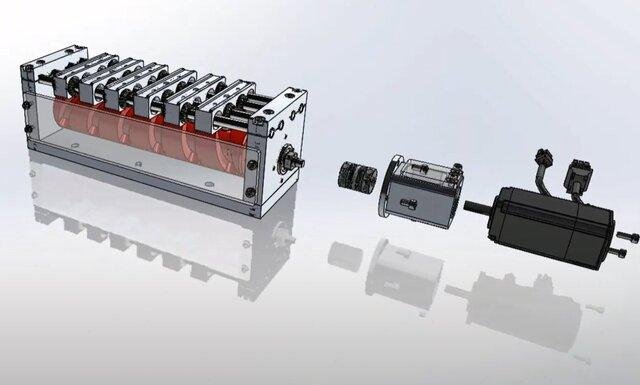
A variable pitch module typically consists of several interconnected motion components that allow multiple sliders or working stations to move in a coordinated manner.
Depending on the design, the mechanism may incorporate:
Linear guide rails and sliders
Synchronized transmission components
Lead screws or mechanical linkage mechanisms
Servo or stepper motors
Mounting plates and gripper interfaces
Position feedback and motion control components, where required
When the drive mechanism operates, the connected sliders move simultaneously according to the designed transmission relationship.
The distance between working positions changes during the movement, allowing products or grippers to transition from one pitch configuration to another.
A Typical Variable Pitch Working Sequence
In a multi-position packaging application, the operating process may look like this:
Step 1: Product Feeding
Products arrive from an upstream conveyor at a predefined spacing.
Step 2: Product Pickup
Multiple vacuum cups or mechanical grippers pick up the products simultaneously.
Step 3: Pitch Adjustment
The variable pitch module changes the spacing between the grippers to match the required packaging arrangement.
Step 4: Product Transfer
The products are transferred toward the carton, tray, or packaging station.
Step 5: Product Placement
The grippers release the products at their designated positions.
This coordinated process helps reduce additional spacing operations and simplifies multi-product handling.
For servo-driven configurations, pitch positions can be programmed through a PLC or motion controller, depending on the system architecture.
This makes it possible to configure different spacing settings for different product formats without redesigning the entire mechanical arrangement.
3. Common Applications of Variable Pitch Modules in Packaging Machinery
Variable pitch technology is widely applicable wherever product spacing needs to change between different stages of a packaging process.
Here are four typical applications.
3.1 Multi-Product Handling and High-Speed Case Packing
One of the most common applications is transferring multiple products into cartons or packaging boxes.
Products on an infeed conveyor may be arranged closely together. However, the spacing between the grippers must match the positions of the products inside the carton.
A variable pitch module can adjust several grippers simultaneously, allowing them to pick up multiple products and reposition them for carton loading.
Typical products include:
Beverage bottles and cans
Food containers
Plastic cups and trays
Packaged consumer goods
Small industrial components
For example, in a beverage packaging line, multiple bottles can be picked up from an infeed conveyor and repositioned to match the bottle arrangement inside a carton.
The required pitch is determined by the bottle dimensions, carton layout, number of products per cycle, and gripper configuration.
3.2 Multi-Lane Product Spacing and Transfer
Packaging lines often process products in multiple lanes.
However, the spacing between incoming products does not always match the arrangement required by the downstream packaging equipment.
A variable pitch module can adjust the spacing between multiple pickup positions or transfer stations, helping synchronize product movement across different lanes.
Typical applications include:
Multi-lane food packaging
Sachet and pouch handling
Pharmaceutical blister packaging
Plastic component packaging
Automated tray loading
For example, multiple blister packs may arrive in closely spaced lanes and need to be repositioned before being loaded into a larger packaging tray.
The variable pitch mechanism helps align the products with the downstream loading positions.
3.3 Flexible Packaging and Automatic Format Changeover
Modern packaging equipment increasingly needs to handle multiple product sizes and packaging formats.
Traditional fixed-pitch mechanisms are often designed around one specific product arrangement. When product dimensions change, operators may need to adjust mechanical positions, replace tooling, or modify the transfer structure.
A programmable servo-driven variable pitch module provides a more flexible alternative.
Different pitch settings can be configured for different product formats, subject to the module’s mechanical travel range and control capabilities.
For example:
Product A: 40 mm pitch
Product B: 60 mm pitch
Product C: 80 mm pitch
The equipment can switch between predefined pitch settings rather than requiring a complete mechanical redesign.
This can help reduce mechanical changeover work and improve production flexibility.
Actual changeover time depends on the machine design, control sequence, tooling, and whether other components also require adjustment.
3.4 Carton Loading, Tray Loading and Pick-and-Place Automation
Variable pitch modules can also be integrated into robotic and automated pick-and-place systems.
A typical configuration may include:
Cartesian robot or robotic arm
Variable pitch linear module
Vacuum suction cups or mechanical grippers
Servo motor and drive
PLC or motion controller
The robot handles the transfer movement, while the variable pitch mechanism adjusts the relative spacing between multiple gripping positions.
This is particularly useful when the pickup arrangement differs from the final placement arrangement.
For packaging machine manufacturers, integrating pitch adjustment into the gripping mechanism can help simplify the overall machine layout.
4. Which Drive System Is Suitable for a Variable Pitch Module?
The appropriate drive mechanism depends on the required pitch adjustment, operating cycle, positioning flexibility, and mechanical design.
Three common approaches are worth considering.
4.1 Servo-Driven Variable Pitch Module
A servo-driven variable pitch module uses a servo motor and transmission mechanism to control the movement of multiple sliders.
Its main advantages include:
Programmable pitch positions
Flexible adjustment for different product formats
Controlled acceleration and deceleration
Integration with PLC and motion control systems
Suitability for automated format changeover
Servo-driven systems are particularly useful for packaging equipment handling multiple product specifications or frequently changing packaging formats.
However, the motor, transmission structure, load, and motion profile must be properly matched to achieve the required cycle time and positioning performance.
A mechanical cam mechanism uses a predefined cam profile to generate a specific movement pattern.
Its main characteristics include:
Fixed and repeatable motion profiles
Mechanical synchronization
Suitability for continuous repetitive production
Potentially high-speed operation when properly designed
Cam-driven systems can be a good option for packaging machines with stable product specifications and repetitive production cycles.
However, changing the motion profile or product spacing may require mechanical adjustment or replacement of cam components, depending on the design.
4.3 Linkage-Type Variable Pitch Mechanism
A linkage-type variable pitch mechanism uses interconnected mechanical links to coordinate the movement of multiple working positions.
It can provide synchronized spacing adjustment through a relatively compact mechanical structure.
Typical characteristics include:
Coordinated multi-position movement
Compact mechanical configuration
Potentially economical construction
Suitability for applications with defined movement relationships
The final performance depends on the linkage geometry, mechanical stiffness, load distribution, and operating conditions.
Drive System Comparison
Selection Factor
Servo-Driven
Cam-Driven
Linkage-Type
Pitch adjustment
Programmable within design limits
Defined by cam profile
Defined by linkage geometry
Format flexibility
High
Generally limited
Depends on design
Motion profile
Adjustable
Predetermined
Mechanically determined
Control integration
Servo and PLC
Mechanical synchronization
Depends on drive design
Typical application
Flexible packaging
Repetitive high-speed production
Synchronized multi-position handling
There is no universally best drive system.
The right choice depends on whether the packaging machine prioritizes flexible format changes, repetitive high-speed operation, mechanical simplicity, or overall equipment cost.
5. How to Select the Right Variable Pitch Module for Packaging Equipment
Selecting a variable pitch module requires more than confirming the required stroke or maximum speed.
The module must match the complete operating conditions of the packaging machine.
Here are the key parameters equipment manufacturers should evaluate.
5.1 Number of Sliders and Working Positions
First, determine how many products need to be handled in each cycle.
For example:
2-position variable pitch module
4-position variable pitch module
6-position variable pitch module
Customized multi-station variable pitch module
The number of working positions directly affects the mechanical structure, load distribution, and overall module dimensions.
5.2 Input Pitch and Output Pitch
This is one of the most important parameters.
Clearly define:
Initial pitch
Required output pitch
Minimum pitch
Maximum pitch
Pitch adjustment range
Remember that pitch normally refers to the center-to-center distance between adjacent positions, not the clear gap between product edges.
Incorrect pitch definitions can lead to unsuitable module configurations and unnecessary design changes.
5.3 Stroke and Installation Space
The required adjustment range determines the necessary travel of the mechanism.
You should also provide:
Available installation dimensions
Mounting position
Module orientation
Required working height
Space available for motors and transmission components
A customized variable pitch module should be designed around the actual machine layout rather than selected only by comparing standard product dimensions.
5.4 Payload and Moving Load
The total moving load should include more than the products themselves.
Consider:
Product weight
Gripper or suction cup weight
Mounting plates
Fixtures and tooling
Other moving accessories
The supplier should evaluate the combined load and dynamic forces during acceleration, deceleration, and repeated operation.
5.5 Operating Speed and Cycle Time
For high-speed packaging equipment, the complete motion cycle matters more than maximum motor speed alone.
Provide:
Required cycle time
Pitch adjustment time
Acceleration and deceleration requirements
Number of operating cycles
Production rate
Continuous or intermittent operating conditions
A module that performs well during a single movement may not necessarily maintain the same performance under continuous production conditions.
5.6 Positioning Accuracy and Repeatability
The required positioning performance depends on the product dimensions, gripper arrangement, and downstream packaging process.
If the pitch is inconsistent, products may not align correctly with the carton or tray positions.
This can result in product misplacement, interference, or packaging defects.
Therefore, evaluate pitch accuracy and repeatability together with the overall mechanical stiffness, transmission design, and control system.
5.7 Motor and Control Compatibility
For automated packaging equipment, the variable pitch module may need to communicate with an existing PLC, servo drive, or motion controller.
Confirm:
Motor type and power requirements
Servo drive compatibility
Control signals and communication protocols
Position feedback requirements
Cable routing
Integration with the existing machine sequence
These details should be confirmed before the final mechanical design.
6. Common Mistakes When Choosing a Variable Pitch Module
Even when the basic parameters appear suitable, some selection mistakes can affect the performance and reliability of the complete packaging line.
Mistake 1: Choosing a Module Based Only on Pitch Range
A suitable pitch range does not automatically mean the module can handle the required payload, cycle time, and number of working positions.
All operating parameters need to be evaluated together.
Mistake 2: Focusing Only on Maximum Speed
High-speed operation requires sufficient mechanical rigidity, appropriate motor sizing, stable synchronization, and suitable acceleration and deceleration profiles.
Maximum speed alone cannot determine whether a module is suitable for continuous production.
Mistake 3: Ignoring Product and Gripper Weight
The moving load includes both the products and the gripping mechanism.
Underestimating the total moving mass may result in insufficient thrust, excessive vibration, or unstable movement.
Mistake 4: Overlooking Future Product Changeovers
If the packaging machine is expected to handle different product sizes, the required pitch adjustment range and available travel should be considered from the beginning.
A module designed around only one product format may limit future equipment flexibility.
Mistake 5: Selecting a Supplier Based Only on Price
A low initial purchase price does not necessarily mean a lower total project cost.
Mechanical design quality, component selection, manufacturing consistency, testing, delivery, and engineering communication all affect the long-term performance of customized equipment.
Before placing an order, ask the supplier to confirm the technical specifications and provide relevant drawings or test information.
7. Daily Maintenance Tips for Variable Pitch Modules
Variable pitch modules used in packaging machinery may operate repeatedly throughout long production shifts.
The following practices are worth including in routine equipment maintenance.
Keep the Transmission Mechanism Clean
Regularly remove dust, packaging debris, and other contaminants from accessible mechanical areas.
Foreign particles entering moving or transmission components may accelerate wear or affect smooth movement.
Follow the Recommended Lubrication Schedule
Lubricate linear guides, bearings, and other designated components according to the manufacturer’s maintenance instructions.
Use the specified lubricant rather than substituting an incompatible grease or oil.
Check for Unusual Noise or Movement
If the module develops abnormal noise, vibration, or sticking during operation, stop the equipment and inspect the relevant components.
Do not continue running the system without identifying the cause.
Inspect Positioning Performance
Periodically check the actual pitch positions and synchronization between sliders.
If positioning deviation increases, inspect the transmission, mounting structure, fastening components, and control settings.
Record Maintenance and Operating Conditions
Keeping maintenance records makes it easier to identify recurring problems and plan preventive maintenance.
The recommended inspection interval should be determined by operating frequency, load, environment, and the manufacturer’s guidance.
8. Why Customized Variable Pitch Modules Matter for Modern Packaging Machinery
Packaging equipment manufacturers increasingly need to balance production efficiency with product flexibility.
A standard motion component may work well for a conventional application, but specialized packaging machines often have different requirements for:
Number of working positions
Pitch range
Adjustment stroke
Payload
Operating speed
Motor orientation
Installation dimensions
Gripper and tooling configuration
A customized variable pitch module allows these parameters to be considered together during the design stage.
Instead of forcing an existing machine layout to fit a standard module, the motion system can be configured around the actual equipment requirements.
Customized Variable Pitch Solutions from HCY Automation
At HCY Automation, we provide industrial automation components and customized linear motion solutions for equipment manufacturers and system integrators.
Our variable pitch module solutions are designed for applications involving synchronized multi-position movement and automatic spacing adjustment.
Depending on project requirements, customization can cover:
Number of sliders and working stations
Pitch range and adjustment stroke
Product and tooling load
Motor selection and installation orientation
Mechanical structure and mounting dimensions
Integration with servo drives and motion control systems
Our engineering team covers mechanical design, electrical engineering, and automation solutions, helping customers evaluate the mechanical and control requirements of their applications.
Whether you are developing a multi-lane packaging machine, an automatic carton loading system, or a customized pick-and-place unit, HCY can work with you to evaluate a suitable variable pitch configuration.
Looking for a customized variable pitch module for your packaging machine?
Share your application details, including the required number of positions, input and output pitch, stroke, payload, operating speed, and installation dimensions.
Drawings, CAD files, or application videos are also helpful for technical evaluation.
Contact HCY Automation to discuss your customized variable pitch requirements.
Frequently Asked Questions About Variable Pitch Modules
Q1: What is the main function of a variable pitch module in packaging machinery?
Its main function is to automatically adjust the spacing between multiple products, grippers, or working positions, allowing packaging equipment to match different product arrangements and packaging formats.
Q2: How does a variable pitch module adjust product spacing?
It uses a synchronized mechanical transmission mechanism to move multiple sliders or working positions. Depending on the design, adjustment can be driven by a servo motor, cam mechanism, or mechanical linkage.
Q3: Can a variable pitch module handle different product sizes?
Yes. A suitably designed system can support different product formats by changing the pitch settings within its mechanical travel and load limits. Servo-driven configurations are particularly useful when frequent format changes are required.
Q4: Is a servo-driven variable pitch module suitable for high-speed packaging?
It can be suitable for high-speed packaging applications when the motor, transmission mechanism, payload, acceleration profile, and control system are properly matched to the required production cycle.
The actual achievable speed must be verified against the complete application.
Q5: What information is required for a customized variable pitch module?
The main information includes:
Number of sliders or working positions
Initial and target pitch
Pitch adjustment range
Required stroke
Product and gripper weight
Operating speed and cycle time
Positioning requirements
Motor installation orientation
Available installation space
Control system requirements
Mechanical drawings or a short video of the existing machine can also help the engineering team understand the application.
Q6: What is the difference between a variable pitch module and a standard linear module?
A standard linear module generally moves one carriage along a linear axis. A variable pitch module coordinates multiple sliders or working positions and changes the distance between them.
The latter is particularly useful for multi-product handling, packaging, and automated format changeover.
Q7: How often should a variable pitch module be maintained?
Maintenance frequency depends on operating hours, load, speed, and the working environment. Regular cleaning, lubrication, fastener inspection, and positioning checks should follow the manufacturer’s recommendations.
HCY Automation delivers integrated solutions across motion control, linear motion, robotics, machine vision, pneumatic systems, and precision gearboxes to help global manufacturers build smarter, faster, and more reliable production lines. Our engineering team helps you select and integrate the right motion control, robotics, and automation components for your specific application.