A Complete Guide to Choosing the Right Linear Motor Supplier for Industrial Automation
Looking for custom direct drive linear motor manufacturers? Learn how to evaluate iron-core and ironless linear motors, compare suppliers, and find customized motion solutions for industrial automation. As industrial automation continues to advance, equipment manufacturers face increasing demands for higher production speeds, greater positioning accuracy, improved reliability, and lower operating costs.
In industries such as lithium battery manufacturing, semiconductor production, optical inspection, and precision assembly, traditional mechanical transmission systems—including ball screws, timing belts, and rack-and-pinion mechanisms—may become limitations when higher dynamic performance and more precise motion control are required.
Direct drive linear motors provide an alternative by generating linear thrust directly, eliminating the need for intermediate mechanical transmission components. This makes them particularly suitable for applications requiring high speed, high acceleration, precise positioning, and flexible long-stroke motion.
However, selecting the right motor is only part of the challenge. Finding reliable custom direct drive linear motor manufacturers with the right technical capabilities, engineering experience, and customization support is equally important.
So, how do you find, evaluate, and choose the right linear motor supplier?
This guide covers the key differences between direct drive and traditional motion systems, iron-core and ironless linear motor technologies, essential selection parameters, and the criteria for evaluating a custom linear motor manufacturer.
1. What Is a Direct Drive Linear Motor and Why Does It Matter?
A direct drive linear motor is an electromagnetic actuator that converts electrical energy directly into linear motion without requiring a rotary-to-linear mechanical transmission mechanism.
Unlike conventional systems that use a rotary motor together with a ball screw, belt, or gear mechanism, a linear motor generates thrust directly between its electromagnetic components.
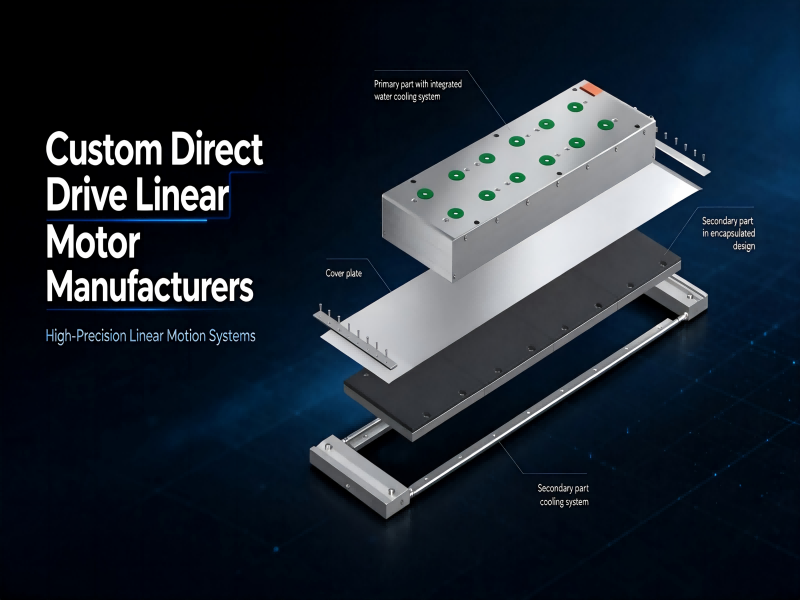
A typical linear motor system consists of:
Stator: The stationary magnetic track or coil assembly, depending on the motor design.
Mover: The moving electromagnetic or magnetic assembly that generates linear motion.
Linear guide system: Supports the moving load and maintains mechanical guidance.
Feedback device: Such as a linear encoder or magnetic scale, providing position information.
Servo drive and motion controller: Regulate motor current, speed, and position.
The direct drive architecture reduces the number of mechanical transmission components and provides greater flexibility for high-performance motion system design.
Direct Drive Linear Motors vs. Traditional Mechanical Transmission Systems
The fundamental difference between direct drive linear motors and conventional linear motion systems lies in how motion is generated and transmitted.
Traditional systems typically combine a rotary motor with a mechanical transmission mechanism to convert rotary motion into linear movement.
Common examples include:
Ball screw drives
Timing belt drives
Rack-and-pinion systems
These mechanisms are widely used in industrial automation, but their mechanical transmission components can introduce backlash, friction, elastic deformation, vibration, and wear.
A direct drive linear motor moves the load by generating linear thrust directly, eliminating the need for these intermediate transmission mechanisms.
This brings several important advantages.
Key Advantages of Direct Drive Linear Motors
1. No intermediate mechanical transmission
Direct drive linear motors eliminate the need for screws, belts, gears, and other intermediate transmission components. This simplifies mechanical structures and avoids transmission-related backlash.
2. High speed and acceleration potential
Without the limitations associated with screw rotation, belt elasticity, or gear engagement, direct drive systems can achieve high speeds and rapid acceleration and deceleration.
They are particularly suitable for applications involving frequent positioning, short cycle times, and high-speed repetitive movement.
3. High positioning accuracy and repeatability
Conventional transmission systems may introduce backlash, mechanical deformation, friction, and wear, all of which can affect positioning performance.
Direct drive systems eliminate transmission-related backlash. When combined with suitable linear feedback devices, rigid mechanical structures, and properly tuned motion controllers, they can achieve excellent positioning accuracy and repeatability.
4. Reduced mechanical wear and maintenance
Fewer transmission components mean fewer mechanical wear points. This can reduce maintenance requirements and improve long-term operating reliability.
However, supporting components such as linear guides and bearings still require appropriate lubrication and maintenance.
5. Flexible long-stroke configurations
Direct drive linear motor systems can be designed for long travel distances. Depending on the motor architecture and modular stator arrangement, the active travel range can be extended to meet specific equipment requirements.
This flexibility is valuable for large-format inspection systems, automated material handling, and production lines requiring long-distance positioning.
Direct Drive Linear Motor vs. Ball Screw vs. Belt Drive
Performance Factor
Direct Drive Linear Motor
Ball Screw Drive
Belt Drive
Motion transmission
Direct linear thrust
Rotary-to-linear conversion
Belt and pulley transmission
Backlash
No transmission backlash
Possible mechanical backlash
Depends on tension and design
Speed potential
High
Limited by screw speed and critical speed
High
Acceleration
High potential
Limited by screw and moving mechanics
High potential
Positioning performance
High with suitable feedback and control
High with proper design
Suitable for general positioning
Mechanical wear
Fewer transmission wear points
Screw and nut wear
Belt aging and tension changes
Long-stroke design
Flexible, including modular configurations
More challenging as stroke increases
Well suited to longer travel
Maintenance
Relatively low for the transmission system
Screw lubrication and maintenance
Belt inspection and replacement
Which solution should you choose?
Direct drive linear motors: Suitable for high-speed, high-acceleration, high-precision, and demanding dynamic motion applications.
Ball screw modules: Practical for applications requiring high thrust, good positioning performance, and cost-effective operation.
Belt-driven modules: Suitable for long-stroke transfer applications where high speed and cost efficiency are important.
The best choice depends on the actual load, travel distance, motion profile, positioning requirements, operating environment, and total system cost.
2. Iron-Core vs. Ironless Linear Motors: Which Should You Choose?
One of the first decisions when selecting a direct drive linear motor is choosing between an iron-core and an ironless design.
Both technologies are widely used in industrial automation, but their electromagnetic structures and performance characteristics are different.
Iron-Core Linear Motors
Iron-core linear motors use coils mounted on an iron core, interacting with a permanent magnet track to generate linear thrust.
Their main characteristics include:
High thrust density
Strong force output relative to motor size
Suitability for heavier moving loads
High acceleration potential
Compact motor design for demanding industrial applications
However, iron-core motors may generate magnetic attraction forces and cogging forces, which need to be considered during mechanical design and servo tuning.
They are often worth evaluating for high-thrust applications such as automated material handling, battery manufacturing equipment, and high-speed industrial transfer systems.
Ironless Linear Motors
Ironless linear motors use coil assemblies without an iron core interacting with a permanent magnet track.
Their main characteristics include:
Virtually no cogging force by design
Very smooth motion
No comparable iron-core magnetic attraction force
Excellent suitability for precision scanning and positioning
Low force ripple when properly configured
Ironless linear motors are commonly considered for optical alignment, semiconductor equipment, precision inspection, and applications requiring exceptionally smooth motion.
Iron-Core vs. Ironless: Quick Comparison
Comparison
Iron-Core Linear Motor
Ironless Linear Motor
Construction
Windings mounted on an iron core
Windings without an iron core
Thrust density
Generally higher
Generally lower
Cogging force
May be present
Virtually eliminated
Magnetic attraction
Present
No comparable iron-core attraction
Motion smoothness
Requires attention to force ripple
Very smooth
Typical applications
High-thrust industrial motion
Precision positioning and scanning
Neither design is universally better.
The right choice depends on thrust requirements, moving mass, acceleration, positioning performance, thermal conditions, installation space, and budget.
3. What Parameters Are Essential for Custom Linear Motor Selection?
A professional supplier should never recommend a linear motor based only on stroke length or maximum speed.
Accurate motor selection requires a complete understanding of the machine’s motion profile, mechanical structure, and operating environment.
Before contacting custom direct drive linear motor manufacturers, prepare the following information.
3.1 Load and Moving Mass
Provide the total moving mass, including:
Workpiece or payload
Mounting plates and fixtures
Tooling and accessories
Moving motor components
Other components carried by the axis
This information is essential for calculating the required thrust and acceleration.
3.2 Stroke and Travel Distance
Specify:
Required effective stroke
Total mechanical travel
Installation dimensions
Whether a long-stroke or modular configuration is required
The effective travel distance and the motor’s active magnetic length are not necessarily the same. A supplier should evaluate the complete mechanical arrangement before recommending a configuration.
3.3 Speed and Acceleration
Maximum speed alone is not sufficient for motor selection.
You should also provide:
Target maximum speed
Acceleration and deceleration
Acceleration time
Motion cycle time
Travel distance per cycle
For example, a high-speed transfer axis with frequent acceleration and deceleration may require a different motor configuration from an axis operating continuously at a constant speed.
3.4 Positioning Accuracy and Repeatability
Clarify the required:
Positioning accuracy
Repeatability
Resolution
Settling time
Positioning stability
These specifications must be evaluated at the complete system level.
The final positioning performance depends not only on the linear motor but also on the encoder or feedback system, guide rails, mechanical stiffness, controller, servo tuning, and thermal conditions.
3.5 Duty Cycle and Operating Environment
A supplier needs to understand how frequently the motor operates and how much time it spends accelerating, moving, and stopping.
Also provide information about:
Ambient temperature
Humidity
Dust and contamination
Cooling requirements
Installation orientation
Available mounting space
These conditions affect motor selection, thermal design, and long-term operating stability.
3.6 Electrical and Control Requirements
Confirm compatibility with your existing control system, including:
DC bus voltage or drive power supply
Peak and continuous current
Servo drive compatibility
Encoder type and resolution
Communication protocol
Cable routing and connection requirements
If the project involves an existing automation platform, share the controller and servo drive information at the beginning of the selection process.
Practical tip: The more complete your application information is, the easier it is for a supplier to calculate the required thrust, verify thermal performance, and recommend an appropriate motor configuration.
4. How to Find and Evaluate Custom Direct Drive Linear Motor Manufacturers
Not all linear motor suppliers provide the same level of engineering support.
Some mainly sell standard motor components, while others can support customized motor selection, mechanical integration, and complete linear motion solutions.
When evaluating potential suppliers, consider the following five factors.
4.1 Product Range and Technical Capability
A capable supplier should be able to provide suitable solutions for different motion requirements.
Check whether its product portfolio includes:
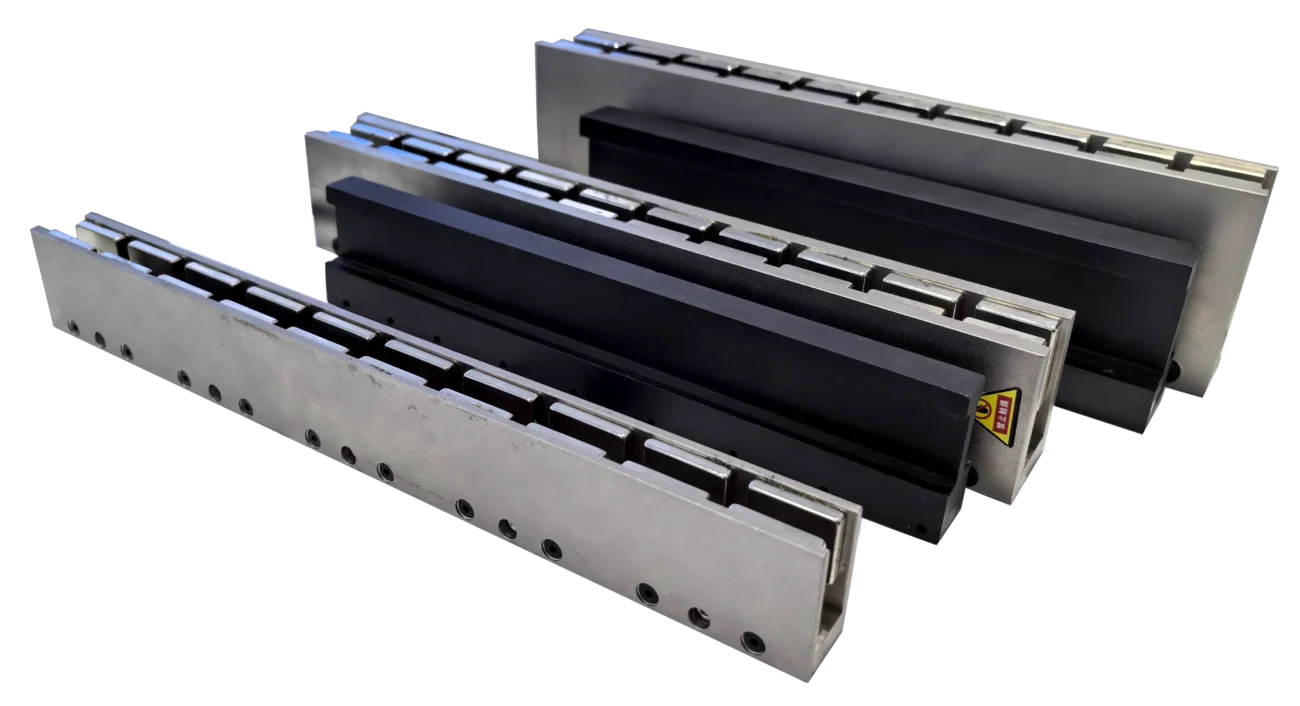
Iron-core linear motors
Ironless linear motors
Linear motor stators and movers
Single-axis linear motor modules
Dual-mover linear motor configurations
Multi-axis precision positioning stages
Servo drives and motion controllers
Linear encoders and magnetic or optical feedback systems
A broader product range makes it easier to configure a complete motion system instead of sourcing every component from different suppliers.
4.2 Customization and Engineering Support
Standard products do not always fit the mechanical structure or performance requirements of specialized equipment.
A reliable custom linear motor supplier should be able to evaluate:
Customized stroke and travel length
Motor thrust and force requirements
Single-mover or multi-mover configurations
Mechanical mounting structures
Cooling and thermal management
Encoder and feedback integration
Servo drive and control configuration
More importantly, the supplier should be able to communicate with your mechanical and electrical engineers to identify potential design issues before production.
4.3 Application Experience
A supplier’s experience in your target industry can make a significant difference.
For example, lithium battery equipment often requires fast, repetitive positioning and stable operation under continuous production cycles.
Optical and photonics equipment, on the other hand, may prioritize smooth motion, positioning stability, and precise alignment.
Ask potential suppliers:
Have they supplied motors or modules for similar equipment?
Can they explain the design considerations for your application?
Can they provide relevant technical drawings or configuration examples?
Can they support performance verification?
Relevant application experience is often more valuable than a long product catalog.
4.4 Total Project Cost, Not Just Motor Price
Imported linear motor brands may offer mature product platforms and established technical support, but the Imported linear motor brands may offer mature product platforms and established technical support, but the total project cost can be a concern for equipment manufacturers.
When comparing suppliers, consider more than the initial motor price.
Evaluate:
Motor and drive costs
Encoder and accessory costs
Mechanical integration costs
Engineering and commissioning costs
Delivery lead time
Spare parts availability
Maintenance and after-sales support
A competitive supplier should help you balance performance, cost, and long-term reliability.
The goal is not simply to find the lowest-priced motor. It is to achieve the required machine performance with a reasonable total investment.
4.5 Delivery, Communication, and After-Sales Support
Customized projects often involve multiple rounds of technical confirmation.
A supplier should be able to provide clear communication throughout the process, including:
Technical requirement review
Motor selection and sizing
Drawing confirmation
Delivery schedule coordination
Installation guidance
Servo parameter and commissioning support
Spare parts and maintenance assistance
Responsive engineering communication can reduce project delays and avoid unnecessary redesign.
5. Why Are Iron-Core Linear Motors Worth Considering for Lithium Battery Equipment?
Lithium battery manufacturing involves several demanding processes, including electrode production, winding, stacking, electrolyte filling, sealing, inspection, and material handling.
These processes place high demands on equipment speed, positioning performance, production efficiency, and operational stability.
Iron-core linear motors can be considered for applications where high thrust and dynamic performance are important.
Potential Applications in Lithium Battery Manufacturing
High-speed material transfer
Direct drive motion can support rapid movement between production stations, particularly where frequent acceleration and deceleration are required.
Precision positioning and alignment
When integrated with appropriate linear feedback and motion control, linear motor stages can support accurate positioning of workpieces and tooling.
Automated inspection equipment
Linear motor platforms can provide controlled scanning and positioning for visual inspection, measurement, and testing processes.
Flexible production equipment
Customized travel lengths and multi-axis configurations can help equipment designers develop more flexible machine layouts.
What Should Lithium Battery Equipment Manufacturers Pay Attention To?
When selecting an iron-core linear motor for battery production equipment, pay particular attention to:
Thrust margin: Ensure that both peak and continuous thrust meet the actual motion profile.
Thermal performance: Evaluate heat generation during continuous operation and high-duty-cycle conditions.
Cogging and force ripple: Consider their impact on motion smoothness and positioning stability.
Mechanical rigidity: Ensure that the guide system and mounting structure can withstand dynamic loads.
Control integration: Confirm compatibility between the motor, encoder, servo drive, and machine controller.
An experienced supplier should evaluate these factors as part of the complete motion system rather than selecting a motor based on one performance parameter.
6. Why Choose HCY Automation for Customized Linear Motion Solutions?
Finding a suitable supplier is about more than purchasing a linear motor. It is about finding a partner who can understand your equipment requirements and coordinate the components and engineering needed to implement the motion solution.
HCY Automation is a supplier and solution partner specializing in industrial automation, motion control, and precision positioning technologies.
With an integrated supply chain and engineering capabilities covering mechanical design, electrical engineering, and automation solutions, HCY supports equipment manufacturers, system integrators, and industrial customers with customized linear motion solutions.
Integrated Product Sourcing and Engineering Support
HCY can support the configuration of motion systems involving:
Iron-core and ironless linear motors
Linear motor stators and movers
Linear motor modules and positioning stages
Servo motors and drives
Motion controllers and PLCs
Linear encoders and feedback components
Mechanical structures and related automation components
This integrated approach helps customers coordinate key components and reduce the complexity of working with multiple suppliers.
Customized Motion Configurations
Different machines have different requirements for stroke, thrust, speed, installation space, and positioning performance.
HCY can work with customers to evaluate customized configurations, including:
Single-axis linear motor modules
Dual-mover linear motor systems
Customized mechanical mounting structures
Multi-axis precision positioning platforms
Integrated servo and motion control configurations
The final configuration is determined by the customer’s application requirements and engineering evaluation.
Engineering-Focused Project Communication
HCY’s engineering team covers mechanical design, electrical engineering, and automation solutions.
This enables technical discussions to go beyond product specifications and address practical machine-level considerations, such as:
Load and thrust calculations
Mechanical structure and installation
Motor and drive matching
Feedback and control configuration
System integration requirements
Whether you are upgrading an existing ball screw system or developing new high-speed automation equipment, HCY can help evaluate an appropriate linear motion solution.
7. Custom Linear Motor Manufacturer Selection Checklist
Before making your final decision, use this checklist to compare potential suppliers.
Evaluation Item
What to Confirm
Motor type
Iron-core or ironless
Thrust capability
Peak thrust and continuous thrust
Motion performance
Speed, acceleration, and cycle time
Travel range
Effective stroke and mechanical travel
Positioning
Accuracy, repeatability, and feedback resolution
Thermal design
Cooling method and continuous-duty capability
Mechanical integration
Mounting dimensions and guide configuration
Electrical compatibility
Drive, encoder, and controller compatibility
Customization
Motor, module, and multi-axis configurations
Engineering support
Sizing, drawings, integration, and commissioning
Commercial terms
Price, lead time, warranty, and spare parts
A supplier that can provide clear answers across these areas is more likely to support your project successfully.
8. Frequently Asked Questions
Q1: What is the difference between a linear motor manufacturer and a linear motor supplier?
A linear motor manufacturer typically develops or produces motor components, while a supplier may provide products from multiple manufacturers and coordinate system integration.
For customized equipment projects, it is important to understand the supplier’s actual engineering, manufacturing, sourcing, and integration capabilities.
Q2: Is an iron-core linear motor suitable for lithium battery equipment?
It can be suitable for applications requiring high thrust, high acceleration, and fast material transfer. However, the motor must be evaluated against the actual load, duty cycle, thermal conditions, and positioning requirements.
Q3: Can a direct drive linear motor replace a ball screw module?
In many applications, yes. A linear motor can eliminate the screw transmission mechanism and provide higher dynamic performance.
However, the replacement decision should consider thrust, stroke, speed, acceleration, positioning requirements, cost, and system integration. A linear motor is not automatically the best choice for every ball screw application.
Q4: What information is needed for a custom linear motor quotation?
At a minimum, prepare the following information:
Required stroke
Moving mass and payload
Maximum speed and acceleration
Positioning accuracy and repeatability
Operating cycle and duty cycle
Installation dimensions
Available power supply and control system
Drawings, CAD files, or application videos can help the supplier understand the project more accurately.
Q5: Can a supplier provide a complete linear motor motion solution?
Some suppliers can coordinate the motor, servo drive, encoder, mechanical structure, and motion control configuration.
When evaluating a supplier, confirm which parts are supplied directly, which are sourced from partner manufacturers, and what engineering and commissioning support is included.
Conclusion: Choose a Motion Solution Partner, Not Just a Motor Supplier
Selecting a custom direct drive linear motor manufacturer requires more than comparing product specifications and prices.
You need to evaluate motor technology, thrust and motion performance, thermal design, customization capabilities, application experience, and engineering support.
For lithium battery equipment and other demanding industrial automation applications, iron-core linear motors can provide an effective solution when high thrust and dynamic performance are required.
HCY Automation works with equipment manufacturers and system integrators to evaluate and configure customized linear motion solutions, combining industrial automation components, supply chain resources, and engineering support.
Looking for a customized iron-core linear motor, a dual-mover linear motor module, or a precision linear positioning platform?
Contact HCY Automation and share your application requirements. Our team can help evaluate a suitable motion solution for your equipment.
HCY Automation delivers integrated solutions across motion control, linear motion, robotics, machine vision, pneumatic systems, and precision gearboxes to help global manufacturers build smarter, faster, and more reliable production lines. Our engineering team helps you select and integrate the right motion control, robotics, and automation components for your specific application.