Linear Motor vs. Rotary Motor: Key Differences, Advantages, and Applications in Industrial Automation
Direct Drive vs. Mechanical Transmission: Understanding the Two Motor Technologies Behind Modern Motion Control
In industrial automation, choosing the right motor is about more than power and speed. The way a motor generates and transfers motion can have a significant impact on positioning accuracy, acceleration, mechanical complexity, energy consumption, and overall machine performance.
Two technologies are commonly used in motion control systems: linear motors and rotary motors.
A rotary motor generates rotational torque, which can be converted into linear movement through a ball screw, timing belt, rack and pinion, or other transmission mechanism. A linear motor, on the other hand, generates linear thrust directly through electromagnetic interaction, eliminating the need for a mechanical rotary-to-linear transmission.
This fundamental difference makes linear motors particularly attractive for high-speed, high-precision applications, while rotary motors remain a practical and cost-effective choice for a wide range of industrial machinery.
But does direct drive always mean better performance? Not necessarily.
In this guide, we explore how linear motors and rotary motors work, compare their advantages and limitations, and explain how to choose the right drive technology for your industrial automation application.
1. What Is a Linear Motor?
Working Principle of a Linear Motor
A linear motor can be understood as a rotary motor that has been cut open and laid flat.
Instead of producing rotational torque around a central shaft, it generates electromagnetic force along a straight path, creating direct linear movement.
A typical linear motor consists of two main components:
Primary (forcer): Contains the electromagnetic windings that generate the driving force.
Secondary (magnet track): Contains permanent magnets or another electromagnetic structure that interacts with the primary.
When electrical current is supplied to the motor windings, an electromagnetic field is generated. The interaction between this field and the magnetic track produces linear thrust, causing the moving component to travel along the guide system.
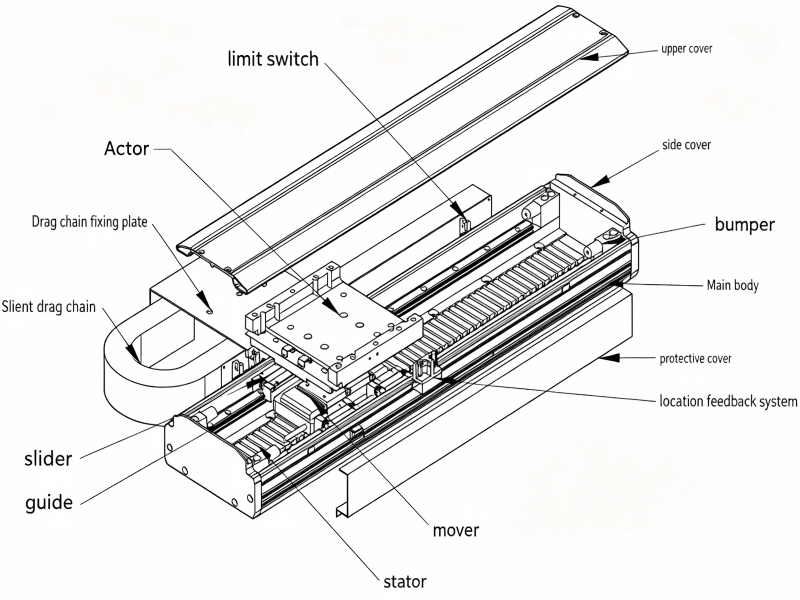
A complete linear motor positioning system generally includes a linear motor, precision linear guides, a servo drive, a motion controller, and a linear encoder for position feedback.
Unlike conventional screw-driven systems, the motor directly drives the moving load without requiring a ball screw, gearbox, or timing belt.
Key Advantages of Linear Motors
1. Direct Drive with No Mechanical Transmission Backlash
Because the motor drives the load directly, there is no backlash introduced by a screw, gearbox, or belt transmission.
This is particularly valuable in precision positioning applications where mechanical transmission errors can affect repeatability and motion accuracy.
2. High Speed and Acceleration
Linear motors are well suited to applications requiring rapid acceleration, high travel speeds, and short positioning times.
Their direct-drive structure reduces mechanical transmission inertia and enables highly responsive motion control.
3. Excellent Positioning Performance
When combined with high-resolution linear encoders and suitable servo control, linear motor stages can achieve excellent positioning accuracy and repeatability.
4. Reduced Mechanical Transmission Components
The absence of screws, couplings, and gearboxes simplifies the transmission structure and reduces mechanical wear associated with these components.
5. Flexible Travel Length
Linear motor tracks can be designed or assembled to accommodate different travel requirements, without the same rotating-screw critical-speed limitations found in long ball screw systems.
Limitations of Linear Motors
Despite their performance advantages, linear motors also have several considerations:
Higher initial investment in the motor, drive, encoder, and precision mechanical structure.
Heat generation in the motor windings requires appropriate thermal management.
The system still requires precision linear guides, which need suitable lubrication and maintenance.
Direct-drive systems do not benefit from the mechanical force multiplication of a gearbox or screw transmission.
Vertical applications may require a holding brake or counterbalance to prevent the load from moving under gravity when power is removed.
Typical Applications
Linear motors are commonly used in:
Semiconductor manufacturing and wafer handling
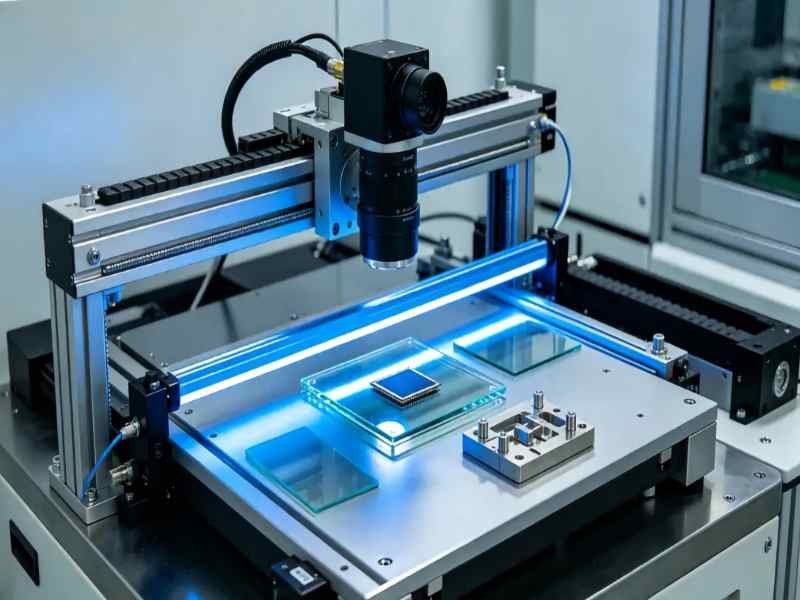
High-speed automated inspection equipment
Precision optical alignment systems
CNC machine tools and precision machining
Laser processing and cutting equipment
Electronic component assembly
High-speed pick-and-place systems
Best suited for: High-speed, high-acceleration, and high-precision linear positioning applications where dynamic performance is a priority.
2. What Is a Rotary Motor?
Working Principle of a Rotary Motor
A rotary motor converts electrical energy into rotational mechanical energy.
Its main components typically include:
Stator: The stationary part containing the motor windings.
Rotor: The rotating component that produces mechanical rotation through electromagnetic interaction.
Shaft: Transfers the motor’s rotational output to the connected mechanical load.
When electrical power is supplied, the electromagnetic interaction between the stator and rotor generates torque, causing the shaft to rotate.
Rotary motors are widely used in industrial automation because of their mature technology, broad power range, flexible mounting options, and compatibility with different transmission mechanisms.
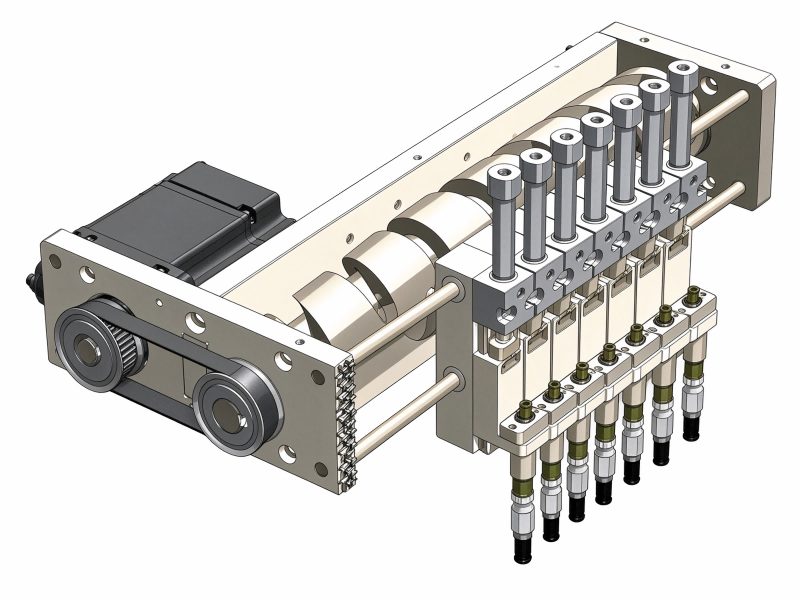
When linear movement is required, a rotary motor can be combined with a mechanical transmission system.
Common configurations include:
Ball Screw Drive
The motor rotates a ball screw, and the ball nut converts this rotational movement into linear travel. This configuration offers high rigidity, good positioning performance, and substantial axial thrust.
Timing Belt Drive
The motor drives a pulley connected to a timing belt, moving the attached carriage along linear guide rails. Belt-driven systems are often suitable for high-speed transportation and longer travel distances.
Rack and Pinion Drive
The motor rotates a pinion gear that moves along a fixed rack, converting rotary movement into linear displacement. This is useful for longer travel applications where screw length may become a limitation.
Key Advantages of Rotary Motors
1. Mature and Cost-Effective Technology
Rotary motors are widely available in different power ratings, sizes, and configurations. Their established supply chain makes them a practical choice for many industrial applications.
2. High Torque and Flexible Transmission Options
When combined with a gearbox or suitable transmission mechanism, rotary motors can provide substantial output torque or linear thrust.
Different mechanical transmission methods allow engineers to adjust speed, thrust, travel distance, and positioning performance according to application requirements.
5. Convenient Maintenance and Replacement
Standardized motors, drives, couplings, and transmission components make maintenance and replacement relatively straightforward.
Limitations of Rotary Motors in Linear Motion Applications
When a rotary motor is used to drive a linear axis, additional mechanical transmission components are required.
These components introduce several design considerations:
Backlash and transmission errors may affect positioning performance.
Couplings, screws, belts, and bearings introduce additional mechanical complexity.
Ball screw critical speed can limit the maximum operating speed of long axes.
Belt elasticity and stretching may affect positioning accuracy.
Additional mechanical components require appropriate lubrication, inspection, and maintenance.
However, these limitations depend heavily on the transmission design. A precision preloaded ball screw with suitable feedback can achieve excellent positioning performance.
Typical Applications
Rotary motors are widely used in:
Industrial conveyors and material handling
Packaging and production machinery
Ball screw linear positioning systems
Belt-driven linear actuators
Automated assembly equipment
Rotary indexing tables
Pumps, fans, and processing machinery
Best suited for: General industrial automation, rotary motion applications, and linear positioning systems where cost, thrust, flexibility, and established mechanical transmission technologies are important.
3. Linear Motor vs. Rotary Motor: Key Differences
The main distinction is not simply how the two motors look. It is how they generate force and transfer motion to the load.
Comparison
Linear Motor
Rotary Motor
Energy conversion
Electrical to linear mechanical motion
Electrical to rotational mechanical motion
Output
Linear thrust
Rotational torque
Drive method
Direct drive
Direct rotary drive or mechanical transmission
Mechanical transmission
Not required for direct linear drive
Required for rotary-to-linear conversion
Backlash
No transmission backlash
Depends on transmission mechanism
Acceleration
Generally very high
Depends on motor and transmission
Positioning performance
Excellent with linear feedback
Excellent with suitable mechanical design and feedback
Thrust / torque
Direct linear thrust
Rotational torque; can be converted into high linear thrust
Travel length
Flexible track configuration
Depends on transmission design
Mechanical complexity
Fewer transmission components
More components in rotary-to-linear systems
Initial investment
Generally higher
Generally lower
Maintenance
Lower transmission-related maintenance
Depends on motor and transmission components
Important: This comparison refers to a linear motor used in a direct-drive linear axis versus a rotary motor used with a mechanical transmission to create linear movement. Actual performance depends on the complete motion system, not the motor alone.
4. Direct Drive vs. Mechanical Transmission: Why Does It Matter?
This is the most important engineering difference between the two technologies.
In a conventional rotary motor-driven linear system, the motor generates rotational torque. A mechanical transmission mechanism then converts this torque into linear movement.
For example:
Rotary Servo Motor → Coupling → Ball Screw → Ball Nut → Linear Carriage
Each transmission component contributes to the overall mechanical behavior of the system.
By contrast, a direct-drive linear motor applies electromagnetic thrust directly to the moving carriage.
Linear Motor → Linear Carriage
This simplified transmission structure offers several important advantages:
No screw or belt transmission backlash.
Reduced mechanical transmission inertia.
Faster response to motion commands.
Fewer transmission components subject to mechanical wear.
Greater flexibility in achieving high-speed positioning.
However, eliminating mechanical transmission does not automatically make the complete system more efficient or economical.
A linear motor must still generate sufficient thrust to accelerate and move the load. A rotary motor combined with a ball screw can use mechanical advantage to generate high axial force, often with a lower motor power requirement.
This is why the two technologies continue to coexist in modern industrial automation.
5. Which Is Better for High-Speed and High-Precision Applications?
The answer depends on the actual motion profile.
When a Linear Motor Is the Better Choice
Consider a semiconductor inspection system that requires a positioning stage to move rapidly between multiple inspection points.
The system may require:
High acceleration and deceleration
Short positioning and settling times
High repeatability
Smooth movement
Frequent start-stop cycles
A direct-drive linear motor can be particularly advantageous because it eliminates mechanical transmission backlash and reduces the inertia associated with a screw or belt drive.
When a Rotary Motor with a Ball Screw Is the Better Choice
Consider an automated pressing or assembly machine that requires substantial axial force and controlled linear movement.
The system may prioritize:
High thrust output
Mechanical rigidity
Stable positioning
Cost-effective operation
Moderate travel speed
A rotary servo motor combined with a ball screw can be a practical solution.
The ball screw converts motor torque into axial force, providing mechanical advantage while maintaining good positioning performance.
When a Rotary Motor with a Timing Belt Is the Better Choice
For long-distance material transfer, a belt-driven linear system may offer a more economical solution.
It is commonly used where:
Travel distance is relatively long.
High-speed transportation is required.
Extremely high positioning accuracy is not essential.
The mechanical structure needs to remain relatively simple.
The key is to match the drive mechanism to the actual machine requirements rather than choosing a technology based on one performance parameter.
6. How to Choose Between a Linear Motor and a Rotary Motor?
Before selecting a motor technology, engineers should evaluate the following factors.
1. Required Motion Type
Does the application require continuous rotation or controlled linear movement?
For rotary applications such as pumps, fans, and rotary tables, a rotary motor is the natural choice.
For direct linear positioning with demanding dynamic performance, a linear motor may be more appropriate.
2. Speed and Acceleration
If the application requires extremely high acceleration, rapid positioning, and short settling times, linear motors offer significant advantages.
For conventional positioning and material transportation, rotary motors combined with ball screws or timing belts are often sufficient.
3. Load and Thrust Requirements
High thrust requirements do not automatically mean a linear motor is the best option.
A rotary servo motor combined with a properly selected ball screw can generate substantial axial force through mechanical advantage.
Linear motor sizing should consider continuous thrust, peak thrust, thermal limits, and duty cycle.
4. Positioning Accuracy
For demanding precision applications, the feedback system is just as important as the motor.
Linear encoders provide direct measurement of the moving carriage position and help compensate for errors that may occur in the transmission system.
Both linear motor stages and rotary motor-driven positioning systems can achieve high precision when properly designed.
5. Installation Space and Mechanical Structure
Linear motors eliminate the need for long screws, couplings, and other transmission components, but still require guide rails, mounting structures, motor tracks, and cable management.
Rotary motor-driven systems may be easier to integrate into existing machine designs, particularly when standard linear modules are available.
6. Total System Cost
Do not compare the motor price alone.
Consider the complete system, including:
Motor and servo drive
Mechanical transmission
Linear guides and bearings
Position feedback devices
Controller and electrical integration
Installation and maintenance
Expected production cycle and service life
The most suitable solution is the one that meets the required performance at an acceptable total cost.
7. Can Linear Motors and Rotary Motors Be Used in the Same Automation System?
Yes. In fact, combining different motor technologies is a common engineering approach for complex automation equipment.
For example, a precision optical inspection machine may use:
X-axis: Linear motor stage for high-speed horizontal positioning.
Y-axis: Linear motor or ball screw module depending on travel and accuracy requirements.
Z-axis: Servo motor-driven ball screw actuator for vertical adjustment.
Rotary axis: Servo rotary motor for workpiece rotation and angular positioning.
This configuration allows each axis to use the most appropriate drive technology.
A machine does not need to use linear motors for every movement simply because one axis requires high precision.
A well-designed motion system balances speed, accuracy, thrust, mechanical rigidity, and cost across all axes.
Frequently Asked Questions (FAQ)
1. What is the main difference between a linear motor and a rotary motor?
The main difference is the type of motion they generate.
A linear motor converts electrical energy directly into linear mechanical motion, producing thrust along a straight path.
A rotary motor converts electrical energy into rotational motion, producing torque around a rotating shaft. When linear movement is required, a mechanical transmission system such as a ball screw, timing belt, or rack and pinion is typically used.
2. Is a linear motor more efficient than a rotary motor?
Not necessarily. A linear motor eliminates the mechanical transmission stage in a direct-drive linear system, reducing transmission-related mechanical losses.
However, overall system efficiency depends on motor design, load, operating speed, duty cycle, drive electronics, and thermal management.
For some applications, a rotary servo motor combined with a ball screw may provide a more energy-efficient and economical solution.
3. Why are linear motors used in high-precision positioning systems?
Linear motors provide direct electromagnetic thrust without mechanical screw or belt transmission.
This eliminates transmission backlash and reduces certain sources of mechanical error.
When combined with precision linear guides, high-resolution encoders, and advanced motion controllers, linear motor stages can achieve excellent positioning accuracy and repeatability.
They are widely used in semiconductor manufacturing, optical alignment, precision inspection, and advanced automation equipment.
4. What are the advantages of a linear motor over a ball screw drive?
A linear motor offers several advantages over a conventional rotary motor-driven ball screw system:
No mechanical transmission backlash.
Higher acceleration potential.
Fast dynamic response.
No ball screw critical-speed limitation.
Fewer transmission components subject to mechanical wear.
However, ball screw drives generally offer good thrust capability, mechanical rigidity, and lower initial system costs.
The right choice depends on speed, payload, accuracy, travel distance, and budget.
5. Can a rotary servo motor drive a linear motion system?
Yes. Rotary servo motors are widely used in linear motion systems.
By connecting a servo motor to a ball screw, timing belt, or rack and pinion mechanism, rotational motion can be converted into controlled linear movement.
This configuration is commonly used in linear modules, electric actuators, automated positioning systems, and multi-axis machinery.
6. Which is better for long-stroke linear motion: a linear motor or a ball screw?
Both technologies can be used for long-stroke applications, but their design considerations differ.
Long ball screws may encounter critical-speed limitations, screw deflection, and vibration as travel length increases.
Linear motors avoid rotating screw limitations and can accommodate long travel through appropriately designed motor tracks.
However, linear motor systems require careful consideration of mounting accuracy, thermal behavior, guide rigidity, and overall system cost.
For long-distance transportation, belt-driven linear modules may also be a practical alternative.
7. Do linear motors require maintenance?
Linear motors have fewer mechanical transmission components than screw-driven systems, which reduces maintenance associated with screws, couplings, and gearboxes.
However, they are not completely maintenance-free.
Linear guides and bearings still require appropriate lubrication and inspection. Cooling systems, encoder components, cables, and mounting surfaces should also be checked according to operating conditions.
8. Are linear motors suitable for heavy-load applications?
Yes, linear motors can be designed for high-load applications, but their suitability depends on the required continuous thrust, peak thrust, acceleration, duty cycle, and thermal limits.
For applications requiring very high axial force, a rotary servo motor combined with a ball screw or a servo electric cylinder may offer a more practical solution.
Proper actuator sizing and load calculations are essential before making a selection.
9. What is the difference between a linear motor and a linear motor stage?
A linear motor is the electromagnetic drive component that generates linear thrust.
A linear motor stage is a complete positioning assembly that typically integrates the motor, linear guides, moving carriage, position feedback device, and mounting structure.
In other words, the motor generates the movement, while the stage provides the mechanical platform and positioning capability required for practical applications.
10. How do I choose between a linear motor and a rotary servo motor for my automation project?
Start by evaluating the actual motion requirements:
Required travel distance and positioning range
Payload and thrust requirements
Maximum speed and acceleration
Positioning accuracy and repeatability
Operating cycle and duty requirements
Installation space and mounting conditions
Budget and maintenance expectations
A linear motor is generally advantageous for high-speed, high-acceleration, and precision direct-drive applications.
A rotary servo motor with a suitable transmission mechanism is often more economical for conventional positioning, high-thrust applications, and general industrial automation.
If the application requirements are complex, a complete motion system evaluation is recommended before selecting the motor technology.
11. Can linear motors and rotary servo motors be integrated into the same machine?
Yes. Combining different motor technologies is a common approach in multi-axis automation systems.
For example, a machine may use linear motors for high-speed X/Y positioning and rotary servo motors with ball screws for Z-axis movement or pressing operations.
This approach allows engineers to optimize each axis according to its individual speed, precision, thrust, and cost requirements.
12. Does HCY Automation provide linear motors and customized linear motion solutions?
HCY Automation provides industrial automation components and linear motion solutions, including linear motor stages, ball screw linear modules, servo motors, motion control components, and precision positioning systems.
With mechanical design, electrical engineering, and automation solution capabilities, HCY can support equipment manufacturers and system integrators in evaluating suitable motion configurations for specific applications.
Contact our team with your technical requirements to discuss a suitable linear motion solution.
How HCY Automation Supports Linear Motion and Motion Control Applications
Selecting the right motor is only one part of designing a reliable motion system.
The mechanical transmission, positioning structure, feedback device, servo drive, and control architecture must work together to achieve the required performance.
HCY Automation specializes in industrial automation, linear motion, motion control, and precision positioning technologies.
Our product and engineering capabilities include:
Linear Motor Stages: Direct-drive positioning solutions for high-speed and precision motion applications.
Ball Screw Linear Modules: Motor-driven linear positioning systems for industrial automation and equipment integration.
Servo Motors and Drives: Motion control components for rotary and linear actuation systems.
Precision Motorized Stages: Positioning platforms for optical alignment, photonics, and precision inspection.
Motion Control Components: PLCs, motion controllers, encoders, and related automation products.
Customized Motion Solutions: Mechanical design, axis configuration, and application-specific motion system integration.
With an integrated supply chain and engineering capabilities covering mechanical design, electrical engineering, and automation solutions, HCY Automation supports equipment manufacturers and system integrators in developing practical motion solutions.
Looking for a suitable linear motor stage or rotary motor-driven linear actuator?
Share your application requirements with our team, including payload, travel distance, speed, acceleration, positioning accuracy, and installation conditions.
We can help evaluate the appropriate drive technology and configuration for your automation project.
Contact HCY Automation to discuss your linear motion requirements.
Conclusion: Linear Motor or Rotary Motor – Which One Should You Choose?
Linear motors and rotary motors are not competing technologies in every application. They are two different approaches to generating and transferring mechanical motion.
A linear motor provides direct linear thrust, excellent dynamic response, and freedom from mechanical transmission backlash. It is particularly suitable for high-speed and high-precision positioning.
A rotary motor offers mature technology, flexible transmission options, and cost-effective performance across a broad range of industrial applications. When combined with a ball screw or timing belt, it can also provide reliable and precise linear motion.
The best motor is not necessarily the most advanced one. It is the one that meets your application’s actual requirements for speed, thrust, accuracy, reliability, and total cost.
Understanding the difference between direct drive and mechanical transmission is the first step toward building a more efficient motion system.
HCY Automation delivers integrated solutions across motion control, linear motion, robotics, machine vision, pneumatic systems, and precision gearboxes to help global manufacturers build smarter, faster, and more reliable production lines. Our engineering team helps you select and integrate the right motion control, robotics, and automation components for your specific application.