Types of Linear Motors: A Complete Guide to Designs, Benefits, and Applications
Linear motors are becoming increasingly important in industrial automation, semiconductor manufacturing, robotics, laser processing, precision positioning, electronics manufacturing, and high-speed motion systems.
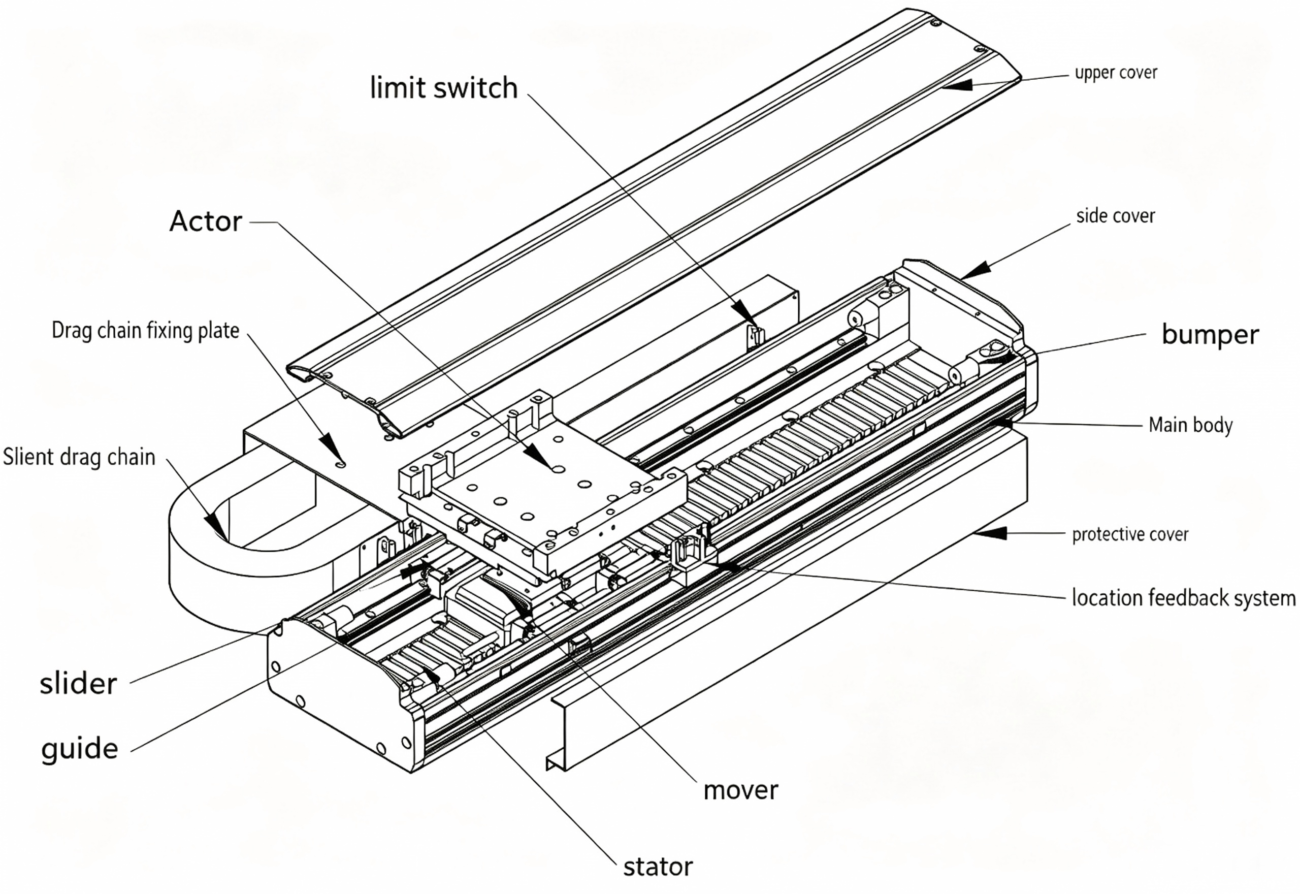
Unlike conventional rotary motors, which generate rotational torque and normally require mechanical components such as ball screws, belts, gears, or rack-and-pinion systems to create linear movement, a linear motor generates force directly along a straight path.
This direct-drive principle can reduce backlash, mechanical wear, and transmission complexity while enabling high speed, rapid acceleration, and precise positioning.
But not all linear motors are the same.
Depending on their electromagnetic principle, magnetic circuit, and mechanical structure, linear motors can be divided into several different types. Among industrial motion-control systems, iron core linear motors, ironless linear motors, and tubular linear motors are especially important.
So, what are the different types of linear motors, and which one is right for your application?
This guide explains the major linear motor types, their advantages and limitations, and how to choose between them.
What Is a Linear Motor?
A linear motor is an electric motor designed to produce linear motion directly instead of rotational motion.
One simple way to understand the concept is to imagine a conventional rotary electric motor being cut along its circumference and “unrolled” into a straight line.
Instead of a rotor continuously rotating inside or around a stator, the electromagnetic field travels along a linear path and generates thrust between the motor’s moving and stationary components.
The basic idea can be summarized as:
Electrical Energy → Electromagnetic Force → Direct Linear Motion
A conventional rotary motor system usually works like this:
Rotary Motor → Coupling → Ball Screw/Belt/Gear → Linear Motion
A direct-drive linear motor eliminates much of this intermediate mechanical transmission.
This is why linear motors are widely considered for machines requiring:
High acceleration
High travel speed
Precise positioning
Smooth motion
High dynamic response
Low mechanical wear
Reduced backlash
Repeatable motion
What Are the Main Types of Linear Motors?
Linear motors can be classified in several ways.
According to their electromagnetic operating principle, common categories include linear synchronous motors (LSMs), linear induction motors (LIMs), and linear stepper motors.
For precision industrial direct-drive applications, however, engineers frequently encounter another practical classification:
Iron Core Linear Motors, Ironless Linear Motors, and Tubular Linear Motors.
Understanding this second classification is particularly useful when selecting a linear motor for automation equipment.
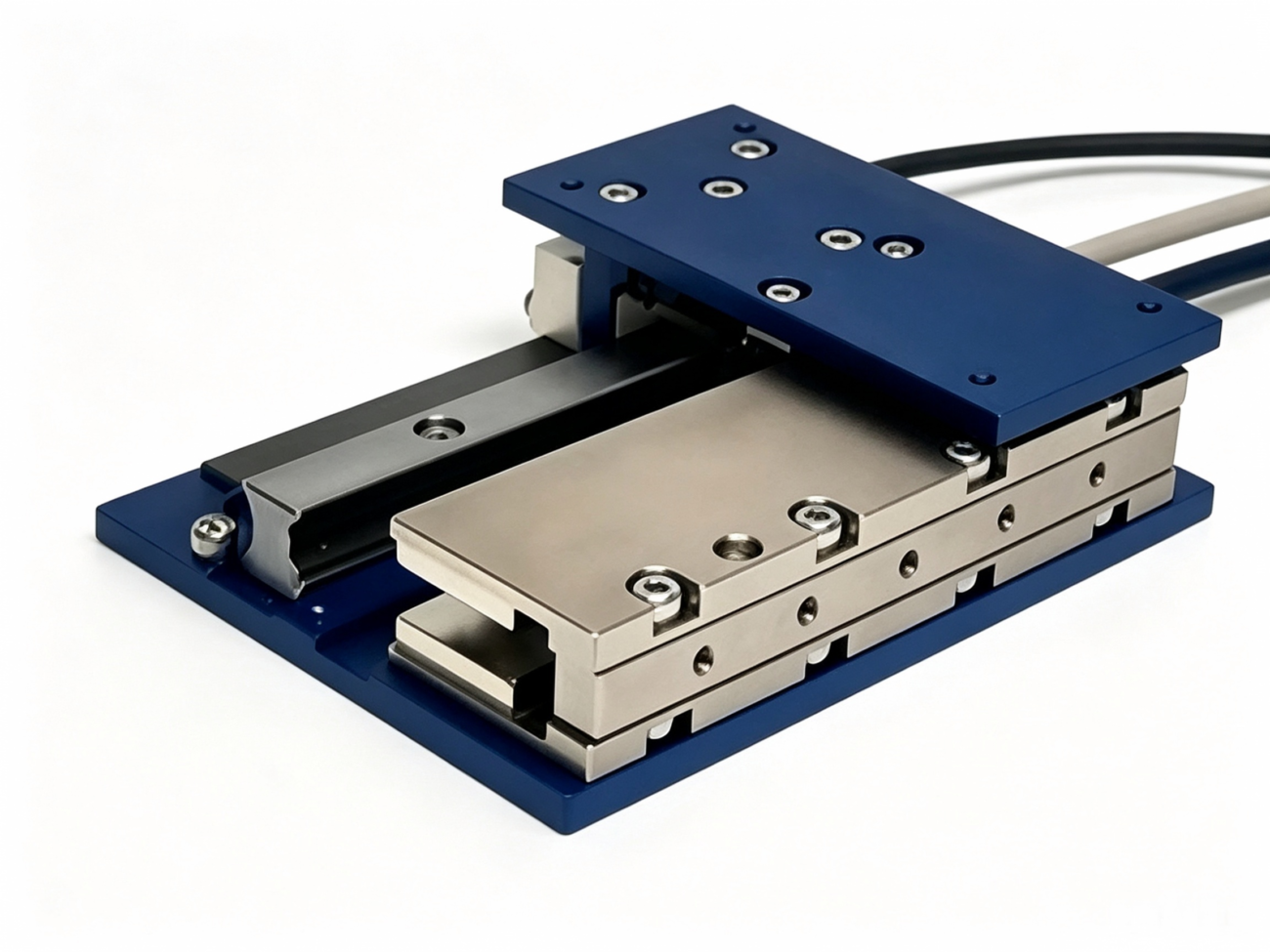
1. Iron Core Linear Motors
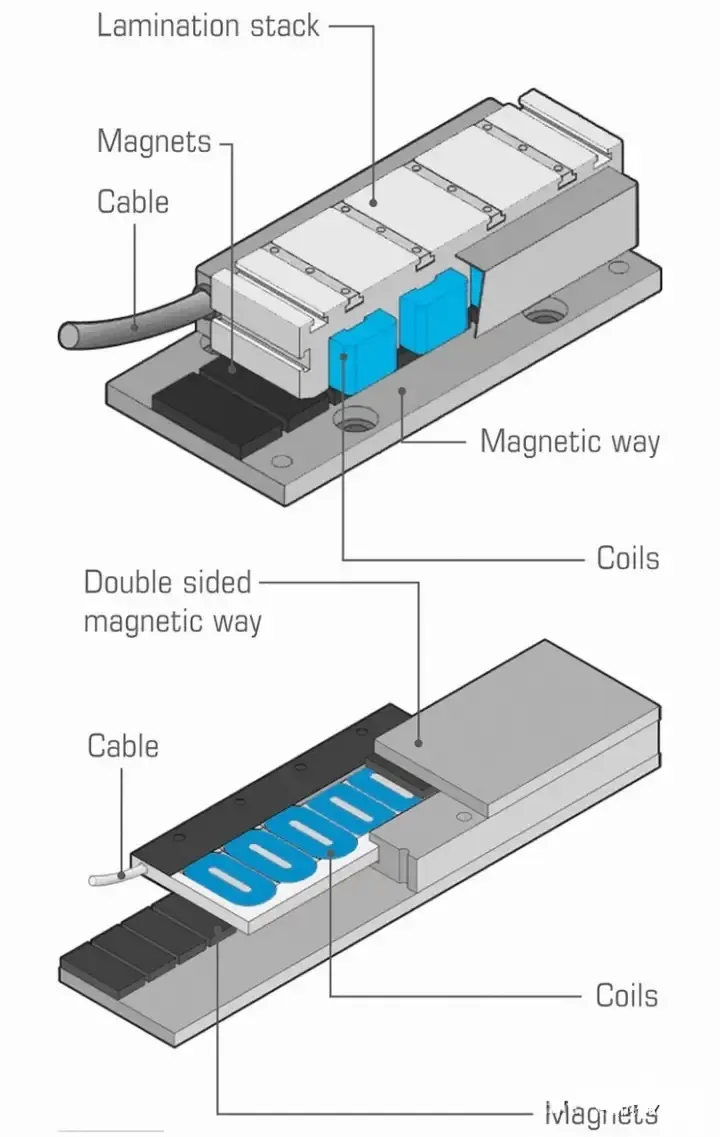
An iron core linear motor uses coils wound around or associated with a ferromagnetic laminated core.
The iron concentrates the magnetic flux, allowing the motor to generate relatively high force from a compact package.
Key Advantages of Iron Core Linear Motors
The most important advantage is high force density.
Because the iron core strengthens the magnetic circuit, an iron core motor can generate substantial continuous and peak thrust without requiring an excessively large motor.
This makes it particularly attractive when the application involves:
Heavy payloads
High process forces
Rapid acceleration of relatively large masses
Compact machine designs
High-force industrial motion
Typical applications include:
CNC machines, laser cutting systems, industrial automation equipment, semiconductor machinery, gantry systems, material handling equipment, and high-force positioning systems.
What Are the Limitations?
The presence of iron also introduces an important engineering consideration: magnetic attraction and cogging force.
The magnetic track strongly attracts the iron-containing forcer. This attractive force must be considered when designing bearings and guide systems.
Interaction between the iron teeth and permanent magnets can also produce periodic force variation known as cogging.
Modern motor designs and control algorithms can significantly reduce its influence, but applications requiring extremely smooth low-speed motion may favor an ironless architecture.
2. Ironless Linear Motors
Anironless linear motor removes the ferromagnetic core from the moving coil assembly.
Instead, the coils are typically positioned within a magnetic track, often using a U-shaped configuration.
Because there is no iron core interacting with the permanent magnets, ironless motors can achieve essentially zero cogging associated with the iron teeth.
This makes them particularly attractive for precision motion applications.
Key Advantages of Ironless Linear Motors
Ironless designs typically provide:
Very smooth motion
No iron-core cogging
No magnetic attraction between an iron forcer and magnet track
Low moving mass
Excellent acceleration capability
Excellent velocity stability
High precision potential
For this reason, ironless linear motors are widely considered for applications such as:
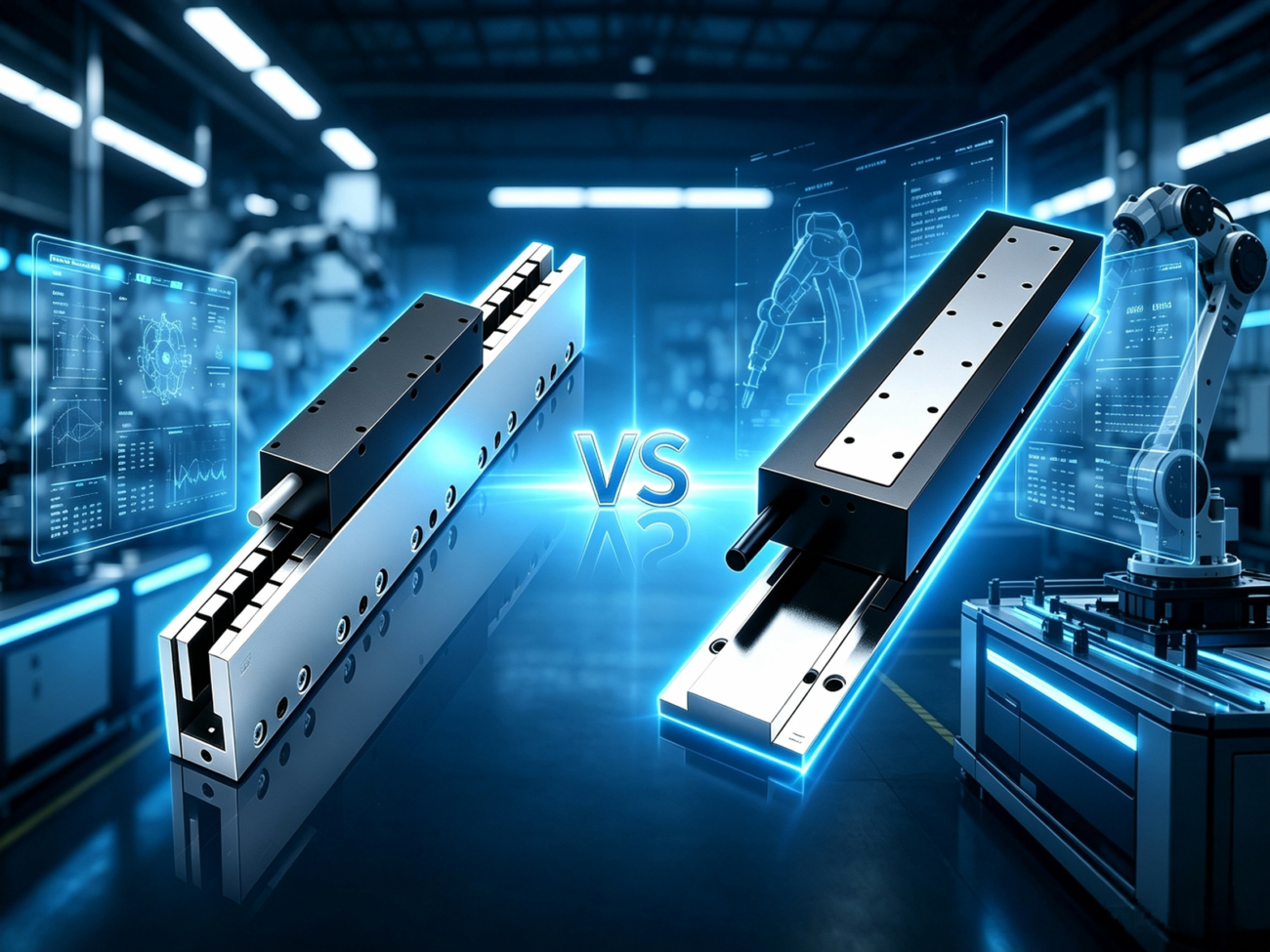
If your machine needs to move a heavy payload with high thrust, an iron core motor may be more appropriate.
If your machine requires extremely smooth motion, low force ripple, or precision scanning, an ironless motor may offer important advantages.
3. Tubular Linear Motors
A tubular linear motor, sometimes called a cylindrical linear motor, arranges its electromagnetic components around a cylindrical axis rather than using a flat magnetic track.
A common design consists of a cylindrical coil assembly interacting with a rod containing permanent magnets.
The geometry provides a compact and symmetrical magnetic circuit.
Why Use a Tubular Linear Motor?
Tubular linear motors can combine:
Compact dimensions
Direct linear motion
High dynamic response
Good force density
High acceleration
Simple mechanical integration
Their shape also makes them particularly interesting as an alternative to conventional linear actuators.
They are especially useful where the designer wants motor-like servo performance in a form factor similar to a linear actuator.
4. Linear Synchronous Motors (LSM)
A linear synchronous motor uses a traveling electromagnetic field to produce synchronous linear movement.
Permanent-magnet linear motors used in precision industrial equipment commonly operate according to synchronous motor principles.
The motion of the moving component remains synchronized with the electromagnetic field, allowing highly controlled movement.
LSMs are therefore widely associated with applications requiring:
High positioning accuracy
High efficiency
High-speed operation
Precise servo control
They can be found in both industrial motion systems and large-scale transportation applications.
5. Linear Induction Motors (LIM)
A linear induction motor applies the operating principle of a conventional AC induction motor to linear motion.
Instead of relying on permanent magnets in the secondary, electromagnetic induction creates currents in a conductive secondary component. Interaction between these induced currents and the traveling magnetic field produces thrust.
One of the advantages of this architecture is mechanical simplicity.
Linear induction motors are commonly associated with applications such as:
Transportation systems
Conveying equipment
Material handling
Long-travel motion systems
Industrial propulsion
For precision positioning machines, permanent-magnet synchronous linear motors are generally more common because they offer characteristics better suited to tightly controlled servo motion.
6. Linear Stepper Motors
A linear stepper motor converts electrical pulses into incremental linear movement.
Instead of continuously controlling the motor like a servo system, the actuator moves through discrete steps.
The major advantages include relatively straightforward control and accurate incremental positioning.
They are useful for applications where:
Motion is relatively slow
Loads are moderate
Incremental positioning is required
Cost and control simplicity are important
For very high-speed, high-dynamic industrial automation, servo-controlled permanent-magnet linear motors are often preferred.
Flat vs. U-Type vs. Tubular Linear Motors
Linear motors can also be classified according to their physical geometry.
Flat Linear Motor
The motor and magnetic track are arranged in a flat configuration.
Iron core motors frequently use this architecture because it provides high force density and straightforward machine integration.
U-Channel Linear Motor
Magnets are positioned on opposing sides of the coil assembly.
This configuration is commonly associated with ironless linear motors and helps create a balanced magnetic field around the coil.
Tubular Linear Motor
The electromagnetic circuit surrounds a cylindrical axis.
This geometry provides a compact actuator-like form and can be advantageous when installation space is limited.
Therefore, terms such as iron core, ironless, synchronous, tubular, and flat linear motor do not necessarily describe mutually exclusive categories.
They may describe different aspects of the same motor: electromagnetic principle, core construction, or mechanical geometry.
How to Choose the Right Linear Motor
Choosing a linear motor should start with the application’s motion requirements rather than simply selecting the motor with the highest peak force.
Consider the following parameters:
1. Continuous Force
How much force must the motor generate continuously without overheating?
2. Peak Force
How much short-duration force is required during acceleration or process events?
3. Payload
What total moving mass must be accelerated?
4. Maximum Speed
What linear velocity must the axis achieve?
5. Acceleration
High-throughput machines may require extremely rapid acceleration and deceleration.
6. Positioning Accuracy and Repeatability
Semiconductor, optical, inspection, and metrology applications can have much stricter requirements than general material-handling systems.
7. Velocity Ripple and Cogging
For scanning, dispensing, imaging, and measurement processes, smooth velocity can be just as important as absolute positioning accuracy.
8. Duty Cycle
A motor repeatedly producing high force generates significant heat. Continuous and peak force ratings should therefore never be treated as interchangeable.
9. Cooling
Depending on the power density and duty cycle, natural convection may not be sufficient. Forced-air or liquid cooling may be required.
10. Installation Space
Machine geometry may determine whether a flat, U-channel, or tubular design is the most practical.
Linear Motor vs. Ball Screw: What’s the Difference?
This is another important question when designing a high-performance motion system.
A servo motor with a ball screw converts rotary motion into linear movement.
Removing the mechanical transmission can reduce backlash, wear, and mechanical limitations at high speed.
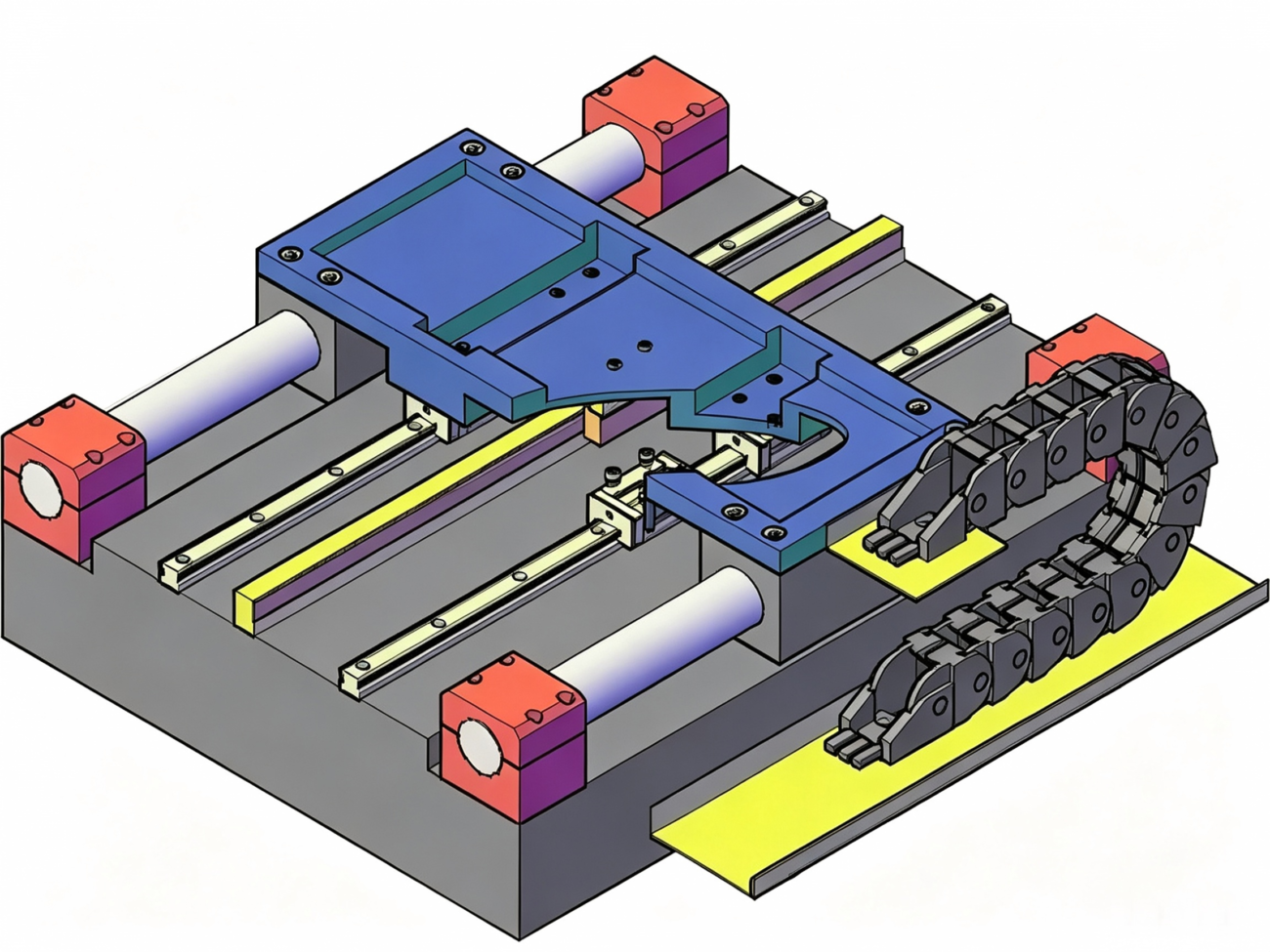
However, linear motors also require careful consideration of feedback systems, servo tuning, thermal management, guide design, cable management, safety, and overall machine stiffness.
Therefore, switching from a ball screw to a linear motor should be considered a system-level engineering decision rather than a simple motor replacement.
Where Are Linear Motors Used?
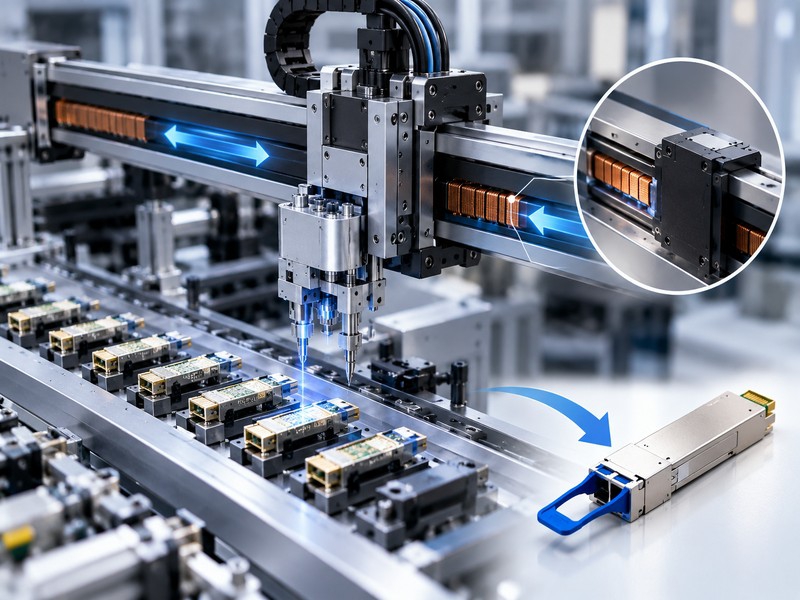
The growing demand for faster and more precise automation has expanded the range of linear motor applications.
Common examples include:
Semiconductor manufacturing equipment
Wafer inspection and handling
PCB and electronics manufacturing
Laser cutting and laser processing
Machine tools
CNC equipment
Robotics
Pick-and-place systems
Automated assembly
Precision measurement
Optical inspection
Medical and laboratory automation
Battery manufacturing
Packaging equipment
High-speed sorting
Material handling
Precision dispensing
As manufacturing systems move toward higher throughput, greater precision, smart automation, and reduced mechanical maintenance, direct-drive linear motion becomes increasingly attractive.
FAQ: Linear Motor Types
What are the three main types of direct-drive linear motors?
For many industrial direct-drive applications, three commonly discussed architectures are iron core, ironless/U-channel, and tubular linear motors.
Broader classifications can also include linear synchronous, linear induction, and linear stepper motors.
What is the difference between an iron core and ironless linear motor?
Iron core linear motors use ferromagnetic material to concentrate magnetic flux and generally provide higher force density.
Ironless motors eliminate the iron core, reducing cogging and magnetic attraction while providing very smooth motion and low moving mass.
Which linear motor is best for high precision?
Ironless linear motors are particularly attractive for applications requiring extremely smooth velocity, low force ripple, and precision positioning.
However, final positioning performance depends on the complete motion system, including the encoder, bearings, mechanical structure, servo drive, controller, and tuning.
Which linear motor is best for high force?
Iron core linear motors are generally preferred when high force density is a major requirement.
What is a tubular linear motor used for?
Tubular linear motors are commonly used in compact high-speed linear actuation, including packaging, assembly, pick-and-place, testing, and automation equipment.
Are linear motors more accurate than ball screws?
Linear motors eliminate transmission-related backlash and can enable extremely high positioning performance.
However, the actual accuracy of a machine depends on the complete mechanical and control system rather than the motor alone.
Final Thoughts
Understanding the different types of linear motors is the first step toward selecting the right direct-drive solution.
For industrial automation, three architectures deserve particular attention:
Iron core linear motors are ideal when high thrust and force density are priorities.
Ironless linear motors are well suited to ultra-smooth motion, high acceleration, and precision positioning.
Tubular linear motors provide compact direct-drive actuation for applications where space, speed, and dynamic performance are important.
Meanwhile, classifications such as linear synchronous motors, linear induction motors, and linear stepper motors help engineers understand the electromagnetic operating principles behind different linear-motion technologies.
The best linear motor is therefore not simply the fastest or most powerful one. It is the motor whose force, speed, acceleration, precision, thermal behavior, physical dimensions, and control characteristics best match the application.
As smart manufacturing, semiconductor production, robotics, and high-speed automation continue to evolve, linear motor technology will remain a key enabler of faster, more precise, and more flexible motion systems.
FAQ About Types of Linear Motors
1. What are the main types of linear motors? The main types include iron core, ironless, U-type, and tubular linear motors, as well as linear synchronous and linear induction motors classified by operating principle.
2. What is the difference between iron core and ironless linear motors? Iron core linear motors offer higher force density, while ironless linear motors provide smoother motion with minimal cogging and no magnetic attraction from an iron core.
3. What is a U-type linear motor? A U-type linear motor typically uses magnets arranged on both sides of an ironless coil, providing smooth motion, low force ripple, and high dynamic performance.
4. Which type of linear motor is best for high precision? Ironless linear motors are often preferred for high-precision applications because of their smooth motion and absence of iron-core cogging.
5. Which linear motor is best for high-force applications? Iron core linear motors are generally preferred when high thrust and high force density are the primary requirements.
6. What is a tubular linear motor? A tubular linear motor uses a cylindrical electromagnetic structure to generate direct linear motion, making it suitable for compact and high-speed automation systems.
7. What is the difference between a linear synchronous motor and a linear induction motor? A linear synchronous motor moves in synchronization with the traveling magnetic field, while a linear induction motor generates thrust through electromagnetic induction.
8. What are linear motors used for? Linear motors are widely used in semiconductor equipment, CNC machines, robotics, laser processing, electronics manufacturing, precision positioning, and industrial automation.
9. Are linear motors better than ball screws? Linear motors offer direct drive, high speed, minimal backlash, and low mechanical wear, while ball screws can be more economical for less demanding applications.
10. How do I choose the right linear motor? Consider continuous and peak force, payload, speed, acceleration, positioning accuracy, duty cycle, cooling, travel length, and installation space.
11. Do linear motors have backlash? Direct-drive linear motors eliminate transmission backlash associated with components such as ball screws, gears, and belts.
12. What are the advantages of direct-drive linear motors? Key advantages include high speed, rapid acceleration, precise positioning, reduced mechanical wear, and fewer transmission components.
13. Are linear motors suitable for high-speed applications? Yes. Their direct-drive design makes linear motors particularly suitable for high-speed and high-acceleration motion systems.
14. What is the difference between flat and U-type linear motors? Flat linear motors typically use a single-sided magnetic track, while U-type designs place magnets on both sides of the coil for a balanced magnetic structure.
15. What industries commonly use linear motors? Linear motors are commonly used in semiconductor, electronics, machine tools, robotics, battery manufacturing, packaging, medical equipment, and precision automation.
HCY Automation delivers integrated solutions across motion control, linear motion, robotics, machine vision, pneumatic systems, and precision gearboxes to help global manufacturers build smarter, faster, and more reliable production lines. Our engineering team helps you select and integrate the right motion control, robotics, and automation components for your specific application.