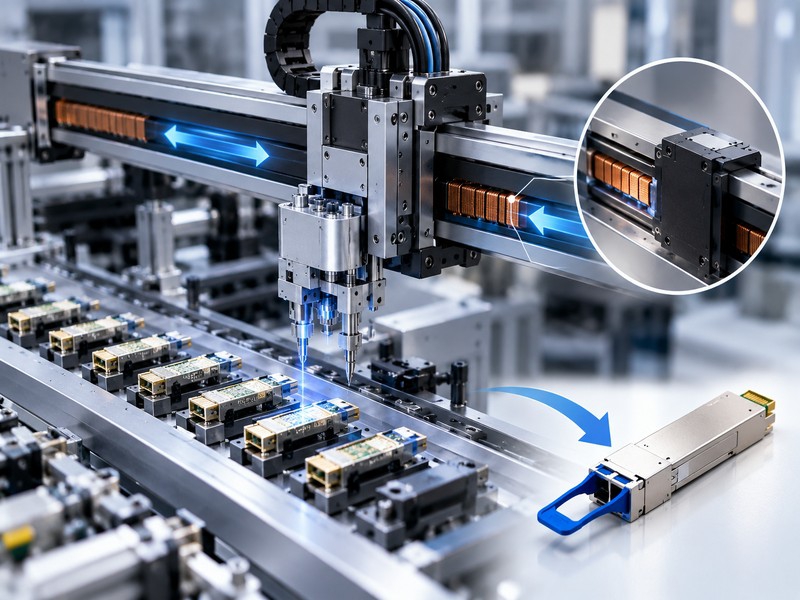
Linear motors are widely used in industrial automation, semiconductor equipment, CNC machines, laser processing systems, robotics, and high-speed positioning applications. But how do you actually drive a linear motor?
Unlike a conventional rotary motor, a linear motor generates force directly in a straight line without requiring a ball screw, belt, rack-and-pinion system, or other mechanical transmission to convert rotary motion into linear motion.
In most modern industrial applications, a linear motor is driven by a servo drive, which supplies precisely controlled current to the motor windings. Combined with a linear encoder and motion controller, the system can accurately control the motor’s position, speed, acceleration, and force.
In simple terms, a typical linear motor drive system works like this:
Power Supply → Servo Drive → Linear Motor → Linear Motion
For high-precision closed-loop control:
Motion Controller → Servo Drive → Linear Motor → Load
Linear Encoder → Position Feedback → Servo Drive / Controller
So, how is a linear motor driven, what components are required, and how does the controller determine its speed, direction, and position?
In this guide, we will explain the complete linear motor drive system, including:
- How a linear motor generates thrust
- How to drive a linear motor with a servo drive
- AC and DC linear motor drive principles
- How linear motor commutation works
- How encoders provide position feedback
- How speed, position, and force are controlled
- Linear motor vs. ball screw servo systems
- Common linear motor drive problems
- How to select a linear motor and servo drive
What Is a Linear Motor?
A linear motor is an electric motor that converts electrical energy directly into linear mechanical motion.
A conventional rotary motor generates torque around a rotating shaft. If linear motion is required, additional mechanical components are normally needed, such as a ball screw, timing belt, gearbox, or rack and pinion.
A linear motor eliminates this rotary-to-linear conversion.
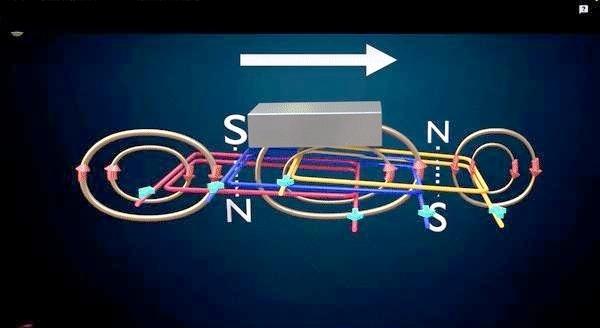
Conceptually, a linear motor can be understood as a rotary motor that has been “unrolled” and laid flat. Instead of producing rotational torque, electromagnetic interaction generates thrust along a straight path.
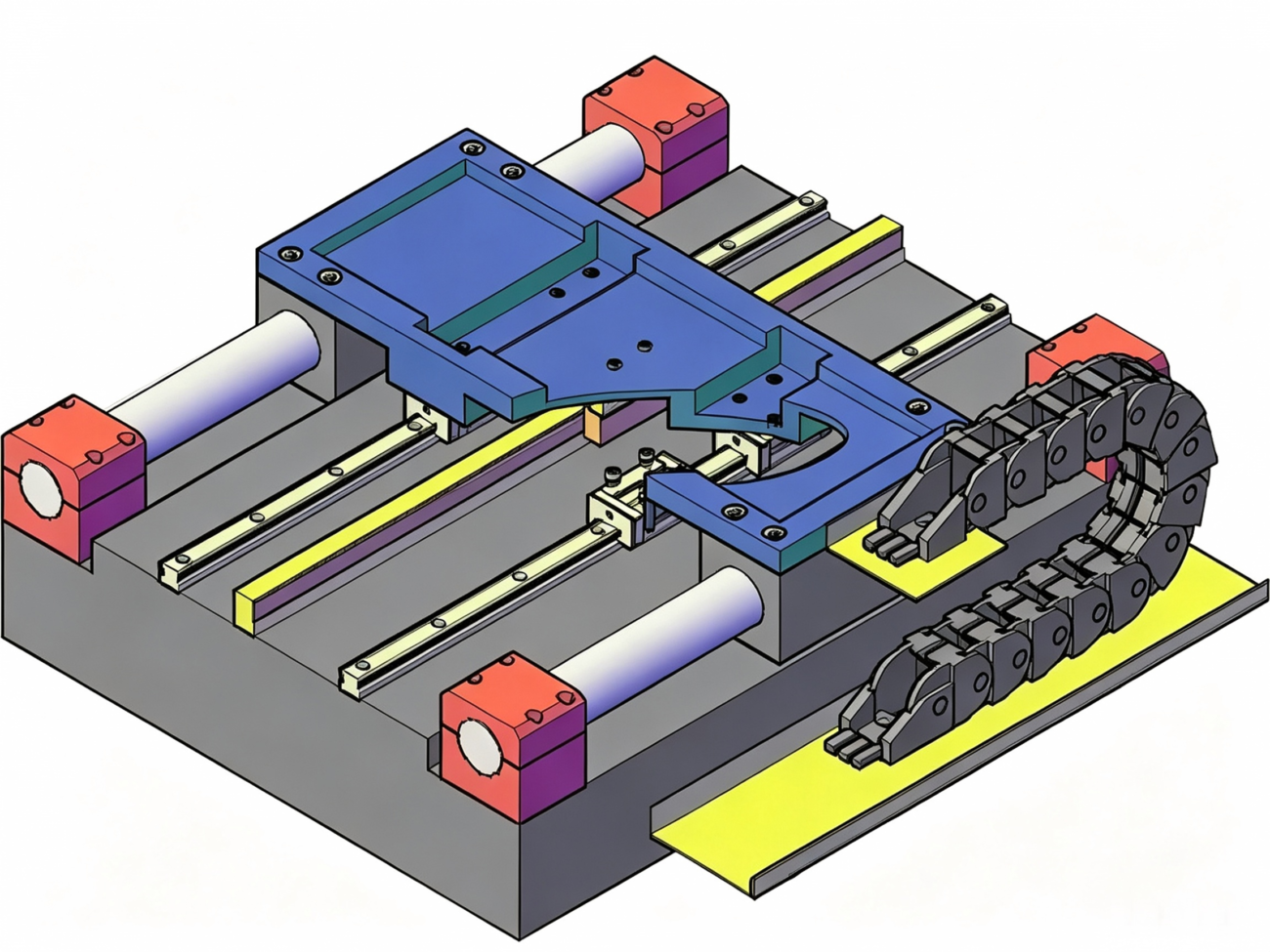
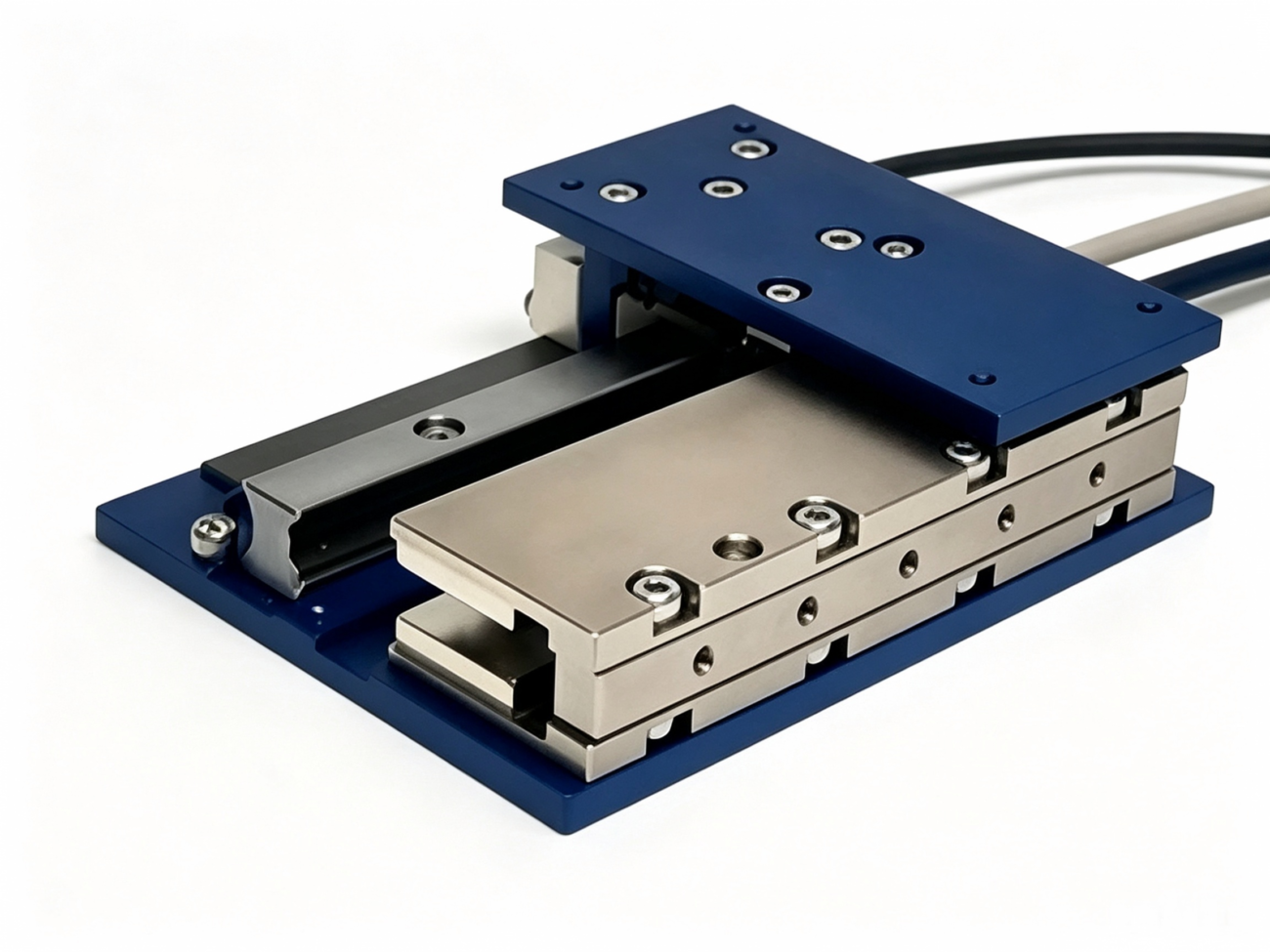
A typical industrial linear motor system may include:
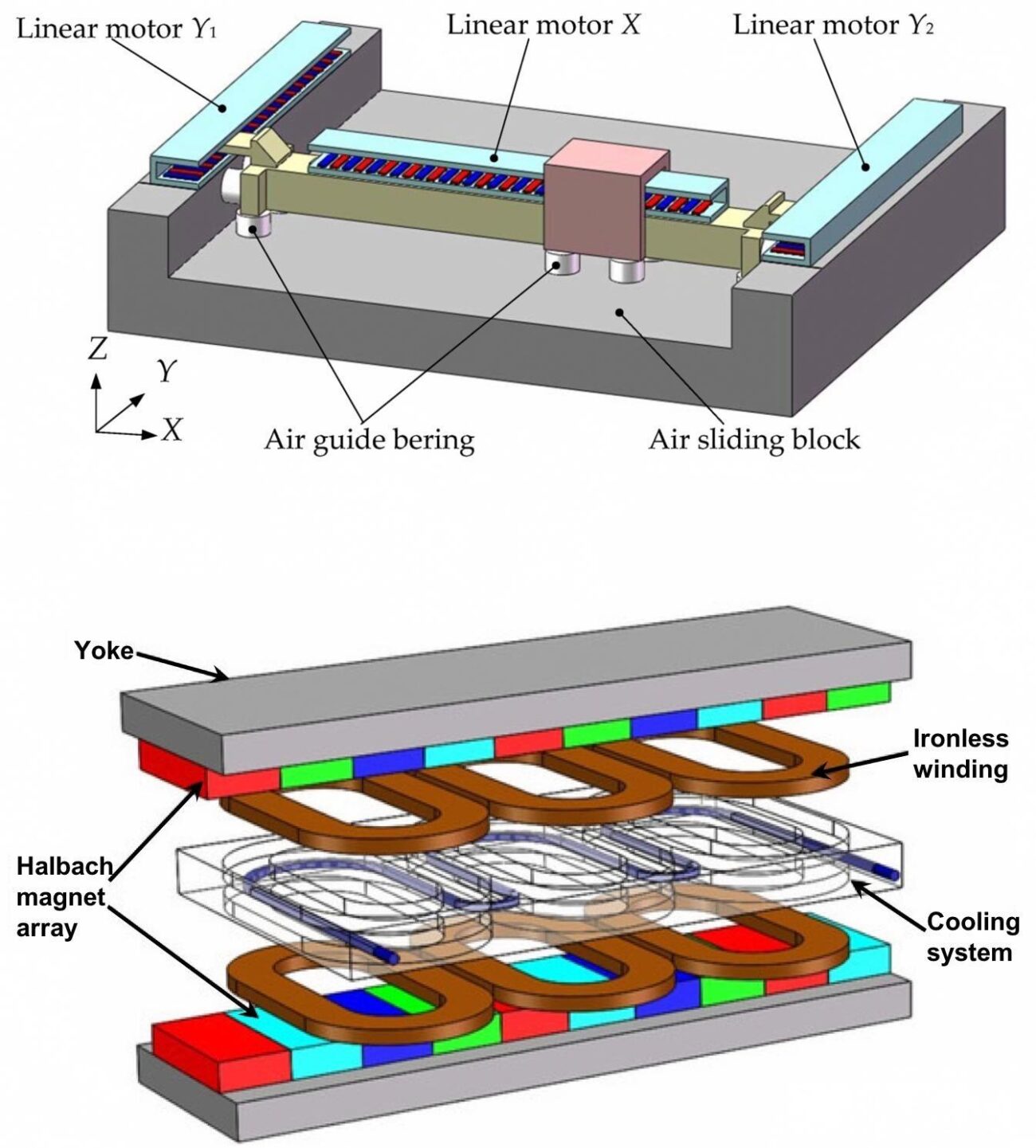
- Linear motor coil assembly
- Permanent magnet track
- Linear guide
- Linear encoder
- Servo drive
- Motion controller
- Power and feedback cables
This direct-drive structure is one of the main reasons linear motors can achieve high speed, high acceleration, and precise positioning.
How to Drive a Linear Motor?
In most precision industrial applications, a linear motor is driven by a servo drive rather than being connected directly to a fixed power source.
The servo drive converts the incoming electrical power into controlled phase currents and supplies them to the motor windings.
These currents generate a traveling electromagnetic field. The interaction between this electromagnetic field and the permanent magnet field produces linear thrust.
By controlling the magnitude, phase, and frequency of the motor current, the servo drive can control:
- Direction of movement
- Motor force
- Acceleration
- Velocity
- Deceleration
- Position
Therefore, driving a linear motor is not simply a matter of switching the power ON or OFF.
For precision motion, the motor, servo drive, encoder, and motion controller work together as one complete motion-control system.
What Components Are Required to Drive a Linear Motor?
A typical closed-loop linear motor drive system requires four major elements.
1. Linear Motor
The linear motor converts electrical energy into electromagnetic thrust.
Depending on the design, it may use permanent magnets, energized coils, or induction principles.
For industrial high-performance motion systems, permanent-magnet synchronous linear motors are commonly used.
2. Servo Drive
The servo drive is responsible for controlling current supplied to the motor.
It receives motion commands and regulates the motor phases to generate the required force.
The servo drive may also perform current-loop, velocity-loop, and position-loop control depending on the system architecture.
3. Linear Encoder
The encoder measures the actual position of the moving axis.
It continuously sends position information back to the servo drive or motion controller.
This allows the system to compare:
Commanded Position ↔ Actual Position
The difference between these values is used to continuously correct the motor’s motion.
4. Motion Controller
The motion controller generates the required motion profile, including target position, speed, acceleration, and deceleration.
In some systems, the controller is integrated into the servo drive.
Together, these components create a closed-loop linear servo system.
How Does a Servo Drive Control a Linear Motor?
The servo drive controls the electromagnetic force generated by the motor.
When the controller commands the axis to move, the drive regulates the current flowing through the motor phases.
The basic process is:
- The controller sends a motion command.
- The servo drive calculates the required motor current.
- Current flows through the motor windings.
- An electromagnetic field is generated.
- The field interacts with the permanent magnet track.
- Linear electromagnetic thrust is produced.
- The moving element accelerates along the guide.
- The encoder measures the actual position.
- Feedback is returned to the control system.
- The drive continuously corrects the current until the commanded motion is achieved.
This process occurs continuously and at very high control-loop frequencies.
As a result, the linear motor can achieve precise control of position, speed, acceleration, and force.
How Does a Linear Motor Change Direction?
A linear motor does not require a mechanical reversing mechanism.
The servo drive changes the electromagnetic field electronically.
By changing the phase sequence and current command, the generated thrust changes direction.
Therefore, the moving element can:
Move Forward → Decelerate → Stop → Reverse → Accelerate
This makes linear motors particularly suitable for high-frequency reciprocating applications such as pick-and-place machines, packaging equipment, sorting systems, semiconductor equipment, and automated assembly lines.
How Is Linear Motor Speed Controlled?
Linear motor speed is controlled electronically by the servo system.
The controller defines the required velocity, while the servo drive regulates motor current and electromagnetic field behavior accordingly.
Encoder feedback allows the system to continuously determine actual position and velocity.
If the actual velocity differs from the commanded velocity, the controller adjusts the motor current.
This closed-loop control provides fast response and precise speed regulation.
How Is Linear Motor Position Controlled?
Position control requires accurate position feedback.
A linear encoder measures the moving element’s actual position and sends this information to the control system.
The servo controller continuously calculates the position error:
Position Error = Commanded Position − Actual Position
The controller then adjusts motor force to minimize this error.
High-performance systems may use optical or magnetic linear encoders with very high resolution, allowing extremely precise positioning when the complete mechanical and control system is properly designed.
AC vs. DC Linear Motor Drive
Linear motors are sometimes classified according to AC or DC drive principles, but this distinction can be misleading in modern servo applications.
AC Linear Motor Drive
Many industrial linear motors use multiphase electronically commutated operation.
The servo drive generates precisely controlled phase currents, creating a traveling electromagnetic field that produces linear thrust.
This is similar in principle to a rotary permanent-magnet servo motor, except that the motor is arranged linearly.
DC Linear Motor Drive
Certain linear motors and linear actuators can operate using DC-based drive architectures.
However, high-precision positioning still generally requires electronic control and position feedback.
For modern industrial automation, it is therefore often more useful to distinguish between open-loop and closed-loop control or between different motor technologies rather than simply referring to AC versus DC.
Why Does a Linear Motor Need an Encoder?
A motor can generate force without an encoder, but high-precision positioning requires the controller to know where the moving element is located.
The encoder provides this information.
Common feedback technologies include:
- Optical linear encoders
- Magnetic linear encoders
- Incremental encoders
- Absolute encoders
Encoder selection affects system resolution, accuracy, repeatability, maximum speed, environmental resistance, and cost.
For precision applications, the encoder should therefore be considered part of the complete linear motor system rather than an optional accessory.
Linear Motor vs. Ball Screw: What’s the Difference?
A traditional servo-driven linear axis usually works like this:
Servo Motor → Coupling → Ball Screw → Nut → Linear Stage
A direct-drive linear motor system is simpler:
Linear Motor → Linear Stage
Removing the mechanical transmission can reduce backlash, friction, mechanical wear, and transmission-related vibration.
Linear motors can therefore offer several advantages:
- High acceleration
- High speed
- Fast dynamic response
- High positioning accuracy
- High repeatability
- No drivetrain backlash
- Reduced mechanical wear
- Fewer transmission components
However, ball screw systems still have important advantages.
They can be more economical and may be better suited to applications requiring high thrust at relatively low speeds or applications where mechanical holding characteristics are important.
The correct technology depends on the application’s speed, force, stroke, accuracy, duty cycle, and cost requirements.
Can You Drive a Linear Motor Vertically?
Yes, but vertical linear motor applications require additional safety considerations.
Because gravity continuously acts on the moving load, the axis may fall if motor force is removed.
Depending on the application, a vertical linear motor axis may require:
- Mechanical brake
- Counterbalance
- Pneumatic balancing system
- Spring mechanism
- Safety locking device
The motor must also provide sufficient continuous force to overcome gravity while meeting the required acceleration and motion profile.
Linear Motor vs. Magnetic Levitation
Linear motor drive and magnetic levitation are related electromagnetic technologies, but they are not the same.
A linear motor generates propulsion or positioning force in a straight line.
A magnetic levitation system uses magnetic force to support or suspend an object with little or no mechanical contact.
The two technologies can be combined.
For example, a magnetically levitated transport system may use magnetic forces for suspension and a linear motor for propulsion.
However, most conventional industrial linear motor axes are not magnetically levitated. They typically use precision linear guides or bearings to mechanically support the moving load.
Common Applications of Linear Motor Drive Systems
Because of their direct-drive characteristics, linear motors are widely used in applications requiring high dynamics and precision.
Typical applications include:
- Semiconductor manufacturing equipment
- CNC machine tools
- Laser cutting and laser processing
- Electronics manufacturing
- High-speed pick-and-place systems
- Packaging machines
- Automated inspection systems
- Precision dispensing equipment
- Robotics
- Gantry systems
- Automated material handling
- Medical and laboratory automation
How to Select a Linear Motor and Servo Drive
Selecting a linear motor should be based on the complete motion profile rather than only stroke or maximum force.
Important parameters include:
- Moving mass
- Payload
- Stroke
- Peak velocity
- Acceleration
- Peak force
- Continuous force
- Duty cycle
- Positioning accuracy
- Repeatability
- Encoder resolution
- Operating orientation
- Thermal conditions
- Cable management
- Environmental requirements
A basic starting point for force estimation is:
Required Force ≈ Moving Mass × Acceleration + External Forces
For a vertical axis, gravitational force must also be considered.
However, peak force alone is not sufficient for final motor selection. Continuous force, RMS force, thermal limits, duty cycle, guide friction, cable drag, safety factors, and motion profile should also be evaluated.
Frequently Asked Questions About Driving Linear Motors
Can I connect a linear motor directly to a power supply?
For precision industrial motion control, normally no. A compatible servo drive is typically required to control motor current and commutation.
Does a linear motor need a VFD?
Not necessarily. High-performance permanent-magnet linear servo motors are normally paired with compatible servo drives rather than conventional general-purpose variable-frequency drives.
Does a linear motor require a servo drive?
Most high-precision industrial linear motor applications use a servo drive to control current, velocity, position, and force.
How do you control the direction of a linear motor?
The drive electronically controls the motor phase currents. Changing the electromagnetic field and force command changes the direction of linear thrust.
How do you control the speed of a linear motor?
The servo system regulates motor current based on the commanded motion profile and feedback from the encoder.
Can a linear motor move back and forth?
Yes. Linear motors are particularly suitable for fast reciprocating motion because direction can be changed electronically without a mechanical reversing transmission.
What is the difference between a linear motor and a linear actuator?
A linear actuator is a broad category of devices that create linear motion. It may use a ball screw, belt, pneumatic cylinder, hydraulic cylinder, or linear motor.
A linear motor is a specific electromagnetic direct-drive technology.
Conclusion: What Is the Best Way to Drive a Linear Motor?
So, how do you drive a linear motor?
For most modern industrial applications, the answer is to use a properly matched linear motor, servo drive, motion controller, and position encoder as a complete closed-loop motion system.
The servo drive supplies controlled current to the motor windings, generating electromagnetic thrust. The encoder measures the actual position, while the controller continuously adjusts the motor command to achieve the required position, speed, acceleration, and force.
Compared with conventional rotary servo systems using ball screws, belts, or gearboxes, linear motors provide direct-drive motion with fewer transmission components.
This can deliver higher speed, higher acceleration, faster response, reduced mechanical backlash, and excellent positioning performance.
However, successful linear motor drive design depends on correct motor sizing, servo drive matching, encoder selection, thermal management, mechanical guidance, motion control, and safety design.
For engineers evaluating a new automation system, the key question is not only “How to drive a linear motor?” but also:
“How do I select the right linear motor and drive system for my application’s speed, stroke, payload, force, and precision requirements?”