Ball Screw Linear Module vs. Belt Drive Linear Module: Which Is Better for Your Application?
Compare ball screw linear modules and belt drive linear modules by accuracy, speed, load capacity, travel length, maintenance, and cost. Find the right solution for your automation project. When selecting a linear motion system for industrial automation, one of the most common questions is whether to choose a ball screw linear module or a belt drive linear module.
Both are widely used in automated machinery, but they differ in drive mechanism, positioning accuracy, operating speed, travel length, load capacity, and maintenance requirements.
A ball screw linear module is often preferred for precision positioning and high mechanical stiffness. A belt drive linear module is generally a practical choice for high-speed movement and long travel distances.
However, the right choice depends on more than a single specification. At HCY Automation, we believe that understanding the actual operating conditions is the first step toward selecting a cost-effective linear motion solution.
In this guide, we compare both types of linear modules to help machine builders and automation engineers make the right decision.
1. What Is a Ball Screw Linear Module?
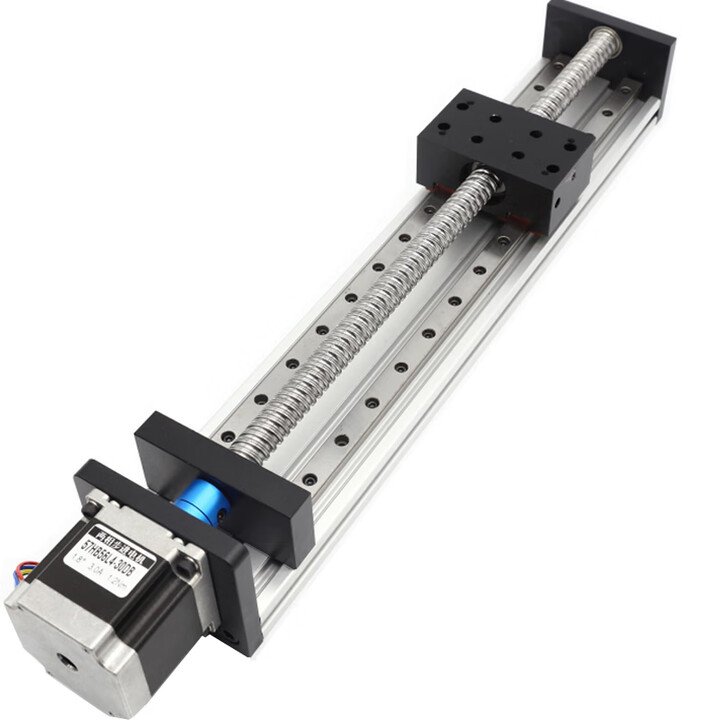
A ball screw linear module converts the rotary motion of a motor into linear movement through a ball screw and nut assembly.
A typical system integrates a ball screw, linear guide, moving carriage, structural base, and motor or motor mounting interface. As the screw rotates, the ball nut moves along the screw shaft, driving the carriage to its target position.
Key Advantages
High positioning accuracy
Ball screw linear modules are well suited to applications requiring precise positioning and repeatable movement. Actual accuracy depends on screw grade, lead, backlash, assembly quality, encoder feedback, and control settings.
High mechanical stiffness
A properly designed ball screw system can provide strong axial stiffness, making it suitable for precision positioning and applications involving relatively high axial forces.
Stable, controlled movement
Ball screw modules are commonly used in applications that require accurate positioning at controlled speeds, including automated assembly, inspection, and machining.
Limitations
Maximum speed is affected by screw length, lead, rotational speed, and critical-speed limits.
Long-stroke applications may require additional attention to screw support, vibration, and stability.
Lubrication and periodic inspection are generally required.
Costs may increase with higher precision, longer travel, and greater load requirements.
Typical Applications
Precision assembly equipment
CNC machinery and machining systems
Automated inspection and measurement equipment
Semiconductor manufacturing equipment
Medical device production
Precision dispensing and positioning systems
A ball screw linear module is a strong starting point when positioning performance and mechanical stiffness are more important than maximum travel speed.
2. What Is a Belt Drive Linear Module?
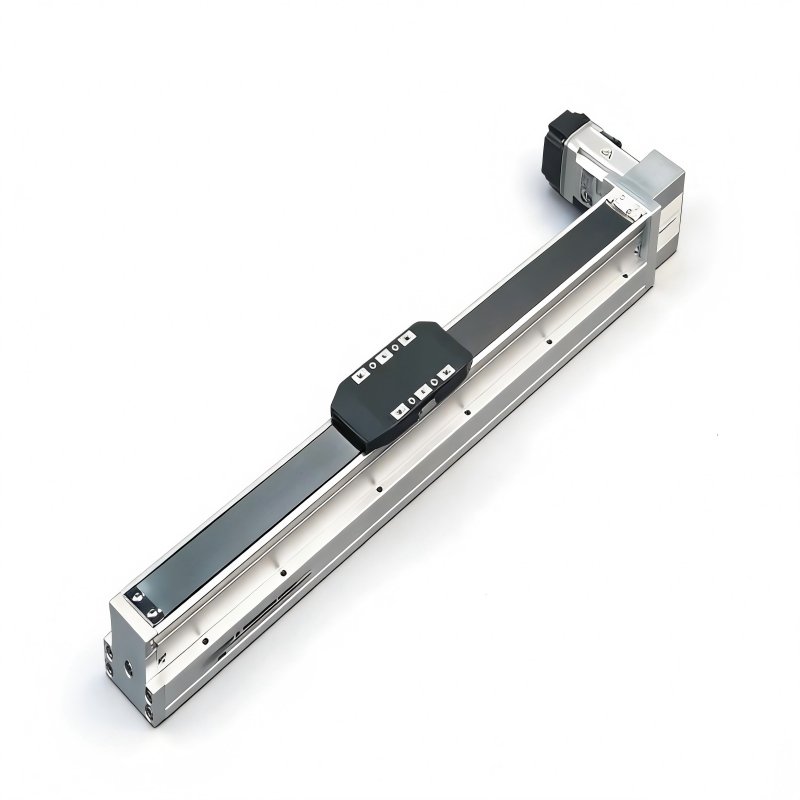
A belt drive linear module uses a timing belt and pulleys to convert motor rotation into linear movement.
The motor drives a pulley, which moves the belt and attached carriage along a linear guide. This configuration is particularly suitable for applications that require long travel distances, frequent movement, and high linear speeds.
Key Advantages
High-speed movement
Belt drive linear modules are commonly used for rapid transfers and repetitive positioning. Their achievable speed and acceleration depend on the belt, motor, guide system, payload, and structural design.
Long travel capability
Belt-driven systems are often suitable for strokes of several meters. Unlike long rotating screws, they do not have the same screw critical-speed limitation.
Cost-effective for long strokes
For many long-distance transfer applications, a belt drive linear module can offer a practical balance between performance and cost.
Flexible system integration
Belt-driven modules are frequently used in production lines and multi-axis automation systems where rapid movement between stations is required.
Limitations
Belt elasticity can affect positioning under changing loads.
Belt tension and wear need periodic inspection.
Stiffness and positioning performance depend on belt characteristics and system configuration.
Applications requiring very high axial stiffness may favor a properly selected ball screw system.
Typical Applications
High-speed pick-and-place systems
Packaging and sorting machinery
Battery production and material handling
Automated assembly lines
Logistics and warehouse automation
Long-distance transfer systems
A belt drive linear module is often the better starting point when long travel, high speed, and cost efficiency are the main priorities.
3. Ball Screw vs. Belt Drive Linear Module: Key Differences
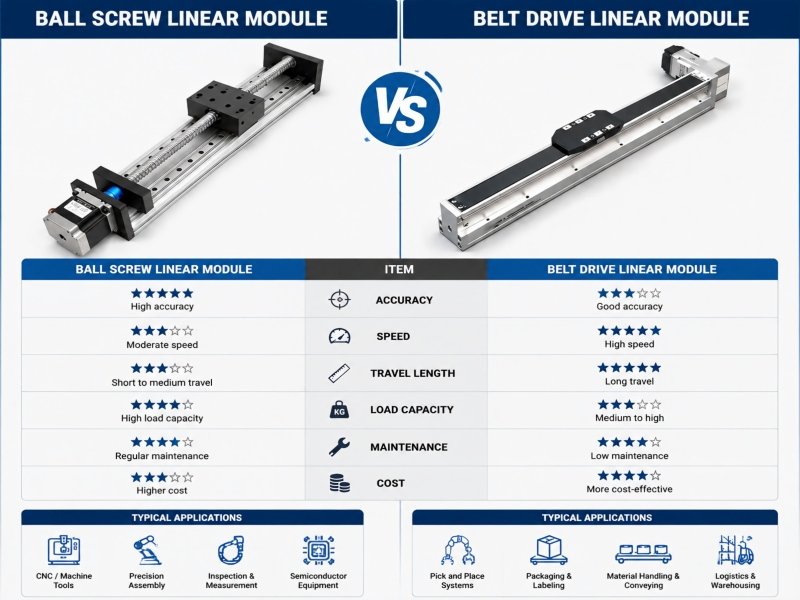
Comparison
Ball Screw Linear Module
Belt Drive Linear Module
Drive mechanism
Ball screw and nut
Timing belt and pulleys
Positioning accuracy
Generally preferred for precision positioning
Suitable for many general automation tasks
Mechanical stiffness
Often higher axial stiffness
Depends on belt tension, belt design, and structure
Operating speed
Limited by screw lead and critical speed
Generally suitable for high linear speeds
Travel length
Requires careful design for long strokes
Well suited to long travel
Load capacity
Depends on screw, guides, and structure
Depends on belt, guides, and structure
Maintenance
Lubrication and screw inspection
Belt tension and wear inspection
Initial cost
Depends on precision and configuration
Often economical for long-stroke applications
Typical applications
Precision positioning, machining, inspection
Material handling, packaging, high-speed transfer
Note: These are general engineering tendencies, not guaranteed specifications. Actual performance depends on the complete module design and operating conditions.
4. Which Linear Module Is More Accurate?
Positioning accuracy is often the first factor engineers consider when choosing a linear motion system.
Ball screw linear modules are generally preferred for applications requiring high positioning accuracy and stiffness. Their performance depends on screw accuracy, backlash, guide alignment, thermal expansion, encoder feedback, and motion-control tuning.
Belt drive linear modules can provide sufficient accuracy for many industrial automation tasks, particularly material handling, packaging, and transfer applications. However, belt elasticity, tension changes, and load variation can influence positioning performance.
When evaluating a module, distinguish between three important specifications:
Positioning accuracy: How closely the actual position matches the commanded position.
Repeatability: How consistently the system returns to the same position under specified conditions.
Resolution: The smallest position increment the control system can command or detect.
These specifications are related but are not interchangeable.
Selection tip: If your application involves precision assembly, measurement, or inspection, compare the manufacturer’s positioning accuracy and repeatability specifications under conditions similar to your actual application.
5. Which Is Faster: Ball Screw or Belt Drive?
Belt drive linear modules are often attractive for high-speed applications because they can support long travel without the critical-speed limitations associated with long rotating screws.
Ball screw modules can also achieve high speeds, but the maximum allowable speed depends on screw diameter, screw lead, supported length, bearing arrangement, and vibration characteristics.
For both systems, maximum speed alone does not determine cycle time. Acceleration, deceleration, settling time, payload, and the distance traveled during each movement also matter.
For example, a high-speed transfer system moving components between workstations may benefit from a belt drive module. A precision positioning station that spends more time settling at a target position may benefit more from a ball screw module.
The best solution is the one that meets the required cycle time while maintaining acceptable positioning performance.
6. Load Capacity and Installation: What Should You Consider?
Neither ball screw nor belt drive technology determines load capacity by itself.
The complete system must be evaluated according to:
Total moving mass and payload
Center of gravity and overhung load
Acceleration and deceleration forces
Guide rail spacing and allowable moment loads
Mounting surface and structural rigidity
Horizontal or vertical installation
Required braking and safety provisions
Ball screw modules can provide high axial thrust and stiffness when correctly sized. Belt-driven modules can also handle substantial loads when their belt, guides, frame, and drive are appropriately selected.
Vertical installation requires special attention. Gravity can cause a moving carriage to descend if the drive cannot hold the load after power loss. A suitable brake, counterbalance, or other safety measure may be necessary.
Always confirm allowable loads, moments, mounting orientation, and braking requirements with the module manufacturer.
7. Ball Screw vs. Belt Drive Linear Module: Which Costs Less?
There is no universal cost winner.
A belt drive linear module may be more economical for a long-stroke transfer system, while a ball screw module may provide better value for a precision positioning station.
The complete project cost should include more than the module itself:
Linear module and motor
Servo drive, encoder, and controller
Mounting and mechanical alignment
Installation and commissioning
Lubrication, belt inspection, and replacement parts
Production cycle time and throughput
Maintenance and potential downtime
A low-cost module that fails to meet the required positioning performance may increase the overall cost of the machine. Likewise, an unnecessarily high-performance module can increase investment without delivering meaningful benefits.
The goal is to select the most suitable configuration for the required performance—not simply the lowest-priced product.
8. How to Choose the Right Linear Module for Your Application
Application requirement
Recommended starting point
High positioning accuracy and mechanical stiffness
Ball screw linear module
Long travel and high-speed transfer
Belt drive linear module
Precision inspection and measurement
Ball screw linear module, subject to accuracy requirements
Packaging and material handling
Belt drive linear module
Precision automated assembly
Ball screw linear module
Long-distance movement between workstations
Belt drive linear module
High-speed, high-precision motion
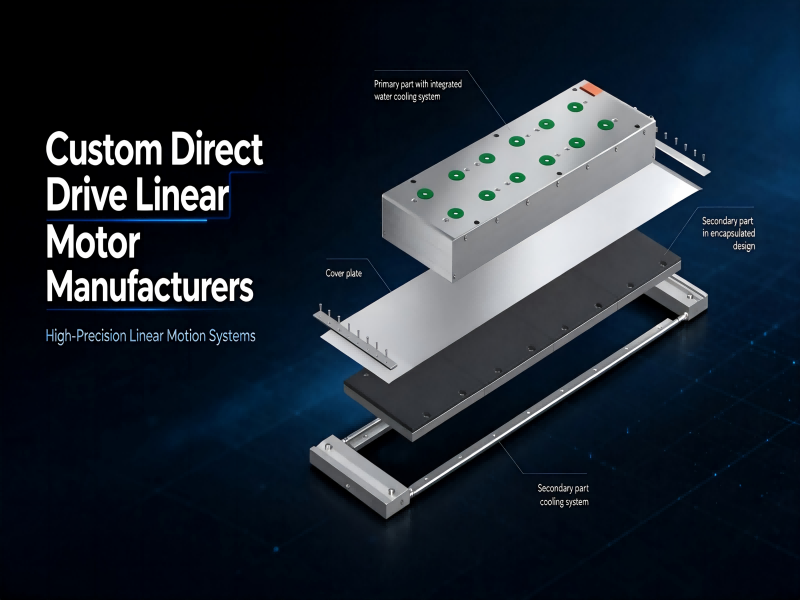
Evaluate a direct-drive linear motor solution
These recommendations are starting points rather than absolute rules. Final selection should consider the complete motion profile, load, travel, mounting conditions, positioning requirement
Frequently Asked Questions
1. What is the difference between a ball screw linear module and a belt drive linear module?
The main difference is the transmission mechanism. A ball screw linear module uses a rotating ball screw to convert rotary motion into linear movement, while a belt drive linear module uses a timing belt and pulleys.
Ball screw modules are generally preferred for high positioning accuracy, rigidity, and demanding load conditions. Belt drive modules are often better suited for high-speed movement and long travel distances.
2. Which is more accurate: a ball screw or a belt drive linear module?
A ball screw linear module generally offers higher positioning accuracy and repeatability, making it suitable for precision assembly, inspection equipment, and semiconductor manufacturing.
A belt drive linear module can also provide good positioning performance, but belt elasticity, tension, and load conditions may affect its accuracy. Always check the manufacturer’s specifications for actual positioning and repeatability values.
3. Is a belt drive linear module faster than a ball screw linear module?
In many applications, yes. Belt drive linear modules are well suited to high-speed movement, rapid pick-and-place operations, and long-distance material handling.
Ball screw modules can also achieve high speeds, but their maximum speed depends on screw lead, screw length, critical speed, and system design.
4. Which linear module is better for long stroke applications?
A belt drive linear module is often a practical choice for long-stroke applications because it can accommodate extended travel without the same screw critical-speed limitations associated with long ball screws.
For long-stroke, high-precision applications, compare the complete system’s rigidity, positioning accuracy, vibration, and speed requirements before selecting a solution.
5. Which linear module has a higher load capacity?
Ball screw linear modules are often preferred for applications requiring high thrust, rigidity, and precise positioning under load.
However, load capacity also depends on the guide rails, bearing arrangement, module structure, motor, and mounting orientation. A belt drive module may also handle substantial loads when properly designed and selected.
6. Which is more cost-effective: a ball screw or a belt drive linear module?
A belt drive linear module is often more cost-effective for high-speed, long-travel applications. A ball screw module may offer better overall value when high accuracy, rigidity, and controlled positioning are essential.
When comparing prices, consider not only the purchase cost but also installation, control requirements, maintenance, calibration, and potential production downtime.
7. How long does a ball screw or belt drive linear module last?
Service life depends on operating speed, load, acceleration, duty cycle, lubrication, alignment, environmental conditions, and maintenance.
Ball screw modules require appropriate lubrication and inspection of the screw and guide system. Belt drive modules require periodic checks of belt tension, wear, and alignment. Follow the manufacturer’s maintenance recommendations to help extend service life.
8. Which linear module is better for pick-and-place automation?
The best choice depends on the application.
Belt drive linear module: Often suitable for high-speed pick-and-place, packaging, conveyor transfer, and long-stroke handling.
Ball screw linear module: Often suitable for precision assembly, positioning, inspection, and applications requiring controlled movement under load.
For multi-axis systems, also consider payload, cycle time, repeatability, and the required motion profile.
9. Can a ball screw linear module be used for vertical installation?
Yes. Ball screw linear modules are commonly used in vertical positioning applications, but the system must be designed for the payload and gravitational force.
Check the required thrust, motor torque, braking requirements, and safety measures. Depending on the application, a brake motor or an additional load-holding mechanism may be necessary to prevent the load from falling when power is removed.
10. How do I choose the right linear module for my automation project?
Start by defining these key requirements:
Required positioning accuracy and repeatability
Payload and external forces
Travel length and target speed
Acceleration and cycle time
Horizontal or vertical mounting
Installation space and total project cost
As a general guideline, consider a ball screw linear module for precision and rigidity, and a belt drive linear module for high speed and long travel. For demanding applications, evaluate the complete motion system rather than choosing based on transmission type alone.
Need Help Selecting a Linear Module?
At HCY Automation, we support linear motion and industrial automation projects with component selection and application-based solutions.
Final Thoughts: Choose the Right Linear Module for Your Application
Both ball screw linear modules and belt drive linear modules have their own advantages. The right choice depends on your application’s positioning accuracy, speed, payload, travel length, and budget.
A ball screw linear module is often the preferred option for precision positioning and high rigidity, while a belt drive linear module is well suited for high-speed movement and long-stroke applications.
At HCY Automation, we help customers find practical linear motion solutions based on their actual operating requirements. We also support custom long-stroke linear modules for automation projects that require extended travel distances or specific installation configurations.
Looking for a suitable linear module for your next project? Contact HCY Automation to discuss your application requirements and explore a solution tailored to your needs.
HCY Automation delivers integrated solutions across motion control, linear motion, robotics, machine vision, pneumatic systems, and precision gearboxes to help global manufacturers build smarter, faster, and more reliable production lines. Our engineering team helps you select and integrate the right motion control, robotics, and automation components for your specific application.