Single-Axis Linear Module vs. Gantry System: Cost vs. Precision
Choosing between a single-axis linear module and a gantry linear motion system is not simply a matter of comparing prices. The right solution depends on payload, travel length, positioning accuracy, structural rigidity, and the total cost of integration.
For some automation projects, a standard single-axis linear module is more than enough. For others, especially those involving large work areas, long travel distances, or heavy and unevenly distributed loads, a gantry system can provide better mechanical stability and more consistent motion.
The challenge is knowing when the additional investment in a gantry system is justified—and when a simpler linear module can deliver the performance you need at a lower cost.
At HCY Automation, we believe linear motion selection should start with the application, not the product price tag.
1. What Is the Difference Between a Single-Axis Linear Module and a Gantry System?
Single-Axis Linear Module: A Compact and Cost-Effective Motion Solution
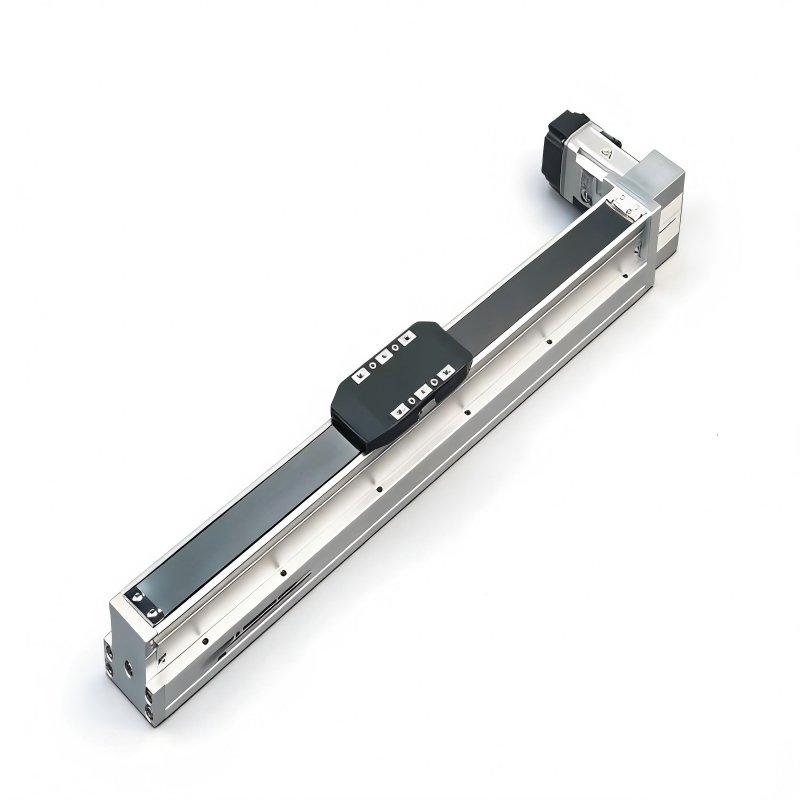
A single-axis linear module is an integrated linear motion unit typically consisting of a structural body, linear guide rails, a ball screw or belt drive, a moving carriage, and a motor or motor interface.
Depending on the design, it can provide accurate and repeatable linear positioning while simplifying mechanical integration.
Its main advantages include:
Lower initial cost: A standard module generally requires less mechanical hardware and fewer components.
Simpler installation: The integrated design reduces assembly and alignment work.
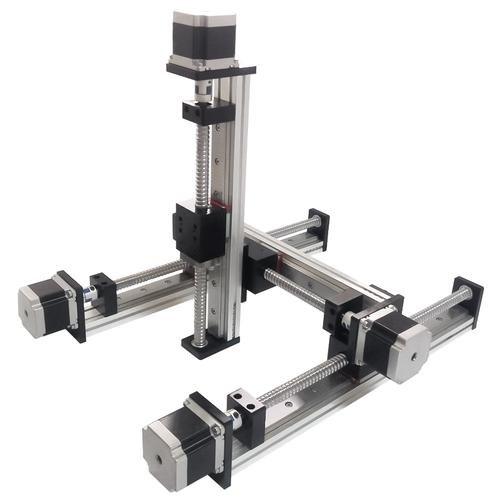
Flexible configuration: Multiple modules can be combined to create XY, XYZ, or other multi-axis motion systems.
Straightforward maintenance: Fewer mechanical and control components can make troubleshooting easier.
Single-axis linear modules are widely used in pick-and-place equipment, inspection machines, dispensing systems, packaging machinery, and automated assembly lines.
However, a single-axis module has practical limits. As travel length, payload, acceleration, or load offset increases, bending, deflection, and moment loads become more important. These factors must be checked against the module’s actual specifications.
Gantry Linear Motion System: Built for Larger Work Areas and Higher Structural Demands
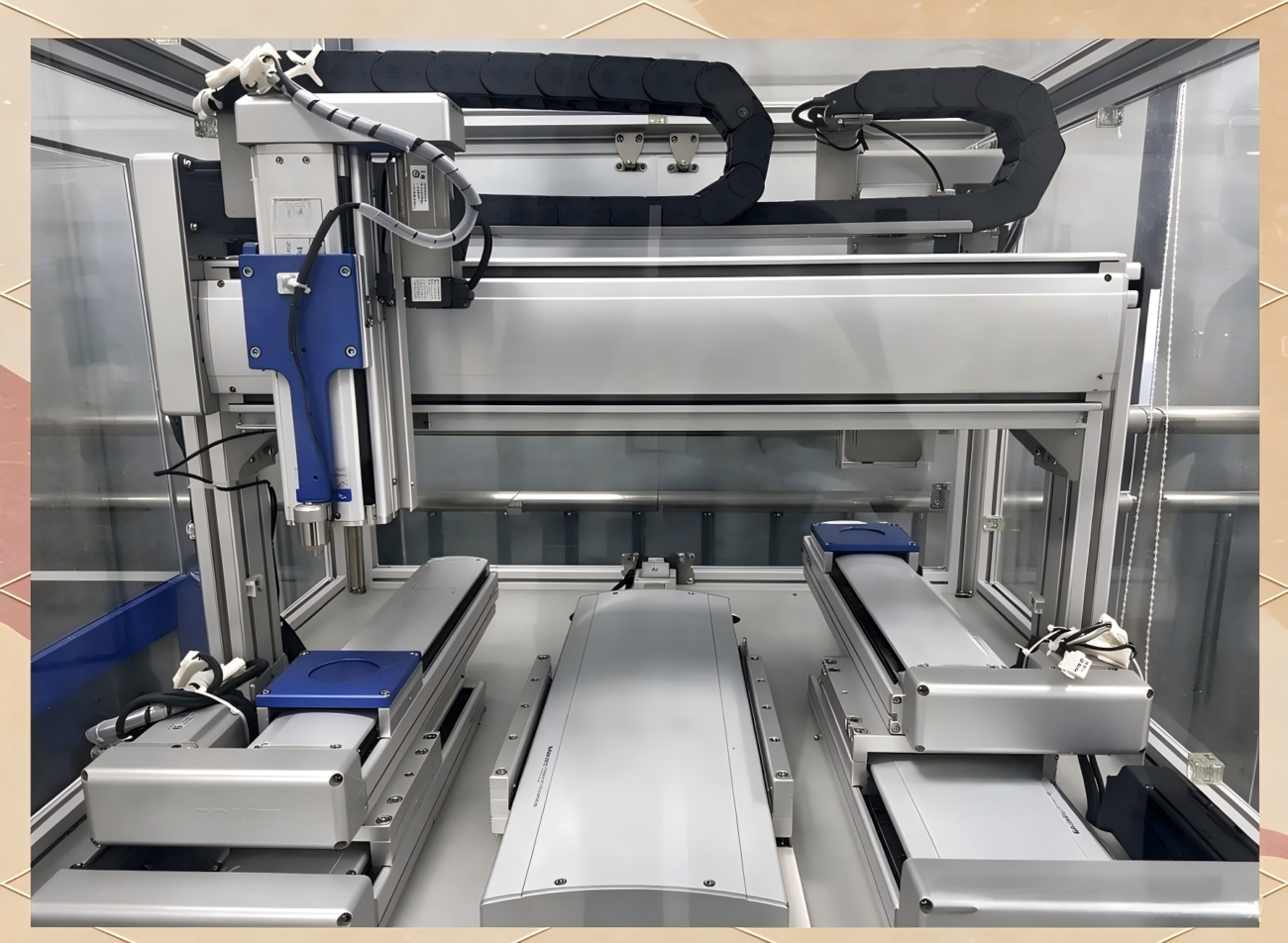
A gantry system typically uses two supporting sides connected by a crossbeam, with a moving axis mounted on the beam. Depending on the application, the system may use a single drive, dual synchronized drives, or a more complex multi-axis configuration.
Unlike a simple single-axis module, a gantry system is designed around the interaction between multiple structural and motion components.
Its main advantages include:
Better support across a wide working area: The two-sided structure can reduce unsupported spans and distribute loads across the machine frame.
Greater potential for structural rigidity: A properly designed gantry can better manage large work envelopes and demanding load conditions.
Flexible multi-axis integration: Additional linear or rotary axes can be incorporated when the application requires more complex motion.
Suitability for long-travel applications: The structure can be engineered for larger processing areas and longer travel distances.
Gantry systems are commonly considered for large-format laser processing, machine vision inspection, semiconductor equipment, photovoltaic manufacturing, battery production lines, and automated material handling.
However, a gantry is not automatically more accurate than a single-axis module. Its actual performance depends on beam stiffness, guide alignment, drive configuration, servo tuning, feedback devices, and installation quality.
2. Single-Axis vs. Gantry System: Key Differences at a Glance
Comparison Factor
Single-Axis Linear Module
Gantry Linear Motion System
Initial equipment cost
Generally lower
Generally higher
Mechanical structure
Compact, integrated axis
Crossbeam and supporting structure
Installation
Usually simpler
Requires more alignment and commissioning
Travel range
Depends on module design
Can be engineered for large work areas
Payload capacity
Depends on size, drive, and guide configuration
Can support larger loads when properly engineered
Resistance to overturning moments
Limited by guide spacing and module design
Can distribute loads across multiple supports
Multi-axis integration
Requires additional modules and mounting
Often designed as an integrated multi-axis system
Control complexity
Relatively simple for one axis
Higher when multiple axes require synchronization
Maintenance
Typically fewer components
More components and alignment points to inspect
Best suited for
Compact machines and standard positioning tasks
Large work areas, demanding loads, and coordinated motion
Important: These are general design tendencies, not guaranteed performance specifications. A heavy-duty single-axis module may outperform an undersized gantry in a particular application. Compare actual load ratings, deflection, accuracy, and duty-cycle data before making a decision.
3. Which System Delivers Better Positioning Accuracy?
This is where many linear motion selection decisions become complicated.
A product’s catalog accuracy does not necessarily equal the positioning accuracy of the complete machine. Mechanical installation, mounting surface flatness, guide parallelism, thermal changes, and motion-control tuning all affect the final result.
Single-axis linear module: Accuracy with fewer variables
A well-selected single-axis module can deliver excellent positioning and repeatability for inspection, dispensing, assembly, and other precision automation tasks.
Because the mechanical structure is relatively simple, installation and commissioning are often more straightforward. There are fewer interacting axes to synchronize, which can reduce the number of potential error sources.
For short or moderate travel distances and manageable loads, a single-axis solution may achieve the required accuracy without the added complexity of a gantry system.
Gantry system: Stability depends on the complete structure
A gantry system can offer excellent motion stability over a large working area, but its accuracy depends on more than the specifications of the individual linear axes.
Several factors deserve particular attention:
Crossbeam deflection: A long beam may bend under its own weight or the moving payload.
Squareness and parallelism: The two supporting sides and their guide rails must be aligned correctly.
Dual-drive synchronization: When two motors drive the same crossbeam, their motion must remain coordinated to prevent racking.
Thermal deformation: Temperature differences can change the geometry of a large mechanical structure.
Servo response and feedback: Encoder resolution, control-loop tuning, and feedback architecture affect actual positioning performance.
For this reason, a gantry system may require more commissioning work than a single-axis module, even when both use high-quality motion components.
What does ±0.02 mm positioning accuracy mean?
A specification such as ±0.02 mm may be achievable in a particular system, but it should never be treated as a universal accuracy rating for all gantry modules.
Before comparing quotations, clarify whether the stated figure refers to absolute positioning accuracy, bidirectional positioning accuracy, or repeatability. Also confirm the measurement range, test conditions, payload, and temperature.
For high-precision applications, request measured performance data under conditions representative of the intended machine.
4. Why Does a Gantry System Cost More?
The initial price difference between a single-axis linear module and a gantry system is only part of the cost comparison.
A gantry may require additional structural components, more extensive mechanical alignment, synchronized motion control, and more commissioning time.
The real cost becomes clearer when the complete project is considered.
1. Mechanical and structural costs
A single-axis module may be supplied as a largely integrated unit. A gantry system can require two supporting axes, a crossbeam, connecting plates, a rigid machine base, additional guide rails, and mounting hardware.
The longer the travel and the heavier the payload, the more important structural stiffness and deflection calculations become.
A single-axis system is relatively straightforward to control. A dual-drive gantry may require coordinated servo control, homing procedures, squaring routines, and fault handling.
If the two sides lose synchronization, the crossbeam can become misaligned or experience excessive mechanical stress.
The control architecture should therefore be selected together with the mechanical design—not added as an afterthought.
3. Installation and calibration
A single-axis module usually involves fewer alignment steps.
A gantry system may require careful adjustment of rail parallelism, beam squareness, axis synchronization, and the relationship between the motion system and the machine base.
These steps can increase commissioning time and labor costs, especially in applications with demanding accuracy requirements.
4. Maintenance and production downtime
More components do not automatically mean more failures, but a more complex system creates additional inspection and maintenance requirements.
For a gantry, maintenance planning may include checking drive synchronization, guide lubrication, fasteners, cable carriers, and mechanical alignment.
The relevant question is not simply how much the system costs to maintain. It is how maintenance affects machine availability and production output.
5. Single Drive vs. Dual Drive: Is Dual Drive Always Necessary?
Not every gantry requires dual-drive synchronization, and not every high-precision application needs a dual-drive system.
The correct configuration depends on the mechanical design and the operating conditions.
When a single-drive configuration may be sufficient
A single drive may be appropriate when:
The crossbeam is relatively short and sufficiently rigid.
The payload and its center of gravity are within the design limits.
Acceleration and deceleration requirements are moderate.
The guide and transmission arrangement can handle the expected moments.
The required positioning performance can be achieved without independent drive synchronization.
This approach can reduce hardware and control-system costs.
When dual drive deserves serious consideration
A dual-drive configuration may be more suitable when:
The gantry has a wide span or a long crossbeam.
The moving payload is heavy or significantly offset from the center.
High acceleration or frequent direction changes create demanding dynamic loads.
The application requires coordinated movement across a large work area.
The structural design and control architecture benefit from independently driven sides.
Dual drive is not a substitute for adequate beam stiffness or correct rail alignment. It must be combined with an appropriate synchronization strategy and commissioning procedure.
For some precision applications, a hybrid configuration makes more sense: dual drives on the main gantry axis and a single drive on the vertical Z-axis. This balances structural requirements with cost and control complexity.
6. How to Choose the Right System for Your Application
The most practical way to compare linear motion solutions is to work backward from the machine’s actual requirements.
Choose a single-axis linear module when:
The machine has a compact working area.
The payload and center of gravity are within the module’s rated limits.
Standard positioning accuracy is sufficient.
Installation time and initial budget are important.
The application involves straightforward linear movement or a modular XY/XYZ arrangement.
Typical applications include small-part assembly, automated inspection, dispensing, labeling, and pick-and-place systems.
Consider a gantry linear motion system when:
The machine needs a large working envelope.
The crossbeam must span a wide distance.
The payload or dynamic loads create demanding structural requirements.
Coordinated multi-axis motion is central to the process.
The cost of deflection, misalignment, or inconsistent motion would be significant.
Typical applications include large-format laser cutting, photovoltaic panel processing, battery manufacturing, large-area vision inspection, and heavy material handling.
For semiconductor and medical equipment, neither architecture should be selected by industry name alone. The required accuracy, cleanliness, vibration limits, payload, and process tolerances should determine the design.
7. The Hidden Cost of Choosing the Wrong Linear Motion System
A low initial purchase price can become expensive if the selected system cannot maintain the required performance after installation.
For example, a single-axis module may appear to be the economical choice for a long-span application. If the structure deflects under load, additional reinforcement or redesign may be necessary.
On the other hand, specifying a dual-drive gantry for a compact, lightweight inspection machine may introduce unnecessary control complexity, calibration work, and cost.
Before finalizing the design, evaluate the following:
Payload, including tooling, workpieces, cables, and accessories.
Center of gravity and overturning moments.
Travel distance, speed, acceleration, and duty cycle.
Required positioning accuracy and repeatability.
Beam deflection and machine-frame stiffness.
Motor torque, reflected inertia, and servo response.
Installation conditions, contamination, and temperature changes.
Maintenance access and expected production uptime.
For a fair comparison, evaluate the total cost of ownership (TCO), not only the quoted component price.
The exact cost structure varies by machine, but including these factors helps prevent a low-cost component choice from creating a high-cost integration problem.
8. What Should You Ask a Linear Motion Supplier Before Ordering?
Whether you are purchasing a single-axis module or a complete gantry system, ask for information that connects catalog specifications to actual operating conditions.
What are the rated payload and allowable moment loads?
What positioning accuracy and repeatability can be achieved over the required travel?
What is the expected deflection under the actual payload?
Does the application require a single drive or dual synchronized drives?
What servo, encoder, and motion-control configuration is recommended?
What mounting-surface tolerances and alignment procedures are required?
Are installation drawings, load calculations, and commissioning guidelines available?
What maintenance intervals and environmental limitations should be considered?
A supplier should be able to explain not only what the system can do, but also the conditions under which its performance specifications apply.
Frequently Asked Questions
Is a gantry system more accurate than a single-axis linear module?
Not necessarily. A gantry can provide better structural support across a large work area, but actual accuracy depends on beam stiffness, rail alignment, drive synchronization, feedback, and installation quality. A properly selected single-axis module may be more than adequate for a precision application.
Is a gantry system always more expensive?
Generally, a gantry requires more structural and integration work than a comparable single-axis module. However, for a large work area, comparing a gantry with several interconnected single-axis modules may produce a different result. Evaluate the complete installed system.
Can single-axis linear modules be combined to create a gantry?
Yes. Multiple linear modules can be integrated into a gantry configuration. However, the supporting frame, beam stiffness, guide alignment, drive synchronization, and control architecture must be designed for the complete system. Simply connecting two modules does not guarantee a properly engineered gantry.
When is dual-drive synchronization necessary?
Dual drive is worth considering for wide gantries, demanding dynamic loads, long crossbeams, or applications where racking must be controlled. The decision should be based on mechanical calculations and motion requirements rather than a general assumption that two motors always deliver better accuracy.
Which system is better for high-speed automation?
It depends on the payload, travel, acceleration, structural stiffness, and transmission type. A belt-driven single-axis module may be suitable for high-speed, lightweight handling, while a properly engineered gantry may be better for high-speed movement across a large working area. Compare the complete system’s dynamic performance rather than motor speed alone.
How do I compare positioning accuracy between suppliers?
Confirm whether the specification refers to absolute positioning accuracy or repeatability. Request the measurement method, travel range, payload, test conditions, and relevant calibration data. Compare specifications defined under equivalent conditions.
Final Thoughts: Choose for Performance, Not Just Price
A single-axis linear module is often the practical choice for compact machines, standard positioning tasks, and cost-sensitive automation projects.
A gantry linear motion system becomes more attractive when the application demands a large working area, greater structural support, or coordinated movement under challenging loads.
Neither solution is universally better. The right choice is the one that meets the machine’s performance requirements without adding unnecessary hardware, integration work, or maintenance costs.
At HCY Automation, we approach linear motion selection from the perspective of the complete application—mechanical structure, drive configuration, control system, installation, and long-term operation.
Planning a new automation project? Share your travel distance, payload, speed, and positioning requirements. These details provide a practical starting point for evaluating a single-axis linear module or a customized gantry motion solution.
HCY Automation delivers integrated solutions across motion control, linear motion, robotics, machine vision, pneumatic systems, and precision gearboxes to help global manufacturers build smarter, faster, and more reliable production lines. Our engineering team helps you select and integrate the right motion control, robotics, and automation components for your specific application.