Iron-Core vs. Coreless Linear Motor Modules: Pros, Cons, and Applications
Compare iron-core vs. coreless linear motor modules, including thrust, cogging force, precision, heat dissipation, cost, and industrial applications. Find the right solution for your automation system. Choosing between an iron-core and a coreless linear motor module is not just a question of motor design. It directly affects thrust, motion smoothness, acceleration, thermal performance, installation, and the overall cost of an automation system.
Both types are widely used in industrial automation, precision positioning, semiconductor equipment, electronics manufacturing, and high-speed motion systems. However, they are designed to solve different motion-control challenges.
An iron-core linear motor is often preferred when high thrust and force density are priorities. A coreless linear motor, on the other hand, is particularly attractive for applications requiring smooth motion, low cogging force, and fast dynamic response.
So, which type is better for your automation project?
The answer depends on your payload, positioning requirements, duty cycle, available installation space, and operating conditions. Let’s break down the key differences to help you make a more informed decision.
1. What Is an Iron-Core Linear Motor?
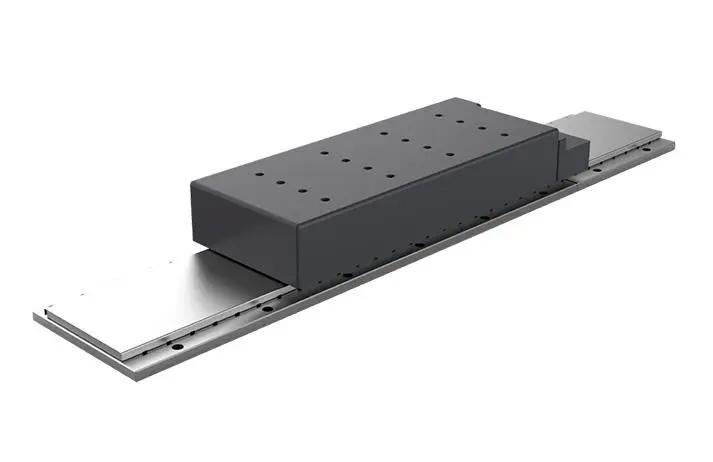
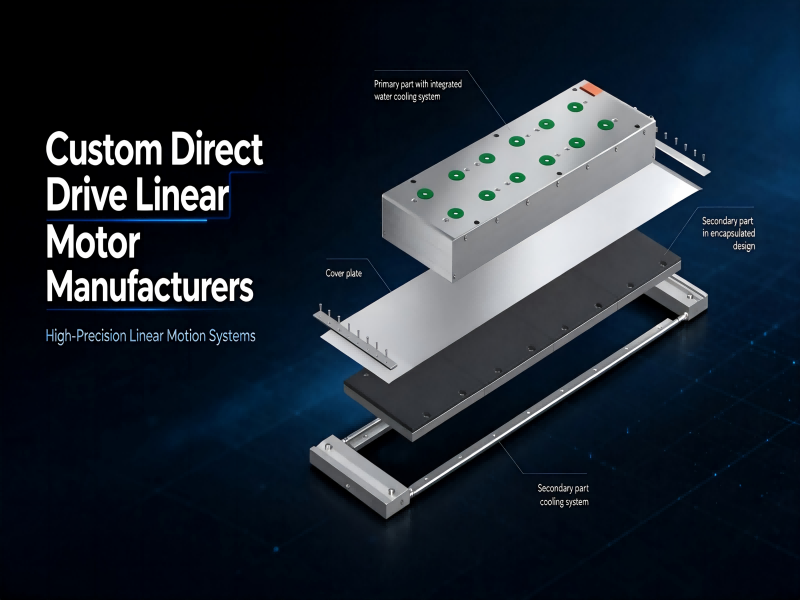
An iron-core linear motor uses a coil winding assembled around a laminated iron core. The iron core provides a magnetic path that helps concentrate magnetic flux and generate electromagnetic thrust.
In a typical flat iron-core linear motor, the coil assembly moves along a track of permanent magnets. Depending on the design, the motor may use natural cooling or liquid cooling to manage heat during continuous operation.
The iron core improves force production within a compact motor structure, making this design suitable for applications where substantial thrust is required.
Advantages of Iron-Core Linear Motors
1. High thrust and force density
The iron core helps concentrate magnetic flux, allowing the motor to produce relatively high thrust within a compact space. This is useful for moving heavier payloads or overcoming higher process forces.
2. Efficient use of installation space
When a machine requires substantial thrust without increasing the overall motor size significantly, an iron-core linear motor can be an effective solution.
3. Flexible thermal management
Iron-core motors can be designed with natural or liquid cooling. For demanding applications with high continuous thrust, a properly engineered cooling system helps maintain winding temperatures within acceptable limits.
4. Competitive cost for high-thrust applications
Many iron-core designs use a single-sided permanent-magnet track, which can reduce magnet-related costs compared with certain double-sided coreless configurations. Actual system cost depends on the motor design, cooling requirements, and mechanical structure.
Disadvantages of Iron-Core Linear Motors
1. Cogging force can affect motion smoothness
The interaction between the iron teeth and the permanent-magnet array can create cogging force. This may cause thrust ripple, low-speed velocity variation, or vibration, particularly in applications requiring exceptionally smooth motion.
Motor design, current control, and motion tuning can reduce these effects, but the results depend on the specific system.
2. Magnetic attraction requires careful installation
The iron core is attracted to the permanent magnets. This magnetic force can be substantial, even when the motor is not producing commanded thrust.
The machine structure, mounting hardware, air gap, and installation procedure must therefore be designed to withstand the magnetic attraction safely. Incorrect installation can damage components or create a safety hazard.
3. Thermal performance must be evaluated under real operating conditions
Like all electric motors, iron-core linear motors generate winding heat. The iron core also introduces additional magnetic losses, including hysteresis and eddy-current losses.
At high speeds or during demanding duty cycles, these losses and the resulting temperature rise must be considered when selecting the motor and cooling method.
Typical Applications of Iron-Core Linear Motor Modules
Iron-core linear motors are commonly considered for:
Heavy-duty precision positioning systems
Battery manufacturing and material handling
Large-panel and industrial equipment positioning
Machine tools and high-thrust feed systems
Automation lines requiring high continuous thrust
Long-travel motion systems with substantial payloads
They are particularly suitable when the machine needs strong thrust and stable movement under load, and when the application can accommodate the motor’s magnetic attraction and cogging characteristics.
2. What Is a Coreless Linear Motor?
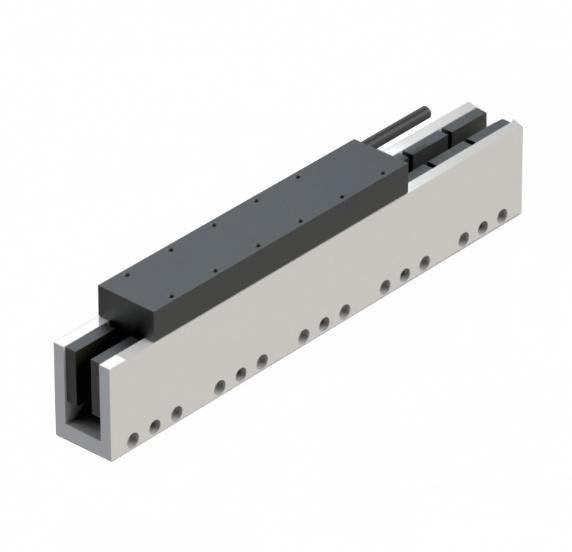
A coreless linear motor uses a coil assembly without an iron core. In a common U-channel configuration, the coil assembly moves between two rows of permanent magnets.
Because the moving coil has no iron core, the motor avoids the conventional iron-to-magnet attraction and tooth-related cogging force associated with iron-core designs.
This arrangement can deliver smooth, consistent motion and a lightweight moving assembly, making coreless linear motors attractive for precision applications with frequent acceleration and deceleration.
Coreless motors are available in different configurations, including U-channel designs and other arrangements tailored to specific thrust, size, and thermal requirements.
Advantages of Coreless Linear Motors
1. No conventional cogging force
Without iron teeth interacting with the permanent magnets, a coreless linear motor avoids conventional cogging force. This helps produce smoother motion, especially at low speeds or during delicate positioning tasks.
It is an important advantage for precision inspection, optical equipment, and applications sensitive to vibration or force ripple.
2. Low moving mass and fast dynamic response
The absence of an iron core reduces the mass of the moving coil assembly. Depending on the complete mechanical design, this can improve acceleration and deceleration performance.
For machines that repeatedly move between closely spaced positions, a lighter moving assembly can help shorten cycle times.
3. No iron-core magnetic attraction
A conventional coreless motor has no iron-core attraction between the moving coil and the permanent-magnet track. This simplifies magnetic-gap alignment and avoids the substantial normal attraction associated with iron-core designs.
However, the motor still requires accurate mechanical alignment, adequate structural stiffness, and proper control of the air gap.
4. Smooth motion for precision applications
The absence of conventional cogging force helps the control system achieve smooth velocity regulation and precise positioning.
Actual positioning accuracy and repeatability still depend on the encoder or linear scale, servo drive, feedback resolution, mechanical structure, tuning, and environmental conditions.
Disadvantages of Coreless Linear Motors
1. Thrust density may be lower in comparable designs
Without an iron core to concentrate magnetic flux, a coreless motor may require a larger active structure to produce the same thrust as a comparable iron-core motor.
This is not an absolute rule for every product, but it is an important consideration when selecting a motor for heavy loads or high process forces.
2. Double-sided magnet arrangements can increase cost
Many U-channel coreless motors use permanent magnets on both sides of the moving coil. The additional magnets and supporting structure can increase component and manufacturing costs.
The final price depends on the motor configuration, travel length, required thrust, cooling, and feedback components.
3. Coil temperature still needs attention
Removing the iron core eliminates iron-core losses, but it does not eliminate copper losses in the winding.
At high current or during continuous high-duty operation, the coil can still generate considerable heat. Thermal calculations, temperature monitoring, and appropriate cooling are essential when operating near the motor’s limits.
Typical Applications of Coreless Linear Motor Modules
Coreless linear motors are often considered for:
Semiconductor inspection and precision positioning
Electronics assembly and micro-component handling
Optical inspection and measurement equipment
Laser processing and precision scanning
Laboratory and scientific instruments
Medical equipment requiring smooth positioning
High-acceleration automation systems
Applications where low cogging force is a priority
They are particularly attractive when smooth motion, low force ripple, and dynamic response are more important than achieving the highest possible thrust within the smallest footprint.
3. Iron-Core vs. Coreless Linear Motor Modules: Key Differences
The following comparison highlights the main design trade-offs. Actual performance varies by motor model and system configuration, so product specifications should always be checked before selection.
Comparison
Iron-Core Linear Motor
Coreless Linear Motor
Coil structure
Winding assembled around an iron core
Winding without an iron core
Thrust capability
Generally favorable for high thrust density
Depends on winding and magnetic design; may be lower in comparable configurations
Cogging force
Present to varying degrees
No conventional iron-to-magnet cogging force
Magnetic attraction
Substantial attraction may exist
No conventional iron-core attraction
Moving mass
Generally higher for the coil assembly
Generally lower for the coil assembly
Acceleration potential
Strong, depending on payload and design
Often attractive for high dynamic response
Motion smoothness
May require cogging-force compensation
Naturally avoids conventional cogging force
Thermal considerations
Winding heat plus iron-core magnetic losses
Winding heat remains; no iron-core losses
Cooling options
Natural or liquid cooling, depending on design
Depends on coil construction and system design
Magnet arrangement
Often single-sided
Often double-sided in U-channel designs
Cost considerations
Often competitive for high-thrust applications
Magnet and manufacturing costs may be higher
Typical priorities
High thrust and force density
Smooth motion and low force ripple
One important distinction: a coreless motor is not automatically more accurate than an iron-core motor. Coreless designs have an inherent advantage in avoiding conventional cogging force, but final positioning performance depends on the complete motion system.
Similarly, an iron-core motor is not inherently unsuitable for precision applications. With appropriate motor design, feedback, and control, it can meet demanding positioning requirements.
4. How to Choose the Right Linear Motor for Your Application
The best way to select a linear motor is to start with the actual machine requirements rather than choosing based on motor type alone.
Choose an Iron-Core Linear Motor When:
Your application requires relatively high thrust within a limited installation space.
The payload or process force is substantial.
The machine operates under demanding continuous-load conditions.
The project benefits from a compact, high-force motor configuration.
The required motion smoothness can be achieved with the selected motor and control system.
Typical examples include high-thrust feed axes, battery manufacturing equipment, industrial material handling, and large automation platforms.
Choose a Coreless Linear Motor When:
Smooth, low-cogging motion is a major requirement.
The application involves precision inspection or measurement.
The moving assembly needs a low mass for rapid acceleration.
The machine performs frequent short-distance positioning moves.
Force ripple or vibration could affect product quality or measurement results.
Typical examples include semiconductor inspection, optical systems, precision assembly, and high-speed positioning equipment.
What If Your Application Requires Both High Thrust and High Precision?
In this case, the decision becomes more complex.
Rather than assuming one motor type can meet every requirement, evaluate the actual thrust demand, acceleration profile, payload inertia, travel distance, positioning tolerance, and thermal limits.
A properly engineered iron-core motor may be suitable when high thrust is essential and force ripple can be controlled adequately. A coreless motor may be preferable when motion smoothness is critical and the required thrust can be achieved within the available space and thermal limits.
For demanding applications, it is also worth comparing the complete linear motor module rather than the motor alone. Guide rails, bearings, encoder selection, structural rigidity, servo drive, and control tuning all influence final performance.
5. Five Factors to Check Before Selecting a Linear Motor Module
1. Required Thrust and Payload
Calculate the force needed to accelerate the payload and overcome friction, gravity, and external process forces.
For vertical axes, include gravity and consider the requirements for holding the load safely when power is removed. Do not size the motor based on payload weight alone.
2. Speed, Acceleration, and Cycle Time
Maximum speed is only one part of motion performance. Acceleration, deceleration, travel distance, settling time, and cycle frequency determine how the motor behaves in a real production process.
A lightweight coreless motor may offer an advantage in dynamic response, but the complete moving mass and required thrust must still be considered.
3. Positioning Accuracy and Motion Smoothness
Clarify whether the application requires absolute positioning accuracy, repeatability, low-speed smoothness, or minimal vibration.
These are different performance requirements. A suitable feedback device and properly tuned motion controller are essential, regardless of motor type.
A motor that performs well during short moves may require additional cooling when operating continuously. Always compare continuous and peak ratings under the manufacturer’s specified conditions.
5. Total System Cost
The purchase price is only one part of the overall cost.
Consider the motor, magnetic track, guide system, encoder, servo drive, cooling equipment, mechanical structure, installation, commissioning, and maintenance.
For some applications, an iron-core motor may offer better value through higher thrust density. For others, a coreless design may justify its cost through smoother motion or better dynamic performance.
6. Common Misconceptions About Iron-Core and Coreless Linear Motors
Misconception 1: Coreless linear motors are always more accurate.
Not necessarily. Coreless motors avoid conventional cogging force, which helps with smooth motion. However, positioning accuracy also depends on feedback resolution, mechanical stiffness, calibration, thermal stability, and control tuning.
Misconception 2: Iron-core linear motors are only suitable for heavy-duty applications.
Iron-core motors can also be used in precision automation. Their suitability depends on the required accuracy, force ripple, motion profile, and system design.
Misconception 3: Coreless linear motors do not generate heat.
Coreless motors still generate copper losses in their windings. Thermal management remains important, especially during continuous operation or high-acceleration cycles.
Misconception 4: A higher peak thrust rating always means better performance.
Peak thrust is typically available only for a limited duration. Continuous thrust, RMS force, temperature limits, and the actual motion profile are equally important when sizing a motor for production equipment.
Misconception 5: The motor alone determines the performance of a linear motor module.
The motor is only one part of the system. Guideways, encoder feedback, structural design, servo control, installation accuracy, and tuning all contribute to the final result.
7. HCY Automation: Linear Motor Modules for Industrial Motion Systems
At HCY Automation, we focus on linear motion solutions for industrial automation, precision positioning, and high-speed production equipment.
Our linear motion solutions can be configured around different application requirements, including long travel, high speed, high precision, substantial thrust, and smooth motion. Single-axis and multi-axis configurations can be evaluated according to the machine structure, payload, travel range, and motion profile.
Applications may include:
Semiconductor and electronics manufacturing
New energy and battery production equipment
Display panel manufacturing
Precision machining and inspection
Laser processing systems
Industrial automation and material handling
Packaging and high-speed positioning equipment
Selecting the right linear motor module starts with understanding the operating conditions. Instead of choosing a motor based on a single specification, consider the complete motion system and how it will perform under actual production loads.
If you are evaluating an iron-core or coreless linear motor module, HCY Automation can help assess your application requirements and identify a suitable motion solution.
Frequently Asked Questions
Q1. What is the main difference between iron-core and coreless linear motors?
The main difference is the construction of the moving coil. An iron-core motor uses windings around an iron core to help concentrate magnetic flux and generate high thrust. A coreless motor uses windings without an iron core, avoiding conventional cogging force and iron-core magnetic attraction.
Q2. Which linear motor is better for high-precision applications?
Coreless linear motors are often preferred when low cogging force and smooth motion are critical. However, both types can support precision applications when the motor, encoder, mechanical structure, and control system are appropriately selected.
Q3. Which linear motor produces more thrust?
Iron-core linear motors generally offer an advantage in thrust density in comparable designs. Actual thrust depends on motor dimensions, current, cooling, magnetic configuration, and the manufacturer’s continuous and peak ratings.
Q4. Are coreless linear motors suitable for semiconductor equipment?
Yes. Coreless linear motors are commonly considered for semiconductor inspection, precision positioning, and other applications where low force ripple and smooth movement are important. Final selection depends on payload, accuracy, cleanliness requirements, and thermal performance.
Q5. Do iron-core linear motors have cogging force?
Yes. The interaction between the iron teeth and permanent magnets can produce cogging force. Its magnitude varies by design, and suitable motor construction and control methods can help reduce its effect.
Q6. Are coreless linear motors more expensive?
They can be more expensive in some configurations, particularly when double-sided permanent magnets are used. However, pricing depends on thrust, travel length, cooling, feedback devices, and the complete module configuration.
Q7. Can an iron-core linear motor be used in a high-speed automation system?
Yes. Iron-core linear motors can support high-speed motion when properly sized and controlled. Acceleration, moving mass, force ripple, thermal limits, and mechanical rigidity should all be evaluated.
Conclusion: Match the Motor to the Motion Requirement
Iron-core and coreless linear motor modules each have clear strengths.
Iron-core designs are often a practical choice for applications requiring high thrust density and compact force generation. Coreless designs are particularly attractive when smooth motion, low cogging force, and fast dynamic response are priorities.
Neither design is universally better. The right choice depends on the balance between thrust, payload, acceleration, positioning requirements, heat dissipation, installation constraints, and total system cost.
For industrial automation projects, selecting the right linear motor module means looking beyond a single performance number and evaluating the complete motion system.
Need help selecting a linear motor module? Contact HCY Automation to discuss your payload, travel distance, speed, acceleration, and positioning requirements.
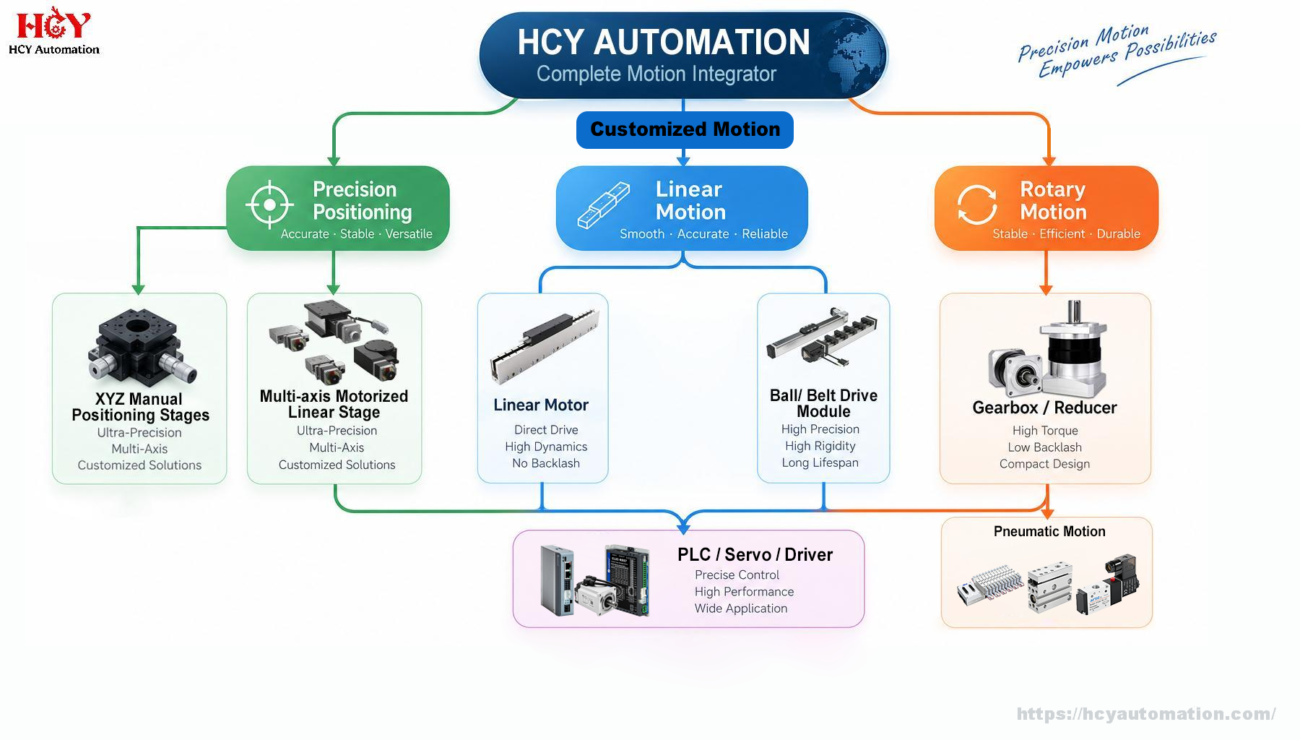
HCY Automation delivers integrated solutions across motion control, linear motion, robotics, machine vision, pneumatic systems, and precision gearboxes to help global manufacturers build smarter, faster, and more reliable production lines. Our engineering team helps you select and integrate the right motion control, robotics, and automation components for your specific application.