Stepper vs. Servo Linear Module: Which Is Better for Your Automation Project?
Choosing a motor for a linear module is not simply a matter of comparing price, speed, or positioning accuracy. The right choice depends on how the axis moves, how much load it carries, how quickly it needs to accelerate, and how precisely it must position a workpiece.
For some automation equipment, a stepper motor provides all the performance needed without adding unnecessary cost. For other applications, a servo motor is the better fit because of its dynamic response, feedback control, and ability to handle demanding motion profiles.
So, how do you decide between a stepper and a servo linear module?
The most practical approach is to start with the machine requirements, then match the motor and transmission system to the actual working conditions.
In this guide, HCY Automation explains the key selection parameters, common application scenarios, and cost considerations that help engineers choose the right linear motion solution.
1. Stepper vs. Servo Linear Module: Understand the Basic Difference
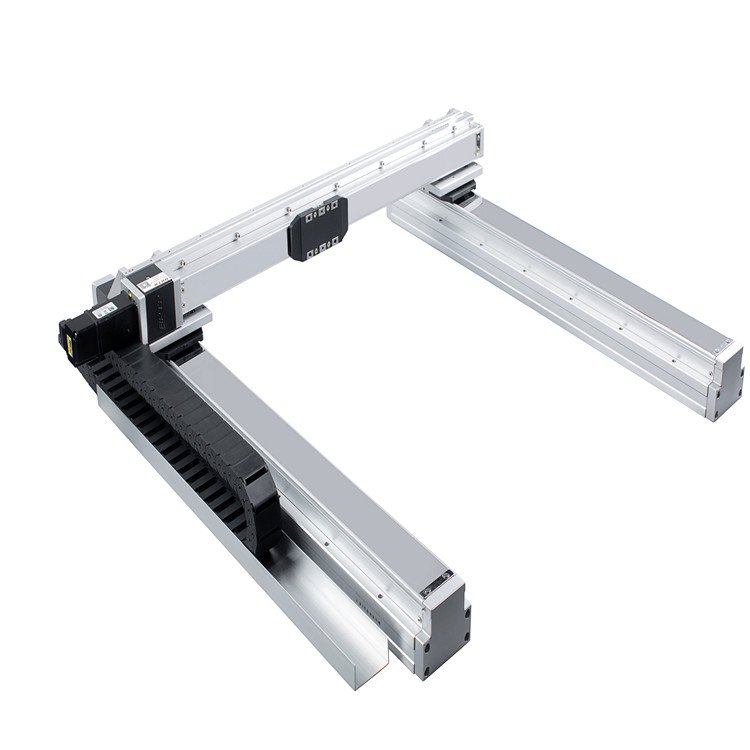
A linear module is commonly used to move components, workpieces, tools, or fixtures along a controlled linear axis. Depending on the design, the module may use a ball screw, timing belt, or another transmission mechanism.
When a rotary motor drives the module, the motor type affects the available torque, acceleration, positioning control, and operating-speed range.
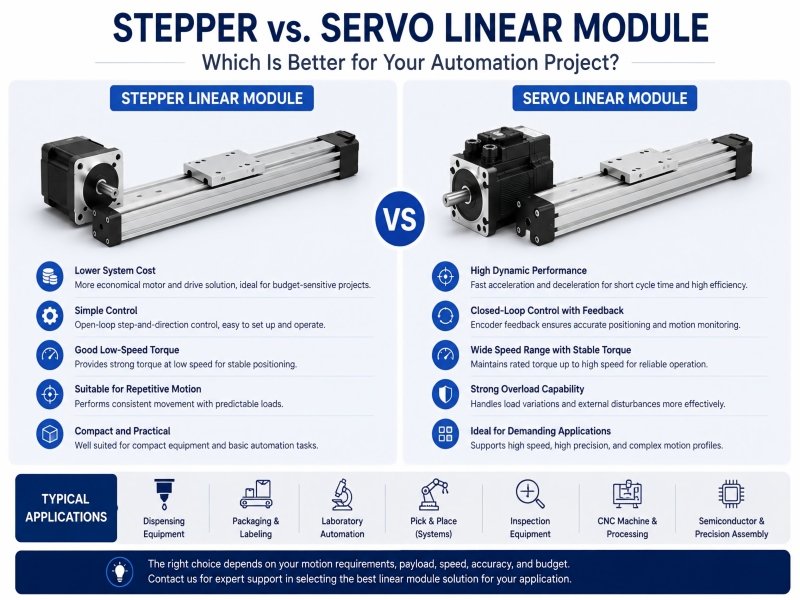
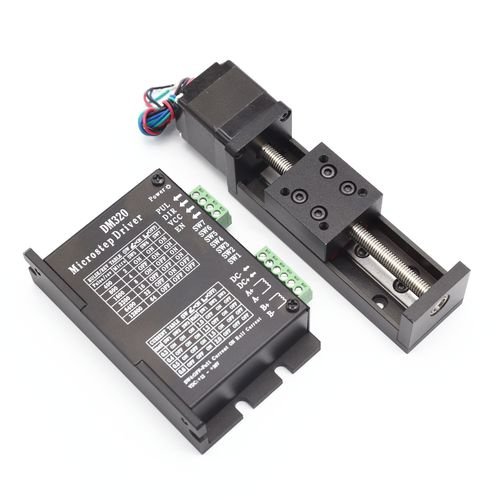
Stepper Motor Linear Module
A stepper motor moves in discrete angular increments in response to electrical command pulses. In a conventional open-loop configuration, the controller commands movement without continuously checking the motor’s actual position.
This straightforward control method makes stepper motors attractive for applications with predictable loads and moderate motion requirements.
A stepper-driven linear module is worth considering when:
The payload remains relatively consistent.
The motion profile does not require extreme acceleration.
Positioning requirements can be met by the selected mechanical system.
The project needs a cost-effective motion axis.
The controller and drive configuration should remain relatively simple.
Stepper motors are frequently used in compact automation equipment, dispensing systems, laboratory instruments, and general-purpose positioning applications.
However, available torque decreases as motor speed increases. If the required torque exceeds the available torque, the motor may lose steps or stall. In a conventional open-loop system, the controller may not detect the resulting position error.
Servo Motor Linear Module
A servo motor typically operates with encoder feedback. The drive compares commanded motion with feedback from the motor and adjusts its output to reduce tracking errors.
This closed-loop control architecture is particularly useful when an application requires rapid acceleration, frequent changes in direction, or precise control of a demanding motion profile.
A servo-driven linear module is worth considering when:
The machine requires short cycle times.
Acceleration and deceleration are demanding.
Payloads or external forces vary.
Position feedback and motion-error monitoring are important.
The application requires coordinated motion or advanced motion profiles.
Servo systems generally require more attention to motor sizing, drive configuration, and tuning. Their higher initial cost can be justified when the application actually benefits from their performance.
The important point is that neither motor type is automatically the right choice for every linear module. The operating requirements determine which solution makes sense.
2. Five Parameters to Check Before Selecting a Linear Module Motor
Before comparing motor specifications, define the conditions the axis must handle. These five parameters provide a useful starting point.
1. Payload and Moving Mass
The payload is not always the total mass that the motor must move.
Include the workpiece, tooling, grippers, fixtures, mounting plates, and other components carried by the moving axis. For multi-axis equipment, also consider the mass of any additional modules mounted on the moving assembly.
A heavier moving mass requires more force to achieve the same acceleration.
A stepper motor may be suitable for a lightweight, predictable load. A servo motor may be more appropriate when the moving assembly is heavy, acceleration is high, or the load changes significantly during operation.
However, payload alone does not determine motor selection. A heavy load moving slowly may require less peak power than a lighter load that accelerates rapidly.
2. Stroke Length and Travel Speed
Stroke length determines how far the module must travel. Travel speed determines how quickly it covers that distance.
These parameters influence the choice of transmission mechanism as well as the motor.
For example:
A ball screw is often suitable for applications requiring controlled positioning and good mechanical stiffness.
A timing belt can be attractive for longer strokes and higher travel speeds.
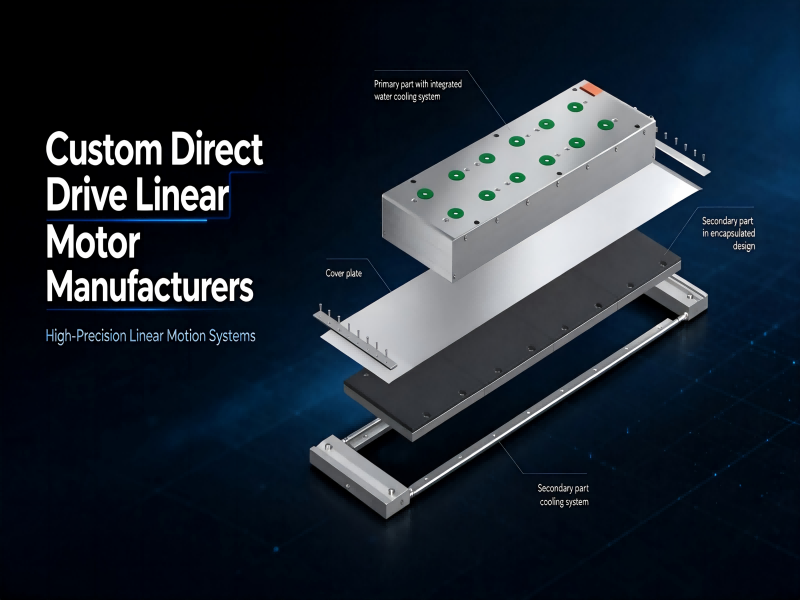
A direct-drive linear motor may be worth evaluating when the application requires demanding dynamic performance or avoids mechanical transmission components.
The actual suitability of each option depends on load, accuracy, mounting arrangement, and system design.
A short stroke does not necessarily mean a low-performance application. A module that repeatedly moves a short distance at high frequency may require substantial acceleration and deceleration capability.
Similarly, a long-stroke module may prioritize travel speed, transmission limits, and installation space over extremely fine positioning.
3. Acceleration and Cycle Time
Maximum travel speed does not tell the whole story.
In automated production equipment, the total cycle time may include acceleration, constant-speed travel, deceleration, settling, and the time required for loading or unloading.
Consider two linear modules with the same maximum speed. If one must repeatedly start and stop over a short distance, its acceleration and settling requirements may be much more demanding.
This is one reason servo motors are commonly selected for high-cycle pick-and-place equipment, precision assembly, and automated inspection systems.
Stepper motors can also handle repetitive motion, provided that the required acceleration remains within the available torque margin.
Practical tip: When requesting a quotation, provide the required cycle time and movement sequence rather than specifying maximum speed alone. This gives the supplier a better basis for evaluating the complete motion system.
4. Positioning Accuracy and Repeatability
Positioning accuracy and repeatability are related but different specifications.
Positioning accuracy describes how closely the axis reaches the commanded position. Repeatability describes how consistently it returns to the same position under defined conditions.
A servo motor’s encoder provides feedback about motor movement, but it does not automatically eliminate every source of error at the linear output.
The final result also depends on:
Transmission accuracy and backlash
Guide rail and mechanical assembly quality
Structural rigidity and load-induced deflection
Encoder resolution and control configuration
Thermal expansion and installation conditions
Stepper motors can provide satisfactory positioning performance in many applications, particularly when the load and motion profile are predictable.
Servo motors offer feedback-based motion control and are often preferable when tracking errors must be monitored or when dynamic conditions make open-loop control less suitable.
If your equipment requires ±0.01 mm repeatability, ask for the complete module’s measured performance under representative operating conditions. Do not assume that motor resolution alone guarantees this result.
5. Mounting Orientation and Mechanical Constraints
The same motor and linear module can behave differently depending on how the equipment is installed.
A horizontal axis primarily needs to overcome inertia, friction, and other operating forces. A vertical axis must also account for gravity and the possibility of the load moving downward when the motor is not energized.
For vertical installations, engineers should evaluate:
Required lifting and lowering force
Acceleration and deceleration under gravity
Motor torque throughout the operating range
Braking or other load-retention requirements
Screw, guide, bearing, and structural limits
A motor’s holding torque should not be treated as a fail-safe brake. Where a falling load could cause injury or equipment damage, an appropriate mechanical holding or braking solution is essential.
These mechanical considerations can influence the selection just as much as the choice between a stepper and a servo.
3. Stepper vs. Servo: Performance and Cost Comparison
Once the application requirements are clear, the following comparison can help narrow down the options.
Selection factor
Stepper motor
Servo motor
Initial system cost
Generally lower
Generally higher
Control architecture
Often open-loop
Typically closed-loop
Position feedback
Optional in open-loop systems
Encoder feedback is standard in typical systems
Low-speed behavior
May experience resonance
Generally smooth when properly tuned
Torque at higher speeds
Generally decreases with speed
Typically maintains rated torque up to rated speed
May require drive tuning and parameter configuration
Best-fit applications
Economical, predictable positioning
Demanding motion profiles and dynamic positioning
These are general comparisons rather than guarantees. Closed-loop steppers, different servo designs, and transmission choices can affect the results.
A servo system should not be selected solely because it has an encoder. Likewise, a stepper system should not be rejected solely because it has a lower purchase price.
The goal is to find the least complex system that reliably meets the machine’s actual performance requirements.
4. How to Estimate Motor Requirements for a Linear Module
A preliminary engineering calculation can help identify whether a proposed motor is suitable before a detailed selection is completed.
For a ball-screw linear module, the approximate relationship between motor torque and axial force during steady motion is:
[ F \approx \frac{2\pi\eta T}{p} ]
Where:
(F) is the axial force in newtons.
(T) is the motor torque in newton-metres.
(\eta) is the transmission efficiency.
(p) is the screw lead in metres per revolution.
This equation estimates the force generated by motor torque through the screw. It does not, by itself, establish the required motor size.
During acceleration, the system must also overcome the forces associated with moving mass, friction, and any external load.
A simplified estimate of the force required to accelerate a translating mass is:
[ F_{\mathrm{acc}}=ma ]
Where (m) is the moving mass in kilograms and (a) is the linear acceleration in metres per second squared.
For a complete calculation, engineers must account for friction, gravity where applicable, rotational inertia, coupling and screw inertia, operating speed, duty cycle, and mechanical limits.
The required motor torque must then be checked against the motor’s torque-speed curve, not just its holding torque or rated torque.
For a timing-belt module, the calculation also needs to consider pulley diameter, belt characteristics, tension, and the inertia of rotating components.
These preliminary relationships are useful for screening potential solutions. Final motor sizing should be based on the actual motion profile and the selected manufacturer’s specifications.
5. Which Motor Fits Your Automation Application?
Application Advantages of Stepper vs. Servo Linear Modules
The best motor for a linear module depends on the machine’s motion requirements, production cycle, and control strategy. Stepper and servo motors each offer practical advantages in industrial automation. Understanding where each performs best helps engineers select a suitable solution without adding unnecessary cost or complexity.
1. Stepper Linear Modules: Cost-Effective Motion for Standard Automation
Stepper-driven linear modules are particularly useful in applications where the payload is predictable, positioning requirements are achievable, and motion does not demand extreme acceleration.
Key advantages in automation:
Lower system cost: A conventional open-loop stepper system can reduce motor and drive costs, making it attractive for budget-conscious equipment.
Straightforward motion control: Step-and-direction control is widely used in point-to-point positioning applications.
Good low-speed torque: When properly sized, stepper motors can provide useful torque at low speeds.
Suitable for repetitive movements: They can perform consistent, programmed movements when the load and operating conditions remain within the system’s limits.
Practical for compact equipment: Stepper-driven modules are often a good fit for smaller positioning axes where the required motion profile is relatively simple.
Typical automation applications
Application
Why a stepper module may be suitable
Desktop and compact dispensing equipment
Moderate-speed positioning with controlled movement
Labeling and packaging machinery
Repetitive positioning with predictable loads
Laboratory automation
Programmable movement for instruments and sample handling
Small pick-and-place systems
Economical point-to-point transfer
Basic inspection fixtures
Movement between predefined measurement positions
Light-duty assembly equipment
Cost-effective positioning for standard production tasks
For these applications, the main advantage is not simply the lower motor price. It is the ability to meet the required motion performance with a relatively straightforward control system.
However, the available torque must be checked at the actual operating speed. Where missed steps would affect product quality or machine safety, additional feedback or position verification may be necessary.
2. Servo Linear Modules: Dynamic Performance for Demanding Automation
Servo-driven linear modules are often preferred when a machine needs faster acceleration, frequent direction changes, accurate motion tracking, or greater flexibility in handling changing operating conditions.
Key advantages in automation:
Fast dynamic response: Suitable for motion profiles involving rapid acceleration and deceleration.
Feedback-based positioning: Encoder feedback allows the drive to monitor motor motion and correct tracking errors.
Better suitability for demanding cycle times: Servo systems can help reduce movement and settling time when properly selected and tuned.
Adaptability to changing loads: Feedback control can respond to disturbances, although correct motor sizing remains essential.
Advanced motion control: Servo systems commonly support more demanding speed, position, and coordinated-motion requirements.
Typical automation applications
Application
Why a servo module may be suitable
High-speed pick-and-place equipment
Rapid movement and frequent direction changes
Semiconductor manufacturing equipment
Controlled positioning for demanding process requirements
Automated optical inspection
Repeatable motion between inspection points and controlled travel profiles
Precision assembly systems
Coordinated movement and demanding positioning requirements
High-cycle battery production lines
Fast, repetitive transfer and synchronization with other equipment
CNC and advanced processing equipment
Controlled feed motion under demanding operating conditions
The main advantage of a servo linear module is its ability to manage demanding motion profiles through feedback-based control. This can be particularly valuable when cycle time, load variation, and positioning performance directly affect production output.
Actual performance still depends on the complete system, including the motor, drive, encoder, transmission, guide rails, mechanical stiffness, and control settings.
3. How to Match the Motor to Your Automation Application
Before choosing a stepper or servo linear module, consider the following practical guidelines.
Choose a stepper module when the application has a predictable load, moderate acceleration, straightforward positioning requirements, and a strong focus on initial cost.
Choose a servo module when the application requires rapid acceleration, frequent starts and stops, demanding motion tracking, or more sophisticated feedback control.
Evaluate both options when the required performance falls between these two categories. Compare the complete motion profile, torque requirements, repeatability, and total system cost rather than relying on motor type alone.
For applications involving extremely high acceleration, smooth direct linear motion, or reduced transmission-related mechanical effects, a direct-drive linear motor may also be worth evaluating.
At HCY Automation, we consider the operating conditions of the complete linear motion system before recommending a motor configuration. The objective is to match the solution to the machine’s actual requirements, not simply to choose the more expensive option.
Need help selecting a linear module for your equipment?
Share your payload, stroke length, target speed, acceleration, positioning requirements, and mounting orientation with HCY Automation. These details provide a practical starting point for evaluating the right motion solution.
Different machines place different demands on a linear module. The following examples illustrate how the operating requirements can guide the choice.
Application A: Compact Dispensing Equipment
Typical requirements include a relatively light payload, controlled movement, moderate speed, and a cost-conscious machine design.
A stepper-driven linear module may be sufficient if it meets the required positioning performance and acceleration without losing steps.
A servo may still be justified if the machine needs a more demanding motion profile, tighter feedback control, or a shorter cycle time.
Application B: High-Speed Pick-and-Place
Typical requirements include frequent starts and stops, rapid direction changes, and short cycle times.
A servo-driven linear module is often a strong candidate because its dynamic response and feedback control can help achieve the required motion profile.
However, the transmission, payload, acceleration limits, and settling time must still be evaluated. A servo motor alone does not guarantee a faster machine.
Application C: Precision Inspection Equipment
Inspection systems may require consistent positioning, controlled movement, and repeatable travel between measurement points.
A servo-driven module may be preferable when the axis requires feedback-based motion control or rapid repositioning between inspection locations.
For applications involving very fine positioning, the complete mechanical structure and measurement system are equally important. Where the requirements are particularly demanding, a direct-drive linear motor may also be worth considering.
Application D: General-Purpose Material Handling
A material-handling axis may move a stable load over a defined distance at moderate speed.
If the required acceleration, positioning performance, and duty cycle are within the stepper system’s capabilities, a stepper-driven module can provide a practical and economical solution.
A servo becomes more attractive when the load changes, the motion profile becomes more demanding, or production targets require faster movement and more sophisticated control.
Application E: Vertical Transfer Systems
Vertical transfer applications require special attention to lifting force, acceleration, braking, and load retention.
Both stepper and servo solutions may be possible, depending on the load and required motion profile. The selection must account for gravity and the consequences of losing power.
Where a falling load creates a safety risk, an appropriately designed brake or independent load-retention mechanism is essential.
The final choice should be based on the complete mechanical and control design, rather than motor type alone.
6. How to Choose Between a Stepper and Servo Linear Module: A Practical Workflow
For equipment designers and automation integrators, the following process can help narrow down the options.
Step 1: Define the movement.
Specify stroke length, travel speed, acceleration, deceleration, cycle time, and dwell time.
Step 2: Calculate the moving load.
Include the workpiece, tooling, fixtures, and all components carried by the axis.
Step 3: Establish positioning requirements.
Define positioning accuracy and repeatability separately. Identify whether position feedback or motion-error monitoring is required.
Step 4: Select a suitable transmission.
Evaluate ball screw, timing belt, or direct-drive linear motor options based on stroke, speed, force, mechanical stiffness, and installation constraints.
Step 5: Verify the motor and drive.
Check torque at the operating speed, acceleration requirements, inertia, thermal limits, duty cycle, and controller compatibility.
Step 6: Compare the complete system cost.
Include the motor, drive, transmission, control configuration, installation, commissioning, and expected production performance.
Step 7: Confirm the result under actual operating conditions.
Where necessary, validate positioning performance, cycle time, thermal behavior, and motion stability using a representative load and motion profile.
This process helps prevent a common selection mistake: choosing a motor based on one attractive specification without checking whether the complete linear module can meet the application requirements.
7. When Should You Consider a Direct-Drive Linear Motor?
A conventional stepper or servo linear module uses a rotary motor and a transmission mechanism to generate linear movement.
A direct-drive linear motor produces linear force without converting rotary motion through a ball screw or belt.
This makes it worth evaluating for applications that require demanding acceleration, smooth linear motion, or reduced transmission-related mechanical effects.
Potential applications include semiconductor equipment, precision inspection, high-speed automated handling, and advanced assembly systems.
However, direct-drive linear motors are not automatically the best option. System cost, heat management, feedback devices, guide rails, control requirements, and installation conditions must all be considered.
For many general-purpose automation applications, a ball-screw or belt-driven module remains a more economical and practical choice.
The correct solution depends on the performance required by the machine, not on whether a particular drive technology is newer or more advanced.
8. What Information Should You Provide When Requesting a Linear Module Quote?
A clear technical inquiry helps the supplier recommend a suitable configuration more efficiently.
Before requesting a quotation from HCY Automation, prepare as much of the following information as possible:
Payload: Total moving mass, including fixtures and tooling
Stroke: Required travel distance
Speed: Target linear speed
Acceleration: Required acceleration and deceleration, if known
Cycle time: Number of movements per minute or target production cycle
Positioning: Required accuracy and repeatability
Mounting: Horizontal, vertical, or inclined installation
Environment: Temperature, dust, and other operating conditions
Control system: Controller model, drive interface, and communication requirements
Project constraints: Installation dimensions, budget, and preferred transmission type
Not every project requires every parameter to be finalized at the beginning. Even preliminary information can help narrow down suitable options.
Conclusion: Choose the Motor That Matches the Machine
The choice between a stepper and a servo linear module should begin with the application, not the motor price.
A stepper motor is often a sensible choice for predictable motion, moderate acceleration, and cost-sensitive automation equipment. A servo motor is generally better suited to demanding motion profiles, frequent acceleration and deceleration, and applications that benefit from feedback-based control.
Neither option is universally better. The right decision depends on payload, stroke, speed, acceleration, positioning requirements, mechanical transmission, and overall system cost.
At HCY Automation, we focus on matching linear motion components and control solutions to practical equipment requirements. Our aim is to help engineers select a configuration that delivers the required performance without unnecessary complexity or expense.
Planning a new automation project?
Share your payload, stroke length, target speed, positioning requirements, and mounting orientation with HCY Automation. Our team can help you evaluate suitable linear module configurations for your application.
Frequently Asked Questions
1. Should I choose a stepper or servo motor for a linear module?
Choose a stepper when the load and motion profile are predictable and the required performance can be achieved economically. Consider a servo when acceleration, cycle time, variable loads, or feedback-based motion control are more demanding.
2. What parameters matter most when selecting a linear module motor?
The most important parameters are moving mass, stroke length, travel speed, acceleration, positioning accuracy, repeatability, mounting orientation, and duty cycle. The transmission and controller must also be compatible with the intended application.
3. Is a servo motor always faster than a stepper motor?
Not necessarily. Actual linear speed depends on the motor’s torque-speed characteristics, drive, transmission, load, and mechanical limits. Servo motors are generally better suited to demanding acceleration and dynamic motion, but the complete system determines achievable performance.
4. Can a stepper motor be used for precision positioning?
Yes. A properly designed stepper-driven linear module can provide suitable positioning performance for many applications. Actual accuracy and repeatability depend on the mechanical system, operating conditions, and whether feedback is used.
5. Is a ball-screw linear module better with a servo motor?
Not in every application. Both stepper and servo motors can drive ball-screw linear modules. The appropriate combination depends on the required speed, torque, acceleration, positioning performance, and system budget.
6. When should I consider a linear motor instead of a stepper or servo?
Consider a direct-drive linear motor when the application demands high acceleration, smooth direct linear motion, or performance that is difficult to achieve with a conventional transmission
HCY Automation delivers integrated solutions across motion control, linear motion, robotics, machine vision, pneumatic systems, and precision gearboxes to help global manufacturers build smarter, faster, and more reliable production lines. Our engineering team helps you select and integrate the right motion control, robotics, and automation components for your specific application.