Ball Screw vs. Belt-Driven Linear Module: Speed, Precision & Service Life Comparison
Compare ball screw vs. belt-driven linear modules in speed, positioning accuracy, load capacity, service life, and maintenance. Find the right linear motion solution for your automation equipment. Choosing between a ball screw linear module and a belt-driven linear module is not just about comparing speed or purchase price. The right choice depends on positioning accuracy, travel distance, payload, acceleration, operating conditions, and long-term maintenance requirements.
For automation engineers designing pick-and-place systems, precision inspection equipment, semiconductor manufacturing machines, packaging lines, or material handling systems, the drive mechanism directly affects machine performance.
A ball screw linear module is generally preferred for precise positioning, high stiffness, and controlled motion over short to medium travel distances. A belt-driven linear module is often the better option for high-speed movement, long travel distances, and applications where throughput matters more than ultra-high positioning accuracy.
So, which linear module should you choose?
Let’s compare the two drive systems from a practical engineering perspective.
1. What Is the Difference Between a Ball Screw and a Belt-Driven Linear Module?
The main difference lies in how each mechanism converts motor rotation into linear motion.
Ball Screw Linear Module
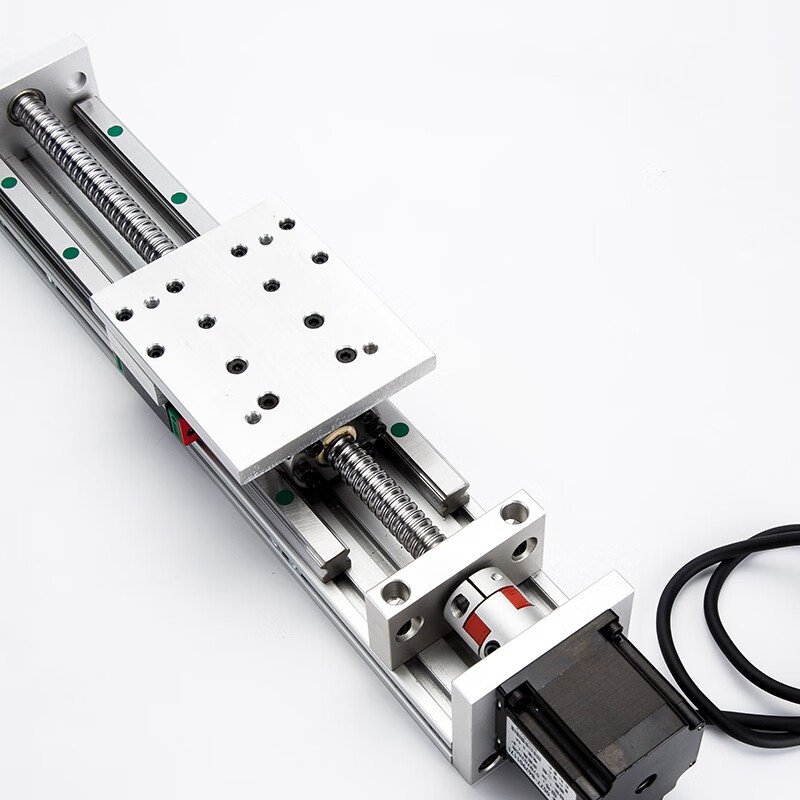
A ball screw linear module uses a rotating ball screw and a ball nut to convert rotary motion into linear movement. Recirculating balls between the screw shaft and nut reduce friction and support precise, repeatable positioning.
This mechanical arrangement provides relatively high stiffness and good positioning stability when properly designed, installed, and maintained.
Ball screw modules are commonly used in precision assembly, inspection systems, dispensing equipment, and other applications that require controlled movement and accurate stopping positions.
Belt-Driven Linear Module
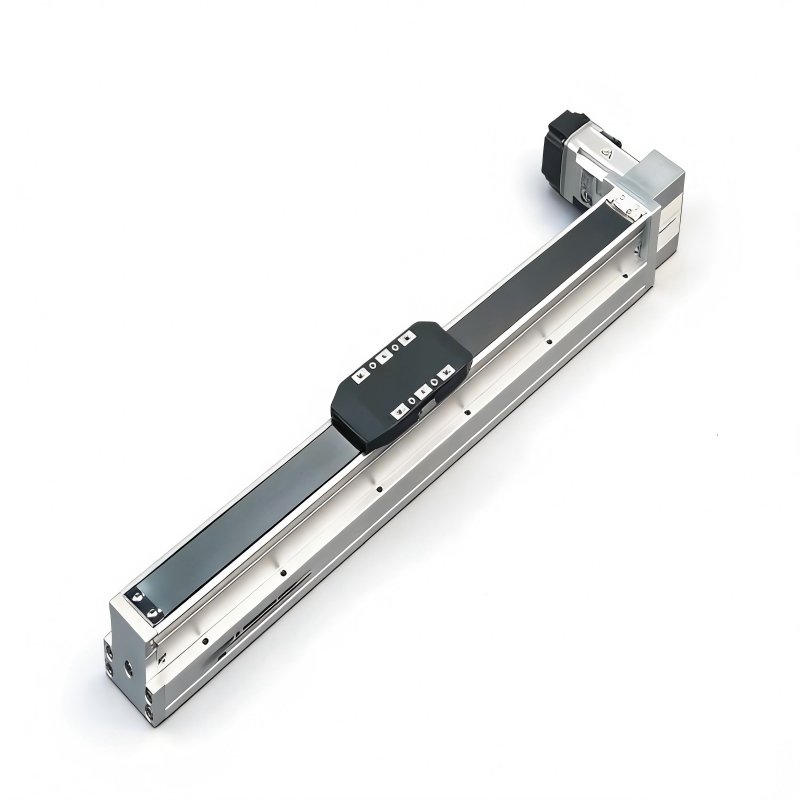
A belt-driven linear module uses a motor-driven pulley and a toothed timing belt to move the carriage along a linear guide.
The belt transmits motion over the length of the module, making this arrangement suitable for long strokes and rapid reciprocating movement. Compared with a ball screw system, it can avoid the rotating-screw critical-speed limitation associated with long screw shafts.
However, belt elasticity, belt tension, pulley alignment, and changes in operating load can affect positioning performance.
Belt-driven modules are widely used in conveyor transfer systems, packaging machinery, high-speed pick-and-place equipment, and automated material handling.
2. Ball Screw vs. Belt-Driven Linear Module: Performance Comparison
The following table summarizes the typical characteristics of the two drive systems. Actual performance varies by model, stroke length, load, drive configuration, and manufacturer specifications.
Comparison
Ball Screw Linear Module
Belt-Driven Linear Module
Drive mechanism
Ball screw and ball nut
Timing belt and pulleys
Positioning accuracy
Generally better for precision positioning
Generally lower due to belt elasticity and transmission effects
Repeatability
Well suited to accurate, repeatable positioning
Suitable for applications with moderate positioning requirements
Maximum speed
Limited by screw lead, critical speed, and vibration
Generally better suited to high-speed, long-stroke motion
Acceleration
Depends on screw inertia, motor sizing, and load
Often advantageous for rapid movement over long distances
Load capacity
Suitable for a wide range of loads when properly sized
Suitable for light to medium loads in many standard configurations
Travel distance
Often preferred for short to medium strokes
Often preferred for long strokes
Mechanical stiffness
Generally higher in the transmission
Affected by belt elasticity and tension
Maintenance
Requires lubrication according to the design and operating conditions
Requires belt tension, wear, and alignment checks
Initial cost
Often higher for comparable precision requirements
Often lower for comparable long-stroke applications
Packaging, sorting, transfer, and high-speed handling
The key takeaway: Ball screw modules generally favor precision and stiffness, while belt-driven modules generally favor speed and long travel. Neither is universally better; the application determines the right choice.
3. Positioning Accuracy: When Should You Choose a Ball Screw Module?
Positioning accuracy is one of the most important considerations when selecting a linear motion system.
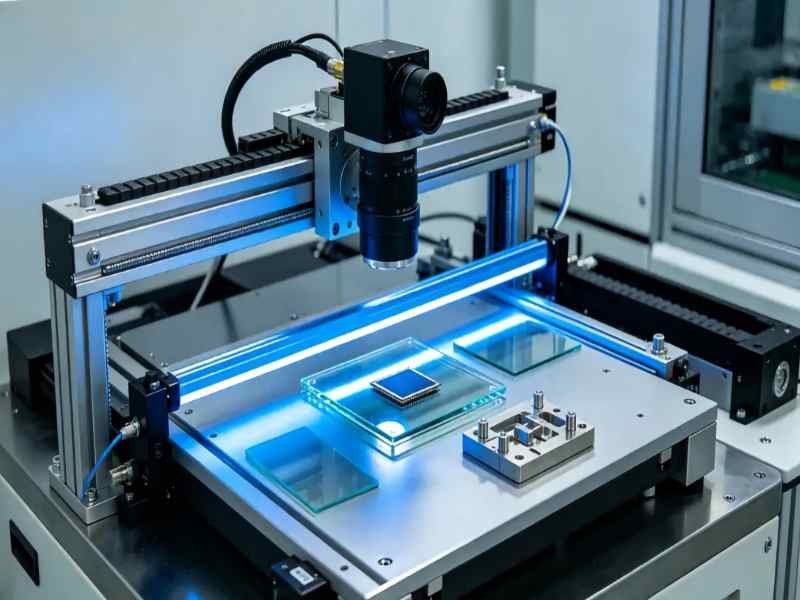
For applications such as electronic component assembly, precision dispensing, optical inspection, and semiconductor equipment, small positioning errors can affect product quality, process consistency, and production yield.
Why ball screw modules are suitable for precision positioning
A ball screw provides a direct mechanical relationship between screw rotation and nut displacement. With an appropriate screw lead, a suitable motor and encoder, properly preloaded components, and a rigid mounting structure, the system can achieve accurate and repeatable positioning.
Its performance depends on several factors:
Ball screw lead accuracy and manufacturing quality
Backlash and preload
Motor and encoder resolution
Servo tuning and motion-control settings
Payload, mounting rigidity, and thermal effects
A well-designed ball screw module is therefore a strong candidate for applications that require precise stopping positions and consistent motion.
What affects the positioning accuracy of a belt-driven module?
A timing belt is flexible by nature. Under acceleration or changing loads, it can stretch slightly, affecting the carriage position.
Other potential contributors to positioning error include belt tension, pulley eccentricity, tooth engagement, mounting rigidity, and changes in payload.
This does not mean belt-driven modules are inherently inaccurate. Proper belt selection, tension adjustment, mechanical design, and feedback control can provide reliable positioning for many automation tasks.
However, when an application requires very tight positioning tolerances, a ball screw module is often the more straightforward starting point.
HCY selection tip: Do not evaluate a linear module based on an unloaded test alone. Check repeatability under the actual payload and operating cycle, including acceleration, deceleration, and direction changes.
4. Running Speed and Travel Distance: Where Belt-Driven Modules Have the Advantage
Speed is where belt-driven linear modules often stand out.
In applications involving long travel distances, frequent reciprocating movement, and high production throughput, a belt drive can provide a practical advantage.
Why belt-driven modules work well for high-speed motion
A belt-driven system does not rely on a long rotating screw shaft. This avoids the ball screw’s screw-shaft critical-speed constraint, which becomes increasingly important as screw length and rotational speed increase.
Depending on the module design, belt-driven systems can support:
High-speed carriage movement
Long travel distances
Frequent acceleration and deceleration
Rapid transfer between workstations
Multi-axis material handling
These characteristics make belt-driven modules attractive for packaging lines, automated sorting, palletizing systems, and long-distance pick-and-place applications.
What limits ball screw speed?
A ball screw module’s maximum operating speed depends on screw diameter, unsupported length, mounting arrangement, screw lead, critical speed, and the rigidity of the complete assembly.
As the screw becomes longer, its allowable rotational speed may become a limiting factor. Vibration, noise, and reduced stability can become concerns if the system is operated beyond its design limits.
A larger screw lead can increase linear travel per revolution, but the complete drive system still needs to meet the required acceleration, thrust, and positioning performance.
For this reason, a ball screw module that performs well over a short stroke may not be the best solution for a high-speed application with several meters of travel.
Practical rule: For long-stroke, high-speed transfer, evaluate a belt-driven module first. For precision positioning over short to medium travel distances, start by evaluating a ball screw module.
Always verify the manufacturer’s rated speed, acceleration, and duty-cycle limits before making the final selection.
5. Load Capacity and Mechanical Rigidity
Payload is another important factor, but load capacity should never be judged by drive mechanism alone.
The actual capability of a linear module depends on the linear guide, carriage arrangement, bearing spacing, frame rigidity, screw or belt configuration, motor torque, and load position.
Ball screw modules for demanding positioning tasks
Ball screw modules are often selected for applications requiring higher transmission stiffness and controlled thrust.
Depending on the design, they can support precision pressing, assembly, inspection, and vertical positioning tasks.
For vertical installations, however, engineers must consider gravity, braking, power-loss behavior, and the risk of the carriage moving downward. A ball screw should not automatically be treated as a self-locking safety device. Where necessary, use an appropriately rated brake or another engineered load-holding mechanism.
Belt-driven modules for lighter, faster movement
Belt-driven modules are often a good fit for lightweight workpieces, rapid transfers, and long travel distances.
Their suitability depends on belt width, belt strength, tooth engagement, tension, pulley design, and the forces generated during acceleration.
Heavy payloads, large eccentric loads, and aggressive motion profiles can increase belt deformation and transmission loads.
For both drive types, engineers should evaluate not only the static payload but also the dynamic forces and moments generated during operation.
6. Service Life and Maintenance: Which Module Is More Cost-Effective?
The service life of a linear module depends on its operating environment, lubrication, load, speed, acceleration, duty cycle, alignment, and maintenance quality.
It is not accurate to assume that every ball screw module lasts longer than every belt-driven module. The more useful comparison is how each mechanism wears and what maintenance it requires.
Ball screw module maintenance
Typical maintenance considerations include:
Lubricating the ball screw and linear guide as specified
Checking for abnormal noise, vibration, or temperature
Monitoring backlash and positioning repeatability
Inspecting seals and contamination protection
Checking alignment and mounting rigidity
Lubrication intervals should follow the manufacturer’s instructions and account for the actual working environment.
In dusty or abrasive environments, suitable covers and sealing arrangements are particularly important.
Belt-driven module maintenance
Typical maintenance considerations include:
Checking belt tension
Inspecting belt teeth for wear or damage
Checking pulley alignment and fasteners
Monitoring positioning changes under load
Replacing the belt when wear or deterioration reaches the specified limit
A belt is a wear component and may require replacement during the machine’s service life. The replacement interval depends on belt quality, tension, operating cycles, temperature, contamination, and dynamic loading.
A belt-driven system can be economical to maintain, especially when the belt is easy to access and replace. However, the cost of belt replacement and production downtime should be included in the overall evaluation.
Compare total cost, not just purchase price
A lower initial purchase price does not always mean a lower total operating cost.
When comparing the two systems, consider:
Initial module and motor costs
Installation and commissioning
Required positioning accuracy
Routine maintenance and replacement parts
Production downtime
Scrap or rework caused by positioning errors
Expected service life under actual operating conditions
For precision-critical processes, the cost of an unsuitable drive mechanism can quickly outweigh the original purchase-price difference. For high-speed, long-stroke handling, a belt-driven module may provide a more economical solution.
7. Typical Applications: Ball Screw vs. Belt-Driven Linear Modules
The following examples show how application requirements influence drive selection.
Application
Suggested Starting Point
Main Reason
Precision dispensing
Ball screw
Controlled positioning and repeatability
Electronic component assembly
Ball screw
Accurate stopping positions
Optical inspection and alignment
Ball screw
Positioning stability
Semiconductor equipment
Ball screw or direct drive, depending on requirements
Precision, vibration, and process constraints
Packaging and sorting
Belt-driven
High-speed movement and throughput
Long-distance material transfer
Belt-driven
Long travel and efficient motion
High-speed pick-and-place
Belt-driven or another suitable drive
Fast movement, depending on payload and accuracy
Vertical lifting
Application-specific engineering required
Gravity, braking, and load-holding safety
Heavy-duty gantry systems
Application-specific engineering required
Structural stiffness, load moments, and travel distance
These are starting points rather than fixed rules. A high-speed precision inspection system may require a different solution from a simple transfer axis, even when both applications use similar travel distances.
8. How to Select the Right Linear Module for Your Equipment
Before requesting a quotation, prepare the following information.
1. Required travel distance
Specify the effective stroke, overall installation length, and available mounting space.
Long travel distances can change the suitability of the transmission mechanism, especially when high speed is required.
2. Payload and load position
Provide the total moving mass, including fixtures, grippers, cameras, or other tooling.
Also specify the load’s center of gravity and any overhung or eccentric loading.
3. Positioning accuracy and repeatability
Define the actual requirement instead of simply asking for a high-precision module.
Distinguish between absolute positioning accuracy, repeatability, and resolution. These are different specifications and should not be used interchangeably.
4. Speed, acceleration, and cycle time
Specify the required maximum speed, acceleration, deceleration, and production cycle.
A system that reaches a high maximum speed may still fail to meet the target cycle time if the acceleration distance is insufficient.
5. Installation orientation and operating environment
State whether the module will be installed horizontally, vertically, or at an angle.
Include information about dust, oil mist, temperature, cleanliness requirements, and available protective covers.
6. Control system and feedback requirements
Identify the motor type, servo drive, encoder requirements, controller, communication interface, and any synchronization requirements.
For multi-axis equipment, the complete motion-control architecture may be just as important as the mechanical drive.
7. Maintenance and service expectations
Consider how easily the module can be inspected, lubricated, adjusted, or repaired after installation.
For production equipment operating continuously, access to replacement parts and the time required for maintenance can significantly affect the overall cost.
Once these parameters are clear, the supplier can evaluate whether a ball screw module, belt-driven module, or another motion solution is the best fit.
9. Frequently Asked Questions
Q1: Is a ball screw linear module more accurate than a belt-driven linear module?
Generally, a ball screw module is better suited to applications requiring tight positioning tolerances because of its transmission characteristics and potential for high mechanical stiffness. However, actual accuracy depends on screw quality, guide design, preload, motor feedback, control settings, installation, and operating conditions.
Q2: Are belt-driven linear modules faster than ball screw modules?
Belt-driven modules are generally better suited to high-speed movement over long travel distances because they avoid the rotating-screw critical-speed constraint. Actual maximum speed depends on the model, payload, acceleration, and operating conditions.
Q3: Which linear module is better for long travel distances?
A belt-driven module is often the preferred starting point for long-stroke applications requiring fast movement. Ball screw modules may still be appropriate when positioning requirements justify the additional design considerations.
Q4: Which is better for heavy loads?
Neither mechanism should be selected based on payload alone. The guide system, frame, load moments, motor sizing, and dynamic forces all affect load capacity. Ball screw modules are often suitable for high-thrust positioning, while belt-driven modules are commonly used for lighter, faster movement.
Q5: Which module requires less maintenance?
A belt-driven module may require periodic belt tension checks and eventual belt replacement. A ball screw module typically requires lubrication and inspection of the screw and guide system. Actual maintenance requirements depend on the design and operating environment.
Q6: Can a belt-driven linear module replace a ball screw module?
Yes, if the application can meet its positioning, load, stiffness, and cycle-time requirements with a belt drive. It is not a direct replacement in every case. The complete motion system should be evaluated before changing the drive mechanism.
Q7: How do I choose between a ball screw and a belt-driven linear module?
Start with four parameters: travel distance, payload, positioning requirement, and cycle time. Then check installation orientation, environmental protection, control requirements, maintenance access, and total operating cost.
Conclusion: Choose the Drive Mechanism That Matches the Application
Ball screw and belt-driven linear modules serve different motion-control needs.
A ball screw linear module is generally a strong choice for precision positioning, high stiffness, and controlled movement. A belt-driven linear module is often more suitable for high-speed transfer, long travel distances, and applications where throughput and cost efficiency are priorities.
The right decision is not simply about choosing the more accurate or faster mechanism. It is about matching the drive system to the actual operating conditions and verifying that the complete assembly can deliver the required performance.
At HCY Automation, we focus on practical motion solutions for industrial automation, including linear modules, motion-control components, and integrated automation systems. By evaluating travel distance, payload, positioning requirements, and operating conditions together, engineers can make more informed decisions and avoid costly changes after installation.
Need help selecting a linear module for your equipment? Share your required stroke, payload, positioning accuracy, speed, and installation orientation with the HCY Automation team to start evaluating a suitable solution.
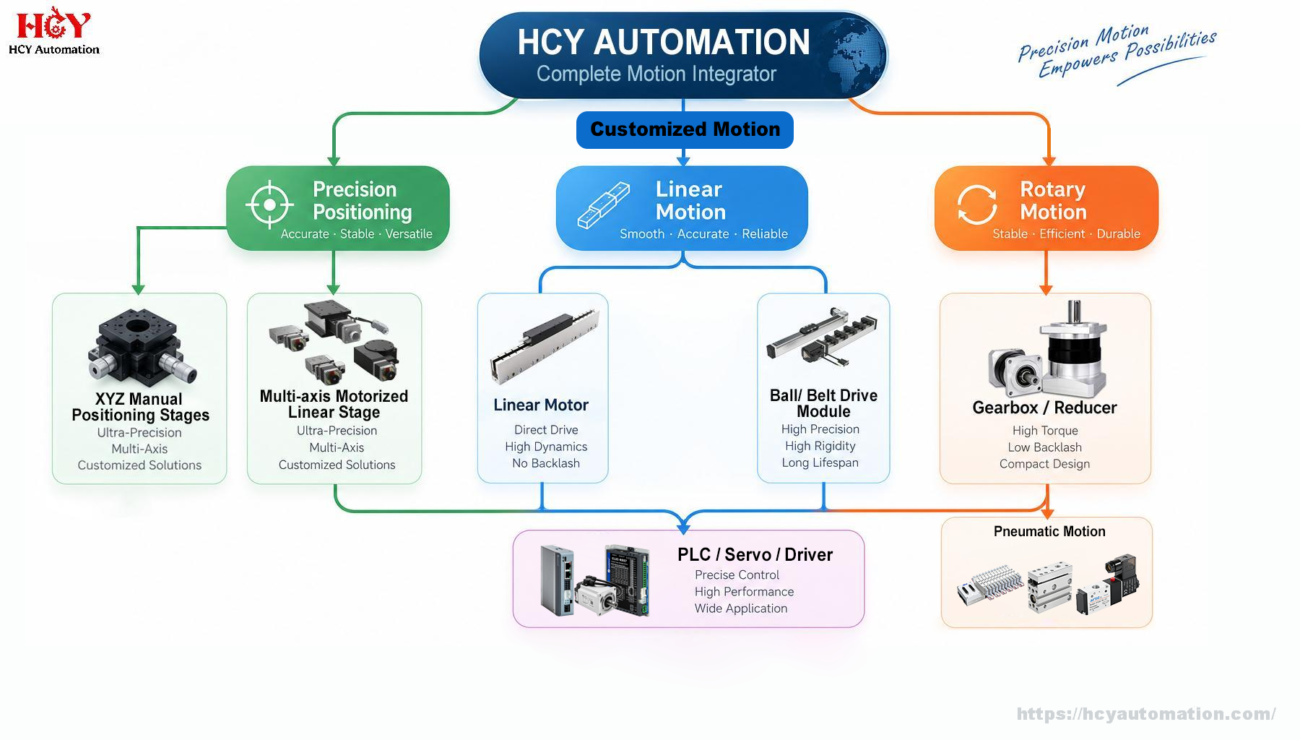
HCY Automation delivers integrated solutions across motion control, linear motion, robotics, machine vision, pneumatic systems, and precision gearboxes to help global manufacturers build smarter, faster, and more reliable production lines. Our engineering team helps you select and integrate the right motion control, robotics, and automation components for your specific application.