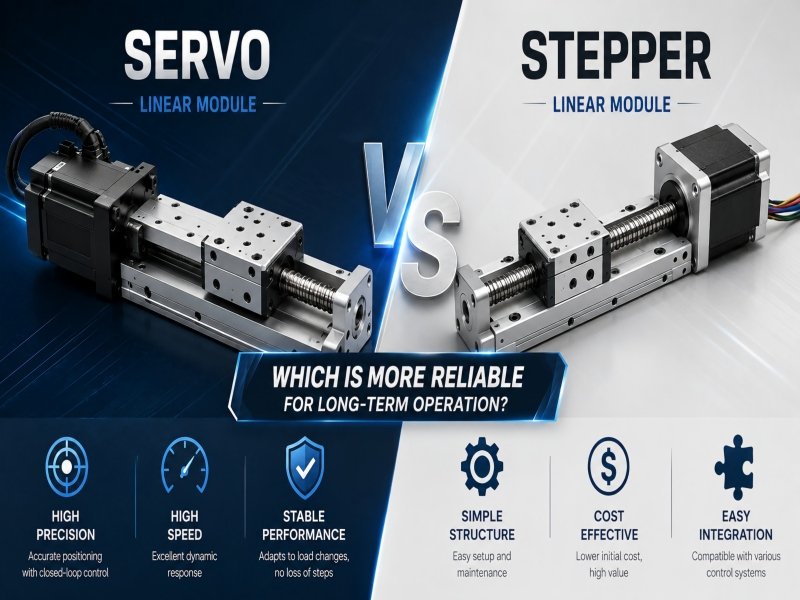
Servo vs. Stepper Linear Modules: Which Is More Reliable for Long-Term Operation?
Compare servo and stepper linear modules for long-term operation. Learn how positioning accuracy, speed, load changes, maintenance, and operating costs affect your motion system.
Introduction: What Happens After Thousands of Operating Hours?
When selecting a linear module for an automated machine, the initial purchase price is easy to compare. Long-term operating performance is a different story.
A stepper motor linear module may work perfectly during initial testing. A servo-driven linear module may deliver excellent acceleration and positioning performance from day one. But what happens after thousands of operating hours, repeated acceleration and deceleration, and changes in payload or production speed?
Will the module maintain consistent positioning accuracy? How will it respond to unexpected load changes? And which drive system requires less maintenance over its service life?
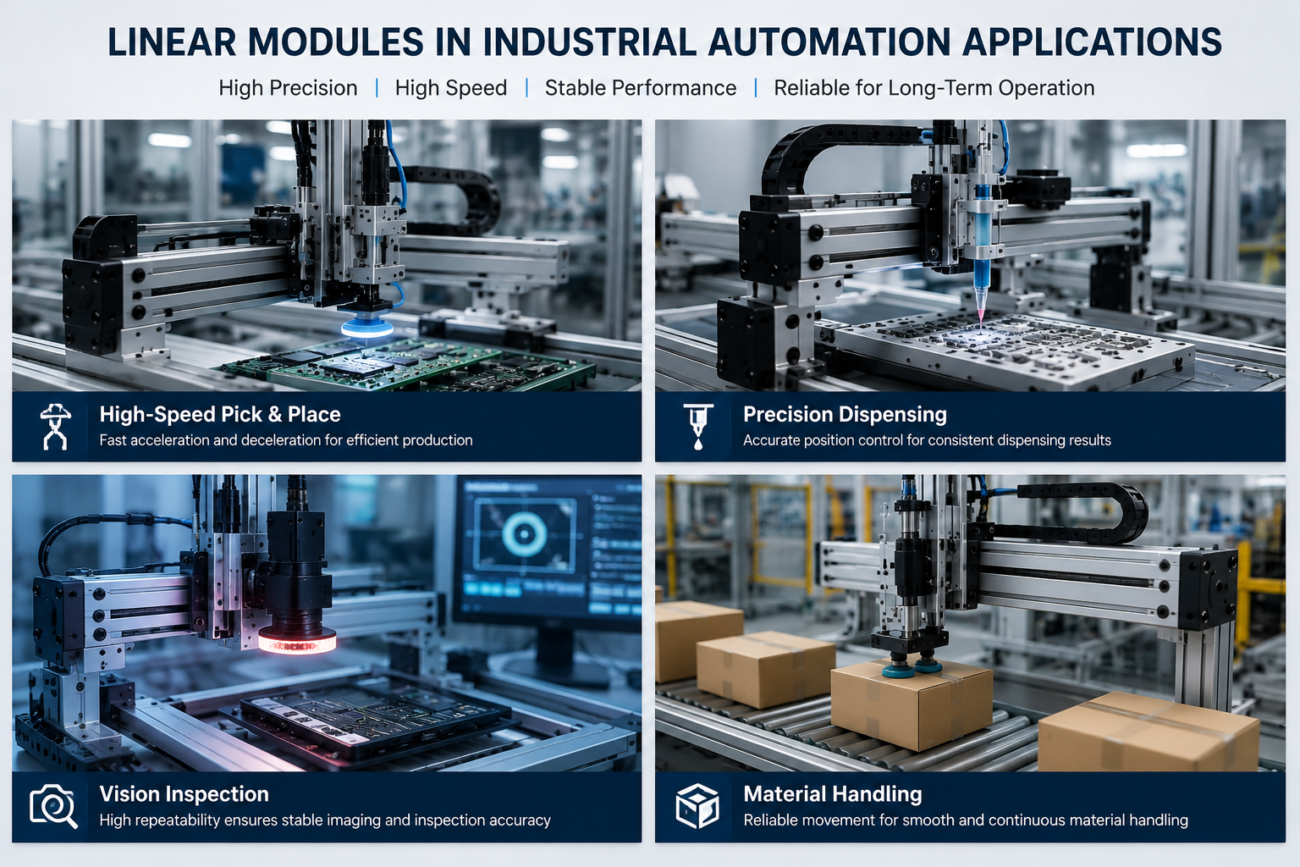
These questions matter in applications such as semiconductor equipment, electronics assembly, automated inspection, precision dispensing, and high-speed material handling.
At HCY Automation, we believe choosing between a servo linear module and a stepper motor linear module should start with the actual working conditions, not simply the motor price.
Let’s look at the differences that matter most for long-term reliability.
1. Positioning Accuracy: Can the Linear Module Maintain Consistent Performance?
Positioning accuracy is often one of the first concerns when engineers compare servo and stepper motor linear stages.
However, the key difference is not simply the accuracy achievable during initial setup. It is how the system responds when operating conditions change.
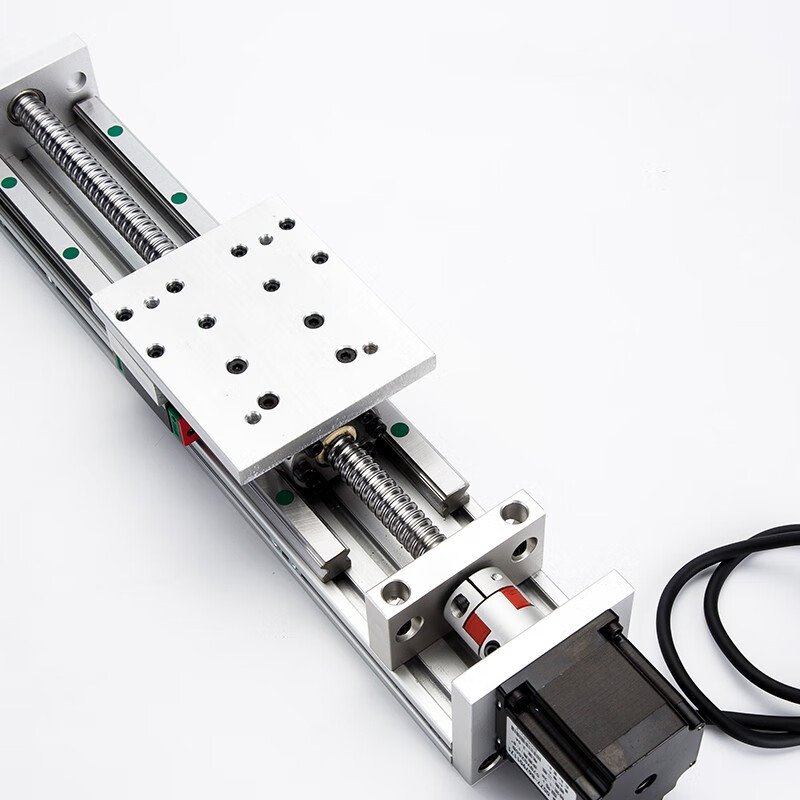
Stepper motor linear modules
A conventional open-loop stepper motor moves according to the pulse commands sent by its controller. Under stable loads and properly selected operating conditions, it can deliver consistent positioning performance over long production runs.
The limitation appears when the actual load exceeds the available torque, particularly during rapid acceleration, sudden stops, or high-speed operation.
If the motor loses synchronization with the commanded steps, the controller may not detect the position error. The resulting positioning deviation can affect subsequent operations until the position is re-established.
This does not mean that every stepper-driven linear module will lose steps. With appropriate torque margins, acceleration settings, and load calculations, open-loop stepper systems can operate reliably for extended periods.
Servo linear modules
A typical servo motor uses an encoder to provide feedback on motor position and speed. The servo drive compares the feedback with the commanded motion and adjusts the motor output to reduce the error.
This closed-loop control is particularly useful when loads change, acceleration is frequent, or positioning requirements are demanding.
If the motor falls behind its command, the control system can respond rather than relying entirely on the assumption that every commanded step has been completed.
There is one important point: a motor encoder does not automatically guarantee perfect positioning at the linear carriage. Mechanical backlash, coupling errors, guide deflection, thermal expansion, and screw or belt characteristics can still affect actual axis accuracy.
For long-term positioning consistency, a servo linear module offers an advantage when load variations and dynamic motion are significant. A properly designed stepper system can still be the more economical choice for stable, predictable applications.
2. Continuous Operation: How Do the Two Systems Handle Long Production Runs?
A linear module used for occasional positioning has different requirements from one running multiple shifts every day.
In continuous production, motor temperature, acceleration frequency, mechanical friction, and load changes all influence operating stability.
Stepper motors under continuous operation
Stepper motors can operate for long periods when their torque requirements, current settings, and thermal conditions are properly managed.
However, a conventional stepper motor generally consumes substantial holding current when stationary, depending on the driver configuration. During extended operation, heat generation needs to be considered.
At higher speeds, available torque typically decreases. A system that performs well during low-speed testing may struggle when production speed increases or acceleration becomes more aggressive.
The practical solution is to calculate the required torque across the full speed range rather than selecting a motor based only on its holding torque.
Servo motors under continuous operation
Servo systems are designed to regulate motion using feedback. They can adjust motor output to meet changing torque demands and typically provide strong dynamic performance during repeated starts, stops, and direction changes.
This makes servo-driven linear modules suitable for demanding production cycles where the motion profile changes frequently.
Nevertheless, servo motors are not automatically cooler or more durable in every application. Incorrect motor sizing, excessive acceleration, poor tuning, inadequate cooling, or sustained high loads can also cause overheating and premature component wear.
For both drive types, continuous-duty performance depends on the complete system design.
Engineering takeaway: For a linear module running frequent, high-speed cycles, evaluate continuous torque, RMS torque, peak torque, duty cycle, thermal limits, and the required service life before selecting the motor.
3. Load Changes and Acceleration: Where Servo Systems Have an Advantage
One of the most important differences between servo and stepper linear modules appears when the load is not constant.
Consider a pick-and-place machine that handles components of different weights. The axis must accelerate, decelerate, stop accurately, and repeat the same movement thousands of times.
A stepper motor may perform well under a predictable load. However, when the required torque exceeds its available torque at a particular speed, it can lose synchronization or stall.
A servo system can use encoder feedback to respond to motion errors and changing torque demands. Many industrial servo systems also provide short-term overload capacity, subject to the motor and drive specifications.
This makes servo-driven linear modules particularly suitable for:
High-speed pick-and-place systems
Frequent acceleration and deceleration
Automated inspection equipment
Precision assembly lines
Variable-payload material handling
Applications requiring rapid direction changes
For a low-speed transfer axis with a consistent payload, the additional dynamic capability of a servo system may not justify the extra cost.
The correct question is not whether servo motors are always better. It is whether the application’s motion profile requires the additional performance.
4. Vibration and Motion Smoothness: Why They Matter Over Time
Vibration is not just a noise issue. In precision automation, excessive vibration can affect positioning repeatability, settling time, inspection results, and mechanical component life.
Stepper-driven linear stages
Open-loop stepper systems can exhibit resonance or vibration in certain speed ranges. The severity depends on motor design, drive settings, load inertia, and the stiffness of the mechanical assembly.
Microstepping, suitable acceleration profiles, mechanical damping, and proper motor sizing can help reduce these effects.
For many standard automation tasks, a well-configured stepper linear stage provides sufficiently smooth motion.
Servo-driven linear stages
Servo systems can use feedback control, gain adjustment, and resonance suppression to improve motion response and reduce vibration.
They are often a better fit for applications requiring fast settling after movement, smooth low-speed travel, or frequent changes in direction.
However, servo tuning matters. Poorly tuned control loops can introduce oscillation, noise, or instability. A servo system still needs to be matched to the mechanical structure.
For long-term operation, the objective is to achieve smooth motion without excessive vibration or unnecessary mechanical stress, regardless of motor type.
5. Maintenance and Operating Costs: Looking Beyond the Purchase Price
A stepper motor linear module generally has a lower initial system cost. Its control architecture can be relatively simple, especially when a conventional open-loop configuration meets the application’s requirements.
A servo linear module usually requires a higher initial investment in the motor, drive, feedback system, and commissioning process.
But the purchase price is only one part of the total cost of ownership.
Cost factor
Stepper linear module
Servo linear module
Initial investment
Generally lower
Generally higher
Control complexity
Simpler in conventional open-loop systems
Requires feedback configuration and tuning
Load variation
More sensitive when torque margins are limited
Better suited to changing dynamic loads
Position error detection
Limited in conventional open-loop systems
Feedback can detect and correct motor-position errors
High-speed operation
Torque decreases as speed rises
Generally better dynamic performance within rated limits
Maintenance needs
Depends on motor, drive, and mechanical system
Depends on motor, drive, feedback, and mechanical system
Long-term operating cost
Often attractive for stable, low-demand applications
Can be advantageous in demanding production applications
Both systems may use similar mechanical components, such as linear guides, ball screws, belts, couplings, and bearings. These parts can wear regardless of the drive type.
Maintenance planning should therefore include lubrication, guide and screw inspection, belt tension checks where applicable, coupling inspection, alignment, cable condition, and thermal monitoring.
A servo system may help reduce production losses associated with undetected motor-position errors, but it does not eliminate mechanical maintenance. Likewise, a stepper system does not automatically require more maintenance simply because it is open-loop.
The better financial comparison considers initial cost, energy use, downtime risk, commissioning, maintenance, and the cost of rejected products over the expected service life.
6. Which Linear Module Is Better for Long-Term Industrial Use?
There is no universal winner. The right choice depends on how the axis operates and what happens if it fails to reach its commanded position.
Choose a stepper motor linear module when:
The payload is relatively light and predictable.
Operating speeds and acceleration requirements are moderate.
The positioning requirements are within the system’s demonstrated capability.
The motion profile is simple and repeatable.
Initial equipment cost is a major consideration.
The application can tolerate the limitations of open-loop position control.
Typical examples include basic transfer mechanisms, simple dispensing systems, light-duty positioning stages, and cost-sensitive automation equipment.
Choose a servo motor linear module when:
The axis runs at high speed or performs frequent rapid movements.
The load varies significantly during production.
High acceleration and short settling times are required.
Position errors could lead to expensive product defects or production interruptions.
The application requires more demanding dynamic performance.
Closed-loop motion control is part of the machine’s reliability strategy.
Typical examples include semiconductor handling, precision inspection, high-speed assembly, advanced pick-and-place equipment, and demanding industrial automation systems.
Keep in mind that a closed-loop stepper system is also available. It combines stepper motor characteristics with encoder feedback and can be a practical middle ground between conventional open-loop steppers and full servo systems.
7. Five Factors Engineers Should Check Before Selecting a Linear Module
Before deciding between a servo and stepper motor, review the complete operating conditions.
1. Payload and moving mass
Calculate the total moving mass, including the workpiece, fixtures, tooling, and any additional components mounted on the carriage.
2. Required speed and acceleration
Maximum speed alone is not enough. Acceleration, deceleration, travel distance, cycle time, and direction changes determine the actual torque demand.
3. Positioning accuracy and repeatability
Define the required positioning accuracy and repeatability separately. Also consider backlash, guide stiffness, mounting accuracy, thermal effects, and the measurement conditions used to verify performance.
4. Duty cycle and operating environment
Determine whether the axis runs intermittently or continuously, how frequently it stops and starts, and whether dust, temperature, vibration, or contamination could affect performance.
5. Control system and safety requirements
Check compatibility with the motion controller, drive interface, feedback requirements, and fault-monitoring strategy. Where unexpected motion could create a hazard, implement appropriate machine-level safety measures rather than relying on motor type alone.
A correctly selected motor cannot compensate for an undersized linear guide, insufficient structural stiffness, poor alignment, or an unsuitable transmission mechanism.
Conclusion: Long-Term Reliability Starts With the Complete Motion System
When comparing servo vs. stepper linear modules, the key difference is how each system handles motion demands, load changes, and position errors.
A stepper motor linear module can provide reliable, cost-effective performance for stable applications with predictable loads and moderate motion requirements.
A servo motor linear module is generally better suited to high-speed, high-cycle applications where dynamic response, load adaptability, and closed-loop motor-position control are important.
Neither option guarantees a longer service life on its own. Motor sizing, thermal management, mechanical design, control configuration, installation quality, and maintenance practices all influence long-term reliability.
At HCY Automation, we help equipment manufacturers evaluate linear motion solutions based on payload, travel, speed, acceleration, positioning requirements, and actual working conditions.
Whether you need a cost-effective stepper-driven linear stage or a high-performance servo linear module, the goal is the same: stable operation, consistent motion, and a drive solution that fits the machine throughout its service life.
Frequently Asked Questions (FAQ)
1. Which is more reliable for long-term operation: a servo or stepper linear module?
Both servo and stepper linear modules can operate reliably for extended periods when properly selected and maintained.
A servo linear module is generally better suited to applications involving high speeds, frequent acceleration and deceleration, and changing loads. Its closed-loop feedback system can detect motor-position errors and adjust the motor output accordingly.
A stepper linear module is often a cost-effective choice for applications with stable loads, moderate speeds, and predictable motion profiles.
The best option depends on the operating conditions, required positioning performance, and maintenance strategy.
2. Can a stepper motor linear module run continuously for 24 hours?
Yes. A properly sized stepper motor linear module can run continuously for 24 hours if its torque requirements, thermal limits, duty cycle, and mechanical components are suitable for the application.
Engineers should check motor temperature, available torque at operating speed, driver current settings, lubrication requirements, and the expected service life of the linear guide and transmission system.
For demanding, high-speed production cycles, a servo-driven linear module may offer greater dynamic performance and better adaptability to changing loads.
3. Does a servo linear module maintain higher positioning accuracy over time?
A servo linear module can maintain more consistent motor-position control when operating conditions change because its encoder provides feedback for error correction.
However, long-term positioning accuracy also depends on mechanical factors such as backlash, guide wear, mounting alignment, thermal expansion, and transmission stiffness.
For applications requiring high precision over extended operating periods, evaluate the complete linear motion system rather than relying on motor encoder resolution alone.
4. Do stepper motors lose steps during long-term operation?
A conventional open-loop stepper motor can lose synchronization when the required torque exceeds the available torque, particularly during rapid acceleration, sudden load changes, or high-speed operation.
If the system has no position feedback, the controller may not detect the resulting position error.
Proper motor sizing, adequate torque margins, suitable acceleration profiles, and appropriate drive settings can significantly reduce this risk. Closed-loop stepper systems are another option when position feedback is required without moving to a conventional servo system.
5. Is a servo linear module worth the extra cost?
A servo linear module can justify its higher initial cost when the application requires high speed, frequent direction changes, demanding positioning performance, or reliable handling of variable loads.
In these situations, improved motion response and feedback-based error detection may help reduce production interruptions and positioning-related defects.
For simple, low-speed applications with stable loads, a stepper linear module may deliver the required performance at a lower overall cost.
Compare the total cost of ownership, including purchase price, commissioning, energy consumption, maintenance, downtime, and potential production losses.
6. Which motor is better for a high-speed linear module?
A servo motor is generally the preferred choice for high-speed linear modules that require rapid acceleration, frequent starts and stops, and consistent dynamic performance.
Stepper motor torque typically decreases as speed increases, which can limit acceleration and load capacity at higher operating speeds.
However, the appropriate choice must be verified against the actual travel distance, payload, acceleration, transmission type, and required cycle time. There is no single speed threshold that determines the best motor for every linear module.
7. What affects the service life of a linear module?
The service life of a linear module depends on several interacting factors:
Payload and load distribution
Operating speed and acceleration
Duty cycle and operating temperature
Lubrication and contamination control
Installation accuracy and mechanical alignment
Motor sizing and control settings
Maintenance intervals and operating environment
Choosing between a servo and stepper motor is only one part of the decision. A properly designed mechanical structure and a correctly sized drive system are equally important for long-term reliability.
8. How do I choose between a servo and stepper linear module for my application?
Start by defining the payload, travel distance, target speed, acceleration, positioning accuracy, repeatability, and daily operating hours.
A stepper linear module is often suitable for predictable, cost-sensitive applications with moderate motion requirements. A servo linear module is generally more suitable for high-speed operation, frequent acceleration and deceleration, variable loads, and demanding dynamic performance.
For a more accurate selection, evaluate the complete motion profile and mechanical configuration before choosing the motor.
Need help selecting a linear module? Contact HCY Automation with your payload, stroke, target speed, acceleration, and positioning requirements. Our team can help you evaluate a suitable linear motion solution for your application.
Frequently Asked Questions (FAQ)
Q1. Which is more reliable for long-term operation: a servo or stepper linear module?
Both servo and stepper linear modules can operate reliably for extended periods when properly selected and maintained.
A servo linear module is generally better suited to applications involving high speeds, frequent acceleration and deceleration, and changing loads. Its closed-loop feedback system can detect motor-position errors and adjust the motor output accordingly.
A stepper linear module is often a cost-effective choice for applications with stable loads, moderate speeds, and predictable motion profiles.
The best option depends on the operating conditions, required positioning performance, and maintenance strategy.
Q2. Can a stepper motor linear module run continuously for 24 hours?
Yes. A properly sized stepper motor linear module can run continuously for 24 hours if its torque requirements, thermal limits, duty cycle, and mechanical components are suitable for the application.
Engineers should check motor temperature, available torque at operating speed, driver current settings, lubrication requirements, and the expected service life of the linear guide and transmission system.
For demanding, high-speed production cycles, a servo-driven linear module may offer greater dynamic performance and better adaptability to changing loads.
Q3. Does a servo linear module maintain higher positioning accuracy over time?
A servo linear module can maintain more consistent motor-position control when operating conditions change because its encoder provides feedback for error correction.
However, long-term positioning accuracy also depends on mechanical factors such as backlash, guide wear, mounting alignment, thermal expansion, and transmission stiffness.
For applications requiring high precision over extended operating periods, evaluate the complete linear motion system rather than relying on motor encoder resolution alone.
Q4. Do stepper motors lose steps during long-term operation?
A conventional open-loop stepper motor can lose synchronization when the required torque exceeds the available torque, particularly during rapid acceleration, sudden load changes, or high-speed operation.
If the system has no position feedback, the controller may not detect the resulting position error.
Proper motor sizing, adequate torque margins, suitable acceleration profiles, and appropriate drive settings can significantly reduce this risk. Closed-loop stepper systems are another option when position feedback is required without moving to a conventional servo system.
Q5. Is a servo linear module worth the extra cost?
A servo linear module can justify its higher initial cost when the application requires high speed, frequent direction changes, demanding positioning performance, or reliable handling of variable loads.
In these situations, improved motion response and feedback-based error detection may help reduce production interruptions and positioning-related defects.
For simple, low-speed applications with stable loads, a stepper linear module may deliver the required performance at a lower overall cost.
Compare the total cost of ownership, including purchase price, commissioning, energy consumption, maintenance, downtime, and potential production losses.
Q6. Which motor is better for a high-speed linear module?
A servo motor is generally the preferred choice for high-speed linear modules that require rapid acceleration, frequent starts and stops, and consistent dynamic performance.
Stepper motor torque typically decreases as speed increases, which can limit acceleration and load capacity at higher operating speeds.
However, the appropriate choice must be verified against the actual travel distance, payload, acceleration, transmission type, and required cycle time. There is no single speed threshold that determines the best motor for every linear module.
Q7. What affects the service life of a linear module?
The service life of a linear module depends on several interacting factors:
Payload and load distribution
Operating speed and acceleration
Duty cycle and operating temperature
Lubrication and contamination control
Installation accuracy and mechanical alignment
Motor sizing and control settings
Maintenance intervals and operating environment
Choosing between a servo and stepper motor is only one part of the decision. A properly designed mechanical structure and a correctly sized drive system are equally important for long-term reliability.
Q8. How do I choose between a servo and stepper linear module for my application?
Start by defining the payload, travel distance, target speed, acceleration, positioning accuracy, repeatability, and daily operating hours.
A stepper linear module is often suitable for predictable, cost-sensitive applications with moderate motion requirements. A servo linear module is generally more suitable for high-speed operation, frequent acceleration and deceleration, variable loads, and demanding dynamic performance.
For a more accurate selection, evaluate the complete motion profile and mechanical configuration before choosing the motor.
Need help selecting a linear module? Contact HCY Automation with your payload, stroke, target speed, acceleration, and positioning requirements. Our team can help you evaluate a suitable linear motion solution for your application.
HCY Automation delivers integrated solutions across motion control, linear motion, robotics, machine vision, pneumatic systems, and precision gearboxes to help global manufacturers build smarter, faster, and more reliable production lines. Our engineering team helps you select and integrate the right motion control, robotics, and automation components for your specific application.