Linear Motor Cooling and Thermal Management: A Practical Guide
Learn how to manage linear motor heat, compare air cooling and water cooling, and choose the right thermal solution for precision motion systems and industrial automation.
Why Does Linear Motor Cooling Matter?
Linear motors are widely used in precision positioning, semiconductor equipment, electronic manufacturing, laser processing, and high-speed automation. Their direct-drive structure eliminates the need for a ball screw or belt to convert rotary motion into linear movement, making them attractive for applications requiring fast acceleration, smooth motion, and precise positioning.
However, direct drive does not mean heat-free operation.
During operation, electrical energy is converted into motion, but some of it is also converted into heat. If this heat cannot be dissipated effectively, the motor temperature rises. Thermal expansion can affect positioning accuracy, while excessive temperature may shorten insulation life or damage permanent magnets.
This is why linear motor cooling and thermal management should be considered during the initial design stage—not added only after overheating occurs.
Should you choose natural cooling, forced-air cooling, or liquid cooling? Does an iron-core linear motor always require water cooling? And how can you prevent thermal drift in a precision linear motor module?
Let’s look at the factors that matter in real-world industrial applications.
1. Why Do Linear Motors Generate Heat?
To select an appropriate cooling method, it is important to understand where the heat comes from and how it affects the motion system.
1.1 Copper Loss: Heat Generated in the Windings
The current flowing through the motor windings encounters electrical resistance, producing heat. This is commonly known as copper loss.
Copper loss increases with current and is approximately proportional to the square of the current:
Copper loss: P = I²R
Where:
P is the electrical power dissipated as heat.
I is the winding current.
R is the winding resistance.
This relationship explains why a linear motor operating at high continuous thrust can generate substantial heat. Doubling the current, with resistance held constant, produces approximately four times the copper loss.
In actual operation, winding resistance also changes with temperature, so the thermal behavior must be evaluated under realistic operating conditions.
1.2 Iron Loss: Hysteresis and Eddy Currents
In iron-core linear motors, the magnetic core experiences changing magnetic fields during operation. These changes can generate hysteresis and eddy-current losses, which contribute to heat.
Iron loss depends on factors such as magnetic flux density, electrical frequency, core material, and motor design.
This is one reason why thermal management deserves particular attention in high-speed iron-core linear motor applications.
However, an iron-core motor does not automatically run hotter than every ironless motor. Actual temperature rise depends on the electromagnetic design, current, duty cycle, cooling arrangement, and heat-transfer path.
1.3 Why Continuous Operation Makes a Difference
A motor running for a few seconds and then stopping has time to dissipate some of the accumulated heat during its idle period. A motor performing rapid, continuous reciprocating motion may generate heat faster than the surrounding structure can remove it.
The most important operating factors include:
Continuous thrust and peak thrust
Acceleration and deceleration
Motion frequency and cycle time
Moving mass and external load
Duty cycle and operating hours
Ambient temperature and available airflow
Cooling arrangement and installation conditions
For example, a linear motor used for intermittent positioning may operate successfully with passive heat dissipation. The same motor operating continuously at high acceleration may require a more effective cooling solution.
The key is to evaluate the actual motion profile rather than selecting cooling equipment based on motor size alone.
2. How Does Heat Affect Linear Motor Performance?
Heat management is not only about protecting the motor. It can also determine whether the entire motion system maintains its required performance.
2.1 Thermal Expansion and Positioning Accuracy
Motor coils, mounting plates, guide rails, and machine structures expand as their temperatures change.
In a precision linear motor stage, even a small amount of thermal expansion can shift the relationship between the encoder, moving assembly, and workpiece. This may cause thermal drift, especially during long operating periods.
For semiconductor equipment, optical inspection systems, and precision measurement machines, temperature stability can be just as important as the motor’s nominal positioning specifications.
Water cooling can help reduce temperature variation when properly designed, but it does not guarantee a particular positioning accuracy. The complete machine structure, encoder arrangement, temperature distribution, and control strategy also matter.
2.2 Permanent Magnet Performance
Permanent magnets have temperature-dependent magnetic properties. If a permanent-magnet linear motor exceeds its specified operating temperature, its magnets may suffer reduced performance or, under sufficiently severe conditions, irreversible demagnetization.
The risk depends on the magnet material, magnetic operating point, temperature, and duration of exposure.
2.3 Coil Insulation and Service Life
Excessive winding temperature accelerates insulation aging. Repeated thermal cycling can also place stress on electrical insulation, bonding materials, cables, and other components.
Maintaining the motor within its specified thermal limits helps support reliability and service life.
2.4 Machine Stability and Production Consistency
For equipment running multiple shifts, thermal behavior may change between startup and steady-state operation.
A system that performs well when cold may show a different positioning offset after hours of continuous production. If this behavior is not considered during commissioning, engineers may spend unnecessary time adjusting the machine or investigating inconsistent results.
Effective thermal management helps make machine behavior more predictable.
3. Linear Motor Cooling Methods: Natural Cooling, Air Cooling, and Water Cooling
There is no single cooling method suitable for every linear motor. The best option depends on heat generation, available space, required accuracy, environmental conditions, and total system cost.
3.1 Natural Cooling and Passive Heat Dissipation
Natural cooling relies on heat conduction through the motor mounting structure and heat transfer to the surrounding air without a dedicated fan or liquid-cooling circuit.
A suitable aluminum mounting plate can help spread heat because aluminum generally has good thermal conductivity. The actual result depends on plate thickness, contact area, mounting interfaces, airflow, and the thermal resistance of the complete structure.
Advantages
Simple system architecture
No additional cooling fan or coolant circuit
Lower integration complexity
No pump or fan noise
Limitations
Limited heat-removal capacity
Performance depends heavily on the mounting structure and ambient conditions
May be unsuitable for high continuous thrust or tightly controlled temperature requirements
Typical applications
Natural cooling may be sufficient for intermittent-duty axes, low thermal-load applications, or systems where the motor’s heat can be conducted effectively into a larger machine structure.
Do not assume that a small motor always needs no cooling. Check its continuous-duty rating and allowable temperature under the actual installation conditions.
3.2 Forced-Air Cooling
Forced-air cooling uses fans to increase airflow over heat-generating components or heat sinks. Depending on the motor design, the airflow may be directed around the coil assembly, mounting plate, or other designated cooling surfaces.
Advantages
Generally simpler than a liquid-cooling circuit
Moderate equipment and installation cost
Suitable for many continuous-duty applications with manageable heat loads
Easier integration in systems where airflow is available
Limitations
Lower heat-transfer capability than many properly designed liquid-cooling arrangements
Fan noise and additional electrical consumption
Dust accumulation and airflow obstruction
Potential airflow and particle-control concerns in clean environments
Typical applications
Forced-air cooling can be suitable for some medium-duty linear motor axes, automated handling systems, and industrial equipment where the required temperature stability can be achieved without liquid cooling.
For cleanroom or contamination-sensitive equipment, consider the airflow path and particle requirements before choosing a fan-based solution.
3.3 Water Cooling and Liquid Cooling
Water cooling transfers heat from the motor or a dedicated cooling plate into circulating coolant. The heat is then removed through a heat exchanger or chiller.
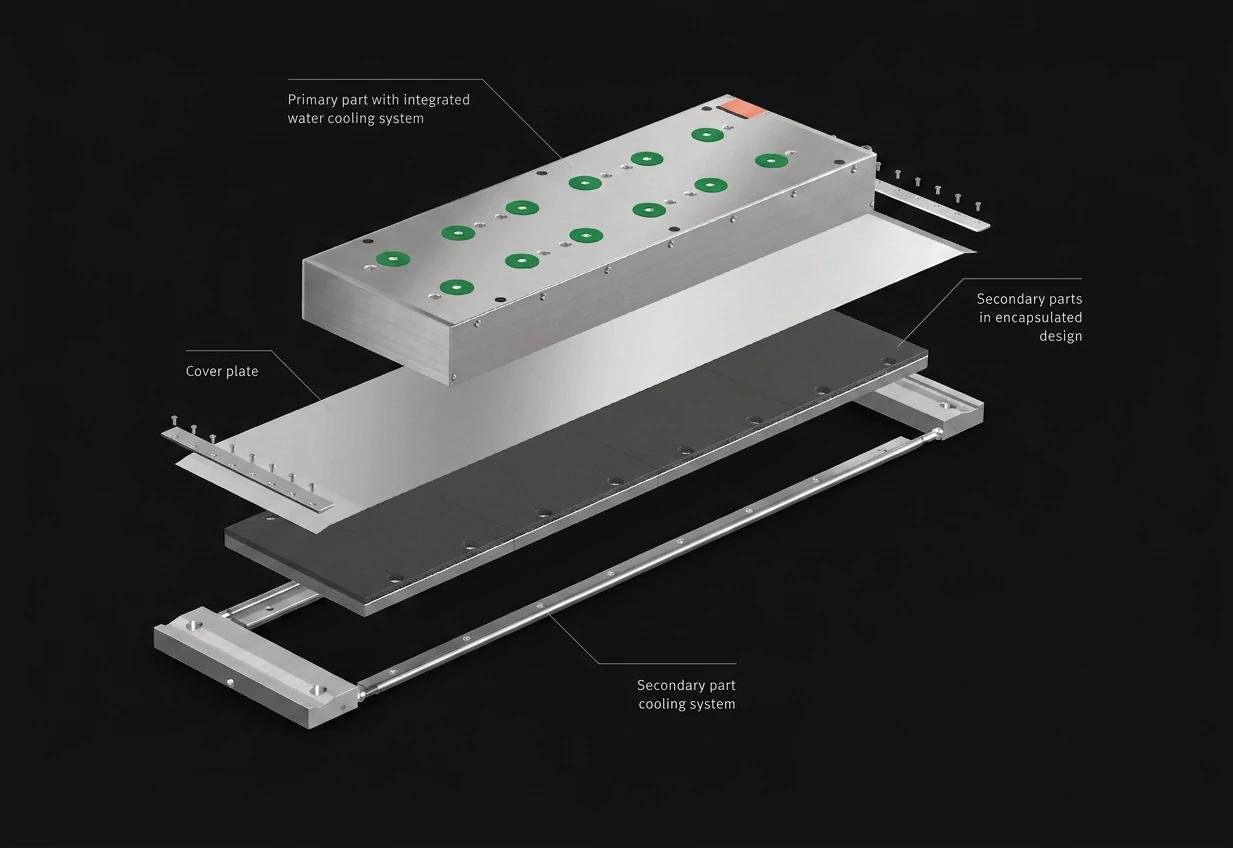
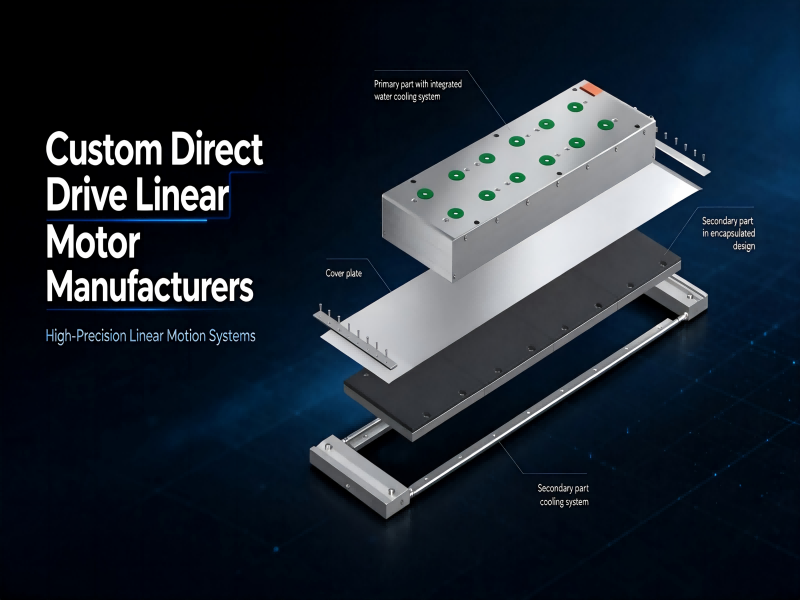
Depending on the design, the cooling channel may be integrated into the motor assembly, mounting structure, or a separate cooling plate. Not every linear motor supports the same cooling configuration, so the manufacturer’s installation and coolant specifications must be followed.
Advantages
High heat-removal capability when correctly designed
Better control of motor temperature under demanding continuous-duty conditions
Potentially lower thermal variation during precision operation
Suitable for many high-thrust or high-duty-cycle applications
Limitations
Additional cost for pumps, tubing, heat exchangers, and potentially a chiller
More complex installation and maintenance
Possible leakage and condensation risks
Dependence on coolant flow, temperature, cleanliness, and system reliability
Typical applications
Water cooling is worth evaluating for high continuous-thrust linear motors, high-duty-cycle precision stages, semiconductor and display manufacturing equipment, and applications where thermal drift must be carefully controlled.
A liquid-cooled system is not automatically the best choice. If the heat load is modest, the extra hardware and maintenance may provide little practical benefit.
Air Cooling vs. Water Cooling: What Is the Difference?
Factor
Natural Cooling
Forced-Air Cooling
Water Cooling
Heat-removal capability
Generally limited
Moderate, depending on design
Often high with suitable system sizing
System complexity
Low
Low to moderate
Higher
Additional equipment
Usually none
Fan and airflow components
Pump, tubing, heat exchanger or chiller as required
Noise
Minimal
Fan noise
Pump and chiller noise may occur
Contamination considerations
Depends on environment
Airflow can move dust
Avoids forced airflow at the motor, but leakage and condensation must be managed
Temperature control
Limited
Depends on airflow and heat load
Can provide more controlled thermal conditions
Typical use
Low heat load or intermittent duty
Moderate thermal load
High thermal load or demanding temperature stability
Important: The achievable heat-removal rate and temperature stability are system-specific. They should be calculated or tested rather than assumed from a generic cooling-method comparison.
4. Does an Iron-Core Linear Motor Need Water Cooling?
This is a common question when selecting linear motor modules for high-speed or high-thrust automation equipment.
Iron-core linear motors can offer high thrust density, which is useful when installation space is limited or the machine requires substantial acceleration. But high thrust capability does not mean water cooling is always mandatory.
The decision depends on the motor’s losses and its ability to dissipate heat under the intended duty cycle.
When Natural Cooling May Be Enough
Passive heat dissipation may be appropriate when:
The motor operates intermittently.
The required continuous thrust is relatively low.
The mounting structure provides a good heat-transfer path.
Ambient temperature is controlled.
The measured or calculated winding temperature remains within the specified limit.
When Forced-Air Cooling Is Worth Considering
Air cooling may be appropriate when:
The motor operates continuously but the thermal load remains manageable.
The machine has sufficient airflow and space.
The application can tolerate the associated noise and airflow.
The required positioning performance remains stable at the expected temperature.
When Water Cooling Should Be Considered
Liquid cooling becomes more attractive when:
Continuous thrust is high relative to the motor’s available heat-dissipation capacity.
The motor runs at high duty cycles with frequent acceleration and deceleration.
The equipment requires stable thermal behavior over long production runs.
The installation structure cannot remove heat quickly enough.
The motor manufacturer’s thermal calculations or test results indicate that passive or air cooling is insufficient.
For precision linear motor modules, the cooling method should be chosen together with the motor, encoder, mounting plate, guide system, and servo drive. Treating cooling as a separate accessory can lead to unnecessary redesign later.
5. How to Design an Effective Linear Motor Thermal Management System
Choosing a cooling method is only part of the process. The complete thermal path—from the motor’s heat source to the surrounding environment—must work effectively.
5.1 Identify the Main Heat Sources and Heat-Transfer Path
Start by identifying where heat is generated and how it leaves the motor.
In many linear motor systems, winding heat must travel through the motor structure, mounting interfaces, cooling plate or heat sink, and eventually into the surrounding air or coolant.
Check:
Where the heat-generating coils are located
Whether the motor design supports integrated liquid cooling
The material and dimensions of the mounting plate
Contact flatness and thermal interface quality
The available surface area for heat dissipation
Whether nearby heat sources affect the motor
A well-designed aluminum mounting plate can help spread heat, but it should not be treated as a substitute for a cooling system when the heat load exceeds the structure’s capacity.
Thermal interface materials should only be used where appropriate for the motor’s mounting design and manufacturer requirements.
5.2 Calculate Continuous Thrust Before Selecting the Motor
One of the most important selection mistakes is choosing a motor based only on its peak thrust.
Peak thrust is typically available for a limited period. Continuous thrust depends on the motor’s thermal limits and cooling conditions.
The motor should be evaluated using the actual motion profile, including acceleration, deceleration, dwell time, external force, and repeated cycles.
For a simplified constant-resistance load, an equivalent RMS current can help estimate winding heating:
I RMS = √[Σ(Iᵢ² × tᵢ) / Σtᵢ]
Where each current value applies for a defined period within the operating cycle.
This is a useful first approximation for copper-loss assessment. A complete motor selection must also consider speed-dependent losses, iron losses where applicable, changing resistance, cooling performance, and the manufacturer’s continuous and peak ratings.
The objective is not to select the largest motor available. It is to choose a motor that can meet the required motion profile without exceeding its thermal limits.
5.3 Check the Mounting Surface and Mechanical Alignment
The mounting surface influences both heat transfer and mechanical performance.
Poor flatness, unsuitable contact surfaces, or incorrect installation can compromise heat conduction and affect the alignment of the linear guide and motor assembly.
In systems with tight mechanical tolerances, uneven mounting or an incorrectly maintained motor air gap can also affect magnetic performance and increase the risk of abnormal operation.
Follow the motor and module manufacturer’s requirements for mounting flatness, alignment, air gap, fastening, and installation sequence.
5.4 Match the Cooling System to the Actual Thermal Load
For a liquid-cooled system, the design should consider:
Required coolant flow rate
Coolant inlet temperature
Allowable temperature rise across the cooling circuit
Coolant compatibility and cleanliness
Pressure drop and pump capacity
Heat exchanger or chiller capacity
Hose routing, leak prevention, and maintenance access
For an air-cooled system, consider fan performance, airflow direction, heat-sink geometry, ambient temperature, and the potential for dust accumulation.
More cooling is not always better. Excessive cooling can increase cost, complexity, and temperature gradients across the machine. In some precision applications, stable and predictable temperatures are more important than simply achieving the lowest possible motor temperature.
5.5 Configure Drive Current and Thermal Protection
Cooling hardware cannot compensate for every sizing or control problem.
Review the servo drive’s current limits, duty-cycle requirements, thermal monitoring, and available protection functions. Where supported, appropriate I²t or thermal-overload protection can help prevent the motor from operating beyond its permitted thermal capacity.
The continuous current, peak current, and peak duration should be checked against the motor and drive specifications. Avoid operating for extended periods in a peak-performance region that the motor was not designed to sustain.
5.6 Verify Thermal Performance Under Real Operating Conditions
A successful design should be verified under representative operating conditions.
Monitor relevant temperatures during startup, steady-state operation, and the most demanding production cycle. Where precision matters, measure positioning drift as the machine warms up.
For a precision linear motor module, verification should consider both motor temperature and the thermal behavior of the surrounding structure.
This helps determine whether the selected cooling method is sufficient and whether additional cooling would deliver a meaningful improvement.
6. Common Linear Motor Cooling Mistakes to Avoid
Mistake 1: Assuming Every High-Thrust Motor Needs Water Cooling
High thrust alone does not determine the cooling requirement. Continuous thrust, duty cycle, motor efficiency, thermal resistance, and allowable winding temperature are also important.
Better approach: Evaluate the actual motion profile and thermal limits before specifying liquid cooling.
Mistake 2: Selecting a Motor Based Only on Peak Thrust
A motor may deliver high peak thrust but be unable to maintain the same force continuously without exceeding its temperature limits.
Mistake 3: Ignoring Thermal Expansion in Precision Equipment
The motor may remain within its permitted temperature range while the mounting plate or machine structure expands enough to affect positioning.
Better approach: Consider thermal drift across the complete motion system, not just the motor.
Mistake 4: Installing Water Cooling Without Checking the Complete Circuit
Insufficient flow, unsuitable coolant, poor hose routing, or inadequate heat-exchanger capacity can reduce cooling effectiveness.
Better approach: Follow the motor manufacturer’s coolant specifications and verify flow, inlet temperature, pressure, and leakage protection.
Mistake 5: Oversizing the Motor Without Reviewing Efficiency and Heat
A larger motor is not automatically a more reliable or cooler motor. Motor sizing affects mass, dynamic performance, current requirements, and the complete system’s thermal behavior.
Better approach: Size the motor from the real load and motion profile, then verify the thermal design.
Mistake 6: Treating Cooling as Separate from the Linear Module
The motor, guide rails, mounting plate, encoder, cables, and control system all contribute to the final performance of the axis.
Better approach: Evaluate the linear motor module as an integrated motion system, including thermal expansion, installation conditions, and maintenance access.
7. Linear Motor Cooling Trends: Smarter and More Integrated Thermal Management
As automation equipment becomes faster and more precise, thermal management is increasingly considered during the overall motion-system design.
Several approaches are worth evaluating.
Integrated Cooling Structures
Some linear motor designs incorporate cooling channels or dedicated cooling plates to shorten the heat-transfer path and simplify integration.
The benefit depends on the cooling-channel layout, thermal contact, flow distribution, and the motor’s actual heat generation.
Temperature Monitoring and Adaptive Control
Temperature sensors can provide information about operating conditions and help trigger alarms, thermal derating, or other protective actions supported by the control system.
In some applications, cooling flow or coolant temperature can also be adjusted according to operating conditions.
The objective is to maintain the motor within its specified limits without using more cooling capacity than necessary.
Thermal Simulation and Testing
Thermal simulation tools can help engineers estimate heat distribution, identify potential hotspots, and compare design options before manufacturing.
However, simulation results depend on the accuracy of the material properties, boundary conditions, heat-source estimates, and model assumptions. Testing the completed system remains important.
System-Level Thermal Optimization
The most effective solution may combine suitable motor sizing, a thermally conductive mounting structure, optimized motion profiles, appropriate cooling, and temperature-aware control.
Rather than relying on a single cooling component, engineers should optimize the complete system around the required production cycle and positioning performance.
8. How to Choose the Right Cooling Solution for Your Linear Motor Module
Before finalizing a linear motor or linear motor module, answer these questions:
What is the actual motion profile? Define travel distance, payload, speed, acceleration, cycle time, and duty cycle.
What is the required continuous thrust? Do not use peak thrust as a substitute for continuous-duty sizing.
What temperature limits apply? Check the motor winding, magnet, encoder, and other component specifications.
How sensitive is the application to thermal drift? Precision inspection and semiconductor applications may require more careful temperature control than general material handling.
Can the mounting structure dissipate enough heat? Evaluate the mounting material, contact quality, surface area, and ambient airflow.
Is liquid cooling supported and practical? Check the available cooling interfaces, coolant requirements, installation space, and maintenance conditions.
What does the complete system cost? Include cooling equipment, integration, commissioning, maintenance, and potential production downtime.
A useful rule is to begin with the thermal requirements of the actual application and then select the cooling method. Do not assume that every linear motor needs water cooling, and do not assume that passive cooling will always be enough.
9. Frequently Asked Questions About Linear Motor Cooling
Do all linear motors need water cooling?
No. Some linear motors can operate with natural heat dissipation or forced-air cooling. Water cooling is worth considering when continuous heat generation, high thrust, demanding duty cycles, or tight thermal-stability requirements exceed what the simpler cooling methods can support.
Why do iron-core linear motors often require careful thermal management?
Iron-core linear motors can provide high thrust density, and their windings and magnetic cores can generate heat during operation. At high continuous loads or operating frequencies, the thermal design becomes particularly important. The actual cooling requirement depends on the motor design and operating conditions.
Is water cooling better than air cooling for a linear motor?
Water cooling often provides greater heat-removal capability and can support more controlled thermal conditions. Air cooling is generally simpler and less expensive to integrate. The right choice depends on heat generation, available space, temperature stability, environmental requirements, and total cost.
Can a linear motor overheat even when its peak thrust rating is not exceeded?
Yes. Peak thrust is not the same as continuous thrust. A motor can overheat if it operates at a high duty cycle, draws excessive RMS current, or cannot dissipate the generated heat adequately.
Does water cooling improve linear motor positioning accuracy?
Water cooling can reduce temperature variation and thermal drift when the system is properly designed. However, positioning accuracy also depends on the encoder, servo control, mounting structure, mechanical alignment, and temperature distribution throughout the machine.
What is the best cooling method for a precision linear motor module?
There is no universal answer. Natural cooling may be sufficient for a low thermal load, forced-air cooling may suit moderate requirements, and liquid cooling may be appropriate for high continuous thrust or demanding thermal stability. Selection should be based on the actual motion profile and the manufacturer’s thermal specifications.
How can I reduce linear motor heating without adding water cooling?
Review motor sizing, continuous current, acceleration profiles, duty cycle, mounting-surface heat transfer, ambient airflow, and available thermal protection. Reducing unnecessary acceleration or peak-current demand may also help, provided the required machine cycle time can still be achieved.
Conclusion: Design Linear Motor Cooling Around the Application
Linear motor cooling is not simply a choice between a fan and a water-cooling system. It is a thermal-management decision that affects motor reliability, positioning stability, maintenance, and the total cost of an automation machine.
Natural cooling can be sufficient for low thermal loads. Forced-air cooling offers a practical option for many moderate-duty applications. Water cooling becomes more attractive when continuous heat generation is high or when stable temperatures are important for precision motion.
For iron-core linear motors and high-performance linear motor modules, the most reliable approach is to calculate the real motion requirements, evaluate the heat-transfer path, select an appropriate cooling method, and verify thermal behavior under actual operating conditions.
At HCY Automation, we look at linear motion as a complete system—not just a motor specification. By considering the motor, module structure, drive, feedback, installation conditions, and cooling requirements together, engineers can make more informed decisions for precision positioning and industrial automation.
Planning a linear motor project? Contact HCY Automation to discuss your travel length, payload, speed, duty cycle, positioning requirements, and thermal-management needs.
HCY Automation delivers integrated solutions across motion control, linear motion, robotics, machine vision, pneumatic systems, and precision gearboxes to help global manufacturers build smarter, faster, and more reliable production lines. Our engineering team helps you select and integrate the right motion control, robotics, and automation components for your specific application.