Linear Motor vs. Ball Screw: Accuracy, Speed, Load Capacity, and Cost Compared
When selecting a linear motion system for industrial automation, two technologies often come into consideration: linear motors and ball screw drives.
Compare linear motors and ball screw drives in speed, accuracy, load capacity, maintenance, and cost. Learn how to choose the right linear motion solution for industrial automatio。 Both are widely used in precision machinery, automated production lines, semiconductor equipment, inspection systems, and CNC machines. However, they work in fundamentally different ways and offer distinct advantages in terms of speed, acceleration, positioning accuracy, load capacity, maintenance, and overall cost.
A linear motor provides direct electromagnetic drive without converting rotary motion into linear motion. A ball screw drive, on the other hand, uses a rotating screw and ball nut to generate precise linear movement.
So, which technology is better for your application?
The answer depends on your machine design, motion requirements, payload, working environment, and budget.
In this guide, we compare linear motors and ball screw drives from an engineering perspective to help equipment manufacturers and automation engineers make the right choice.
1. Working Principles: Direct Drive vs. Mechanical Transmission
Before comparing performance, it is important to understand how these two technologies generate linear motion.
1.1 How Does a Linear Motor Work?
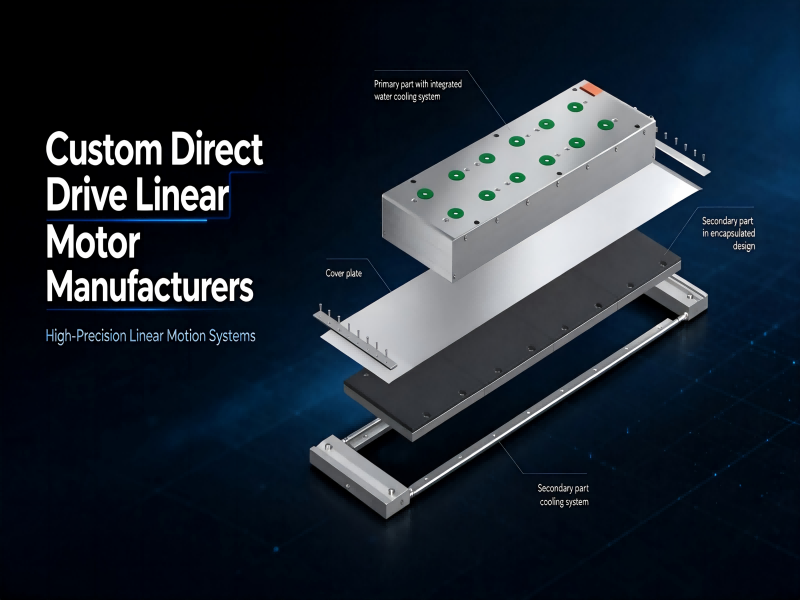
A linear motor can be understood as a rotary motor that has been cut open and laid flat.
Instead of generating rotational motion, it produces linear thrust directly through electromagnetic interaction between the motor’s primary and secondary components.
When electrical current flows through the motor windings, a magnetic field is generated. The interaction between this field and the permanent magnets produces a driving force, moving the motor carriage along a linear guide.
Because the motor directly drives the moving load, no ball screw, gearbox, or mechanical rotary-to-linear transmission is required.
Key characteristics:
Direct electromagnetic drive
No mechanical transmission backlash
High acceleration and dynamic response
Smooth motion and precise velocity control
Suitable for high-speed, high-precision applications
<IMAGE_PLACEHOLDER_1>
1.2 How Does a Ball Screw Drive Work?
A ball screw drive converts the rotational motion of a motor into linear movement through a screw-and-nut mechanism.
When a servo motor rotates the ball screw, steel balls circulate between the screw shaft and the ball nut. This rolling contact mechanism reduces friction and allows the nut, and the attached carriage, to move along a linear guide.
Ball screw linear modules typically integrate several components:
Ball screw and ball nut
Servo or stepper motor
Linear guide rails and bearings
Aluminum or steel structural frame
Couplings and motor mounting components
The ball screw provides efficient mechanical transmission, high thrust capability, and reliable positioning performance.
Key characteristics:
High mechanical transmission efficiency
Good axial stiffness
High thrust and load capacity
Mature and widely available technology
Suitable for a broad range of industrial automation applications
<IMAGE_PLACEHOLDER_2>
2. Linear Motor vs. Ball Screw: Key Performance Comparison
The main differences become clearer when comparing their actual performance characteristics.
Performance Factor
Linear Motor
Ball Screw Drive
Drive principle
Direct electromagnetic drive
Rotary-to-linear mechanical transmission
Maximum speed
Very high, application-dependent
Limited by screw speed and critical speed
Acceleration
Very high
Moderate to high, depending on design
Positioning accuracy
Very high with suitable feedback
High with precision screw and compensation
Mechanical backlash
No transmission backlash
Depends on nut preload and mechanical condition
Load capacity
Depends on motor thrust and guide structure
Often advantageous for high-thrust applications
Maintenance
No screw or nut wear
Requires lubrication and periodic inspection
Heat management
Motor heat must be managed
Screw and motor heat must be managed
Initial investment
Generally higher
Generally more economical
Typical applications
High-speed precision equipment
General industrial automation and heavy-duty positioning
These are general engineering tendencies rather than fixed performance limits. Actual specifications depend on the motor, screw, guide system, feedback device, controller, and mechanical structure.
3. Speed and Acceleration: Where Linear Motors Have the Advantage
Speed is one of the most significant differences between linear motors and ball screw drives.
Linear Motors: High Speed and Fast Dynamic Response
Since a linear motor drives the load directly, it avoids the rotational inertia and mechanical limitations associated with screw transmission.
This allows linear motor systems to achieve:
High linear speeds
High acceleration and deceleration
Fast response to motion commands
Shorter positioning cycles
Smooth high-speed scanning and movement
Depending on the motor and application, some linear motor systems can reach speeds of several meters per second and accelerations of multiple G.
This makes them particularly suitable for applications where cycle time and dynamic performance are critical.
Typical applications include:
Semiconductor manufacturing equipment
High-speed optical inspection systems
Laser processing machines
Precision dispensing and assembly
High-speed pick-and-place systems
Ball Screw Drives: Speed Limited by Mechanical Factors
Ball screw performance is affected by several mechanical factors, including:
Screw lead
Screw shaft diameter
Rotational speed
Critical speed
DN value of the ball screw
Screw support and mounting conditions
Moving load and acceleration requirements
Increasing the screw lead can improve linear speed, but it may affect thrust, resolution, and positioning characteristics.
At longer strokes, screw deflection, vibration, and critical speed become increasingly important design considerations.
This is why ball screw systems require careful matching of screw diameter, lead, support configuration, and motor specifications.
Engineering takeaway: If your machine requires very high speed, high acceleration, and frequent start-stop cycles, a linear motor is often the better choice. For moderate-speed positioning and applications where high thrust is more important than maximum speed, a ball screw drive is usually a more practical solution.
4. Positioning Accuracy and Repeatability: Which Is More Precise?
Both technologies can achieve high positioning accuracy, but they rely on different mechanical and control characteristics.
Linear Motor Accuracy
A linear motor has no screw transmission, mechanical backlash, or rotary-to-linear conversion error.
Its positioning performance is primarily determined by:
Linear encoder resolution and accuracy
Servo control performance
Feedback configuration
Thermal stability
Guide rail accuracy
Machine structural rigidity
Installation and calibration quality
With a high-resolution linear encoder and a properly configured closed-loop control system, linear motors can achieve excellent positioning accuracy and repeatability.
They are particularly suitable for applications requiring smooth motion, precise interpolation, and rapid positioning.
However, direct drive does not automatically guarantee higher accuracy. Thermal expansion, magnetic force variation, installation errors, and feedback system performance still need to be considered.
Ball Screw Accuracy
Ball screw positioning accuracy depends on the precision grade of the screw, lead accuracy, preload, support bearings, coupling, motor encoder, and control system.
A precision-ground ball screw with appropriate preload and compensation can achieve excellent positioning and repeatability, making it suitable for many precision industrial applications.
Its mechanical transmission also provides good axial stiffness, which is valuable when the system needs to resist external forces or maintain stable positioning under load.
However, ball screw systems may be affected by:
Lead error
Backlash or preload changes
Screw thermal expansion
Mechanical wear
Coupling and bearing errors
Vibration at high rotational speeds
Positioning Accuracy vs. Repeatability
It is important not to confuse these two specifications.
Positioning accuracy describes how closely the system reaches the commanded position.
Repeatability describes how consistently the system returns to the same position under the same conditions.
A system may have excellent repeatability but still have a systematic positioning error.
For applications requiring high absolute positioning accuracy, calibration, compensation, and a suitable feedback system are essential, regardless of the drive technology.
Engineering takeaway: Linear motors offer advantages in direct-drive motion and the elimination of transmission backlash. Ball screw systems remain highly competitive in precision positioning, particularly when high rigidity and stable thrust are required.
5. Load Capacity and Mechanical Rigidity
Load capacity is another important consideration when selecting a linear motion system.
Ball Screw: A Practical Choice for High-Thrust Applications
Ball screw drives are often preferred for applications involving relatively heavy loads or high axial thrust.
The ball screw and nut provide mechanical force transmission, while the linear guide rails support the moving load and resist external moments.
With appropriate screw diameter, lead, preload, bearing support, and guide selection, ball screw modules can handle demanding industrial loads.
Typical applications include:
CNC machine feed axes
Heavy-duty positioning equipment
Pressing and clamping mechanisms
Industrial lifting and handling systems
Large-format automation equipment
Linear Motor: High Dynamic Performance with Proper Load Matching
Linear motors can also deliver substantial thrust, but their load capacity depends on the motor’s continuous and peak thrust, thermal conditions, cooling configuration, and guide system.
An important factor is the normal attractive force generated by some iron-core linear motors. This magnetic force acts between the motor components and may introduce additional loads on the guide rails and supporting structure.
The guide system must therefore be selected according to both the payload and the motor’s magnetic forces.
For applications involving high payloads, large external forces, or demanding cutting loads, the complete mechanical structure must be evaluated rather than selecting a motor based only on its rated thrust.
Engineering takeaway: Ball screw modules often offer a more economical route to high-thrust positioning. Linear motors are suitable for high-dynamic applications when motor thrust, thermal management, and guide capacity are properly matched.
6. Maintenance and Operating Costs
Initial purchase price is only one part of the total cost of a linear motion system.
Maintenance requirements, energy consumption, component replacement, and downtime should also be considered.
Linear Motor Maintenance
A linear motor has no ball screw, ball nut, or mechanical transmission components between the motor and the moving load.
This eliminates several common wear points associated with screw-driven systems.
Potential benefits include:
No ball screw lubrication
No ball nut replacement due to screw transmission wear
No transmission backlash caused by screw-nut wear
Reduced mechanical maintenance requirements
However, linear motors are not completely maintenance-free.
Linear guides, bearings, encoder systems, cooling components, and cable management systems still require inspection and maintenance.
Thermal management is particularly important. Continuous high-force operation may require additional cooling to maintain stable performance and positioning accuracy.
Ball Screw Maintenance
Ball screw systems rely on rolling contact between the screw and nut, so proper lubrication and maintenance are essential.
Common maintenance tasks include:
Lubricating the ball screw
Inspecting the ball nut and guide rails
Checking backlash and preload
Monitoring vibration and noise
Inspecting couplings and support bearings
Replacing worn components when necessary
With proper lubrication, installation, and load selection, ball screw systems can provide long and reliable service life.
Which Has the Lower Total Cost?
Linear motors generally involve a higher initial investment because of the motor, drive, encoder, and potential cooling requirements.
Ball screw systems are usually more cost-effective for general-purpose applications and moderate-speed positioning.
However, in high-speed production environments, a linear motor may reduce cycle time, improve throughput, and lower mechanical maintenance requirements.
The right comparison should consider the total cost of ownership (TCO), not just the initial equipment price.
7. Energy Consumption and Thermal Management
Energy consumption is influenced by the actual motion profile, payload, acceleration, operating frequency, drive efficiency, and standby time.
Linear motors generate thrust directly through electromagnetic force. During acceleration and high-force operation, they may require substantial current and produce considerable heat.
In continuous-duty applications, cooling may be necessary to maintain motor temperature and positioning stability.
Ball screw drives benefit from the mechanical advantage of screw lead and efficient rolling transmission. However, energy consumption also depends on the servo motor, screw efficiency, preload, lubrication, and mechanical load.
Neither technology is universally more energy-efficient.
For a meaningful comparison, engineers should evaluate:
Average and peak motor current
Continuous thrust requirements
Acceleration and deceleration profiles
Operating duty cycle
Cooling power consumption
Regenerative energy during deceleration
Thermal expansion is also important. Heat generated by either the motor or the screw can affect positioning accuracy if the machine does not have adequate thermal management.
8. Z-Axis Applications: Can Linear Motors Replace Ball Screws?
Ball screw drives are widely used in vertical motion applications because their mechanical structure can provide high axial thrust and rigidity.
Linear motors can also be used for Z-axis applications, but additional design considerations are required.
The main challenge is not simply the motor type. It is how the system supports the vertical load when the motor stops or loses power.
For either technology, engineers may need to consider:
Electromagnetic or mechanical holding brakes
Counterbalance systems
Mechanical safety locks
Load retention after power failure
Vertical guide rail capacity
Safe stopping and emergency conditions
A ball screw should not automatically be assumed to be self-locking. Most ball screws are backdrivable and may require a separate brake.
Similarly, a linear motor cannot hold a vertical load safely without an appropriate holding or counterbalance arrangement.
Engineering takeaway: Linear motors can be used for precision Z-axis positioning, provided that the holding and safety requirements are properly addressed. Ball screws are often preferred when high thrust and a more conventional vertical drive arrangement are required.
9. Typical Applications: When Should You Choose Each Technology?
The best solution depends on the actual requirements of the machine.
When to Choose a Linear Motor
<IMAGE_PLACEHOLDER_3>
A linear motor is worth considering when your application requires:
Very high speed and acceleration
High-frequency start-stop motion
Smooth and continuous scanning
High positioning repeatability
No mechanical transmission backlash
Long travel with demanding dynamic performance
Typical industries and applications include:
Semiconductor Equipment
Precision positioning, wafer handling, inspection, and high-speed motion stages.
Optical and Photonics Alignment
Fine positioning of optical components, lenses, fiber alignment, and precision measurement systems.
Laser Processing
High-speed scanning and positioning in laser cutting, marking, and precision processing equipment.
Automated Inspection
High-speed camera movement, precision scanning, and repeatable positioning in machine vision systems.
High-Speed Assembly
Fast pick-and-place, electronic component assembly, and precision dispensing.
When to Choose a Ball Screw Module
A ball screw module is generally a good choice when your application requires:
High axial thrust
Good mechanical rigidity
Stable precision positioning
Moderate operating speed
Cost-effective motion control
A mature and widely supported mechanical design
Typical applications include:
CNC Machine Tools
Feed axes and precision positioning under cutting forces.
Industrial Automation
Material handling, assembly, loading and unloading, and general positioning.
Pressing and Clamping Equipment
Controlled linear movement with relatively high thrust requirements.
Testing and Measurement Equipment
Repeatable positioning and controlled movement of test fixtures and components.
Heavy-Duty Positioning Systems
Applications where load capacity, rigidity, and mechanical stability are important.
10. Linear Motor vs. Ball Screw: How to Make the Right Decision
There is no universal winner between linear motors and ball screw drives.
A linear motor is often the better choice when speed, acceleration, dynamic response, and direct-drive precision are the primary requirements.
A ball screw module is often the more practical choice when high thrust, rigidity, reliable positioning, and investment cost are the main considerations.
Before selecting a system, equipment manufacturers and automation engineers should evaluate the following parameters:
Selection Parameter
What to Check
Travel distance
Required stroke and installation space
Payload
Moving mass and external forces
Speed
Maximum and average operating speed
Acceleration
Required acceleration and deceleration
Positioning accuracy
Absolute positioning accuracy
Repeatability
Required positioning consistency
Duty cycle
Operating frequency and working hours
Mounting direction
Horizontal, vertical, or inclined
Environment
Temperature, dust, vibration, and cleanliness
Budget
Initial investment and long-term operating costs
The selection should be based on the complete motion system rather than the motor or transmission component alone.
11. HCY Automation: Linear Motion Solutions for Different Applications
At HCY Automation, we provide linear motion and positioning solutions for industrial automation equipment manufacturers, system integrators, and engineering teams.
Our product range covers both ball screw-driven linear modules and direct-drive linear motor stages, as well as customized motion platforms for different positioning requirements.
Depending on your application, we can support:
Ball screw linear modules for precision positioning and high-thrust applications
Linear motor stages for high-speed and high-dynamic motion
Customized linear motion systems with application-specific stroke and mounting configurations
Multi-axis positioning platforms for automated inspection and precision alignment
Servo motor and motion control integration
Our engineering team works with customers to evaluate payload, travel, speed, positioning accuracy, mounting conditions, and control requirements before recommending a suitable configuration.
Whether you are developing a high-speed inspection machine, a precision alignment platform, or a customized industrial automation system, selecting the right linear drive technology is the first step toward achieving reliable machine performance.
Need help choosing between a linear motor and a ball screw module?
Contact HCY Automation and share your application requirements. Our team can help evaluate the motion parameters and recommend a suitable linear motion solution.
1. Is a linear motor more accurate than a ball screw?
Not necessarily in every application. Linear motors eliminate mechanical transmission backlash and can achieve excellent positioning performance with a high-quality linear encoder and closed-loop control. However, precision ball screw systems can also achieve very high accuracy and repeatability. Actual performance depends on the complete mechanical and control system.
2. Is a linear motor faster than a ball screw?
Generally, yes. Linear motors are better suited to very high speeds and accelerations because they eliminate the rotational-to-linear transmission mechanism. Ball screw speed is limited by factors such as screw critical speed, lead, shaft diameter, and support configuration.
3. Can a ball screw module handle heavier loads than a linear motor?
Ball screw modules often provide a practical advantage in high-thrust applications. However, linear motors can also generate substantial thrust. The actual load capacity must be evaluated based on motor thrust, guide rail capacity, structural rigidity, and operating conditions.
4. Which has lower maintenance costs: a linear motor or a ball screw?
Linear motors generally require less maintenance related to mechanical transmission because they do not have a ball screw or ball nut. However, guide rails, bearings, encoders, and cooling systems still require maintenance. Ball screw systems need regular lubrication and inspection of the screw, nut, and support components.
5. Can a linear motor replace a ball screw?
Yes, in many applications, provided that the linear motor can meet the required thrust, speed, acceleration, positioning accuracy, and safety requirements. However, the machine structure, guide system, feedback device, and control system may also need to be redesigned.
6. Are linear motors suitable for Z-axis applications?
Yes. Linear motors can be used for vertical positioning, but the system must include an appropriate solution for holding the load when power is removed, such as a mechanical brake, safety lock, or counterbalance mechanism.
7. Which is more cost-effective for industrial automation?
Ball screw modules are generally more economical for standard industrial automation and moderate-speed positioning. Linear motors may offer better long-term value in high-speed, high-throughput applications where shorter cycle times and reduced transmission maintenance justify the higher initial investment.
8. What information is needed to select a linear motion system?
Important parameters include stroke, payload, speed, acceleration, positioning accuracy, repeatability, duty cycle, mounting direction, installation space, and operating environment. Providing these details helps engineers select a suitable linear motion configuration.
HCY Automation delivers integrated solutions across motion control, linear motion, robotics, machine vision, pneumatic systems, and precision gearboxes to help global manufacturers build smarter, faster, and more reliable production lines. Our engineering team helps you select and integrate the right motion control, robotics, and automation components for your specific application.