Linear Motor vs. Ball Screw: Which Motion Technology Fits High-Precision Automation?
Linear motor vs ball screw: Compare travel length, speed, acceleration, positioning accuracy, load capacity, maintenance, and cost to find the right motion solution for high-precision automation.
Introduction: Choosing the Right Linear Motion Technology for Precision Automation
In modern industrial automation, motion performance directly affects equipment productivity, positioning accuracy, and long-term operating costs.
Whether you are developing semiconductor equipment, lithium battery production lines, precision assembly machines, or automated inspection systems, selecting the right linear motion technology is an important part of the equipment design process.
Two of the most widely used solutions are direct drive linear motors and ball screw-driven linear modules.
Both technologies can deliver accurate and reliable linear movement, but their mechanical structures and operating characteristics are quite different.
A ball screw module converts rotary motion from a servo motor into linear movement through a screw and nut mechanism. It is a mature, reliable, and cost-effective solution for many conventional automation applications.
A linear motor module generates linear force directly through electromagnetic interaction. Without an intermediate mechanical transmission mechanism, it offers significant advantages in high-speed movement, acceleration, dynamic response, and long-travel applications.
But does a linear motor always outperform a ball screw?
Not necessarily.
The right choice depends on several factors, including travel length, speed, acceleration, positioning repeatability, payload, mechanical rigidity, operating environment, and total cost of ownership.
At HCY Automation, we work with industrial linear motion and precision positioning solutions. In this article, we compare linear motors and ball screw modules from practical engineering perspectives to help equipment manufacturers select the most suitable motion technology.
1. Working Principle: Direct Drive vs. Mechanical Transmission
Before comparing performance, it is important to understand how these two technologies generate linear movement.
How Does a Linear Motor Module Work?
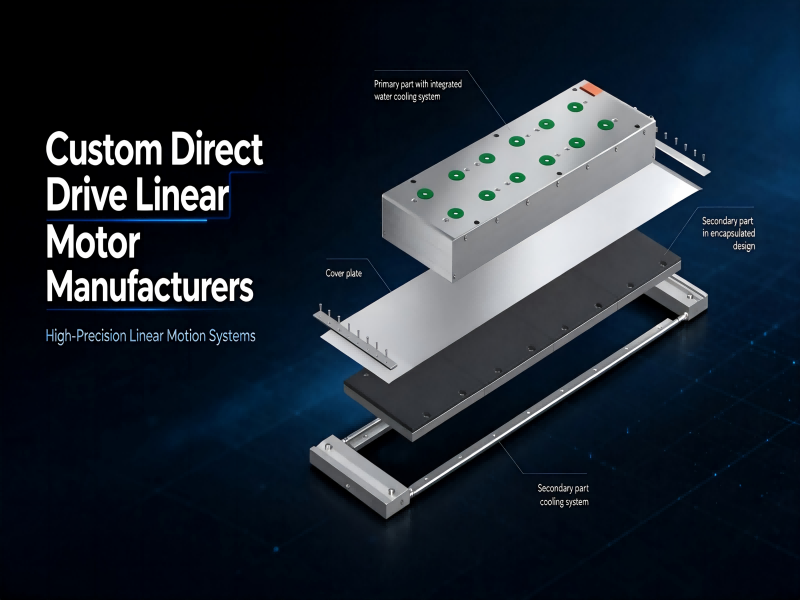
A linear motor is essentially a rotary motor that has been unrolled into a straight configuration.
Instead of generating rotational motion, it produces electromagnetic force directly along a linear path.
A typical linear motor positioning system consists of:
Linear motor stator or magnetic track.
Moving element or motor coil assembly.
Linear guide rails and sliders.
Position feedback system, such as an optical grating or magnetic scale.
Servo drive and motion controller.
When the motor receives a control signal, electromagnetic force drives the moving platform directly along the guide rails.
Because there is no screw, belt, or gearbox between the motor and the moving platform, the system eliminates the corresponding mechanical transmission backlash and reduces transmission-related inertia.
This direct-drive structure makes linear motors particularly suitable for applications requiring high acceleration, high positioning repeatability, and fast dynamic response.
How Does a Ball Screw Linear Module Work?
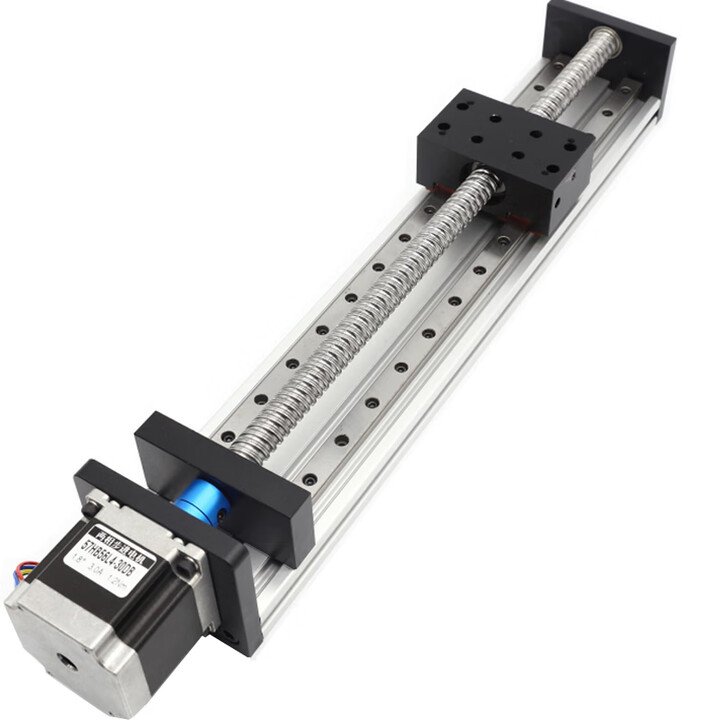
A ball screw linear module uses a rotary servo motor to drive a precision screw.
The rotating screw moves the ball nut along its axis, converting rotary movement into linear displacement.
A typical ball screw module consists of:
Servo motor.
Ball screw.
Ball nut.
Linear guide rails and sliders.
Bearing support.
Coupling or direct motor connection.
Motion controller and feedback system.
Ball screws use recirculating balls between the screw and nut to reduce friction and improve transmission efficiency.
With appropriate screw accuracy, preload, guide selection, and servo tuning, ball screw modules can achieve excellent positioning performance.
Their mature mechanical design makes them widely used in CNC machinery, assembly equipment, lifting mechanisms, and general industrial automation.
The fundamental difference:
A linear motor generates linear movement directly, while a ball screw module converts rotary movement into linear movement through a mechanical transmission mechanism.
This difference determines much of their performance in practical applications.
2. Travel Length: Which Technology Is Better for Long-Stroke Applications?
Travel length is one of the most important factors when selecting a linear motion system.
Ball Screw: Limited by Screw Length and Critical Speed
The effective travel length of a ball screw module depends on several factors:
Screw diameter.
Screw lead.
Unsupported screw length.
Critical rotational speed.
Mounting and bearing support conditions.
Required positioning accuracy.
As the screw becomes longer, its susceptibility to bending and vibration increases.
At higher rotational speeds, screw whip and critical-speed limitations can become significant engineering concerns.
To achieve longer travel, engineers may need larger screw diameters, more rigid support structures, or specialized screw configurations.
These changes can increase equipment cost and mechanical complexity.
For applications requiring long travel, synchronous belt-driven linear modules can also be considered, although their stiffness and positioning performance must be evaluated against the required accuracy.
Linear Motor: A More Flexible Architecture for Long Travel
Linear motor modules do not rely on a rotating screw or belt transmission.
Their achievable travel length is primarily determined by the magnetic track, guide rail structure, feedback scale, and overall mechanical design.
For long-stroke applications, segmented magnetic tracks can be assembled to extend the working range.
With proper alignment and installation, this architecture supports continuous direct-drive movement over long distances.
Typical applications include:
Long-travel gantry systems.
Floor-mounted material transfer systems.
Large-format inspection platforms.
Semiconductor handling equipment.
High-speed automated production lines.
Engineering takeaway:
For applications requiring long travel combined with high speed and high acceleration, linear motor modules generally offer greater structural flexibility.
Ball screw modules remain practical for short- and medium-stroke applications where screw dimensions and critical speed can be properly controlled.
3. Speed and Acceleration: Which System Delivers Better Dynamic Performance?
In high-speed automation, maximum operating speed is only one part of motion performance.
Acceleration, deceleration, settling time, and positioning cycle time are equally important.
Ball Screw: Speed Is Influenced by Rotational Limitations
The operating speed of a ball screw system is influenced by:
Screw critical speed.
Screw lead.
Motor rotational speed.
Bearing support.
Moving load and inertia.
Nut temperature and lubrication conditions.
As operating speed increases, screw vibration, frictional heat, and lubrication requirements become more important.
During continuous high-frequency reciprocating movement, thermal expansion and mechanical wear may affect positioning stability and service life.
Acceleration performance is also influenced by the inertia of the rotating screw and transmission components.
When payload conditions change, servo tuning and motion response may require adjustment.
Linear Motor: Direct Drive for High-Speed Motion
A linear motor directly drives the moving platform through electromagnetic force.
Without the rotating screw and mechanical transmission components, the system avoids screw-related rotational speed limitations and transmission backlash.
Its main advantages include:
High acceleration and deceleration capability.
Fast response to motion commands.
Reduced transmission-related inertia.
High-frequency reciprocating movement.
Shorter positioning and settling times when properly configured.
For applications involving frequent start-stop movements, even a small reduction in cycle time can improve overall production efficiency.
For example, high-speed inspection equipment may perform hundreds or thousands of positioning movements during a production shift.
In such applications, dynamic response can be just as important as positioning accuracy.
Engineering takeaway:
Linear motor technology is particularly suitable for high-speed pick-and-place systems, precision inspection equipment, and automated production lines requiring frequent reciprocating movement.
4. Positioning Accuracy and Repeatability: Why Long-Term Consistency Matters
For high-precision automation, positioning accuracy is not simply a matter of achieving a small error during factory testing.
Maintaining consistent positioning performance throughout the equipment’s operating life is equally important.
First, it is necessary to distinguish between two commonly confused terms:
Positioning Accuracy: How closely the actual position matches the commanded position.
Repeatability: How consistently the system returns to the same position under the same operating conditions.
Both technologies can achieve high positioning accuracy and repeatability when properly designed.
However, their transmission characteristics are different.
Ball Screw: Preload, Backlash, and Mechanical Wear
Ball screw systems rely on mechanical contact between the screw and ball nut.
To reduce backlash, manufacturers commonly use preloaded ball nuts or other anti-backlash designs.
However, mechanical wear, lubrication changes, temperature variation, and structural deformation may gradually influence positioning performance.
Depending on the application, periodic inspection, lubrication, and positioning compensation may be required.
Linear Motor: No Mechanical Backlash in the Drive Transmission
Linear motor modules use electromagnetic force to drive the moving platform directly.
Because there is no screw-and-nut transmission, there is no mechanical backlash associated with that transmission mechanism.
Their positioning performance is mainly influenced by:
Feedback scale resolution and accuracy.
Servo control performance.
Mechanical rigidity.
Thermal deformation.
Guide rail condition.
Installation and calibration quality.
With an appropriate optical grating or magnetic scale feedback system, linear motor modules can achieve highly consistent positioning performance.
For example, HCY linear motor stages can be configured to achieve repeatability as high as ±0.002 mm, depending on the selected model and operating conditions.
However, direct drive does not automatically guarantee higher absolute positioning accuracy. The complete motion system must be correctly designed, calibrated, and controlled.
Engineering takeaway:
For applications requiring frequent precision positioning and reduced transmission-related backlash, linear motors offer clear advantages.
Ball screw modules remain an excellent choice when their positioning performance meets the application requirements and periodic maintenance can be arranged.
5. Payload and Mechanical Rigidity: Don’t Overlook Overturning Moments
When selecting a linear motion module, engineers often focus on motor thrust or maximum payload.
However, the actual load capacity of a system also depends on mechanical rigidity and allowable moments.
Ball Screw Modules: A Mature Mechanical Structure
Ball screw modules generally use an established mechanical architecture consisting of a screw drive and linear guide system.
Depending on their structural design, they can provide good resistance to bending and torsional loads.
They are commonly used in:
Heavy-duty positioning equipment.
Vertical lifting mechanisms.
Assembly machinery.
Long-cantilever pick-and-place systems.
Applications involving eccentric payloads.
For long cantilever structures or offset loads, the guide rail arrangement and bearing support must still be properly evaluated.
Linear Motor Modules: Structural Design Determines Load Capacity
Linear motor modules can also support heavy payloads, but their mechanical rigidity depends heavily on the base, guide rails, sliders, and mounting structure.
For high-load or eccentric-load applications, engineers should carefully evaluate:
Pitch, roll, and yaw moments.
Guide rail spacing.
Number and arrangement of sliders.
Base plate rigidity.
Center of gravity.
Moving platform deformation.
For example, a linear motor may provide sufficient thrust to move a payload, but the guide system may not have sufficient allowable moment capacity to support a long cantilever.
This is why motor thrust and mechanical load capacity should always be calculated separately.
Engineering takeaway:
Ball screw modules can be a practical choice for heavy eccentric loads and long-cantilever structures.
Linear motor modules are also suitable for demanding payload applications when the guide system and base structure are properly designed.
The right choice depends on the complete mechanical configuration, not simply the drive technology.
6. Operating Environment and Maintenance: Calculate the Total Lifecycle Cost
Different industrial environments place different demands on linear motion systems.
A cleanroom, CNC machining center, lithium battery production line, and high-frequency inspection station all have different maintenance requirements.
Linear Motor Modules: Reduced Transmission-Related Maintenance
Since linear motors do not use screw-and-nut transmission, they eliminate the associated screw lubrication requirements.
Their direct-drive structure can reduce certain mechanical maintenance tasks.
This can be particularly advantageous in cleanroom and precision inspection applications where lubrication contamination and particle generation must be carefully controlled.
However, engineers should still consider:
Magnetic track protection.
Attraction of ferromagnetic particles.
Feedback scale protection.
Motor temperature.
Guide rail lubrication.
Cable management.
Cooling requirements where applicable.
Ball Screw Modules: Regular Lubrication and Mechanical Protection
Ball screw systems require suitable lubrication to reduce friction and mechanical wear.
In environments involving metal chips, cutting fluids, or dust, appropriate protective covers and sealing structures are important.
Routine maintenance may include:
Screw and nut lubrication.
Inspection of ball screw wear.
Cleaning of protective covers.
Checking guide rail condition.
Positioning accuracy verification.
Total Cost of Ownership: Look Beyond the Purchase Price
Initial procurement cost is only one part of the total investment.
A complete cost evaluation should include:
Initial purchase price.
Installation and commissioning.
Lubrication and maintenance.
Positioning calibration.
Spare parts and replacement.
Production downtime.
Long-term operating efficiency.
For high-frequency production lines, the cost of maintenance-related downtime may eventually exceed the initial price difference between the two technologies.
Engineering takeaway:
Linear motors can reduce maintenance associated with mechanical transmission, while ball screw systems remain economical and reliable when regular lubrication and inspection can be properly managed.
7. Application Comparison: Which Technology Fits Different Automation Tasks?
The most appropriate motion technology may vary even between different stations on the same production line.
Let’s look at several common industrial applications.
7.1 Automated Loading and Unloading
Ball screw modules:
Suitable for short-stroke loading and unloading mechanisms where compact structure, accurate positioning, and cost control are important.
Linear motor modules:
More suitable for long-distance transfer between machines or high-speed material handling requiring frequent positioning.
7.2 Precision Assembly
Precision assembly often requires small positioning increments, smooth movement, and consistent motion response.
Linear motors provide direct drive without screw transmission backlash, making them suitable for applications requiring precise micro-positioning.
For force-controlled contact operations, the system may also require force sensors or an appropriate force-control strategy.
Ball screw modules can also achieve excellent precision assembly performance when properly designed and controlled.
7.3 Semiconductor and Precision Inspection Equipment
Semiconductor manufacturing and automated optical inspection require high repeatability, stable motion, and precise positioning.
Linear motor positioning systems are widely considered for:
Wafer inspection.
Optical alignment.
Precision scanning.
High-speed positioning.
Automated measurement systems.
Their direct-drive architecture can support fast and repeatable movement.
7.4 Automated Production Lines
Not every station on an automated production line requires the same motion performance.
A practical design approach is to select the transmission technology according to each station’s actual requirements.
For example:
Standard transfer station: Ball screw or belt-driven module.
High-speed inspection station: Linear motor module.
Vertical lifting station: Ball screw or a suitably engineered direct-drive system.
Long-distance transfer station: Linear motor or belt-driven system, depending on the required precision and speed.
The objective is not to use one technology everywhere, but to achieve the best balance between performance and cost across the complete production line.
7.5 High-End Industrial Automation
As production equipment moves toward higher speeds, more frequent product changeovers, and increased automation, dynamic performance and maintenance requirements become increasingly important.
In these applications, direct-drive linear motor technology can help equipment manufacturers improve motion response and simplify transmission structures.
However, the final configuration should always be determined by the actual payload, cycle time, travel, and positioning requirements.
8. Linear Motor vs. Ball Screw: Side-by-Side Comparison
The following table summarizes the key differences.
Evaluation Factor
Linear Motor Module
Ball Screw Module
Drive principle
Direct electromagnetic drive
Rotary-to-linear mechanical transmission
Travel length
Flexible long-stroke configuration
Limited by screw design and critical speed
Speed
High potential
Limited by screw rotational conditions
Acceleration
High dynamic response
Influenced by screw and motor inertia
Backlash
No screw transmission backlash
Preload can reduce backlash
Repeatability
High, depending on feedback and structure
High, depending on screw and system quality
Payload
Depends on motor thrust and guide design
Depends on screw, motor, and guide design
Eccentric load
Requires careful structural design
Can provide good rigidity with suitable configuration
Maintenance
No screw lubrication required
Requires screw lubrication
Cleanroom suitability
Potential advantage from no screw lubrication
Requires appropriate lubricant and protection
Initial investment
Generally higher
Generally lower
Typical applications
High-speed, high-precision, long-travel systems
General positioning, lifting, machining, and assembly
Neither technology is universally superior. Actual performance depends on the selected product, mechanical structure, feedback system, and operating conditions.
9. How HCY Automation Helps You Select the Right Linear Motion Solution
At HCY Automation, we understand that choosing between a linear motor and a ball screw is not simply a matter of comparing two product specifications.
The right solution must match the complete equipment design.
Our linear motion product range covers both direct-drive and servo-driven transmission solutions, allowing equipment manufacturers to select the appropriate technology according to their application requirements.
Flexible Motion Architecture
HCY provides different linear motion configurations, including:
Direct-drive linear motor modules.
Ball screw linear modules.
Belt-driven linear modules.
High-precision positioning stages.
Single-axis and multi-axis linear motion platforms.
Customized linear motion solutions.
Engineering-Oriented Design
For customized projects, important design considerations include:
Base and guide rail mounting surfaces.
Mechanical rigidity and structural stability.
Moving mass and center of gravity.
Guide rail spacing and allowable moments.
Motor and feedback configuration.
Installation space and cable routing.
Protection and lubrication requirements.
The objective is to balance motion performance with mechanical reliability and ease of integration.
Precision and Motion Control
HCY linear motor stages can be configured with optical grating or magnetic scale feedback systems.
Depending on the selected configuration, the maximum repeatability can reach ±0.002 mm.
Our linear motion solutions also support different payload, travel, and speed requirements, with engineering evaluation based on actual operating conditions.
Application-Based Customization
Whether you need a compact ball screw module for a conventional assembly machine or a high-speed multi-axis linear motor platform for precision inspection, HCY can help evaluate the appropriate configuration.
Our engineering team covers mechanical design, electrical engineering, and automation solutions.
We aim to help equipment manufacturers reduce integration complexity and achieve a practical balance between performance, reliability, and project cost.
Conclusion: The Best Motion Technology Is the One That Fits Your Application
Linear motors and ball screw modules each have their own advantages.
Linear motors are particularly suitable for applications requiring high speed, high acceleration, long travel, and high positioning repeatability.
Ball screw modules remain a proven and cost-effective choice for conventional positioning, lifting, machining, and assembly applications.
Before selecting a linear motion system, evaluate the following factors:
Required travel length.
Operating speed and acceleration.
Positioning accuracy and repeatability.
Payload and mechanical rigidity.
Operating environment and maintenance.
Total cost of ownership.
Equipment integration and future expansion.
As industrial automation continues to evolve, motion technology selection is becoming less about choosing the product with the highest specifications and more about controlling performance risks under real operating conditions.
The right transmission technology can make a significant difference to equipment productivity, reliability, and long-term operating costs.
Looking for a suitable linear motion solution for your next automation project?
Contact HCY Automation with your payload, stroke, speed, and positioning requirements. Our engineering team can help you evaluate the right linear motor, ball screw, or customized linear motion solution.
1. What is the main difference between a linear motor and a ball screw?
A linear motor generates linear movement directly through electromagnetic force, while a ball screw converts rotary motor movement into linear displacement through a screw and nut mechanism.
2. Is a linear motor more accurate than a ball screw?
Not necessarily in every application. Both can achieve high positioning accuracy and repeatability. Linear motors eliminate screw transmission backlash, while ball screw systems can achieve excellent precision through high-quality screws, preload, feedback, and servo control.
3. Why are linear motors better for long-travel applications?
Linear motors do not rely on a rotating screw, so they avoid the screw critical-speed and whip limitations associated with long ball screw systems. Their travel can be extended through appropriately designed magnetic tracks and feedback scales.
4. Are linear motors suitable for heavy-load applications?
Yes. Linear motors can support heavy payloads when properly sized. Motor thrust, guide rail capacity, structural rigidity, and allowable overturning moments must all be considered.
5. Do linear motors require maintenance?
Linear motors do not require screw-and-nut lubrication because they use direct electromagnetic drive. However, linear guides, feedback scales, magnetic tracks, and cooling systems may still require inspection and maintenance.
6. Which is more cost-effective, a linear motor or a ball screw?
Ball screw modules generally have a lower initial purchase cost. Linear motor systems may offer better overall value in high-speed, high-frequency, and long-travel applications where productivity and reduced transmission-related maintenance are important.
7. Can I use both linear motors and ball screw modules in one automation production line?
Yes. Different stations often have different motion requirements. Using ball screw modules for conventional positioning and linear motors for high-speed precision stations can provide a better balance between equipment performance and overall cost.
8. Does HCY Automation provide both linear motor and ball screw modules?
Yes. HCY Automation provides direct-drive linear motor stages, ball screw linear modules, belt-driven linear modules, and customized single-axis and multi-axis positioning solutions for industrial automation applications.
HCY Automation delivers integrated solutions across motion control, linear motion, robotics, machine vision, pneumatic systems, and precision gearboxes to help global manufacturers build smarter, faster, and more reliable production lines. Our engineering team helps you select and integrate the right motion control, robotics, and automation components for your specific application.