Linear Motor Working Principle: How Does a Linear Motor Work?
A linear motor is an electric motor that converts electrical energy directly into linear mechanical motion. Unlike a conventional rotary motor, which produces rotational torque and requires mechanical components such as screws, belts, gears, or rack-and-pinion systems to create linear motion, a linear motor generates linear force directly.
This direct-drive technology has become increasingly important in industrial automation, CNC machines, semiconductor equipment, robotics, transportation systems, and other high-speed precision applications.
But how does a linear motor actually work?
In this guide, we will explain the linear motor working principle, its basic structure, major types, control methods, advantages and disadvantages, and how linear motors compare with conventional rotary motor systems.
What Is a Linear Motor?
A linear motor can be thought of as a rotary motor that has been “unrolled.”
Instead of producing torque around a rotating shaft, a linear motor creates a linear electromagnetic force that moves a component along a straight path.
The basic operating concept is:
Electrical energy → Magnetic field → Electromagnetic force → Linear motion
Depending on the motor design, the electromagnetic force can be generated through interaction between permanent magnets and energized coils, or through electromagnetic induction between a primary winding and a secondary conductive element.
Because the motor can drive a load directly, linear motors are often called direct-drive motors or linear direct-drive systems.
This eliminates many mechanical transmission components and can significantly improve positioning accuracy, acceleration, response time, and repeatability.
How Does a Linear Motor Work?
The working principle of a linear motor is based on electromagnetic interaction.
When electric current flows through the motor windings, it creates a magnetic field. This magnetic field interacts with another magnetic field or conductive secondary element, producing an electromagnetic force.
That force pushes or pulls the moving part of the motor along a linear axis.
There are two major operating principles to understand.
1. Permanent-Magnet Linear Motors
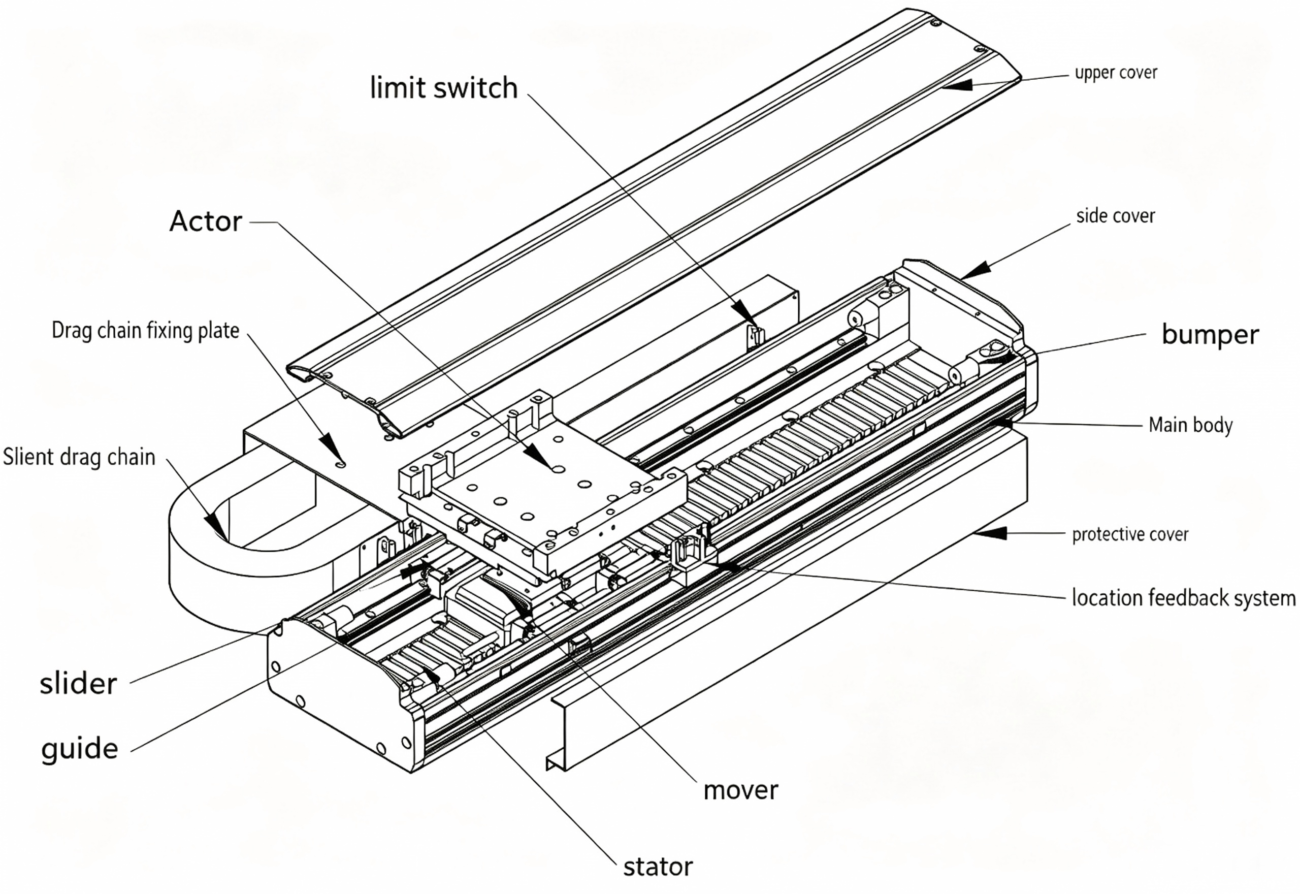
In a permanent-magnet linear motor, the motor generally consists of:
A primary or stator, containing electromagnetic coils
A secondary or mover, containing permanent magnets
A linear guide or bearing system that supports the moving assembly
Position feedback and a motor controller
When controlled electrical current flows through the coils, a magnetic field is generated.
The controller continuously regulates the current in the individual phases. The resulting magnetic field moves along the motor’s travel direction.
The permanent magnets on the mover interact with this traveling magnetic field, generating electromagnetic thrust.
As the magnetic field moves, the mover follows it.
In simplified form:
Three-phase current → Traveling magnetic field → Magnetic interaction → Electromagnetic thrust → Linear motion
The direction of motion can be changed by changing the phase sequence or command direction.
The Working Principle of a Linear Induction Motor
A linear induction motor (LIM) operates differently from a permanent-magnet linear motor.
A useful way to understand it is to imagine taking a conventional three-phase squirrel-cage induction motor and cutting it along its radial direction, then laying it flat.
In a conventional rotary induction motor, three-phase AC power creates a rotating magnetic field.
In a linear induction motor, the same electromagnetic principle creates a traveling magnetic field.
When three-phase AC current is supplied to the primary winding, the magnetic field travels along the linear axis.
This traveling magnetic field induces an electrical current in the conductive secondary.
The interaction between the induced current and the traveling magnetic field produces electromagnetic thrust.
The secondary therefore moves in the same general direction as the traveling magnetic field.
This is the fundamental operating principle of a linear induction motor.
Linear Motor vs. Rotary Motor
The easiest way to understand the difference is to compare their electromagnetic motion.
Rotary Motor
Linear Motor
Produces rotational torque
Produces linear thrust
Magnetic field rotates
Magnetic field travels linearly
Drives a rotating shaft
Drives a linear mover
Often requires transmission components for linear motion
Can provide direct linear motion
Uses gears, belts or screws when linear output is required
Can eliminate many mechanical transmission components
A linear motor does not fundamentally “convert rotation into translation.” Instead, it produces translation directly.
Basic Structure of a Linear Motor
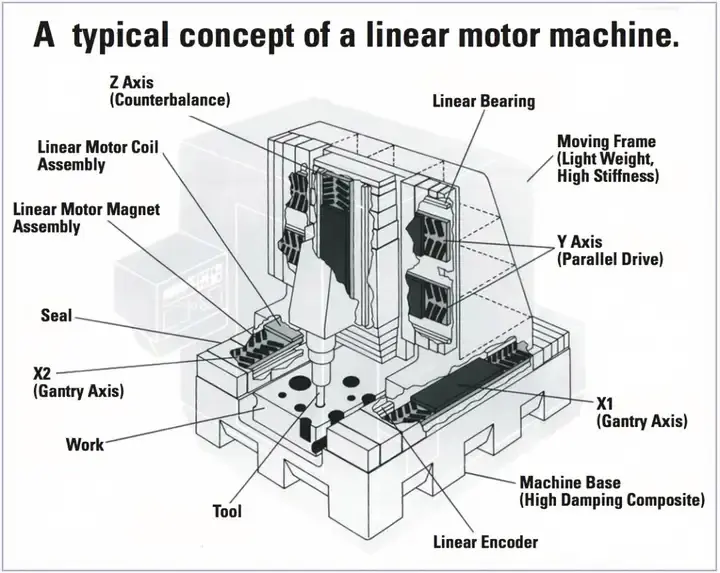
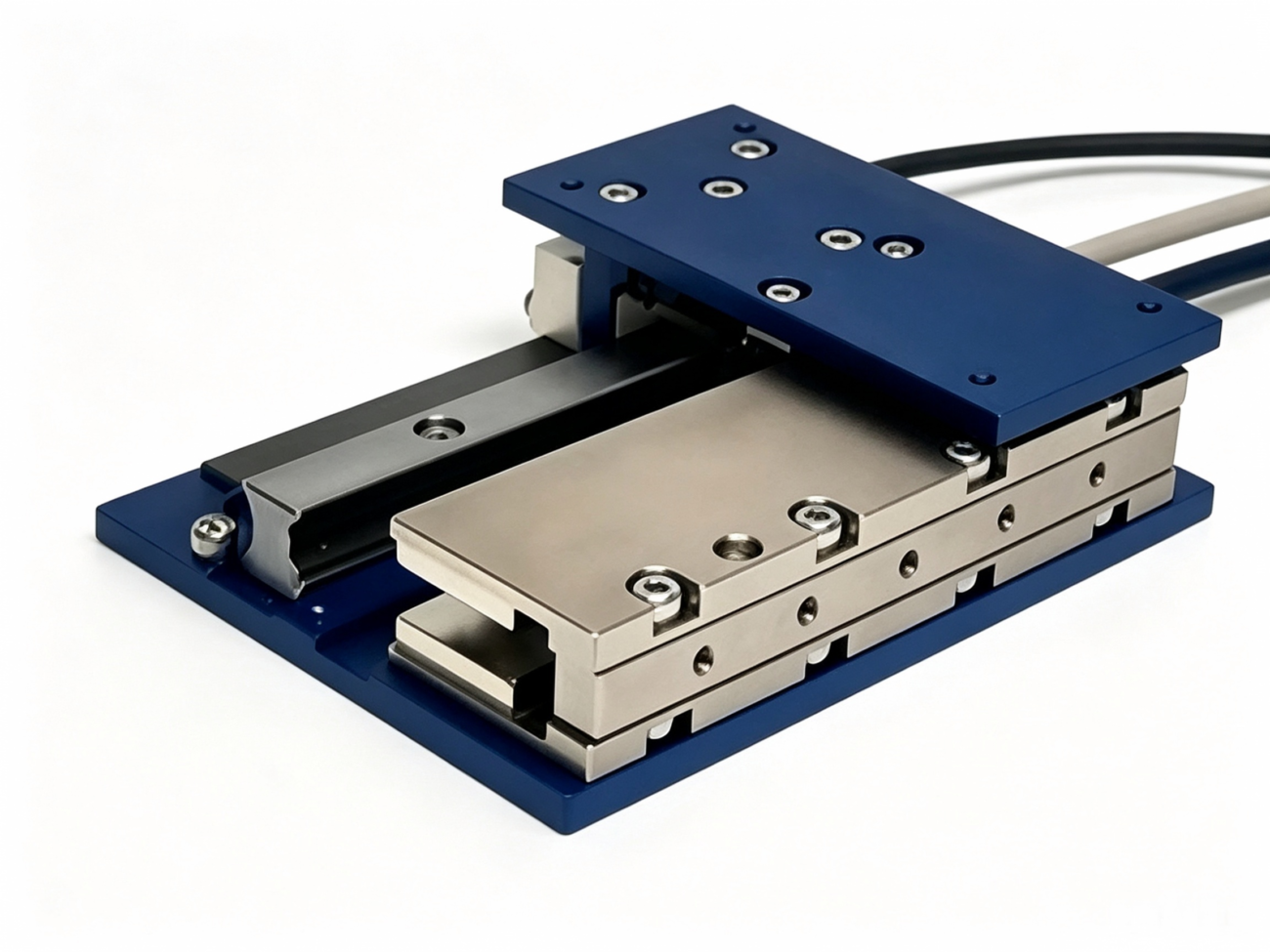
Although linear motors come in many configurations, a typical system includes three main functional parts:
Primary/stator
Secondary/mover
Linear support and guidance system
Additional components, such as position sensors and servo drives, are normally required in a complete motion-control system.
1. Primary or Stator
The primary is the electromagnetic section of the motor.
It normally contains:
Laminated iron cores
Copper windings
Insulation
Motor housing or structural support
When current flows through the windings, they generate the magnetic field required to create thrust.
The laminated iron core is commonly made from electrical steel or silicon steel. Its magnetic properties help guide the magnetic flux and reduce electromagnetic losses.
In precision applications, the design of the magnetic circuit is particularly important because variations in magnetic force can influence thrust ripple, vibration, heat generation, and positioning performance.
2. Secondary or Mover
The secondary is the part that moves relative to the primary.
Its construction depends on the type of linear motor.
For a permanent-magnet linear motor, the mover or magnetic track typically contains permanent magnets arranged with alternating magnetic polarity.
For a linear induction motor, the secondary may consist of a conductive plate, such as aluminum or copper, or another suitable electromagnetic structure.
The mover transfers the generated electromagnetic thrust to the machine’s load.
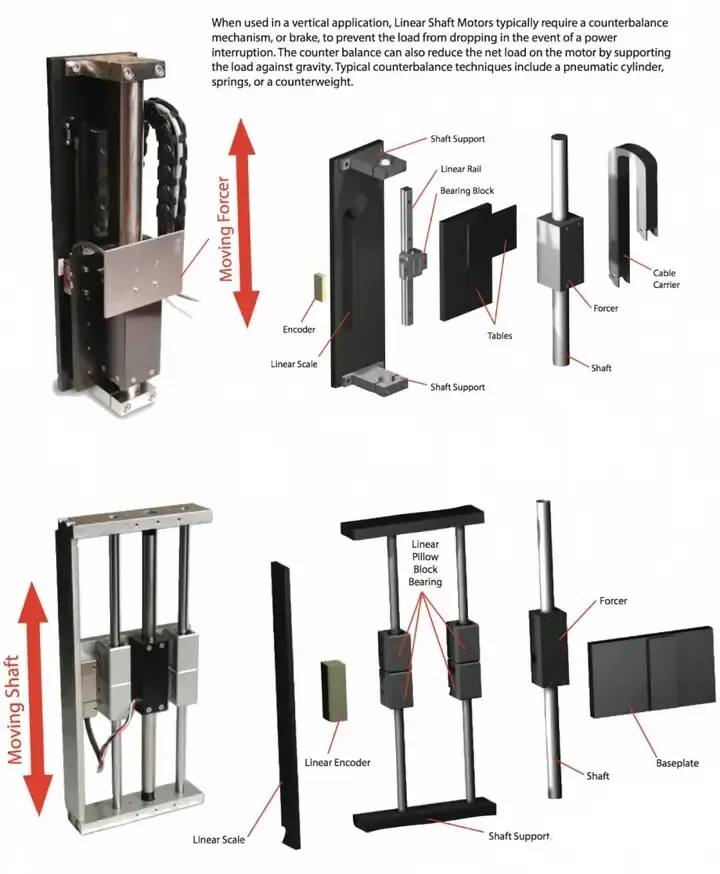
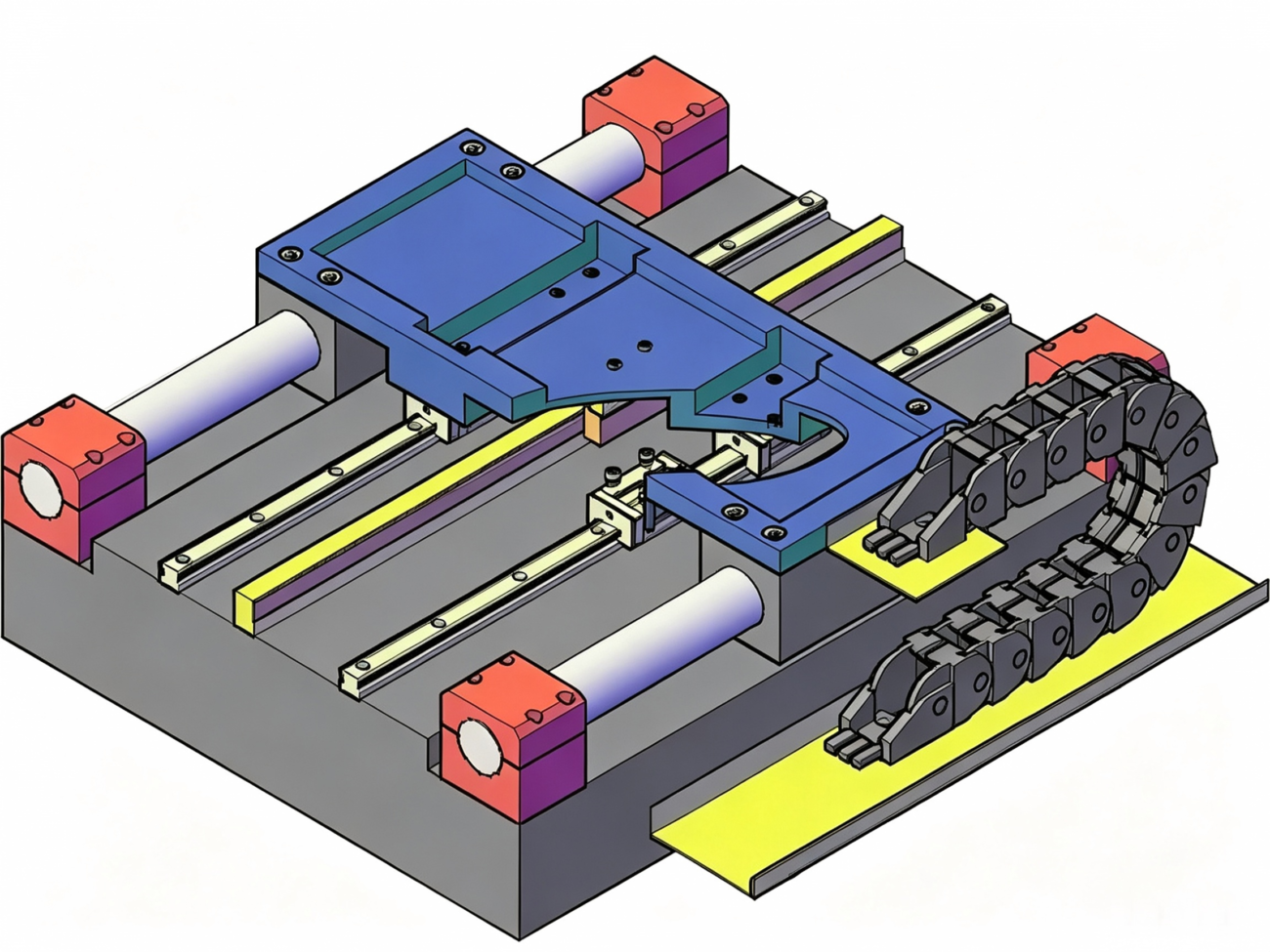
3. Linear Guide and Support System
A linear motor generates thrust, but it does not necessarily provide the mechanical guidance required to constrain the load to a specific path.
Therefore, a complete linear motion system usually requires:
Linear guides
Bearings
Rails
Structural supports
Position feedback devices
The guide system determines the mechanical travel direction and supports the moving load.
This distinction is important:
The linear motor generates force; the guide system controls the mechanical path.
What Is a Traveling Magnetic Field?
The concept of a traveling magnetic field is one of the most important ideas in understanding linear motor operation.
In a conventional AC rotary motor, three-phase current produces a rotating magnetic field.
In a linear motor, the spatial arrangement of the windings is extended along a straight line. As the phase currents change over time, the peak of the magnetic field effectively moves from one section of the motor to another.
This creates a magnetic wave traveling along the motor.
The mover interacts with this traveling magnetic field and is pulled or pushed along the linear axis.
The direction of the traveling field depends on the phase sequence of the electrical input.
Therefore, reversing the phase sequence can reverse the direction of motion.
Linear Motor Speed and Pole Pitch
For many AC linear motors, synchronous linear speed is related to electrical frequency and pole pitch.
A commonly used relationship is:
vₛ = 2τf
where:
vₛ = synchronous linear speed
τ = pole pitch
f = electrical supply frequency
This relationship shows why motor speed can be controlled by changing the electrical frequency.
In a servo-driven linear motor, however, actual mover speed is controlled by the complete motion-control system, including the drive, feedback device, current loop, velocity loop, and position loop.
For a linear induction motor, the actual mover speed is normally lower than synchronous speed because of slip, which is necessary for electromagnetic induction and thrust production.
How Is Linear Motor Motion Controlled?
Modern linear motor systems are usually controlled by a servo drive and a motion controller.
The control system continuously monitors the position and speed of the mover and adjusts motor current accordingly.
Common control technologies include:
PID control
Vector control
Field-oriented control
Feedforward control
Adaptive control
Robust control
Sliding-mode control
Fuzzy logic control
Neural-network-based control
In high-precision applications, the position feedback system is particularly important.
Linear encoders can measure the actual position of the moving axis and provide feedback to the controller.
The controller can then correct position errors in real time.
This closed-loop architecture is one of the reasons linear motors can achieve extremely high positioning accuracy and dynamic response.
With fewer mechanical transmission components, the moving system can respond more quickly to changes in the motion command.
This is especially valuable when a machine must repeatedly accelerate, decelerate, reverse direction, and stop within a very short distance.
Advantages of Linear Motors
1. Direct Linear Drive
The motor produces linear thrust directly, eliminating the need to convert rotary motion into linear motion.
This can simplify the mechanical architecture and reduce transmission-related errors.
2. High Acceleration
Because there is no long mechanical transmission chain such as a ball screw, the system can achieve very high acceleration and deceleration.
This makes linear motors suitable for applications requiring rapid positioning and short cycle times.
3. High-Speed Operation
Linear motors can achieve high linear speeds while maintaining excellent dynamic response.
Their performance is especially useful in high-speed machine tools, semiconductor manufacturing equipment, automation systems, and precision stages.
4. High Positioning Accuracy
Removing mechanical backlash and reducing transmission deformation can improve positioning accuracy and repeatability.
When combined with a high-resolution linear encoder and a suitable servo controller, linear motor systems can provide extremely precise motion.
5. Fast Dynamic Response
The elimination of mechanical transmission components reduces mechanical inertia and compliance.
As a result, the system can respond quickly to acceleration, deceleration, reversal, and positioning commands.
6. Low Mechanical Wear
Because the motor can operate without gears, belts, and ball screws, there are fewer mechanical contact components that can wear out.
This can reduce maintenance requirements and extend system life.
7. Flexible Mechanical Integration
Linear motors can be integrated directly into machine structures.
They are available in different shapes and configurations, allowing engineers to design compact and highly integrated motion systems.
Linear Motor Applications
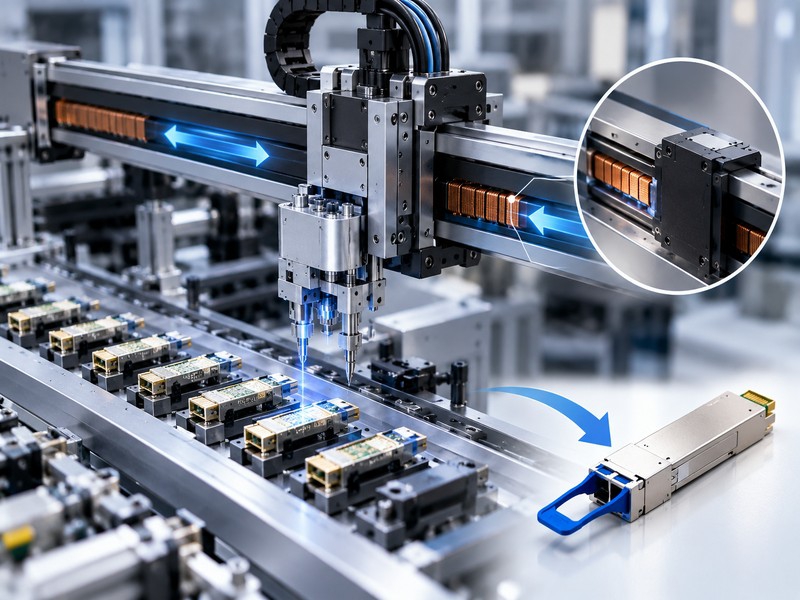
CNC Machine Tools
Linear motors are used for high-speed feed axes where rapid acceleration and precise positioning are required.
Compared with conventional ball-screw systems, linear motors can reduce mechanical transmission errors and improve dynamic performance.
Semiconductor Manufacturing
Semiconductor production requires extremely accurate and repeatable motion.
Linear motors are therefore used in:
Wafer stages
Inspection equipment
Lithography-related motion systems
Pick-and-place equipment
Precision positioning platforms
Industrial Automation
Linear motors can provide rapid and repeatable movement for automated production systems.
Typical applications include material handling, assembly, inspection, packaging, and high-speed pick-and-place machines.
Robotics
Linear motor technology can be used in linear robotic axes and high-speed positioning mechanisms.
It is particularly useful where fast acceleration and precise positioning are required.
Transportation
Linear motor technology has also been used in transportation systems.
Linear Motor vs. Ball Screw: Which Is Better?
Feature
Linear Motor
Ball Screw
Motion
Direct linear motion
Rotary-to-linear conversion
Speed
⭐⭐⭐⭐⭐
⭐⭐⭐
Acceleration
⭐⭐⭐⭐⭐
⭐⭐⭐
Accuracy
⭐⭐⭐⭐⭐
⭐⭐⭐⭐
Backlash
Minimal
Low, but possible
Response Time
Very fast
Moderate
Maintenance
Low
Moderate
Travel Length
Excellent
Limited by screw length
High-Speed Performance
Excellent
Moderate
Initial Cost
High
Lower
Thermal Management
Important
Important
Mechanical Wear
Low
Higher
Best Application
High-speed precision motion
Cost-effective general motion
Linear Motor Working Principle: Key Takeaways
The fundamental principle behind a linear motor is simple:
Electrical current creates a magnetic field, and electromagnetic interaction converts that field into linear thrust.
For linear induction motors, a traveling magnetic field induces permanent-magnet linear motors, the interaction between energized coils and permanent magnets generates the force that moves the mover.
For linear induction motors, a traveling magnetic field induces current in a conductive secondary, and the interaction between the induced current and magnetic field generates thrust.
The major difference between linear and rotary motors is therefore not the basic laws of electromagnetism, but the way electromagnetic force is converted into mechanical motion.
A rotary motor produces torque.
A linear motor produces thrust.
By eliminating many mechanical transmission components, linear motors can offer high speed, high acceleration, high positioning accuracy, rapid response, and low mechanical transmission error.
However, their higher initial cost, thermal management requirements, magnetic forces, and installation requirements must also be considered.
For modern automation, precision manufacturing, semiconductor equipment, CNC machine tools, robotics, and other high-performance motion systems, linear motor technology provides an important alternative to traditional rotary motor and mechanical transmission solutions.
Frequently Asked Questions About Linear Motors
What is a linear motor?
A linear motor is an electric motor that converts electrical energy directly into linear mechanical motion instead of producing rotational motion.
How does a linear motor work?
A linear motor works by generating an electromagnetic field that interacts with permanent magnets or an induced current to produce linear electromagnetic thrust.
What is the difference between a linear motor and a rotary motor?
A rotary motor produces rotational torque, while a linear motor produces direct linear thrust. A rotary motor generally requires additional mechanical components to create linear motion.
Do linear motors need a ball screw?
No. One of the main advantages of a linear motor is that it can directly drive a linear load without a ball screw, gearbox, or other rotary-to-linear transmission mechanism.
Are linear motors more accurate than ball screws?
They can be, particularly in high-speed precision applications, because they eliminate backlash and many transmission errors associated with mechanical drive components. Actual system accuracy still depends on the motor, encoder, guide system, controller, machine structure, and installation.
What controls the speed of a linear motor?
Speed is controlled by the motor drive and motion controller. Depending on the motor type and control architecture, electrical frequency, phase current, feedback, and motion commands are used to control speed and position.
Where are linear motors used?
Linear motors are commonly found in CNC machines, semiconductor equipment, precision stages, industrial automation, robotics, inspection systems, transportation systems, and other applications requiring fast and precise linear motion.
HCY Automation delivers integrated solutions across motion control, linear motion, robotics, machine vision, pneumatic systems, and precision gearboxes to help global manufacturers build smarter, faster, and more reliable production lines. Our engineering team helps you select and integrate the right motion control, robotics, and automation components for your specific application.