Variable Pitch Module vs Ball Screw Linear Module: Key Differences & Selection Guide
In industrial automation, choosing the right motion system is rarely just about speed or accuracy.
A machine may need to move one component from Point A to Point B. But in many modern production lines, the real challenge is different: multiple products need to be picked at one spacing, processed at another, and placed at a completely different pitch.
That is where a variable pitch module becomes useful.
A ball screw linear module, by comparison, is primarily designed to provide controlled, repeatable linear positioning. It is widely used when an axis needs high rigidity, accurate positioning, and reliable thrust.
Although both technologies involve linear motion, they solve different engineering problems.
This guide explains the difference between a variable pitch module and a ball screw linear module, how each mechanism works, where they are commonly used, and what engineers should consider when selecting one for an automation system.
Variable Pitch Module vs. Ball Screw Module at a Glance
The easiest way to understand the difference is to look at what each system is designed to control.
Feature
Variable Pitch Module
Ball Screw Linear Module
Primary function
Change the spacing between multiple workpieces or tooling stations
Provide precise linear positioning
Main motion
Multiple stations move relative to each other
One carriage moves along an axis
Pitch
Adjustable Pitch System
Normally fixed by the mechanical layout
Typical mechanism
Cam, screw, belt, linkage, or other pitch-adjustment mechanism
Ball screw and nut
Main advantage
Flexible spacing and synchronized multi-position handling
A ball screw module controls position. A variable pitch module controls the relationship between positions.
That distinction becomes important when designing high-throughput automation equipment.
What Is a Ball Screw Linear Module?
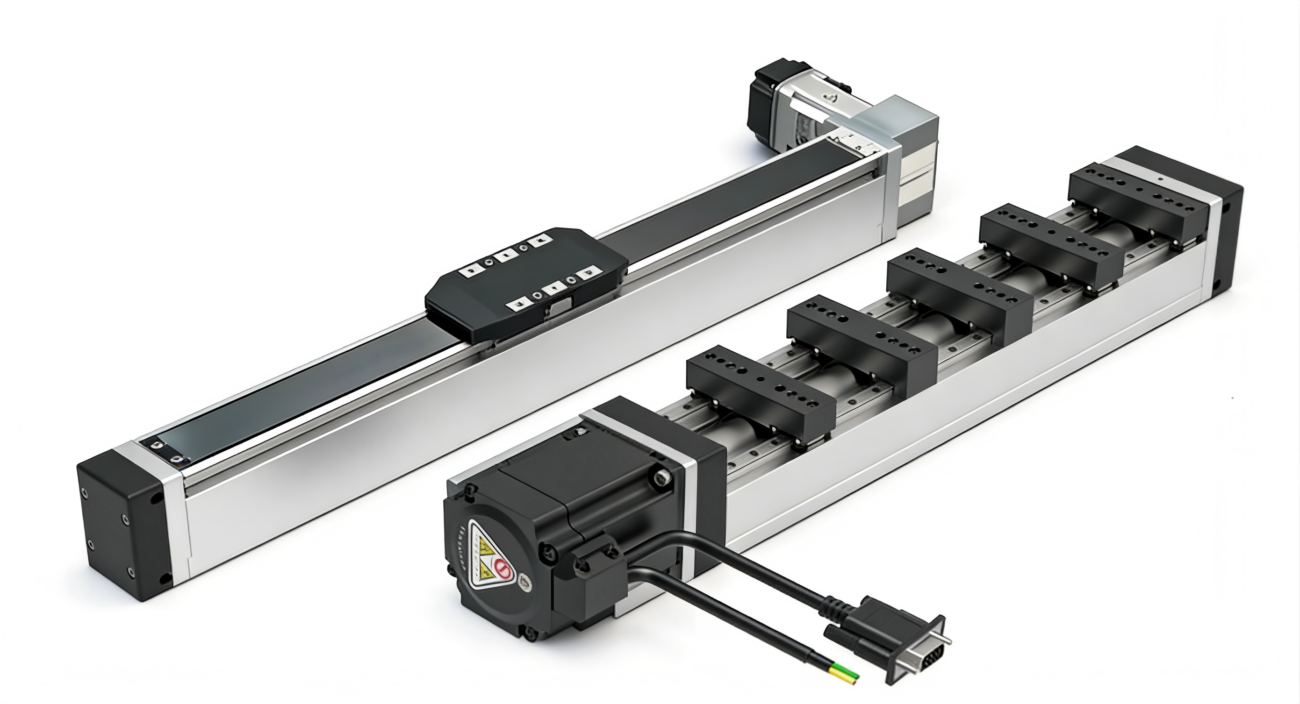
A ball screw linear module converts the rotary motion of a motor into linear movement.
A typical system consists of:
Servo or stepper motor
Ball screw
Ball nut
Linear guide
Moving carriage
Coupling and support bearings
Sensors or limit switches
When the motor rotates the ball screw, the ball nut travels along the screw and moves the carriage.
Because the balls roll between the screw and nut rather than sliding directly against the surfaces, a ball screw can provide high efficiency, low friction and good positioning performance.
This makes ball screw modules a common choice for applications where positioning accuracy, rigidity and controlled thrust are important. They are frequently used in assembly, inspection, dispensing and other precision automation processes.
What does a ball screw module actually do?
Imagine a machine that needs to move a gripper exactly 250 mm.
The requirement is straightforward:
Move the carriage to 250 mm, stop, perform the operation, and return or move to the next position.
A ball screw linear module is well suited to this type of motion.
The mechanical transmission is predictable, and the servo system can control position, velocity and acceleration according to the required motion profile.
For applications requiring high thrust or precise positioning over a short-to-medium stroke, ball screw systems are often a practical solution.
What Is a Variable Pitch Module?
A variable pitch module solves a different problem.
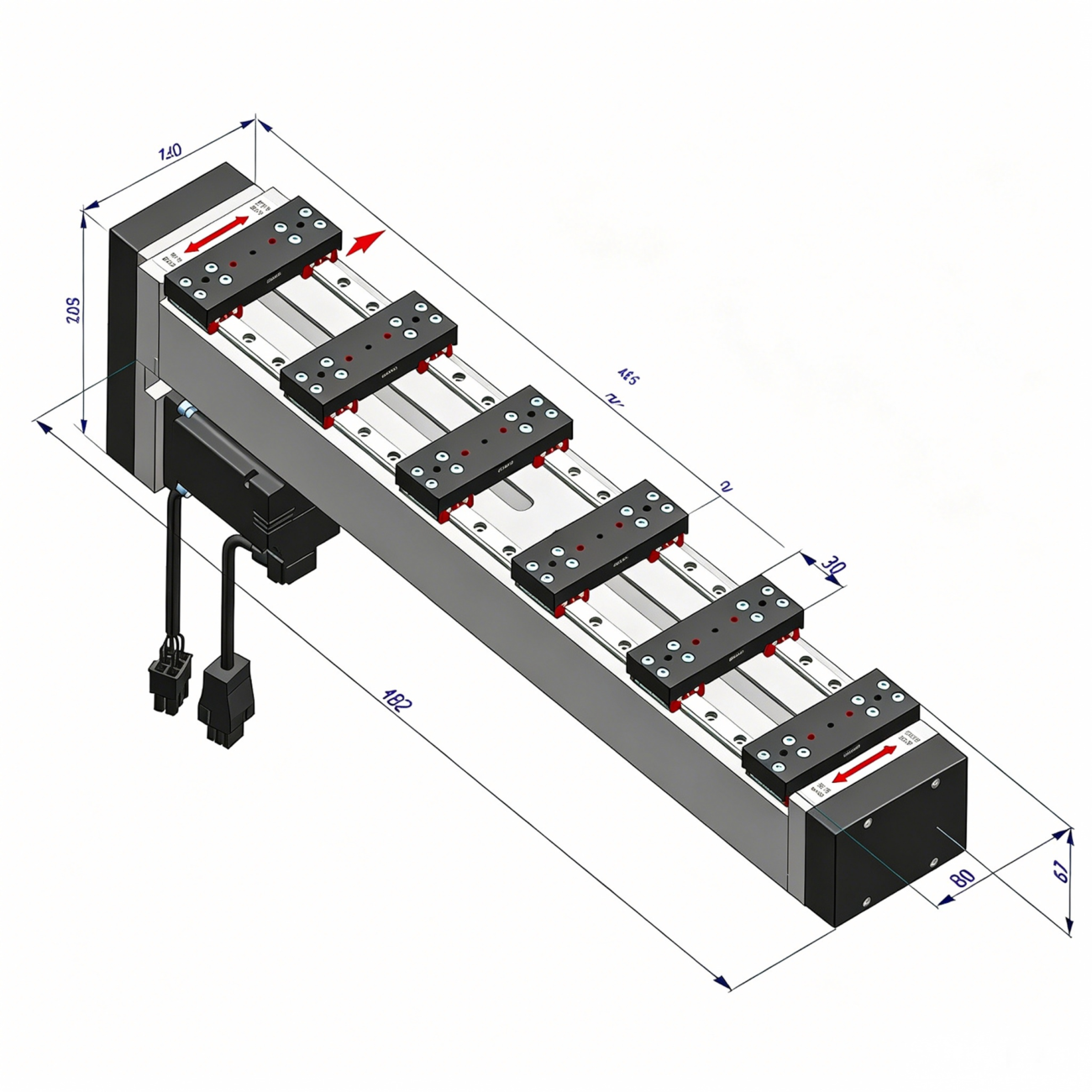
Instead of simply moving one carriage along a fixed axis, it changes the distance between multiple products, Variable Pitch Gripper, nozzles, fixtures or workstations.
For example, imagine six products arriving on a conveyor at a 20 mm pitch.
The next machine requires the six products to be positioned at 40 mm intervals.
A conventional linear axis can move the entire group from one location to another, but it does not automatically solve the spacing problem.
A variable pitch mechanism can.
The module can pick the products at the original pitch, expand or reduce the spacing, and then place them at the required pitch.
This type of motion is commonly used in pick-and-place, packaging, tray loading, labeling, assembly and inspection applications. Rop+1
In other words:
Variable pitch technology changes the spacing between positions rather than simply changing the position of one carriagewith Multi Position Handling System
How Does a Variable Pitch Module Work?
There is no single mechanical design for a variable pitch module.
The mechanism depends on the required pitch range, number of stations, load, speed, accuracy and available installation space.
Common approaches include:
1. Cam-Based Variable Pitch Mechanism
A cam profile controls the movement of multiple followers.
As the cam rotates, each follower follows a predetermined path, causing the attached grippers or tooling to move according to a defined pitch profile.
The advantage is that the motion relationship can be mechanically synchronized.
For high-cycle automation, this can be useful when the pitch-change movement is repetitive and predictable.
2. Screw-Based Pitch Adjustment
A screw mechanism can move multiple stations simultaneously.
Dep
ing on the screw geometry and connection structure, one motor can control several moving elements and change their relative spacing.
This approach can provide good positioning control and is suitable for applications where pitch accuracy is important.
3. Belt or Pulley-Based Mechanisms
Timing belts and pulley arrangements can also be used to coordinate multiple moving components.
Belt-driven mechanisms are particularly attractive when the design prioritizes speed, long travel or relatively low moving mass.
4. Linkage or Scissor Mechanisms
Some variable pitch systems use mechanical linkages to expand or contract several stations simultaneously.
These designs can be compact and effective when the required pitch movement follows a defined geometric relationship.
The important engineering principle is that the mechanism must coordinate several positions at the same time.
That is fundamentally different from a conventional single-axis linear actuator.
Variable Pitch Is Not the Same as Variable Transmission Ratio
This is an important distinction that is sometimes overlooked.
A variable pitch module does not necessarily mean that the motor’s transmission ratio is continuously changing.
The purpose is usually to change the relative spacing between multiple output positions.
For example:
Input pitch: 25 mm → Output pitch: 50 mm
or:
Input pitch: 50 mm → Output pitch: 30 mm
The exact mechanical relationship depends on the design of the pitch-change mechanism.
In a real machine, the adjustable pitch module may work together with a robot, linear axis, servo actuator, vacuum gripper or other tooling. Commercial systems are commonly designed to mount on robotic or linear motion platforms and change the spacing between parts during pick-and-place operations. Rop
The Main Difference: Positioning vs. Pitch Control
This is the most useful way for engineers to think about the two technologies.
Ball Screw Module: “Where should the carriage go?”
A ball screw module is primarily concerned with:
Position
Stroke
Speed
Acceleration
Thrust
Repeatability
Rigidity
The basic motion is usually:
Motor rotation → screw rotation → nut movement → linear carriage movement
It is essentially a controlled linear axis.
Variable Pitch Module: “How far apart should these stations be?”
This is why comparing the two purely in terms of “accuracy” or “speed” can be misleading.
They are often solving different problems.
Variable Pitch Module vs. Ball Screw Module: Accuracy
Accuracy requirements depend heavily on the application.
A ball screw module is typically selected when the machine needs a defined linear position with high repeatability and rigidity.
For example:
Move a dispensing head to a specific coordinate
Position a camera for inspection
Move a fixture into an assembly station
Control the vertical position of a tool
Automatic pitch adjustment system, however, needs to maintain the required relationship between multiple stations.
If six grippers are supposed to remain evenly spaced, the engineering challenge is not simply the absolute position of one gripper.
The relationship between all six grippers matters.
This means designers need to consider:
Pitch accuracy
Pitch repeatability
Synchronization error
Mechanical clearance
Backlash
Load distribution
Tooling stiffness
For a variable pitch system, relative positioning can be just as important as absolute positioning.
Speed and Cycle Time
High-speed automation often makes the difference between these technologies more obvious.
A ball screw system is excellent for controlled positioning, but screw speed, screw length, inertia, vibration and critical-speed limitations need to be considered as travel speed increases. Belt-driven linear systems, for example, are commonly selected for long travel and high-speed transfer applications. Skr Linear Module+1
A variable pitch mechanism has another consideration:
How quickly can the pitch change without disturbing the product?
Suppose a packaging machine handles 10 products simultaneously.
The machine may need to:
Pick products at one pitch.
Transport them.
Expand the pitch.
Match the packaging pockets.
Place all products.
Return to the initial pitch.
The pitch-changing motion becomes part of the machine’s cycle time.
Therefore, engineers should evaluate the complete motion profile rather than looking only at the motor’s rated speed.
Applications of Variable Pitch Modules
Variable pitch technology becomes especially useful when products need to move between processes with different spacing requirements.
Packaging Automation
Packaging machines frequently have different pitch requirements between feeding, inspection and packaging stations.
For example:
Infeed pitch → inspection pitch → packaging pitch
A variable pitch module can help synchronize these different stages without requiring a completely separate handling system for every pitch.
Variable-pitch pick-and-place systems are already used for packaging operations where products must be picked at one spacing and placed at another. Rop+1
Pick and Place
Multiple products can be picked simultaneously and repositioned into the spacing required by the next process.
This can reduce repeated individual handling movements.
Typical examples include:
Electronic components
Small mechanical parts
Food products
Pharmaceutical packaging
Consumer goods
Battery components
Tray Loading and Unloading
Products may arrive in a tray at a fixed grid pitch while the next process uses a different fixture or carrier pitch.
A variable pitch mechanism can bridge the difference.
This principle has also been used in electronic component packaging, where pick-and-place tooling changes the spacing of multiple vacuum nozzles before placing components into another packaging format.
Assembly Automation
In assembly lines, different stations may require different component spacing.
A variable pitch mechanism can reposition several components simultaneously before they enter:
Assembly fixtures
Testing stations
Bonding equipment
Fastening stations
Inspection systems
Vision Inspection
Spacing can also affect machine vision.
If products are too close together, they may overlap in the camera’s field of view or make individual inspection more difficult.
Expanding the pitch before inspection can create a more consistent inspection layout.
Where Ball Screw Modules Make More Sense
Ball screw linear modules remain a strong choice when the machine primarily requires controlled linear positioning.
Typical applications include:
Precision assembly
Dispensing
Inspection
Measuring equipment
CNC-related machinery
Vertical lifting
High-thrust positioning
Robotic linear axes
They are especially useful when the machine needs a combination of precision, rigidity and axial force.
For example, if a machine only needs to move a 20 kg fixture along a 500 mm stroke and position it accurately at several points, there may be no reason to introduce a variable pitch mechanism.
A conventional ball screw linear axis may be simpler.
When Should You Choose a Variable Pitch Module?
A variable pitch module becomes more relevant when several conditions exist at the same time.
Consider it when:
Multiple products must be handled simultaneously.
Input and output pitches are different.
Several grippers or tooling stations need synchronized movement.
Product spacing changes between production processes.
Fast format changes are required.
Packaging or assembly stations use different pitches.
The machine needs to reduce individual pick-and-place movements.
Compact multi-station handling is required.
A useful engineering question is:
Does the machine need to move products, or does it need to change the relationship between products?
If the main requirement is simply moving one load from one position to another, a conventional linear module may be sufficient.
If the machine needs to change the spacing between multiple loads, a variable pitch solution deserves closer consideration.
How to Select the Right Motion Solution
Instead of starting with the product name, start with the motion requirements.
Step 1: Define the Payload
Calculate the weight of:
Workpieces
Grippers
Vacuum cups
Fixtures
Tooling
Moving mechanisms
Do not evaluate payload by product weight alone.
Step 2: Define the Motion Profile
Specify:
Stroke
Maximum speed
Acceleration
Deceleration
Cycle time
Number of cycles per minute
Duty cycle
These parameters can have a significant impact on the mechanical design.
Step 3: Define the Pitch
For variable pitch applications, clearly identify:
Input pitch → Required output pitch
Also define:
Minimum pitch
Maximum pitch
Number of stations
Equal or unequal spacing
Required pitch repeatability
Step 4: Check the Installation Space
Variable pitch mechanisms can be highly integrated, but the required movement envelope still needs to be checked.
Look at:
Overall length
Width
Height
Tooling interference
Cable routing
Maintenance access
Step 5: Consider the Product
The product itself can determine the mechanism.
Important factors include:
Product dimensions
Weight
Surface condition
Fragility
Center of gravity
Allowable gripping force
Required orientation
For example, a high-speed pitch-change mechanism may not be suitable if the product is unstable or easily damaged during acceleration.
Step 6: Consider Changeover Requirements
If the machine needs to handle multiple product sizes, ask whether the pitch needs to be:
Fixed
Manually adjustable
Servo adjustable
Recipe controlled
Continuously variable
This can have a major impact on the final architecture.
Can a Variable Pitch Module and Ball Screw Module Be Used Together?
Yes.
In fact, they can complement each other.
A machine may use a ball screw linear module as the main positioning axis while using a variable pitch mechanism at the end of the axis.
For example:
Ball screw axis → moves tooling between stations
Variable pitch mechanism → adjusts spacing between multiple grippers
This combination separates two different motion requirements.
The linear axis controls where the tooling goes.
The variable pitch mechanism controls how the tooling is arranged.
This architecture can be particularly useful in automated packaging, assembly and pick-and-place equipment.
Common Design Mistakes
Mistake 1: Comparing Them Only by Positioning Accuracy
Accuracy is important, but it is not the whole story.
If the machine needs to change six product positions simultaneously, the key question is not simply whether the axis can achieve ±X mm positioning.
The designer also needs to understand pitch repeatability and synchronization between stations.
Mistake 2: Treating Variable Pitch as Just Another Linear Axis
A variable pitch system may contain linear movement, but its design objective is different.
A standard linear axis usually moves a carriage.
A variable pitch mechanism coordinates several moving elements.
That difference affects the mechanical design, control strategy and tooling.
Mistake 3: Ignoring the Gripper and Tooling
The pitch mechanism is only one part of the system.
The actual performance can also depend on:
Gripper mass
Vacuum response
Product friction
Tool stiffness
Cable drag
Acceleration
Product inertia
A pitch mechanism that looks adequate on paper may perform differently once the complete end-of-arm tooling is installed.
Mistake 4: Selecting the Mechanism Before Defining the Cycle
This approach usually produces a more practical machine design.
Variable Pitch Module or Ball Screw Module: Which One Fits Your Machine?
There is no universal winner because the two technologies are designed around different motion requirements.
Choose a ball screw linear module when your primary requirement is controlled linear positioning, high rigidity, repeatability and thrust.
Choose a variable pitch module when the machine needs to coordinate multiple products or tooling stations and change their relative spacing during the process.
And in more advanced automation systems, you may not have to choose between them.
A ball screw axis can provide the main linear movement, while a variable pitch mechanism handles the spacing adjustment.
The better approach is to look at the complete motion sequence rather than selecting a mechanism based on a single specification.
Frequently Asked Questions(FAQ))
What is a variable pitch module?
A variable pitch module is a motion system designed to change the distance between multiple products, grippers, fixtures, or tooling stations. It is commonly used when the input and output pitch of an automated process are different.
What is a ball screw linear module?
A ball screw linear module converts motor rotation into controlled linear motion through a ball screw and ball nut. It is commonly used for applications requiring accurate positioning, rigidity, repeatability, and controlled thrust.
What is the main difference between a variable pitch module and a ball screw module?
The main difference is the type of motion being controlled. A ball screw module primarily controls the linear position of a carriage, while a variable pitch module controls the relative spacing between multiple moving elements.
Can a ball screw be used in a variable pitch system?
Yes. A ball screw can be part of a variable pitch mechanism. In some designs, a screw-driven mechanism is used to move multiple stations and adjust their spacing. The exact design depends on the required pitch range, load, accuracy, speed, and number of stations.
Where are variable pitch slide modules used?
Variable pitch systems are commonly used in packaging, pick-and-place automation, tray loading, electronics assembly, inspection, sorting, and other applications where products need to be transferred between processes with different spacing requirements.
Are variable pitch modules suitable for high-speed automation?
They can be, but suitability depends on the mechanism, moving mass, acceleration, product stability, pitch range, and required cycle time. The complete motion profile should be evaluated rather than looking only at motor speed.
Can variable pitch and linear motion modules be used together?
Yes. A linear module can provide the main X/Y/Z positioning motion, while a variable pitch mechanism adjusts the spacing between multiple grippers or products.
How do I choose between a variable pitch module and a ball screw module?
Start with the actual motion requirement. If the machine mainly needs accurate linear positioning, a ball screw module may be appropriate. If several products or tooling stations need to change their relative spacing, a variable pitch solution may be more suitable.
Final Thoughts
The difference between a variable pitch module and a ball screw linear module comes down to one fundamental question:
Are you controlling the position of one moving element, or are you controlling the spacing between multiple moving elements?
A ball screw module is a proven solution for precise, controlled linear motion.
Automatic Pitch Adjustment System is designed for a different challenge: changing the distance between products, grippers or stations while keeping them synchronized.
As automation systems become faster and more flexible, pitch management is becoming increasingly important in packaging, electronics, assembly, inspection and material handling.
For machine builders, the best starting point is not the name of the mechanism. It is the actual motion requirement:
Once these parameters are clear, the right mechanical architecture becomes much easier to determine.
HCY-Your Complete Motion Integrator
HCY accepts customized variable pitch requirements. It is a precision motion solution designed for automated production systems, enabling synchronized spacing adjustment between multiple sliders, grippers, suction nozzles, or workstations. As a versatile industrial automation module, it is ideal for pick-and-place, assembly, sorting, packaging, semiconductor, electronics, and other automated applications.
HCY Automation delivers integrated solutions across motion control, linear motion, robotics, machine vision, pneumatic systems, and precision gearboxes to help global manufacturers build smarter, faster, and more reliable production lines. Our engineering team helps you select and integrate the right motion control, robotics, and automation components for your specific application.