Wondering what affects linear motor positioning accuracy? Explore mechanical assembly, encoder installation, servo control, load, motion parameters and environmental interference, with practical micron-level test data for precision automation design.
Linear motors are widely adopted for high-precision direct-drive automation in semiconductor equipment, inspection machinery, laser processing and robotic platforms. Many automation engineers encounter a confusing phenomenon: identical linear motor models deliver vastly different positioning performance when installed on different machines.
what determines linear motor precision, linear motor positioning accuracy factors, linear encoder installation error, double-sided linear motor end effect, thermal drift linear motor, linear motor servo control algorithm, direct drive motion control
The precision of a linear motor is never determined by the motor hardware alone. It is a combined result of mechanical structure, feedback system, servo control algorithm, load characteristics, motion profiles and operating environment. Every factor interacts dynamically and introduces measurable positioning deviation.
1. Mechanical Structure & Assembly Quality
Mechanical design, manufacturing tolerance and assembly workmanship build the foundation of achievable precision. Core components include linear guides, sliders, stator tracks and mounting bases. Matching clearance, structural rigidity and flatness directly decide basic motion stability.
Among all mechanical error sources, linear encoder installation error ranks first. Misalignment between the readhead and linear scale distorts position feedback data, triggering persistent positioning inaccuracy.
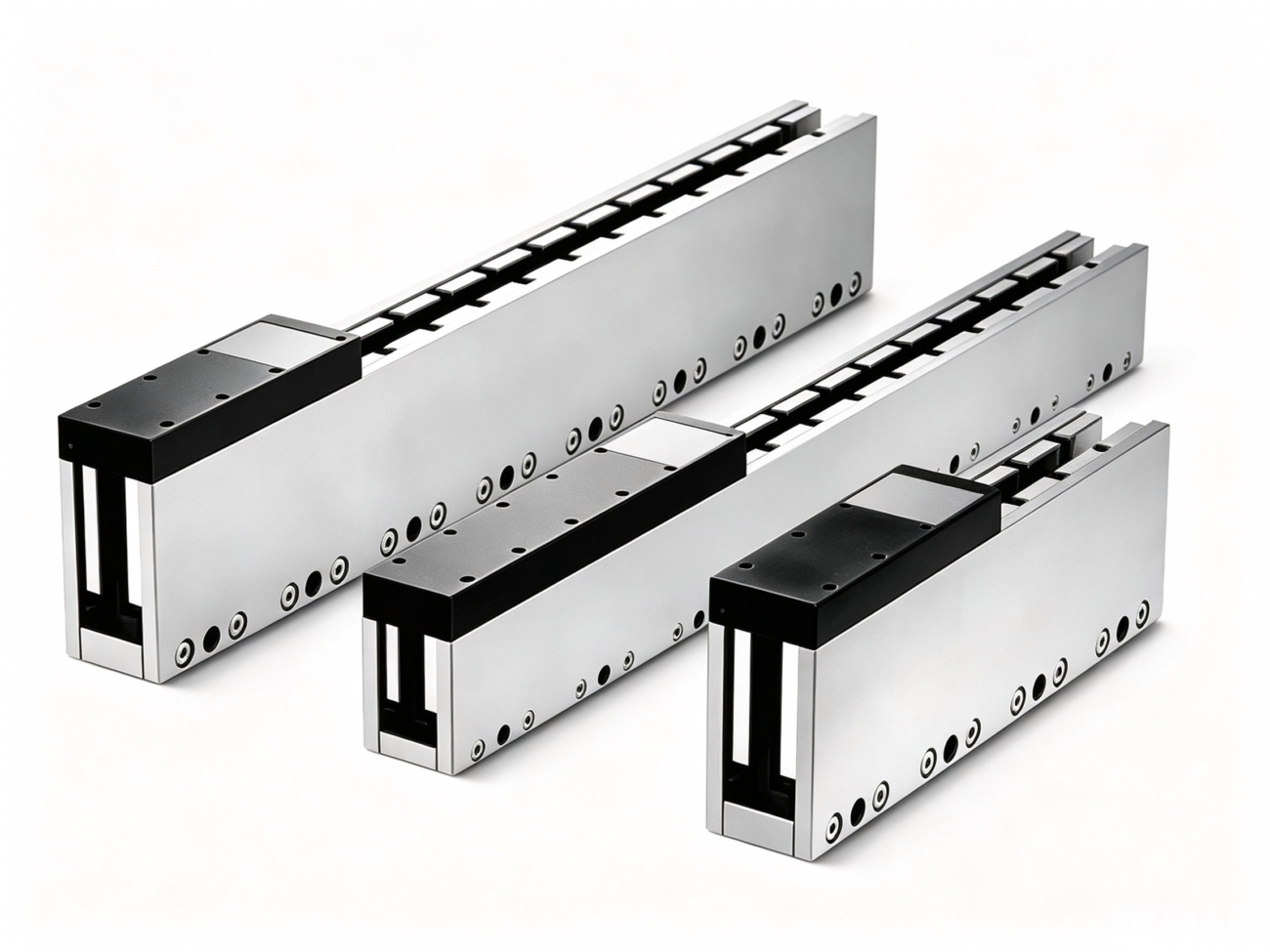
Structural design also matters greatly. Double-sided linear motors feature symmetric electromagnetic coupling on both sides. Compared with single-sided linear motor configurations, they can reduce end effect interference by approximately 30%, effectively lowering force ripple and positioning jitter at stroke endpoints.
2. Servo Control System Design
The servo system acts as the “brain” of linear motion. Critical elements include position feedback sensor resolution, drive sampling performance and motion control algorithms.
Traditional PID control tends to produce overshoot during high-speed positioning cycles. By contrast, compound control combining feedforward compensation and fuzzy control can cut system response time by 40%, greatly improving dynamic positioning stability.
3. Load Characteristics
Payload mass and moving inertia create variable friction and inertial force during acceleration and deceleration. Unbalanced loads or offset center of gravity introduce micro-deformation and tiny positioning errors that cannot be eliminated by control algorithms alone. Proper load matching is essential to maintain consistent precision over long-running cycles.
4. Motion Operating Parameters
Speed, acceleration and deceleration profiles exert obvious influence on final positioning results:
- Under low-speed operation (<1 m/s), well-tuned linear motor systems can reach positioning accuracy up to ±0.1 μm.
- Once speed exceeds 2 m/s and actual load surpasses 50% of the rated value, positioning accuracy typically degrades to ±1 μm or worse.
Long-term mechanical wear will also gradually reduce precision after thousands of operating hours.
5. Working Environmental Conditions (Easily Overlooked)
Environmental disturbance is frequently underestimated in precision motion system design.
- Temperature drift: Every 1 ℃ temperature rise causes stator iron core thermal expansion, generating 0.3–0.5 μm positioning deviation.
- Vibration interference: Within the vibration frequency range of 10–100 Hz, every additional 1 g acceleration worsens repeat positioning accuracy by 0.2 μm.
- Humidity and electromagnetic interference may corrupt encoder signals and trigger unstable positioning.
Summary
Linear motor positioning accuracy is affected by multiple interactive factors. To obtain stable micron-level precision, systematic optimization is required across mechanical assembly, feedback device selection, servo tuning, load matching, motion profile planning and environmental control.
Engineers should evaluate all relevant conditions in the early machine design phase instead of relying solely on motor datasheet parameters.