What Is a Linear Actuator Motor? How Is It Different from a Linear Motor?
Learn what a linear actuator motor is, how electric linear actuators and direct drive linear motors work, and how to choose the right linear motion solution for speed, thrust, precision, and cost.
1. What Is a Linear Actuator Motor?
A linear actuator is a device that produces straight-line motion. In industrial automation, an electric linear actuator commonly uses a rotary motor combined with a mechanical transmission system to move a load along a straight path.
Depending on the design, the transmission mechanism may use a ball screw, lead screw, belt, or another mechanical drive.
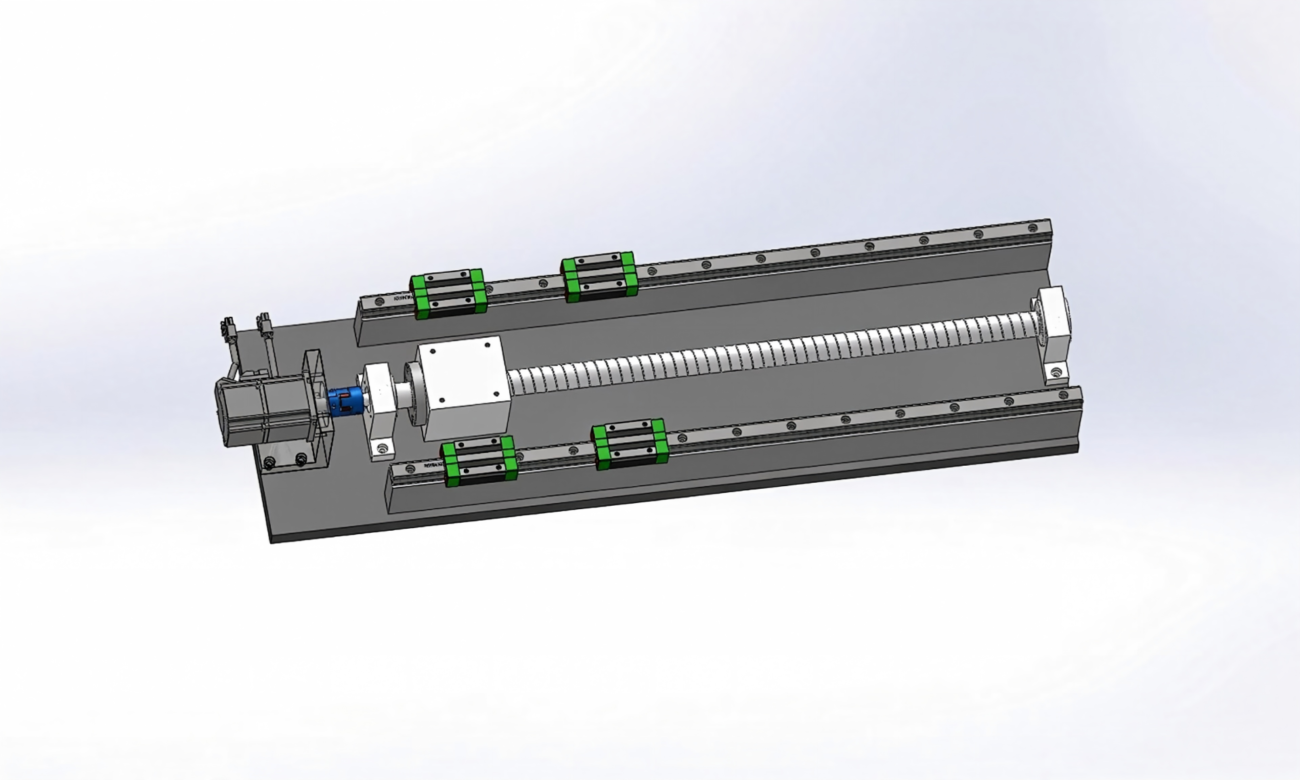
For example, a typical ball screw linear actuator converts the rotary motion of a servo or stepper motor into linear displacement. The motor rotates the screw, and the nut moves along it, carrying the attached load.
A belt-driven linear actuator works on a similar principle, but uses a motor-driven pulley and timing belt to produce linear movement.
These systems are widely used in automated assembly, material handling, packaging machinery, inspection equipment, and general industrial automation.
How does an electric linear actuator work?
The basic working process is straightforward:
The servo or stepper motor generates rotary motion.
A ball screw, lead screw, or belt transmits the movement.
The transmission mechanism converts rotation into linear displacement.
Linear guides support the moving carriage and help maintain its travel path.
A controller and feedback devices, where applicable, regulate position, speed, and acceleration.
The actual performance depends on the motor, transmission, guide system, controller, feedback configuration, and mechanical installation.
Common types of electric linear actuators
Ball screw linear actuator
A ball screw actuator uses rolling elements between the screw and nut to transmit motion efficiently. It is often selected for applications requiring good positioning accuracy, rigidity, and load capacity.
Belt-driven linear actuator
A belt-driven actuator uses a timing belt and pulleys to move the carriage. It is particularly useful for longer strokes and applications that prioritize speed and cost efficiency.
Servo electric cylinder
A servo electric cylinder integrates an electric motor and a linear transmission mechanism into a compact actuator. Depending on its design, it can deliver controlled thrust for pressing, lifting, pushing, and positioning tasks.
Although these products all produce linear motion, their performance characteristics and suitable applications are not identical.
2. What Is a Linear Motor?
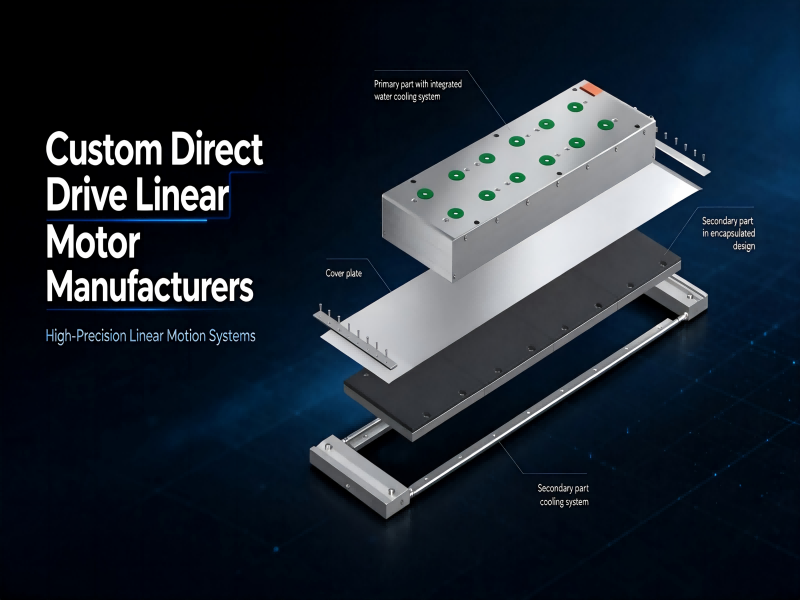
A linear motor is an electric motor designed to generate linear motion directly rather than relying on a rotary motor and a mechanical transmission to convert rotation into straight-line movement.
One way to understand its structure is to imagine a rotary motor opened out and arranged along a straight path.
In a typical permanent-magnet linear motor, the energized windings generate a moving magnetic field that interacts with the permanent magnets to produce thrust. Depending on the design, the motor’s moving and stationary components may be arranged differently.
A complete linear motor motion system may include:
Motion controller and supporting mechanical structure
The key difference is the drive mechanism: a direct drive linear motor produces linear thrust without a screw or belt transmission between the motor and the load.
Key performance advantages of linear motors
High speed and acceleration
Linear motors can support high-speed movement and rapid acceleration, making them suitable for short-cycle-time applications. Actual performance depends on motor force, moving mass, stroke, cooling, drive capacity, and mechanical design.
No mechanical transmission backlash
Because there is no screw-and-nut or belt transmission in the drive chain, conventional transmission backlash is eliminated. Positioning performance still depends on encoder resolution, feedback control, structural stiffness, thermal behavior, and installation accuracy.
Fast dynamic response
Direct drive reduces the number of mechanical transmission elements between the motor and the moving load. This can improve responsiveness during frequent starts, stops, reversals, and high-speed positioning.
Reduced transmission wear
Without a screw-and-nut pair or drive belt, the system avoids wear associated with those transmission components. However, guide rails, bearings, cables, cooling components, and other mechanical parts may still require inspection and maintenance.
Where are linear motors used?
Linear motors are particularly useful in applications such as:
Semiconductor manufacturing and wafer handling
Precision optical inspection
High-speed electronic component placement
Laser processing and precision positioning
High-frequency pick-and-place systems
Multi-axis precision automation
They are not automatically the best solution for every application. Their higher system cost, thermal management requirements, feedback requirements, and installation considerations must be evaluated against the expected performance benefits.
3. Linear Actuator vs. Linear Motor: What’s the Difference?
The most important difference is how each system generates linear motion.
A conventional electric linear actuator uses a mechanical transmission to convert rotary motion into linear movement. A direct drive linear motor generates linear thrust directly through electromagnetic interaction.
This difference affects speed, positioning behavior, thrust, maintenance, and overall project cost.
Comparison
Electric Linear Actuator
Direct Drive Linear Motor
Drive principle
Rotary motor with screw, belt, or other transmission
Direct electromagnetic thrust
Mechanical transmission
Required in conventional screw- and belt-driven designs
No screw or belt in the motor drive chain
Backlash
Depends on transmission design and adjustment
No conventional transmission backlash
Speed and acceleration
Depends on screw lead, belt design, motor, and load
Often well suited to high-speed, high-acceleration motion
Thrust and load
Can provide high thrust and support substantial loads when properly sized
Depends on motor force, cooling, duty cycle, and mechanical support
Positioning accuracy
Depends on transmission, feedback, stiffness, and control
Depends on encoder, control, stiffness, thermal behavior, and installation
Maintenance
Screw and guide lubrication, belt inspection, and other servicing as applicable
Less transmission-related maintenance, but guides and other components still need servicing
Vertical operation
May use a suitable screw, brake, or other load-holding mechanism
Usually requires an appropriate brake or counterbalance for safe vertical holding
Initial system cost
Often economical for general-purpose automation
Often higher due to motor, feedback, drive, and integration requirements
Typical applications
Lifting, pushing, assembly, transfer, and general positioning
High-speed positioning, precision inspection, and high-cycle automation
The table describes typical system-level differences rather than guaranteed performance. Actual specifications vary with the product design and operating conditions.
4. Performance Comparison: Speed, Precision, and Thrust
Choosing between a linear actuator and a linear motor requires more than comparing their maximum speed or advertised positioning accuracy.
The complete motion system must meet the application’s real operating requirements.
4.1 Speed and acceleration
For many standard automation tasks, a ball screw linear actuator provides sufficient speed and positioning performance.
A belt-driven actuator may be a better choice when the stroke is long and rapid material transfer is the main priority.
Linear motors are worth considering when a machine needs frequent acceleration, rapid direction changes, or very short positioning cycles.
However, maximum speed alone does not determine productivity. Acceleration, settling time, travel distance, payload, and the time required for loading or processing all affect the final cycle time.
Practical selection tip: Calculate the required motion profile before choosing the drive technology. A system that reaches a high maximum speed but takes too long to settle may not improve production throughput.
4.2 Positioning accuracy and repeatability
Positioning accuracy and repeatability are related but different.
Positioning accuracy describes how closely the actual position matches the commanded position.
Repeatability describes how consistently the system returns to the same position under specified conditions.
A ball screw actuator can deliver excellent positioning performance when the screw, nut preload, guides, motor, and feedback system are properly selected.
A linear motor removes conventional screw or belt transmission backlash, which can be valuable for applications involving frequent reversals and precision positioning.
Nevertheless, neither technology guarantees a particular accuracy simply because of its drive principle. Encoder quality, machine structure, temperature changes, servo tuning, and installation conditions all matter.
For precision inspection, semiconductor equipment, and optical applications, evaluate the complete system’s positioning accuracy, repeatability, and settling performance rather than relying on a single specification.
4.3 Thrust and load capacity
Ball screw actuators and servo electric cylinders are often attractive when an application requires substantial thrust, controlled pushing force, or vertical lifting.
A properly selected screw drive can convert motor torque into significant axial force. The achievable force depends on motor torque, screw lead, transmission efficiency, speed, and duty cycle.
Linear motors can also produce high continuous and peak forces, but the usable force depends on the motor’s thermal limits, cooling method, operating cycle, and available drive capacity.
Peak thrust should not be confused with continuous thrust. A motor that can briefly deliver a high force may not be able to sustain that force throughout a production cycle.
For applications involving pressing, lifting, or heavy loads, compare continuous thrust, peak thrust, duty cycle, load inertia, guide capacity, and the required safety factor.
4.4 Maintenance and service life
A screw-driven linear actuator typically requires appropriate lubrication and periodic inspection of the screw, nut, guide rails, and other mechanical components. Belt-driven systems require checks for belt tension, wear, and alignment.
A linear motor eliminates wear associated with a screw-and-nut or belt transmission. This can reduce maintenance associated with the drive mechanism, especially in high-cycle applications.
However, a linear motor system is not maintenance-free. Guide rails, bearings, cable management, cooling systems, and environmental protection still need attention.
Service life for either solution depends on load, acceleration, operating hours, lubrication, contamination, installation quality, and maintenance practices.
5. Linear Actuator vs. Linear Motor: Which Is More Cost-Effective?
The lowest initial purchase price does not always result in the lowest total project cost.
A conventional linear actuator is often a cost-effective choice when its speed, accuracy, and load capacity already meet the application’s requirements. Standardized components, familiar installation methods, and straightforward maintenance can also reduce engineering and commissioning costs.
A linear motor generally requires a more carefully integrated motion system, potentially including a motor track, encoder, servo drive, cooling, and precision mechanical structure.
The additional investment may be justified when improved cycle time, reduced transmission backlash, or higher dynamic performance provides measurable production benefits.
When comparing solutions, consider:
Initial component and system cost
Mechanical installation and alignment
Control system integration and commissioning
Required positioning performance
Maintenance and replacement parts
Production cycle time and throughput
Downtime risk and expected service life
For example, a packaging machine may achieve its target throughput using a belt-driven linear actuator. Replacing it with a linear motor could increase cost without delivering a meaningful production benefit.
In contrast, a high-speed inspection machine may benefit from the rapid response and direct drive characteristics of a linear motor. In that situation, the additional investment may be worthwhile.
The best solution is the one that meets the performance target at the lowest reasonable total cost—not necessarily the one with the highest specifications.
6. Linear Actuator, Linear Module, or Servo Electric Cylinder?
These terms are sometimes used interchangeably in industrial automation, but they do not always refer to the same product.
Linear actuator: A broad term for a device that produces linear motion. It may be electric, pneumatic, or hydraulic.
Linear module: An integrated linear motion assembly, commonly incorporating a base, guide rails, carriage, and a screw or belt drive. Some models include a motor, while others are supplied without one.
Servo electric cylinder: A compact electric actuator designed to provide controlled linear movement and, depending on the design, substantial thrust for pressing, pushing, and lifting.
Linear motor: An electric motor that generates linear thrust directly through electromagnetic interaction, without a screw or belt transmission in its drive chain.
The distinction matters because a linear module is a mechanical assembly, whereas a linear motor describes a drive technology. A linear motor can itself be integrated into a linear motion module.
In practical machine design, these technologies can complement one another rather than compete directly.
7. How to Choose the Right Linear Motion Solution
Before selecting a drive system, define the operating requirements.
Choose a screw-driven linear actuator when:
The application requires substantial thrust at moderate speeds.
Positioning performance can be achieved with a screw-based system.
The project has a limited equipment budget.
The mechanism is used for lifting, pushing, transferring, or assembly.
A mature, standardized mechanical solution is preferred.
Typical applications include automated assembly stations, vertical positioning units, packaging equipment, and general-purpose material handling.
Choose a belt-driven linear actuator when:
The application requires a relatively long travel distance.
Fast material transfer is more important than ultra-high positioning precision.
The payload and dynamic requirements are compatible with the belt design.
A cost-effective solution is needed for repetitive movement.
Typical applications include conveyor transfer systems, pick-and-place equipment, and long-stroke positioning mechanisms.
Choose a linear motor when:
The machine requires high acceleration and frequent direction changes.
Short cycle times are a major production requirement.
Transmission backlash must be eliminated.
Precision positioning and dynamic response are important.
The project justifies the additional investment in direct drive technology.
Typical applications include semiconductor equipment, precision optical inspection, high-speed electronics assembly, and advanced laser processing.
Choose a servo electric cylinder when:
The application needs controlled linear thrust.
Pressing, clamping, lifting, or pushing is involved.
Force, position, and speed must be coordinated.
A compact actuator is preferred over a more complex custom mechanism.
Vertical applications require particular attention to load holding and safety. Do not assume that a screw drive is self-locking or that a motor will hold a load safely when power is removed. Select suitable brakes, counterbalances, and safety provisions based on the mechanism and risk assessment.
8. Can You Combine Different Motion Technologies in One Machine?
Yes. In many automation projects, combining different drive technologies provides a more practical solution than using the same drive for every axis.
Consider a precision electronics assembly machine:
X/Y positioning: Linear motors may be used where high-speed movement and rapid settling are important.
Z-axis pressing: A servo electric cylinder may provide controlled pressing force and vertical movement.
Material transfer: A belt-driven or ball screw linear module may provide an economical solution for feeding and transferring components.
Each axis has a different job. The best drive depends on its payload, travel distance, required accuracy, cycle time, and operating environment.
This approach allows machine builders to balance performance and cost instead of specifying an expensive drive technology for every movement.
It also highlights why selecting a motion system should begin with the application requirements rather than a product name alone.
9. Frequently Asked Questions
Is a linear actuator motor the same as a linear motor?
Not necessarily. In everyday industrial purchasing, “linear actuator motor” often refers to an electric linear actuator driven by a rotary servo or stepper motor through a screw or belt. A linear motor generates linear thrust directly. In the broader technical sense, a linear motor is also a type of linear actuator.
Is a linear motor better than a ball screw actuator?
Neither is universally better. A linear motor is often advantageous for high acceleration, frequent reversals, and applications where transmission backlash is undesirable. A ball screw actuator is often attractive for high thrust, moderate-speed positioning, and cost-sensitive applications.
Can a linear actuator achieve high positioning accuracy?
Yes. A properly designed ball screw actuator with suitable guides, feedback, and control can provide high positioning accuracy and repeatability. Actual performance depends on the complete mechanical and control system.
Are linear motors maintenance-free?
No. Linear motors eliminate screw or belt transmission wear, but the overall system may still require maintenance of guide rails, bearings, cables, cooling components, and protective systems.
Are linear motors suitable for vertical installation?
They can be used in vertical applications, but the system must safely support the load when motion stops or power is lost. A suitable brake, counterbalance, or other engineered load-holding mechanism may be necessary.
Which is better for long-stroke applications: a belt actuator or a linear motor?
A belt-driven actuator is often a cost-effective choice for long-stroke material transfer. A linear motor may be preferable when the application also requires high acceleration, precise positioning, or rapid settling. The appropriate choice depends on stroke, payload, cycle time, and accuracy requirements.
What should I consider before selecting a linear motion system?
Start with payload, stroke length, travel speed, acceleration, required positioning accuracy and repeatability, duty cycle, mounting orientation, operating environment, and budget. These parameters help determine whether a screw actuator, belt-driven module, servo electric cylinder, or linear motor is the most suitable option.
10. Final Thoughts: Select the Drive Technology That Fits Your Application
Linear actuators and linear motors both play important roles in industrial automation, but they solve different engineering problems.
A screw-driven linear actuator offers a mature and practical approach to linear positioning. A belt-driven module can be a strong choice for economical, long-stroke movement. A servo electric cylinder is useful when controlled thrust is required, while a linear motor is particularly valuable for high-speed, high-dynamic, and precision motion applications.
The right choice depends on how the machine actually operates—not simply on which product offers the highest speed or the smallest advertised positioning error.
At HCY Automation, we support industrial automation projects with linear motion modules, direct drive linear motor solutions, servo electric cylinders, and related motion control components. We work with customers to evaluate application requirements and identify suitable standard or customized solutions.
Whether you are developing a new machine, upgrading an existing production line, or comparing different motion technologies, selecting the right drive system early can help reduce integration risks and avoid unnecessary costs.
Need help selecting a linear motion solution? Share your required stroke, payload, speed, positioning accuracy, mounting orientation, and application details with HCY Automation. Our team can help you evaluate suitable options for your project.
HCY Automation delivers integrated solutions across motion control, linear motion, robotics, machine vision, pneumatic systems, and precision gearboxes to help global manufacturers build smarter, faster, and more reliable production lines. Our engineering team helps you select and integrate the right motion control, robotics, and automation components for your specific application.