What Is the Lifespan of a Linear Motor? Factors That Affect Service Life
How long does a linear motor last? It is one of the most common questions engineers ask when selecting a direct drive motion system for industrial automation. The answer depends on more than the motor itself. Operating hours, payload, acceleration, temperature, environmental conditions, and maintenance all affect the overall service life of a linear motor module.
As a general planning reference, a well-selected industrial linear motor system may remain in service for many years. Under suitable operating conditions, some systems can achieve a service life of 8–15 years. However, this is not a universal guarantee or a standardized lifespan for every linear motor. Actual performance depends on the specific motor design, linear guides, bearings, feedback devices, cables, and operating conditions.
In this guide, HCY Automation explains what determines linear motor life expectancy, how to recognize early signs of wear, and which maintenance practices help industrial motion systems remain accurate and reliable for longer.
1. What Is the Average Lifespan of a Linear Motor?
There is no single service life that applies to every linear motor. A direct drive linear motor used in a clean, temperature-controlled precision assembly line operates under very different conditions from one exposed to heavy loads, metal particles, or continuous high-speed reciprocating motion.
For preliminary planning, the following ranges can serve as illustrative estimates rather than guaranteed product ratings.
Application or operating condition
Illustrative service-life estimate
High-precision, high-speed applications
Approximately 8–10 years
General industrial automation
Approximately 12–15 years under favorable conditions
Heavy loads, frequent acceleration, or harsh environments
Potentially much shorter; application-specific assessment required
Poor lubrication, contamination, or repeated overloading
Premature wear or failure may occur
These estimates are intended to help with early-stage planning. They should not replace the manufacturer’s rated life calculations, product specifications, or maintenance recommendations.
It is also important to distinguish between motor life, mechanical guide life, and complete linear motor module life.
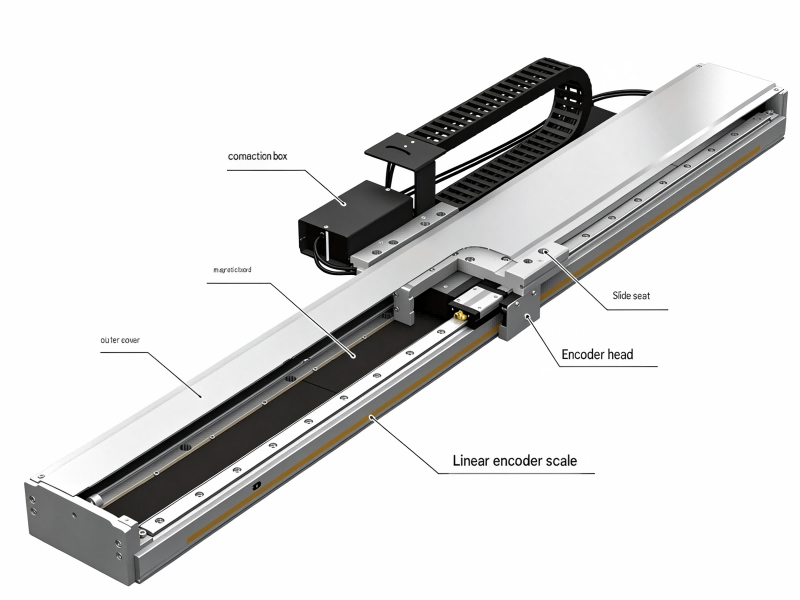
A linear motor generates thrust through electromagnetic interaction without requiring a mechanical transmission between the motor’s primary and secondary parts. This eliminates the belt, screw, or gearbox wear associated with many conventional drive systems. However, a complete linear motor module may still contain linear guides, bearings, an encoder, moving cables, and other components that require inspection or eventual replacement.
For this reason, the service life of a linear motor module is often determined by its mechanical and auxiliary components rather than the electromagnetic motor alone. Manufacturer guidance for linear guides and motorized linear slides likewise emphasizes load, lubrication, temperature, and operating conditions when estimating service life.
2. What Factors Affect Linear Motor Life Expectancy?
Understanding the main factors affecting linear motor lifespan helps engineers select the right equipment and reduce unexpected downtime.
2.1 Load, Acceleration, and Operating Frequency
Load is one of the most important considerations when sizing a linear motor system.
A motor that regularly operates within its rated thrust and thermal limits generally experiences less stress than one that repeatedly runs at its limits. High acceleration, rapid deceleration, frequent reversals, and sudden changes in load can also increase mechanical stress and heat generation.
Consider two examples:
Precision inspection equipment: A relatively light payload moves along a controlled trajectory with moderate acceleration. With correct sizing and maintenance, the system may provide years of reliable service.
Heavy-duty material handling: A large payload moves repeatedly at high speed, with frequent starts and stops. The guides, bearings, mounting structure, and motor cooling system may experience substantially greater demands.
When selecting a linear motor, engineers should evaluate continuous thrust, peak thrust, peak current, acceleration, moving mass, duty cycle, and the required positioning accuracy.
Peak thrust is generally intended for short-duration operation within the manufacturer’s specified limits. It should not be treated as a continuous operating rating. Repeatedly exceeding the motor’s thermal limits can accelerate insulation aging and may damage permanent magnets.
2.2 Operating Temperature and Heat Dissipation
Heat is another major factor affecting linear motor reliability.
Excessive temperature can accelerate winding insulation deterioration, affect encoder performance, shorten the life of electrical components, and potentially cause irreversible demagnetization of permanent magnets.
Several factors influence operating temperature:
Continuous thrust and current demand
Duty cycle and operating frequency
Cooling method and airflow
Ambient temperature
Heat transfer through the mounting structure
Motor resistance and thermal design
A motor may perform well during short test cycles but overheat during continuous production. This is why testing under the actual operating duty cycle is essential.
Before choosing a model, check its maximum continuous power loss, thermal resistance, allowable winding temperature, cooling requirements, and peak current limits.
Good thermal management helps protect the motor and its surrounding components while maintaining consistent positioning performance.
2.3 Dust, Humidity, and Environmental Contamination
The operating environment can have a significant impact on the service life of a linear motor module.
In cleanroom applications, controlled temperature and low particle contamination can reduce certain environmental risks. In contrast, industrial environments may expose the system to metal chips, abrasive dust, oil mist, moisture, or corrosive substances.
These contaminants can cause several problems:
Dust and metal particles can accumulate around magnetic components.
Contamination can damage guide surfaces or interfere with lubrication.
Moisture can contribute to corrosion and electrical insulation problems.
Oil mist and chemical vapors may affect cables, seals, and other materials.
Inadequate cooling can increase the risk of overheating.
Linear motors with exposed magnetic tracks require particular attention because ferrous particles can be attracted to the magnets.
If the application involves machining, battery manufacturing, food processing, or other demanding environments, consider suitable covers, protective seals, cable protection, and environmental ratings.
A cleanroom-compatible linear motor is not automatically suitable for every harsh environment. Protection requirements should be matched to the actual contaminants and operating conditions.
2.4 Maintenance and Lubrication
A direct drive motor can reduce mechanical transmission maintenance, but it does not make the complete motion system maintenance-free.
Linear guides and bearings still require appropriate lubrication and inspection. Moving cables may experience fatigue after repeated bending, while encoders and connectors can be affected by contamination, vibration, or electrical interference.
A practical linear motor maintenance program should include:
Cleaning exposed guide surfaces and magnetic areas using approved procedures.
Checking guide lubrication according to the manufacturer’s instructions.
Inspecting moving cables, connectors, and cable carriers.
Monitoring motor temperature, current, vibration, and positioning errors.
Checking mounting bolts, alignment, and mechanical play.
Inspecting the encoder and feedback system when accuracy deteriorates.
Lubrication intervals should be based on the guide manufacturer’s recommendations, operating distance, load, speed, and environment. Replacing grease at an arbitrary fixed interval is not appropriate for every system.
Proper preventive maintenance helps detect early signs of wear before they lead to unplanned downtime. Always follow the manufacturer’s maintenance instructions for lubrication, cleaning, inspection, and component replacement.
2.5 Product Quality, Installation, and System Design
The initial design and installation also influence long-term reliability.
A correctly sized motor can still experience premature problems if the guide rails are misaligned, the mounting surface lacks sufficient rigidity, the load creates excessive moments, or the cooling system is inadequate.
When evaluating a linear motor module, consider:
Motor force constant and continuous thrust capability
Peak force and peak current limits
Maximum speed at the specified supply voltage
Thermal resistance and cooling requirements
Encoder resolution and repeatability requirements
Guide load capacity and rated service life
Motor attraction force and guide support requirements
Cable routing, mounting accuracy, and structural rigidity
For iron-core linear motors, magnetic attraction between the motor primary and permanent magnets can create substantial normal forces. The supporting guides and mounting structure must be designed to handle these forces as well as the external payload.
Choosing the right motor is not simply a matter of selecting the highest thrust or speed rating. The entire motion system must be designed around the application.
3. How to Extend the Service Life of a Linear Motor
A well-planned maintenance strategy can help preserve positioning accuracy, reduce component wear, and improve equipment availability.
3.1 Select the Right Linear Motor for the Application
Avoid choosing a motor based only on its peak thrust or maximum speed.
Instead, calculate the required force from the moving mass, acceleration, friction, and external loads. Check the continuous thrust requirement against the motor’s thermal limits, and verify that the guide system can support the payload and applied moments.
If the equipment operates around the clock, account for the actual duty cycle and cooling conditions rather than relying on intermittent-operation specifications.
3.2 Establish a Preventive Maintenance Schedule
A maintenance schedule should reflect operating conditions and manufacturer recommendations.
Component
Recommended inspection focus
Linear guides and bearings
Lubrication, smooth movement, wear, and abnormal noise
Magnetic track
Metal particles, contamination, and surface condition
Motor windings and cooling system
Temperature trends and signs of overheating
Encoder and feedback system
Positioning accuracy, signal stability, and alarms
Moving cables and connectors
Bending fatigue, insulation damage, and loose connections
Mounting structure
Alignment, fastener tightness, and mechanical vibration
The inspection frequency should increase when equipment operates continuously or in environments with heavy contamination.
Maintenance personnel should follow the manufacturer’s safety procedures and isolate electrical and mechanical energy before servicing the equipment.
3.3 Monitor Performance Trends
Preventive maintenance is more effective when it includes condition monitoring.
Instead of waiting for a complete failure, track parameters such as motor temperature, current consumption, following error, positioning repeatability, and vibration.
A gradual increase in current under the same operating conditions may indicate changing friction, alignment problems, or an increased mechanical load. Rising temperature may indicate inadequate cooling or an operating point that exceeds the intended thermal limits.
Positioning errors and unusual noise can also signal problems with the guides, encoder, mounting structure, or motion controller.
These symptoms do not identify a specific fault on their own, but they provide useful clues for troubleshooting.
3.4 Avoid Repeated Overloading and Thermal Stress
Repeatedly operating beyond rated limits can shorten component life.
Use the motor manufacturer’s continuous and peak ratings to configure the servo drive and motion profile. Set acceleration and deceleration values appropriate for the moving mass, and verify that regenerative energy and braking behavior are handled correctly.
If the application requires higher throughput, evaluate whether the motor, cooling system, mechanical structure, and controller can support the increased duty cycle before changing production settings.
3.5 Keep the Operating Environment Under Control
Use suitable covers, approved cleaning methods, and appropriate cable protection. Prevent metal chips and other contaminants from accumulating around the magnetic track and linear guides.
Where temperature or humidity fluctuates significantly, confirm that all components are rated for the actual conditions.
For applications involving corrosive chemicals, high temperatures, or stringent cleanliness requirements, discuss environmental protection and material compatibility with the supplier before finalizing the design.
4. Linear Motor Service Life vs. Linear Guide Service Life
A linear motion system combines the linear motor, guide rails, encoder, cables, and other supporting components to deliver precise and reliable movement.
One common misconception is that a linear motor’s service life is identical to the service life of its linear guides.
In reality, these components have different wear mechanisms.
Component
Main factors affecting service life
Linear motor
Thermal stress, winding insulation, magnet temperature, and electrical operating conditions
Linear guides
Dynamic load, rolling fatigue, lubrication, contamination, and alignment
Encoder
Contamination, vibration, electrical interference, and component aging
Moving cables
Bending cycles, installation, temperature, and cable carrier design
Servo drive and electrical components
Temperature, electrical stress, cooling, and operating conditions
Linear guide service life is commonly estimated using a rated-life calculation based on the applied load and the guide’s basic dynamic load rating. The result is generally expressed as travel distance rather than a fixed number of calendar years. Actual service life depends on load distribution, lubrication, contamination, alignment, and operating conditions.
The actual time in service depends on stroke length, reciprocating frequency, load, and operating conditions.
This distinction matters when planning preventive maintenance. A linear motor may still generate thrust normally even when its guides, cables, or encoder need attention.
For this reason, evaluating the entire linear motion system provides a more realistic picture of long-term operating costs and reliability.
5. How Do You Know When a Linear Motor Module Needs Inspection or Replacement?
A linear motor does not necessarily need to be replaced simply because it has been operating for a certain number of years.
Instead, pay attention to changes in performance and the condition of individual components.
Common warning signs include:
Reduced positioning accuracy: The system no longer meets its required positioning or repeatability tolerances.
Abnormal noise or vibration: The guides, bearings, mounting structure, or other components may require inspection.
Unexpected temperature increases: The motor may be overloaded, poorly cooled, or operating under abnormal conditions.
Unstable current or servo alarms: These may indicate electrical, feedback, mechanical, or configuration issues.
Jerky movement or increased friction: Contamination, lubrication problems, misalignment, or guide wear may be responsible.
Visible cable or connector damage: Continued operation may lead to intermittent faults or electrical failure.
When these symptoms occur, stop the equipment if safe operation or product quality may be compromised. Have qualified personnel diagnose the problem before resuming operation.
Replacing a worn guide, damaged cable, or faulty encoder may restore system performance without requiring replacement of the entire linear motor module. The appropriate repair depends on the fault, component availability, and the manufacturer’s service guidance.
6. How to Choose a Linear Motor with a Longer Service Life
If long-term reliability is a priority, evaluate the following factors before purchasing a linear motor system.
1. Define the actual operating requirements. Establish the payload, stroke, speed, acceleration, duty cycle, positioning accuracy, and environmental conditions.
2. Verify continuous thrust and thermal performance. Make sure the motor can sustain the required operating profile without exceeding its specified thermal limits.
3. Evaluate the guide system. Check load capacity, applied moments, lubrication requirements, and rated life under the intended operating conditions.
4. Confirm environmental suitability. Select appropriate protection for dust, metal particles, moisture, temperature, and chemical exposure.
5. Review maintenance and service support. Ask about recommended inspection intervals, spare parts, troubleshooting, and component replacement.
6. Request application-specific service-life guidance. A reliable estimate should be based on actual load calculations, operating profiles, component ratings, and environmental conditions rather than a generic lifespan claim.
HCY Automation can be considered when evaluating linear motion solutions for industrial automation. When comparing systems, focus on the technical specifications, application compatibility, and support available for your particular operating requirements.
7. Frequently Asked Questions About Linear Motor Lifespan
How many years does a linear motor last?
There is no universal lifespan for all linear motors. For preliminary planning, some industrial linear motor systems may operate for 8–15 years under suitable conditions. Actual service life depends on the motor design, guide system, duty cycle, load, temperature, maintenance, and environment.
Can a linear motor run continuously for 24 hours?
Yes, if the complete system is designed and rated for the required continuous duty cycle. Continuous operation must remain within the specified thrust, current, temperature, cooling, guide-load, and cable-flex limits. A peak thrust rating does not mean the motor can operate at that thrust indefinitely.
Do linear motors require regular maintenance?
Yes. Although direct drive linear motors eliminate mechanical transmission components such as belts and lead screws, linear motor modules may still require guide lubrication, cleaning, cable inspections, encoder checks, and thermal monitoring.
What causes a linear motor to fail prematurely?
Common causes include overheating, repeated overloading, contamination, inadequate lubrication of the guide system, poor installation alignment, cable fatigue, and unsuitable environmental conditions. Incorrect drive configuration can also contribute to excessive electrical or thermal stress.
Is a linear motor more durable than a ball screw system?
Neither technology is universally more durable. A linear motor eliminates mechanical transmission through a screw, reducing certain sources of mechanical wear. However, it still relies on supporting guides, bearings, cables, and feedback components. The better choice depends on required speed, thrust, accuracy, duty cycle, maintenance capability, and total cost of ownership.
How can I calculate the service life of a linear motor module?
Start by identifying the rated life of the linear guides and bearings, then evaluate motor thermal limits, duty cycle, cable life, encoder requirements, and environmental conditions. For rolling-element linear guides, use the manufacturer’s rated-life method and adjust for the actual load and operating conditions. The resulting system-life estimate should account for the components most likely to require maintenance or replacement.
Conclusion: How Long Does a Linear Motor Last?
The service life of a linear motor depends on the complete motion system, not just the motor’s electromagnetic design. Correct sizing, thermal management, environmental protection, proper installation, and preventive maintenance all contribute to long-term performance.
For engineers and automation equipment manufacturers, the most effective approach is to evaluate service life during the selection stage, monitor operating conditions, and maintain the mechanical and electrical components according to their specific requirements.
Looking for a linear motor solution for your application? Contact HCY Automation to discuss your motion requirements, including thrust, speed, stroke, positioning accuracy, operating environment, and expected duty cycle. These details provide a stronger basis for selecting a suitable system and assessing its expected service life.
HCY Automation delivers integrated solutions across motion control, linear motion, robotics, machine vision, pneumatic systems, and precision gearboxes to help global manufacturers build smarter, faster, and more reliable production lines. Our engineering team helps you select and integrate the right motion control, robotics, and automation components for your specific application.