Linear Motor Direct Drive Technology: How It Works, Key Benefits, and How to Choose the Right Solution
Learn how linear motor direct drive technology works, compare linear motors vs ball screws, understand ironcore vs ironless designs, and choose the right high-precision linear motion solution.
Why More Manufacturers Are Switching to Linear Motor Direct Drive
In modern manufacturing, speed alone is no longer enough. Equipment manufacturers also need precise positioning, fast acceleration, stable motion, and consistent performance over millions of operating cycles.
Traditional linear motion systems, typically built around a rotary servo motor and a ball screw or belt drive, remain widely used. However, as production requirements become more demanding, mechanical transmission components can introduce backlash, friction, compliance, and maintenance requirements that are difficult to eliminate completely.
Instead of converting rotary motion into linear motion through a mechanical transmission, a linear motor generates thrust directly along the required axis. The result is a simpler motion path with fewer mechanical transmission components and greater potential for high-speed, high-precision positioning.
Linear motor direct drive systems are increasingly used in semiconductor manufacturing, precision inspection, electronics assembly, laser processing, machine tools, and automated production lines.
But is a linear motor always better than a ball screw? What is the difference between ironcore and ironless linear motors? And what should engineers consider before selecting a direct drive linear motion system?
Let’s look at the technology from an engineering perspective.
1. What Is Linear Motor Direct Drive Technology?
Linear motor direct drive technology is a motion control method in which a linear motor produces thrust directly on a moving component without requiring a rotary-to-linear transmission mechanism.
In a conventional system, a rotary servo motor drives a ball screw, belt, rack and pinion, or another mechanical transmission. The transmission converts the motor’s rotation into linear movement.
A direct drive linear motor eliminates that conversion stage.
The motor’s electromagnetic force acts directly on the moving part, commonly called the mover or forcer, allowing it to travel along a linear axis.
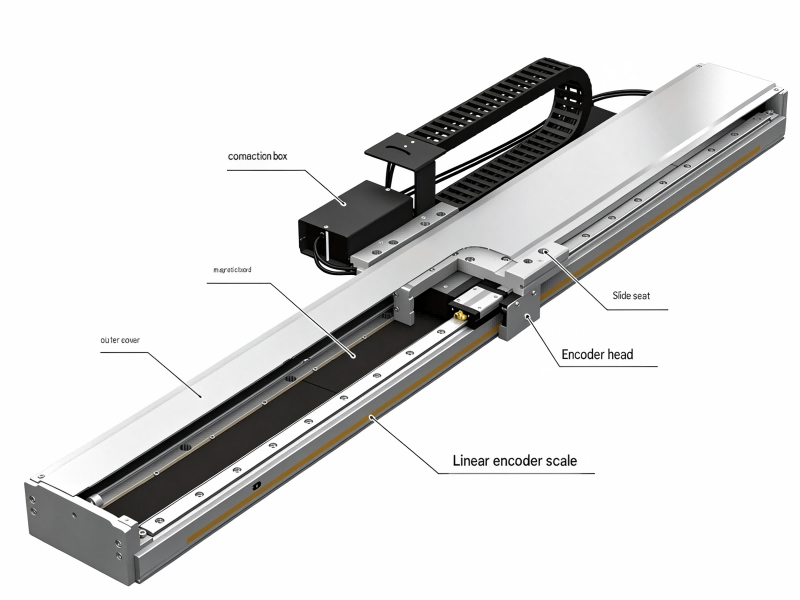
A typical linear motor motion system consists of:
Linear motor: Generates the force required to move the load.
Linear guideway: Supports the moving assembly and constrains its motion.
Position feedback device: Measures actual position, often using an optical encoder or linear encoder scale.
Servo drive: Controls motor current and regulates motion.
Motion controller: Coordinates position, velocity, acceleration, and synchronization.
Mechanical structure: Provides the rigidity and alignment required for stable operation.
The linear motor itself provides the driving force, but the complete motion system determines the final positioning accuracy, repeatability, and dynamic performance.
How Does a Linear Motor Work?
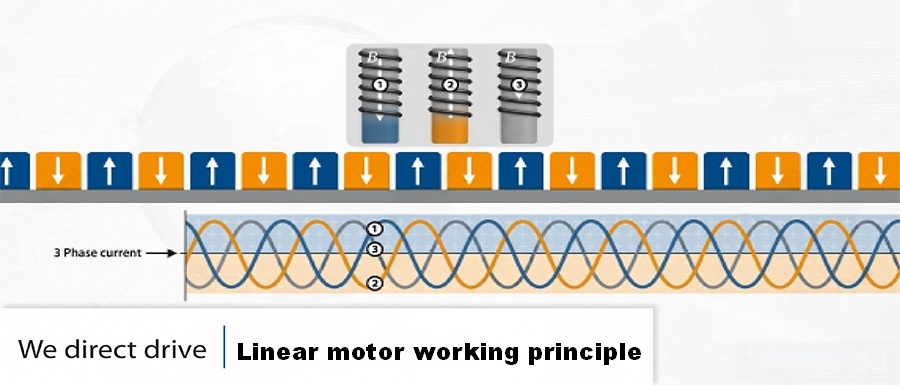
A linear motor can be understood as a rotary motor that has been opened and laid flat.
In a conventional rotary motor, electromagnetic interaction produces torque and rotation. In a linear motor, a similar electromagnetic interaction produces force along a straight path.
Depending on the design, permanent magnets may be installed along a magnetic track, while the moving coil assembly generates the electromagnetic field required for propulsion.
When the motor is energized, the interaction between the magnetic fields produces linear thrust. By controlling the motor current and commutation, the servo system regulates the mover’s position, speed, and acceleration.
Because the motor produces linear motion directly, there is no need for a ball screw or belt to convert rotary motion into translation.
The key principle is simple: generate motion in the form the machine actually needs.
2. Linear Motor vs Ball Screw: What Is the Difference?
One of the most common questions engineers ask is whether a linear motor is better than a ball screw actuator.
The answer depends on the application, including travel distance, payload, duty cycle, positioning requirements, and total system cost.
Comparison
Linear Motor Direct Drive
Ball Screw Drive
Motion conversion
Direct electromagnetic thrust
Rotary-to-linear mechanical conversion
Backlash
No screw backlash; system errors still exist
Depends on screw, nut, preload, and assembly
Maximum speed
Well suited to high-speed motion
Limited by screw critical speed and other mechanical factors
Acceleration
High dynamic response is possible
Limited by moving mass, screw inertia, and mechanics
Travel length
Suitable for long-stroke configurations
Long strokes can introduce screw speed and stiffness challenges
Positioning accuracy
Depends on feedback, mechanics, thermal stability, and control
Depends on screw accuracy, feedback, mechanics, and control
Maintenance
Fewer transmission components; guides and bearings still require care
Screw, nut, bearings, and lubrication require attention
Initial investment
Often higher for the complete system
Often economical for standard applications
Best-fit applications
High-speed, high-precision, dynamic motion
General-purpose positioning and cost-sensitive machinery
When Should You Choose a Linear Motor?
A direct drive linear motor is worth considering when your equipment requires:
High-speed positioning. Applications with frequent moves, short settling times, and rapid production cycles can benefit from the motor’s direct force generation.
High acceleration. Removing the ball screw and associated transmission components can reduce certain sources of mechanical inertia, although actual performance depends on the complete moving assembly.
High repeatability. A linear encoder can measure the position of the moving load directly, helping the control system compensate for certain mechanical and motion errors.
Long travel with demanding dynamics. Linear motors can be configured for long travel without the rotating screw becoming the primary speed limitation.
Frequent starts and stops. Direct drive can reduce transmission-related backlash and compliance, making it attractive for demanding positioning cycles.
When Is a Ball Screw Still the Better Choice?
A ball screw may be the more practical option for moderate speeds, relatively simple motion profiles, cost-sensitive machinery, or applications where a mature and easily integrated mechanical solution is preferred.
The goal is not to replace every ball screw with a linear motor. It is to choose a drive architecture that meets the machine’s performance requirements at an acceptable total cost.
3. Ironcore vs Ironless Linear Motors: Which Design Is Right for You?
Not all linear motors behave the same way. One of the most important design choices is whether to use an ironcore or ironless linear motor.
The difference lies primarily in the motor’s moving coil assembly and its interaction with the permanent magnet track.
Ironcore Linear Motors
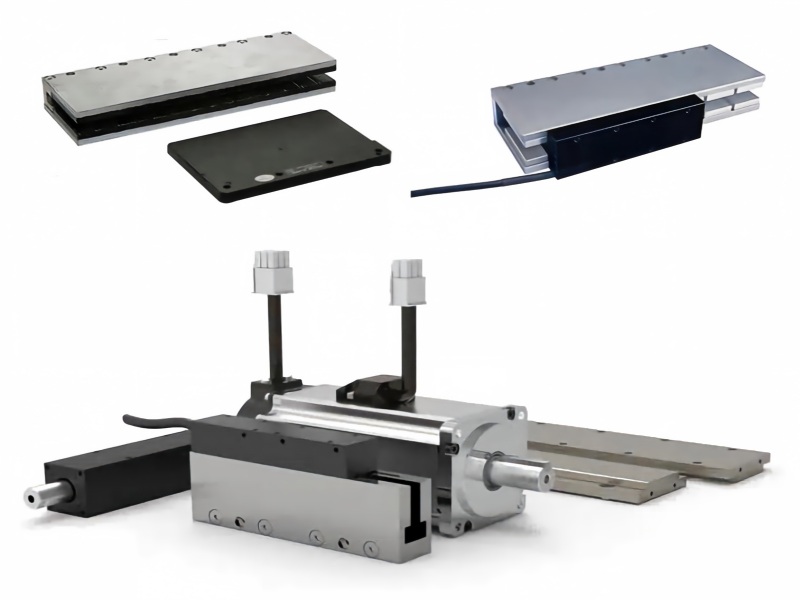
An ironcore linear motor uses ferromagnetic material in the coil assembly to concentrate magnetic flux and increase force production within a given motor size.
This design is particularly attractive when high thrust density is a priority.
Key advantages
High force output relative to motor size.
Suitable for demanding acceleration and heavier loads.
A practical choice for many machine tool and industrial automation applications.
Can offer a competitive cost-to-thrust ratio.
Engineering considerations
Ironcore designs generally experience magnetic attraction between the motor’s ironcore assembly and the magnet track. This normal force must be considered when designing the guideways, mounting structure, and bearing arrangement.
Some ironcore designs also exhibit cogging force, which can cause small variations in thrust as the motor moves. The actual effect depends on the motor’s magnetic and mechanical design.
Typical applications: Machine tool feed axes, heavy-duty positioning, industrial handling, and applications requiring relatively high thrust.
Ironless Linear Motors
An ironless linear motor uses a coil assembly without an ironcore. In many designs, the coil assembly moves within a magnetic field generated by opposing magnet tracks.
Without an ironcore interacting with the magnets, the motor avoids the associated ironcore cogging effect and magnetic attraction between the moving ironcore and the magnet track.
This makes ironless linear motors especially attractive for applications requiring exceptionally smooth motion.
Key advantages
Very low cogging force.
Smooth motion at low speeds.
No ironcore-related magnetic attraction force.
Lightweight moving coil assemblies can support high acceleration.
Suitable for precision inspection and sensitive positioning applications.
Engineering considerations
The coil assembly must dissipate the heat generated during operation. Depending on the design and duty cycle, thermal management can become a major factor in continuous force capability.
Ironless designs may also require a larger motor envelope or a higher initial investment to achieve the same thrust as a comparable ironcore design.
Ironcore vs Ironless Linear Motor: Quick Selection Guide
Requirement
Recommended Starting Point
High thrust in a compact motor
Ironcore
Very smooth low-speed motion
Ironless
High acceleration with low moving mass
Ironless is worth evaluating
Heavy-duty machine feed
Ironcore is worth evaluating
Low cogging force
Ironless
High continuous force
Compare thermal performance and cooling requirements
Lowest total system cost
Evaluate both designs in the complete machine
These are starting points, not universal rules. A well-designed system must be evaluated using actual thrust, speed, acceleration, positioning, thermal, and mechanical requirements.
4. The Main Benefits of Linear Motor Direct Drive Systems
Why are linear motors increasingly considered for high-performance automation equipment?
The answer lies in the interaction between motor design, feedback technology, mechanical structure, and motion control.
4.1 High-Speed Linear Motion
Linear motors eliminate the need to accelerate and decelerate a rotary transmission mechanism such as a ball screw.
This can simplify the mechanical design and enable high-speed travel and rapid positioning. Some specialized systems achieve speeds of several meters per second, but actual performance varies significantly with stroke length, payload, motor size, cooling, and control configuration.
For production equipment, the real benefit is often not maximum speed alone. Shorter move times and faster settling can increase throughput across the entire operating cycle.
4.2 High Acceleration and Dynamic Response
Direct electromagnetic force allows the servo system to change thrust quickly in response to motion commands.
This is useful for applications involving frequent short movements, rapid direction changes, synchronized axes, and high-cycle production.
However, high acceleration also increases the demands on the machine frame, guideways, payload mounting, and control tuning. A powerful motor cannot compensate for an insufficiently rigid mechanical structure.
4.3 High Positioning Accuracy and Repeatability
A linear motor does not have the screw lead error or screw backlash associated with a conventional ball screw transmission.
When paired with a suitable linear encoder and a properly tuned servo system, it can support precise closed-loop positioning.
Actual performance still depends on several factors:
Encoder resolution and accuracy.
Mechanical alignment and straightness.
Structural stiffness.
Thermal expansion.
Servo tuning and control bandwidth.
Cable forces, vibration, and external disturbances.
It is also important to distinguish resolution, accuracy, and repeatability. A system may detect extremely small position changes without achieving the same absolute positioning accuracy.
4.4 Reduced Transmission-Related Maintenance
A direct drive linear motor removes components such as the ball screw, screw nut, and transmission couplings from the drive train.
Fewer transmission components can mean fewer sources of backlash, wear, and maintenance.
However, direct drive does not make the entire machine maintenance-free. Linear guides, bearings, cables, cooling systems, and other components may still require inspection, lubrication, or replacement.
4.5 Cleaner Mechanical Design
Without a long ball screw or belt transmission, the motion architecture can be easier to adapt to certain machine layouts.
This is particularly useful when designing long-travel axes, multi-axis automation platforms, or compact precision machinery.
The final footprint still depends on the motor track, guideways, cooling equipment, cable management, and supporting structure.
5. What Makes a High-Precision Linear Motor System Accurate?
A common misconception is that choosing a high-resolution encoder automatically guarantees high positioning accuracy.
In practice, precision motion is a system-level engineering problem.
Linear Encoder and Position Feedback
A linear encoder measures the actual position of the moving assembly rather than estimating position solely from motor rotation.
This can help the controller correct errors arising from certain mechanical transmission effects.
Optical linear encoders are often selected for demanding accuracy and resolution requirements. Magnetic encoders may be attractive when contamination resistance, packaging, or cost is more important.
The correct choice depends on the required accuracy, measuring length, operating environment, installation conditions, and contamination level.
Mechanical Rigidity and Alignment
The motor generates force, but the guideways and supporting structure determine how the load is constrained.
Poor alignment, structural deformation, vibration, and thermal distortion can all reduce system accuracy.
For this reason, high-performance linear motor stages often require careful consideration of the machine base, guideway spacing, mounting surfaces, and cable routing.
Servo Tuning and Motion Control
A linear motor must be correctly matched to its servo drive and motion controller.
Current loops, velocity loops, position loops, feedforward control, and trajectory planning all influence the system’s dynamic behavior.
Aggressive tuning may improve response under certain conditions but can also introduce vibration or instability if the mechanical structure is not sufficiently rigid.
For high-precision applications, the objective is to balance tracking accuracy, settling time, stability, and robustness under real operating conditions.
Thermal Management
Heat can affect both motor performance and positioning accuracy.
Coil temperature influences continuous thrust capability, while thermal expansion of the machine structure can cause dimensional drift.
When designing a direct drive linear stage, engineers should evaluate peak thrust, continuous thrust, duty cycle, cooling requirements, and expected ambient temperature together.
6. Linear Motor Modules vs Standalone Linear Motors
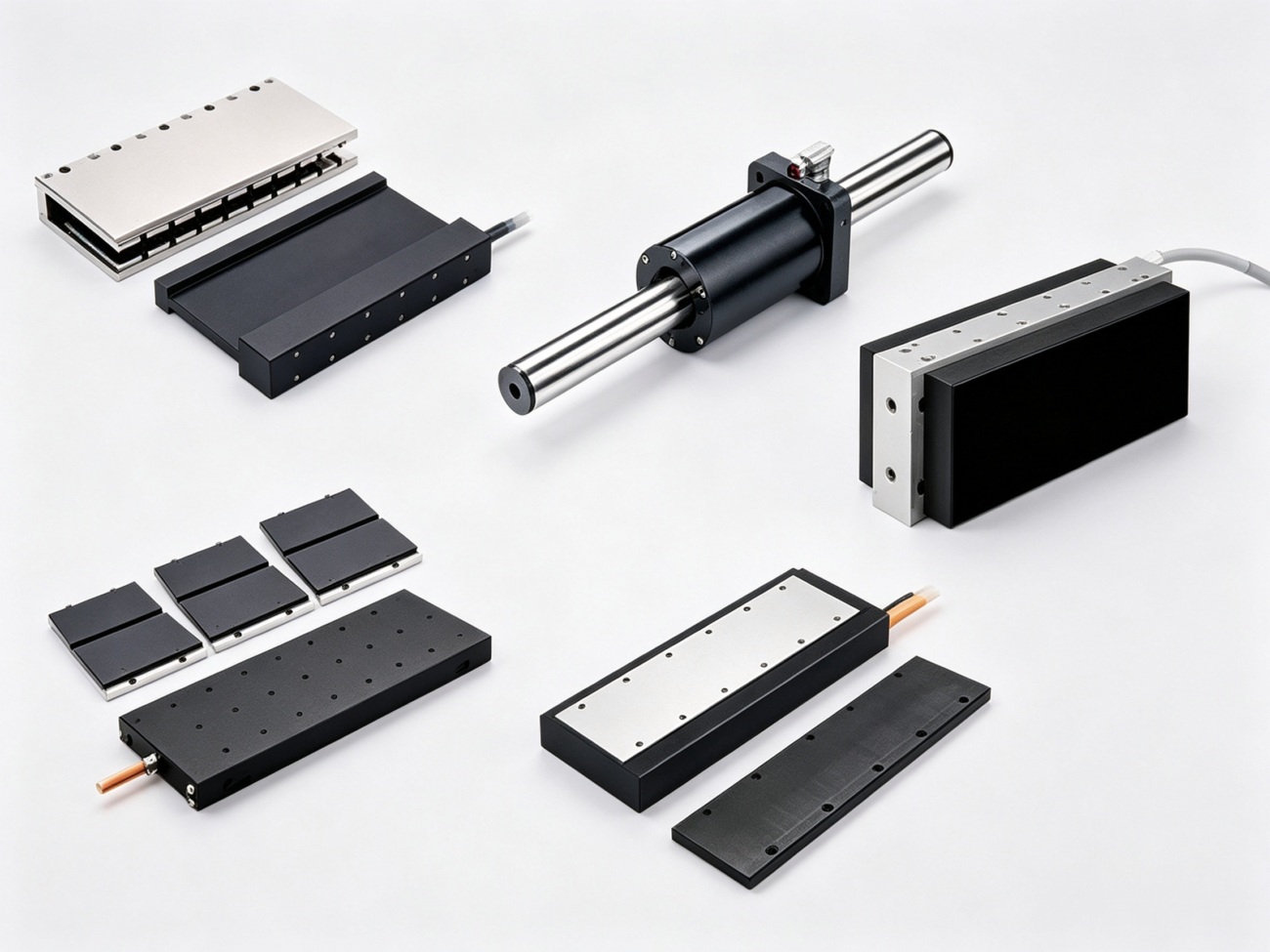
When sourcing a direct drive linear motion solution, buyers generally encounter two product formats: integrated linear motor modules and standalone linear motor components.
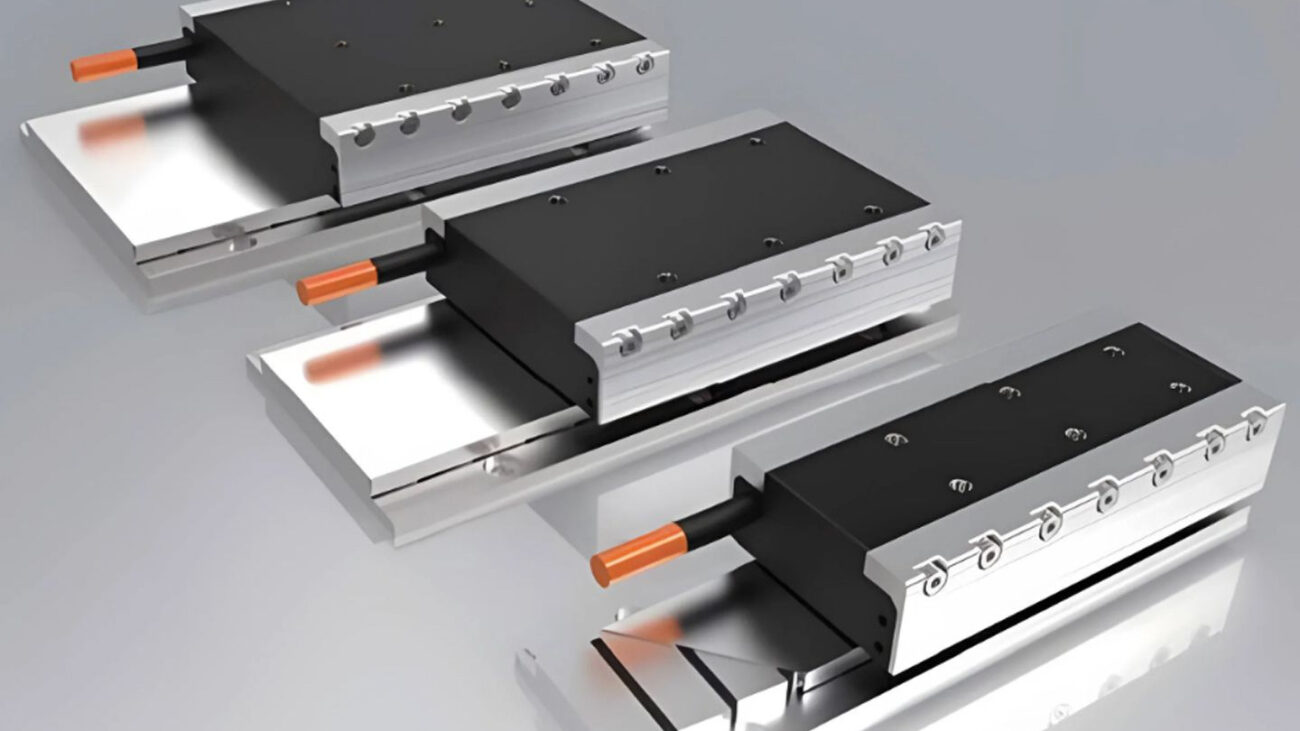
Integrated Linear Motor Modules
An integrated linear motor module typically combines the motor with selected mechanical components, such as guideways, a carriage, an encoder, and mounting features.
Depending on the product configuration, the servo drive and controller may be supplied separately or integrated into a larger motion platform.
Advantages
Faster mechanical integration.
Less design work for standard applications.
Simplified installation and alignment.
Easier evaluation of a predefined motion platform.
Limitations
Travel lengths and dimensions may be limited by the available product range.
Custom mechanical requirements may increase cost.
The integrated design may not suit every machine architecture.
Standalone Linear Motor Kits
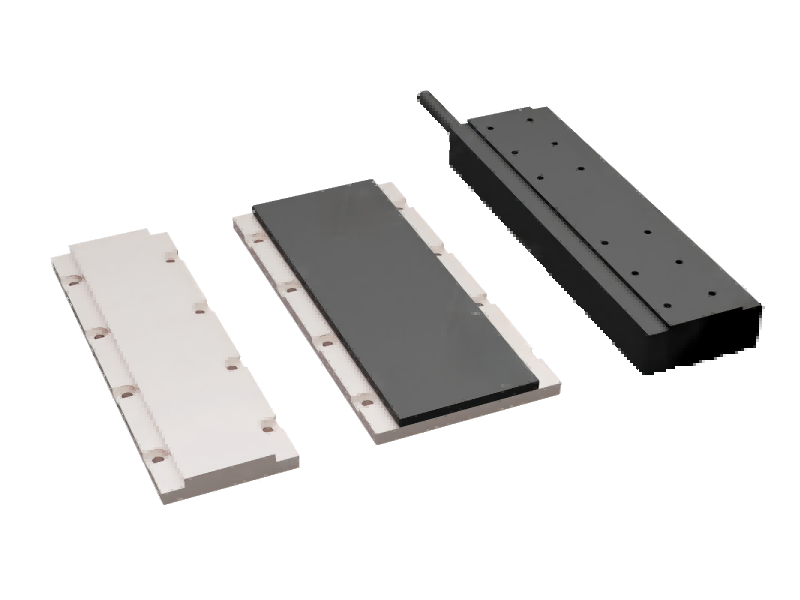
A standalone linear motor kit typically supplies the motor’s active components, such as the coil assembly and magnet track. Guideways, encoder systems, mounting structures, and control hardware are selected separately.
Advantages
Greater freedom in mechanical design.
Flexible travel length and machine geometry.
Better control over integration into specialized equipment.
Potential advantages for custom, multi-axis, or large-format machinery.
Limitations
More engineering work is required.
Mechanical alignment and cable routing need careful planning.
Encoder selection, servo matching, and thermal design become the system integrator’s responsibility.
For standard automation equipment, an integrated module may reduce development time. For specialized machinery, a standalone linear motor may offer the flexibility needed to optimize the complete system.
7. Where Is Linear Motor Direct Drive Technology Used?
Linear motor direct drive systems are most valuable when motion performance has a direct impact on product quality, production speed, or measurement reliability.
Semiconductor Manufacturing
Wafer handling, inspection stages, precision positioning platforms, and related semiconductor processes often require controlled motion, low vibration, and high repeatability.
Linear motors can support these requirements when the complete stage is designed for the necessary accuracy, cleanliness, and thermal stability.
Electronics Manufacturing and SMT Equipment
High-speed component placement, optical inspection, dispensing, and precision assembly frequently involve short moves and rapid acceleration.
A direct drive architecture can reduce transmission-related limitations and support demanding cycle times.
Laser Processing and Precision Inspection
Laser cutting, marking, scanning, and dimensional inspection may benefit from smooth motion, fast trajectory changes, and accurate synchronization between movement and process timing.
Ironless linear motors are worth considering where low cogging force and smooth low-speed movement are particularly important.
CNC Machine Tools
Linear motors can be used for machine tool feed axes where high dynamic response, fast travel, and precise contouring are priorities.
These systems require careful attention to thermal management, mechanical rigidity, protection against chips and coolant, and the machine’s overall cost structure.
Industrial Automation and Robotic Systems
Linear motor stages are used in precision transfer systems, automated testing equipment, inspection platforms, and multi-axis positioning systems.
They are particularly useful when the required travel, speed, or positioning performance is difficult to achieve economically with conventional mechanical transmission.
8. How to Select the Right Direct Drive Linear Motor
Selecting a linear motor based only on maximum thrust or maximum speed can lead to an unsuitable design.
A more reliable selection process starts with the application’s motion profile and operating conditions.
Step 1: Define the Payload and Moving Mass
Calculate the total moving mass, including the workpiece, carriage, fixtures, and any moving cables or accessories that affect the axis.
For vertical axes, gravity must also be included in the force calculation.
Step 2: Define Speed, Acceleration, and Stroke
Identify the required travel distance, peak speed, acceleration, deceleration, and positioning time.
For high-cycle applications, the complete motion profile matters more than th
Frequently Asked Questions About Linear Motor Direct Drive Technology
1. What is linear motor direct drive technology?
Linear motor direct drive technology uses electromagnetic force to move a load directly along a straight path without a ball screw, belt, or other rotary-to-linear transmission mechanism. It is widely used in high-speed automation, precision positioning, semiconductor equipment, and industrial motion control.
2. How does a direct drive linear motor work?
A direct drive linear motor generates linear thrust through the interaction of magnetic fields and electric current. The motor’s moving component travels along a magnetic track, producing controlled linear motion. A servo drive and position feedback device regulate speed, acceleration, and positioning accuracy.
3. What is the difference between a linear motor and a ball screw?
A linear motor generates linear force directly, while a ball screw converts rotary motor motion into linear movement. Linear motors are often preferred for high-speed positioning, high acceleration, and demanding dynamic performance. Ball screws remain a cost-effective choice for many standard positioning applications.
4. What are the main advantages of linear motor direct drive systems?
The main advantages include high dynamic response, reduced transmission-related backlash, smooth motion, flexible machine design, and fewer mechanical transmission components. With suitable feedback and control, linear motors can support high-precision positioning and demanding production cycles.
5. Are linear motors more accurate than ball screws?
Linear motors can offer advantages in applications where screw lead error, backlash, and mechanical compliance limit performance. However, actual positioning accuracy depends on the encoder, guideway, machine structure, thermal stability, and servo control. Both technologies can achieve high accuracy when properly designed.
6. What is the difference between ironcore and ironless linear motors?
Ironcore linear motors use ferromagnetic material in the motor’s magnetic circuit to achieve high force density. Ironless linear motors use a coil assembly without an ironcore, reducing cogging and normal magnetic attraction between the moving coil and magnet track. Ironcore designs are often suitable for high-thrust applications, while ironless designs are attractive for smooth, precision motion.
7. Which is better for high-speed positioning: ironcore or ironless linear motors?
Both can support high-speed positioning. Ironless linear motors are often attractive for applications requiring low moving mass, low cogging, and smooth velocity control. Ironcore linear motors may be preferable when higher thrust density is required. The final choice depends on payload, acceleration, stroke, duty cycle, and thermal limi
HCY Automation delivers integrated solutions across motion control, linear motion, robotics, machine vision, pneumatic systems, and precision gearboxes to help global manufacturers build smarter, faster, and more reliable production lines. Our engineering team helps you select and integrate the right motion control, robotics, and automation components for your specific application.