Belt Drive vs. Ball Screw Linear Modules: A Practical Selection Guide for Industrial Automation
Choosing the right linear motion module can make a significant difference to machine performance, production efficiency, and long-term operating costs.
For industrial automation engineers, two of the most common options are belt-driven linear modules and ball screw linear modules. Both convert rotary motion into linear movement, but they behave differently when it comes to positioning accuracy, travel length, speed, load capacity, and maintenance.
So, which is better: a belt drive or a ball screw?
The answer depends on what your machine needs to do. A ball screw module is often a strong choice for precision positioning and high mechanical stiffness, while a belt-driven module is frequently preferred for high-speed movement and long travel distances.
However, neither option is automatically the best for every application. The right choice depends on the complete motion profile, installation conditions, and performance requirements.
In this guide, we compare belt-driven and ball screw linear modules across five practical engineering considerations, explain common selection mistakes, and show when a customized linear motion solution may be worth considering.
1. How Do Belt-Driven and Ball Screw Linear Modules Work?
Before comparing performance, it helps to understand how each mechanism operates.
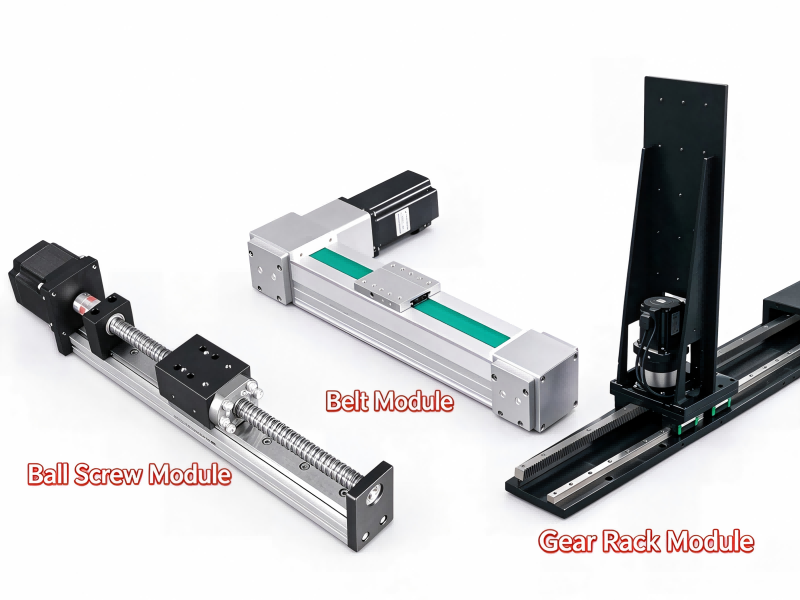
What Is a Ball Screw Linear Module?
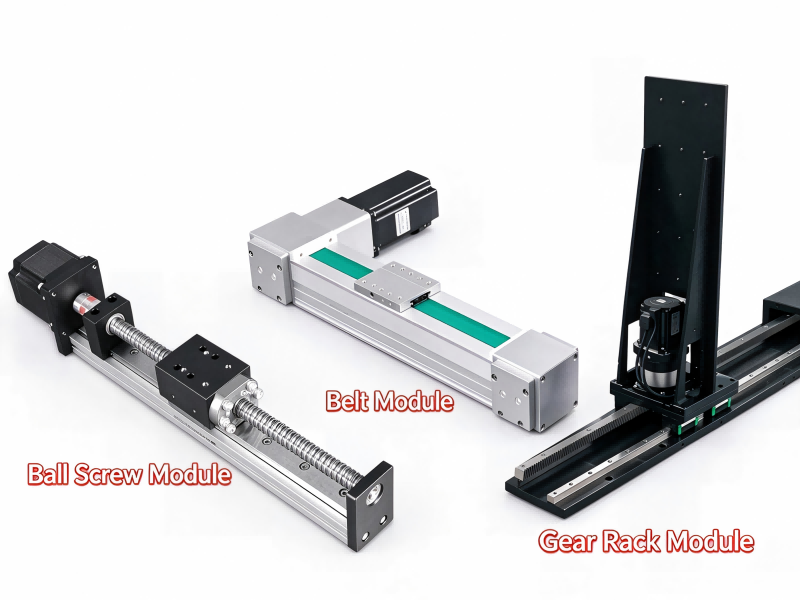
A ball screw linear module uses a rotating screw shaft and a ball nut to convert rotary motion into linear movement. Recirculating balls roll between the screw and nut, reducing friction and enabling precise motion control.
A typical ball screw linear module includes:
Ball screw and ball nut
Linear guide rail and carriage
Aluminum or steel base
Screw support bearings
Motor and coupling
Limit switches or position sensors
When the motor rotates the screw, the ball nut moves along its axis, carrying the slide and attached payload.
Ball screw modules are commonly used in precision assembly, dispensing, inspection equipment, CNC machinery, and automated positioning systems.
What Is a Belt-Driven Linear Module?
A belt-driven linear module uses a motor-driven pulley and a synchronous belt to move a carriage along a linear guide.
Its main components typically include:
Timing belt and drive pulley
Idler pulley and tensioning mechanism
Linear guide rail and carriage
Aluminum extrusion or structural base
Motor and drive components
Limit switches or position sensors
As the drive pulley rotates, the belt moves the carriage along the guide rail.
Because the belt can travel over long distances without requiring a long rotating screw, belt-driven modules are particularly useful for material handling, packaging, sorting, and high-speed transfer applications.
The linear guide supports the load and controls the carriage path. The belt or screw provides the driving force.
2. Belt Drive vs. Ball Screw: Five Key Differences
Difference 1: Positioning Accuracy and Mechanical Stiffness
When a machine needs to position a component accurately, the transmission mechanism matters.
Ball screw modules generally offer higher mechanical stiffness and are often easier to optimize for demanding positioning applications. Their performance depends on screw lead accuracy, ball nut preload, bearing arrangement, guide quality, mounting conditions, and control configuration.
Belt-driven modules can also deliver good positioning performance, but belt elasticity, tension, tooth engagement, pulley geometry, and changes in operating load can affect the result.
A properly designed belt-driven system may be sufficiently accurate for many automation applications. It should not be dismissed simply because it uses a belt.
Which should you choose?
Ball screw: Precision assembly, dispensing, measurement, and applications requiring controlled positioning under load.
Belt drive: Pick-and-place transfer, packaging, sorting, and applications where moderate positioning accuracy is acceptable.
One important distinction is the difference between positioning accuracy and repeatability. Positioning accuracy describes how closely the actual position matches the commanded position. Repeatability describes how consistently the system returns to the same position under comparable conditions.
When comparing suppliers, ask for the relevant test data under representative loads and speeds rather than relying on a single headline accuracy figure.
Difference 2: Speed and Travel Length
Speed and stroke length are often decisive factors in linear module selection.
Ball screw modules can provide high acceleration and precise motion, but their maximum practical speed depends on screw diameter, lead, unsupported length, support configuration, critical speed, and the required service life.
As the screw becomes longer, rotational speed limitations and shaft deflection become increasingly important design considerations.
Belt-driven modules are often advantageous for long-stroke, high-speed applications. They avoid the long rotating shaft required by a ball screw and can be configured for extended travel.
However, belt stretch, vibration, carriage mass, pulley size, and structural stiffness still limit achievable acceleration and positioning performance.
A practical selection guide:
Application requirement
Initial option to evaluate
Short stroke with demanding positioning
Ball screw
Long stroke with rapid point-to-point movement
Belt drive
High acceleration with moderate accuracy requirements
Belt drive
High stiffness and controlled positioning under load
Ball screw
Long-distance material transfer
Belt drive
These are starting points, not absolute rules. Both options require engineering checks against the actual load, speed, acceleration, and duty cycle.
For very high-speed or high-precision applications, a direct-drive linear motor may also be worth evaluating, particularly when eliminating mechanical transmission components is a priority.
Difference 3: Load Capacity and Rigidity
A linear module must support more than the nominal weight of the workpiece.
Engineers should consider the complete moving mass, including fixtures, tooling, grippers, cables, and attached equipment. They should also account for acceleration forces, overturning moments, mounting orientation, and external process forces.
Ball screw modules are often selected for applications requiring high stiffness and controlled movement under load. However, their actual capacity depends on the screw, nut, bearings, linear guides, and base structure.
Belt-driven modules can handle substantial loads when properly engineered, particularly when equipped with appropriately sized linear guides and a sufficiently rigid structure. The belt itself, however, has finite tensile stiffness and load limits.
Before selecting a module, check:
Total moving mass and payload
Acceleration and deceleration forces
Radial and axial loads
Pitch, roll, and yaw moments
Guide rail capacity and mounting rigidity
Required positioning performance under load
For heavy loads, long cantilevered tooling, or significant external process forces, the entire mechanical structure must be evaluated rather than selecting a transmission based on payload alone.
Difference 4: Maintenance and Total Cost of Ownership
Purchase price is only one part of the cost of a linear motion system.
A more useful comparison includes installation, lubrication, routine inspection, replacement components, downtime, and the cost of recalibration or process interruptions.
Ball screw modules typically require lubrication and periodic inspection of the screw, nut, bearings, and guide system. Wear and contamination can affect positioning performance and service life.
Belt-driven modules require attention to belt tension, belt condition, pulley alignment, and wear. Belt replacement intervals depend on the belt material, operating conditions, load, acceleration, and cycle frequency.
Neither mechanism has a universal service life. A well-maintained belt system may provide years of service, while an incorrectly sized ball screw can experience premature wear or failure.
For machines operating continuously, estimate the total cost over the intended service period rather than comparing initial prices alone.
A slightly more expensive module may prove more economical if it reduces maintenance labor, unplanned downtime, or rejected products.
Difference 5: Operating Environment and Protection
Industrial environments can significantly influence the reliability of a linear motion module.
Dust, abrasive particles, oil mist, cutting fluids, moisture, and temperature changes can affect mechanical components and lubrication.
Ball screw modules can be equipped with covers, bellows, seals, or other protective structures. These features help limit contamination, but their effectiveness depends on the design and the environment.
Belt-driven modules can also be protected with suitable covers and sealing arrangements. Belt material selection is important where exposure to oils, chemicals, or elevated temperatures is expected.
Neither mechanism is inherently suitable for every harsh environment.
For cleanrooms, food processing, corrosive environments, or machining applications with substantial coolant exposure, the entire assembly must be assessed, including the belt or screw, guide rails, lubricant, seals, motor, cables, and enclosure.
Selection tip: Define the actual contamination risks before specifying an IP rating or protective cover. An IP rating applies to a defined enclosure or assembly under specified test conditions; it should not be assumed from the transmission type alone.
3. Belt Drive vs. Ball Screw: Quick Comparison Table
Performance factor
Ball screw module
Belt-driven module
Positioning accuracy
Often preferred for precision applications
Suitable for many moderate-accuracy applications
Mechanical stiffness
Generally high, depending on design
Influenced by belt elasticity and structural design
Long-stroke capability
Limited by screw length, speed, and deflection considerations
Often advantageous for extended travel
High-speed transfer
Possible within screw design limits
Often well suited to rapid long-distance movement
Load handling
Depends on screw, bearings, guides, and structure
Depends on belt capacity, guides, and structure
Maintenance
Screw and guide lubrication; wear inspection
Belt tension, wear, pulley alignment, and guide maintenance
Contamination protection
Covers and seals can be added
Covers and suitable belt materials can be selected
Cost considerations
Depends on accuracy, screw specification, and support structure
Often cost-effective for long travel and high-speed transfer
The key takeaway is simple: ball screw modules are often chosen for precision and stiffness, while belt-driven modules are often chosen for long travel and fast movement. The final decision should always be based on application-specific engineering requirements.
4. How to Choose the Right Linear Module for Your Application
A useful selection process starts with measurable requirements rather than assumptions about which transmission is better.
Step 1: Define the Required Positioning Performance
Specify whether your application requires absolute positioning accuracy, repeatability, or both.
For example, an inspection machine may need to return consistently to the same measurement position, while a dispensing system may also require accurate positioning across the entire travel range.
Clarifying this distinction helps prevent unnecessary cost or inadequate performance.
Step 2: Determine Stroke, Speed, and Acceleration
Record the required travel length, maximum speed, acceleration, deceleration, and cycle time.
Long travel combined with high speed may favor a belt-driven module. A shorter stroke with demanding positioning requirements may favor a ball screw.
If both high speed and high precision are required, compare the complete performance envelope of each candidate.
Step 3: Calculate the Total Moving Load
Include the workpiece, tooling, fixtures, cables, and other moving components.
Check the guide system’s load capacity and moment ratings, and consider how the payload is positioned relative to the carriage. An off-center load can create significant moments even when its total mass is modest.
Step 4: Evaluate the Operating Environment
Identify dust, oil, coolant, humidity, temperature, and cleanroom requirements.
Select appropriate protective structures and materials. Where contamination is a major concern, verify the proposed enclosure and sealing design rather than assuming that one transmission type is automatically more suitable.
Step 5: Compare Lifecycle Cost and Validate the Design
Compare the complete module cost, installation requirements, maintenance schedule, expected downtime, and replacement components.
Before finalizing a design, verify performance under representative conditions. Depending on the application, this may include loaded positioning tests, speed and acceleration checks, thermal evaluation, vibration measurement, and endurance testing.
This process helps reduce the risk of selecting a module that performs well in a catalog but fails to meet the actual machine requirements.
5. Three Typical Industrial Automation Applications
Ball screw linear modules are often a good starting point for electronic assembly, precision dispensing, and inspection stations.
However, if the application also demands high acceleration, low moving mass, or exceptionally smooth direct-drive motion, a linear motor may be worth evaluating.
The best solution depends on the required cycle time, measurement method, payload, and positioning specifications.
Application 2: High-Speed Material Handling
Typical requirements: Long travel, rapid transfers, frequent acceleration, and moderate positioning requirements.
Belt-driven linear modules are commonly used in packaging equipment, sorting systems, automated warehouses, and product transfer stations.
Their ability to support long travel without a long rotating screw can simplify the mechanical layout.
For demanding applications, the design should still account for belt tension, vibration, carriage inertia, and the stiffness of the supporting structure.
Application 3: Precision Inspection and Automated Testing
Ball screw modules may suit applications where stiffness and controlled positioning are important.
For applications involving high throughput, multiple moving stations, or independent carriers, an integrated linear motion system or direct-drive linear motor may provide additional design flexibility.
The choice should be made by evaluating the required accuracy, cycle time, mechanical layout, and control architecture together.
6. When Should You Consider a Linear Motor Instead?
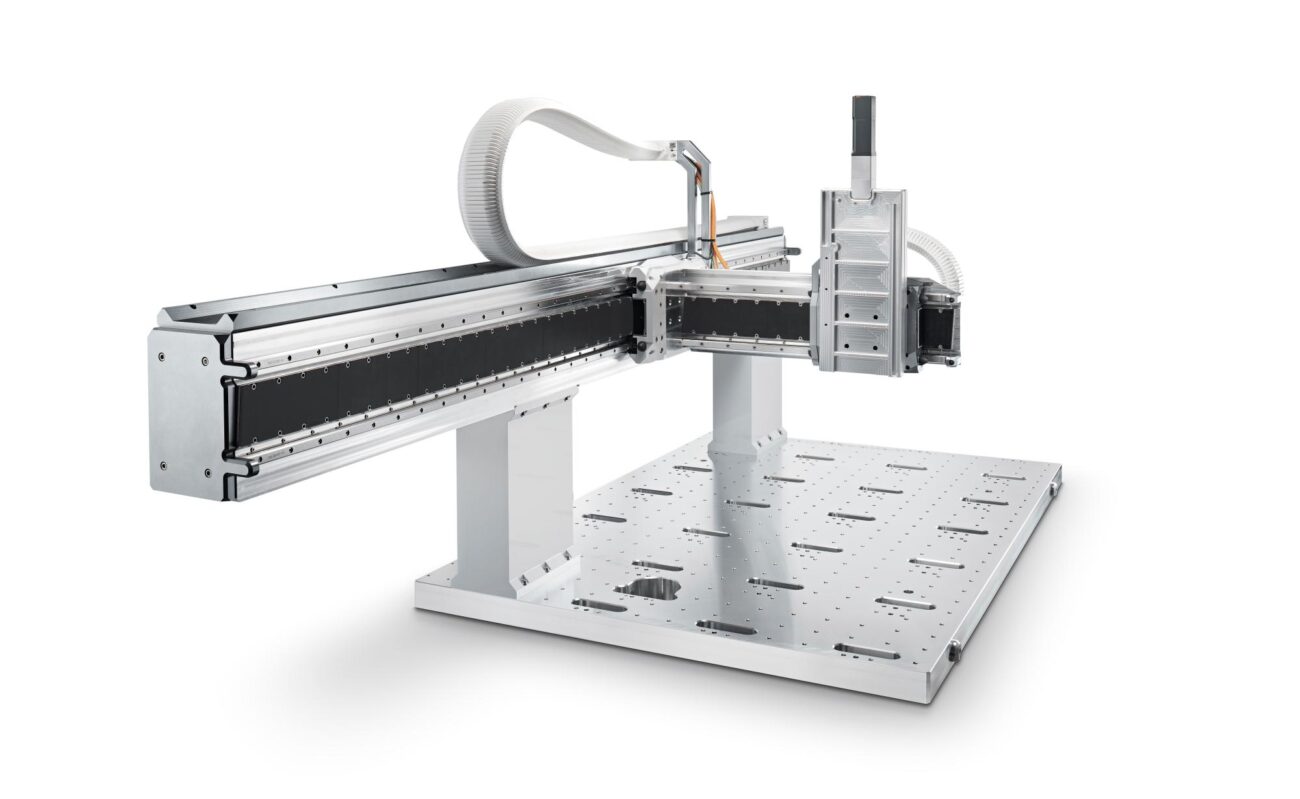
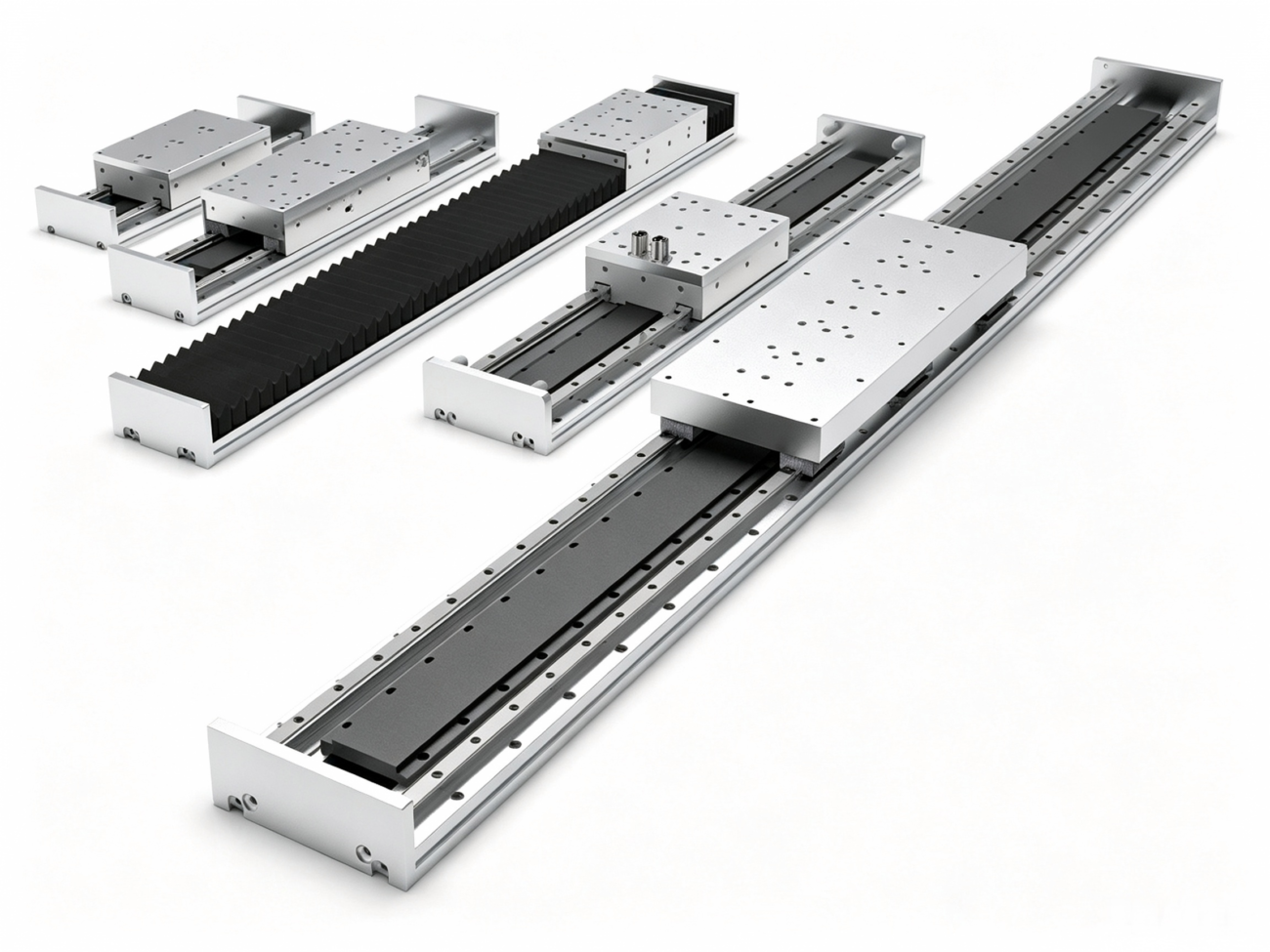
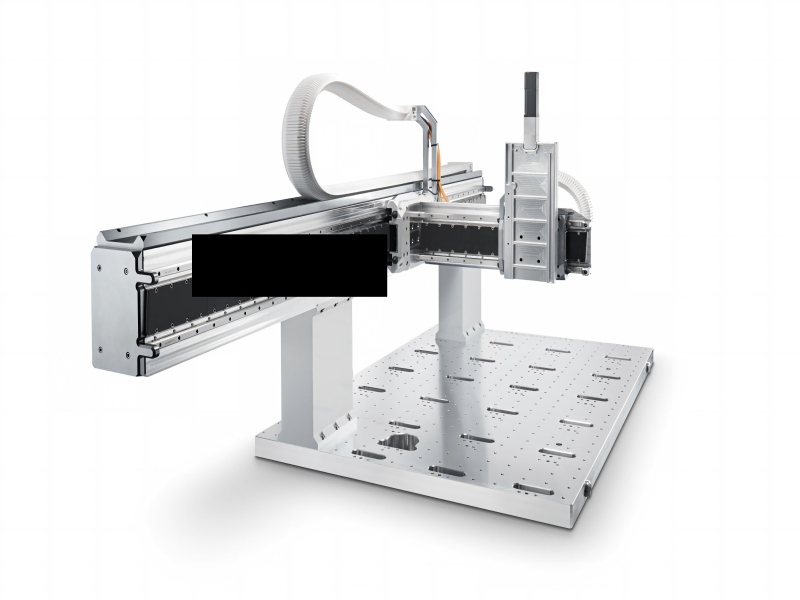
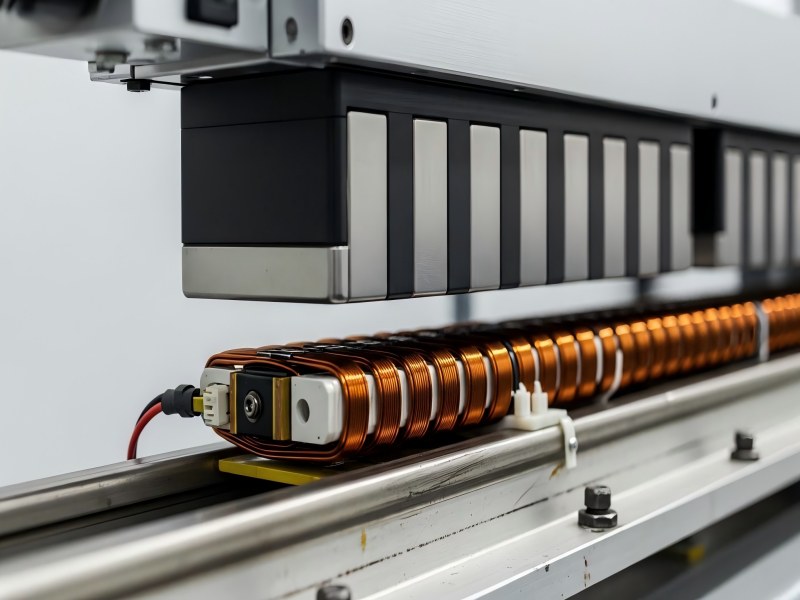
Belt-driven and ball screw modules rely on mechanical transmission components. A linear motor generates thrust directly along the direction of travel, eliminating the need for a rotary-to-linear transmission mechanism.
This can be advantageous when a machine requires high acceleration, rapid response, reduced transmission backlash, or flexible multi-axis motion.
Linear motors are commonly considered for semiconductor equipment, precision inspection, electronic manufacturing, automated assembly, and other demanding motion applications.
However, direct drive does not automatically guarantee better positioning accuracy. The final performance depends on the motor, encoder, guide system, structural stiffness, thermal management, servo drive, and control tuning.
When comparing a linear motor with a belt-driven or ball screw module, evaluate:
Required continuous and peak thrust
Moving mass and acceleration
Stroke length and operating speed
Positioning accuracy and repeatability
Cooling and thermal stability
Feedback and controller compatibility
Total system cost and integration effort
For some applications, a conventional transmission module remains the most practical choice. For others, a customized linear motor solution may offer a better balance of performance and machine flexibility.
Not every automation project fits a standard linear module. Installation space, payload, travel length, positioning performance, and production cycle time can all require a different configuration.
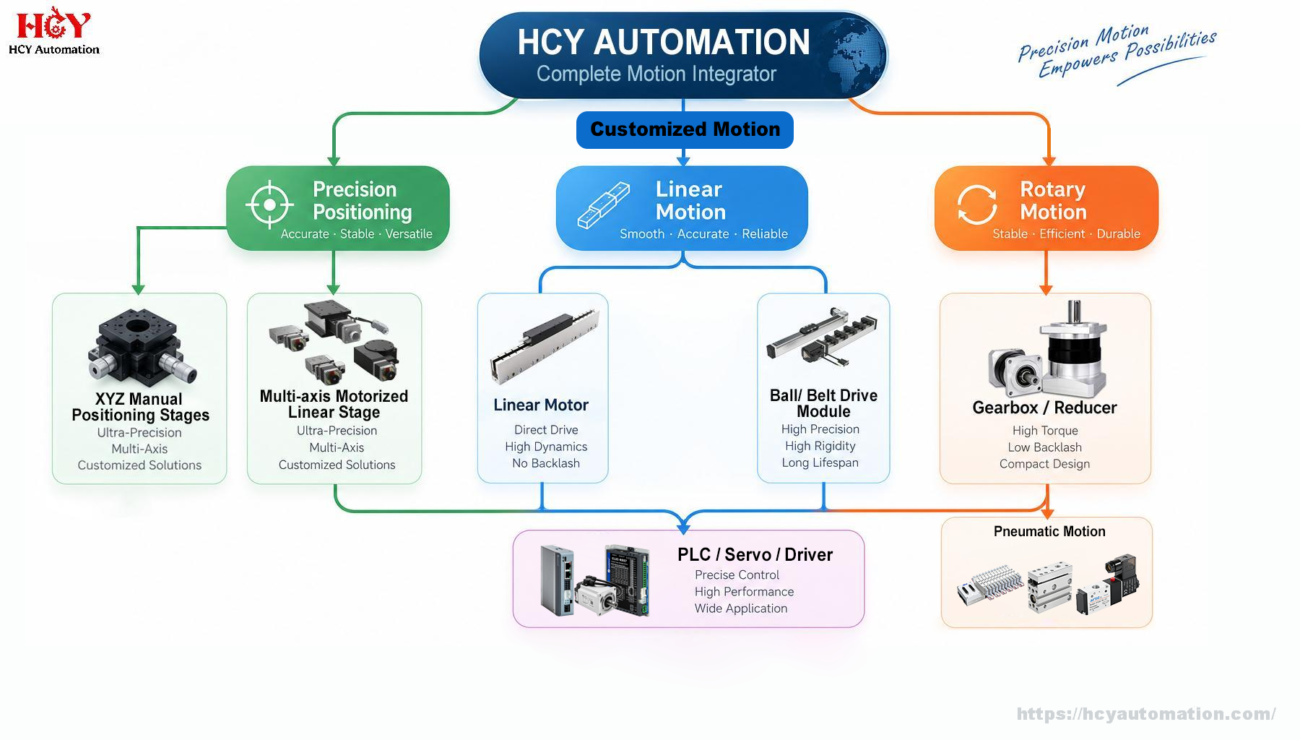
HCY Automation focuses on linear motion applications and customized solutions designed around machine-level requirements.
Depending on project feasibility and configuration, customization may involve:
Custom linear motor modules: Configurations tailored to specific motion and installation requirements.
Dual-carrier linear motor modules: Designs for applications requiring two moving carriers on a shared motion platform.
Customized stroke and mounting dimensions: Mechanical configurations adapted to the available machine space.
Integrated linear motion systems: Coordination of motors, guides, feedback components, and related motion hardware.
Application-oriented engineering: Reviewing payload, acceleration, cycle time, positioning requirements, and operating conditions before recommending a configuration.
For example, a machine builder developing a high-speed inspection system may need to balance long travel with precise positioning. A dual-carrier arrangement may also be worth evaluating if two workpieces need to move independently or operate in a coordinated sequence.
In such cases, the most suitable solution depends on the complete machine design rather than the transmission mechanism alone.
To begin a selection discussion, prepare the required stroke, payload, target speed, acceleration, positioning accuracy, installation dimensions, and operating environment. These details help establish a realistic technical specification and narrow down the available options.
Looking for a belt-driven module, ball screw linear stage, or customized linear motor solution? Contact HCY Automation to discuss your application and identify a suitable linear motion configuration.
8. Frequently Asked Questions
Is a belt-driven linear module more accurate than a ball screw module?
Not generally. Ball screw modules are often preferred for demanding positioning applications because of their stiffness and transmission characteristics. Belt-driven modules can still achieve good accuracy when properly designed and controlled. Actual performance depends on the specific product, load, speed, mounting conditions, and feedback system.
Which is better for long-stroke applications: a belt drive or a ball screw?
A belt-driven module is often advantageous for long travel because it avoids the long rotating shaft used in a ball screw system. However, the final choice should consider required accuracy, load, speed, stiffness, and installation conditions.
Can a belt-driven linear module handle heavy loads?
Yes, if the belt, linear guides, base, and drive system are appropriately sized. The load capacity cannot be determined from the belt alone. Total moving mass, acceleration, external forces, and overturning moments must also be considered.
Do ball screw linear modules require regular maintenance?
Yes. Lubrication and periodic inspection are generally necessary. Maintenance intervals depend on the screw and guide design, operating conditions, contamination, load, and duty cycle.
When should I choose a linear motor instead of a belt or ball screw module?
Consider a linear motor when high acceleration, rapid response, reduced mechanical transmission components, or flexible motion control is important. Compare the complete system requirements and lifecycle cost before making the decision.
Can HCY Automation provide customized linear motion solutions?
HCY Automation can discuss application-specific linear motion requirements, including customized module configurations and linear motor applications. Available options should be confirmed against the project’s technical specifications and integration requirements.
Conclusion
Choosing between a belt-driven and a ball screw linear module is not simply a question of speed versus accuracy.
Ball screw modules are often a strong choice for precision positioning and high stiffness. Belt-driven modules are frequently advantageous for long travel and high-speed transfer. Both can perform well when correctly specified, installed, and maintained.
The best selection starts with the real operating requirements: positioning performance, travel length, moving load, acceleration, environment, and expected service life.
When standard configurations cannot meet those requirements, a customized linear motion system or direct-drive linear motor may provide a better fit.
Need help selecting a linear module for your next automation project? Contact HCY Automation to discuss your application requirements and explore a suitable solution.
Linear Motion & Motion Control | Precision Positioning | Industrial Automation Solutions | HCY Automation
HCY Automation delivers integrated solutions across motion control, linear motion, robotics, machine vision, pneumatic systems, and precision gearboxes to help global manufacturers build smarter, faster, and more reliable production lines. Our engineering team helps you select and integrate the right motion control, robotics, and automation components for your specific application.