Ironless Linear Motor Pros and Cons: A Complete Guide
Ironless Linear Motor Advantages and Disadvantages: Selection Guide
Ironless linear motors are increasingly used in high-precision automation, semiconductor equipment, inspection systems, robotics, medical equipment, and advanced manufacturing.
But what makes an ironless linear motor different from an iron-core linear motor?
What are the real advantages and disadvantages of an ironless linear motor?
And more importantly, is an ironless linear motor the right choice for your application?
The answer depends on what your motion system needs.
Ironless linear motors are particularly attractive when an application requires smooth motion, low cogging force, low moving mass, high acceleration, and precise positioning. However, they also have engineering challenges, including force density, thermal management, magnetic circuit design, and overall system cost.
This guide explains the key advantages and disadvantages of ironless linear motors and compares them with iron-core designs to help engineers and machine builders make a better decision.
What Is an Ironless Linear Motor?
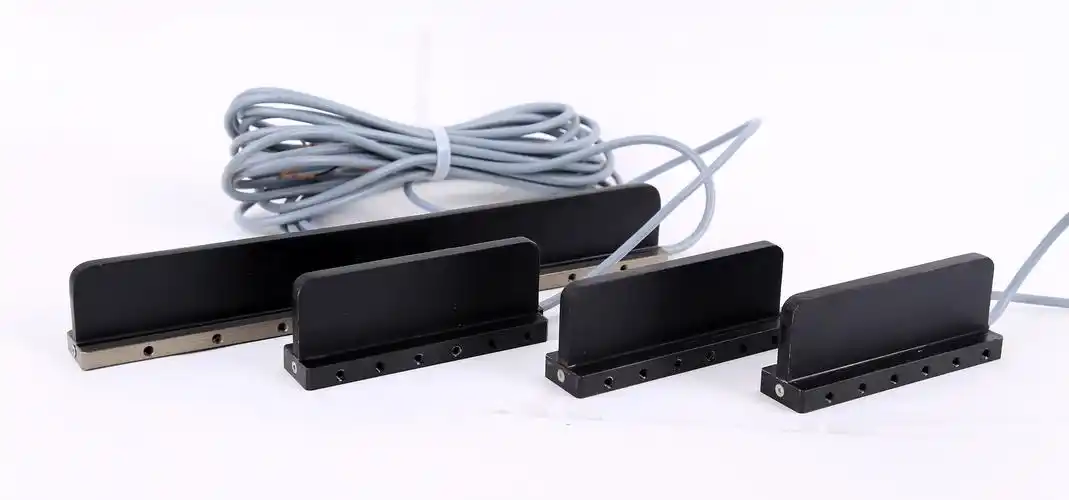
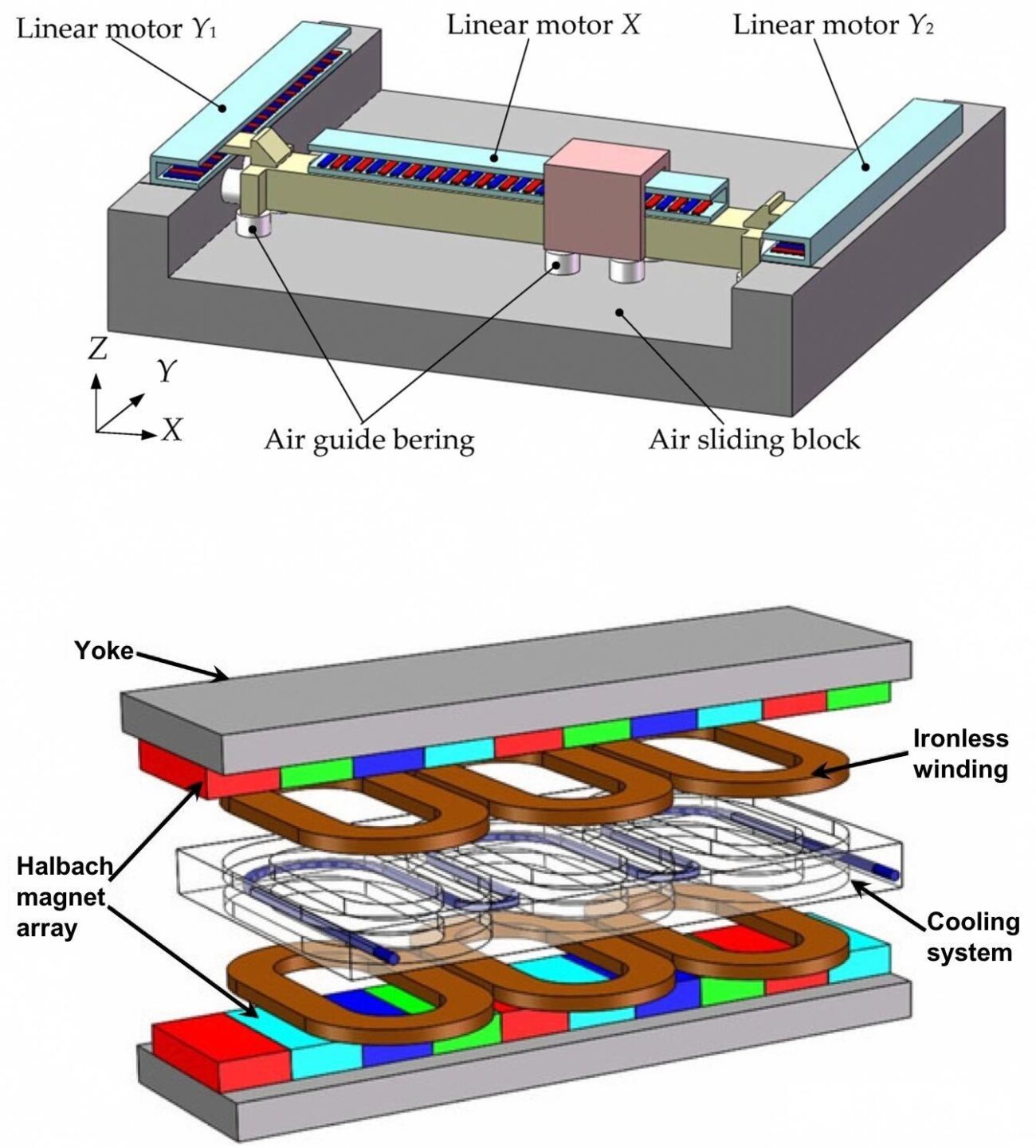
An ironless linear motor, also known as a coreless linear motoror air-core linear motor, is a direct-drive linear motor that does not use an iron core in its moving coil assembly.
Instead, the coil moves through the magnetic field generated by a permanent-magnet track.
The basic working principle is:
Electrical current + Magnetic field → Electromagnetic force → Linear motion
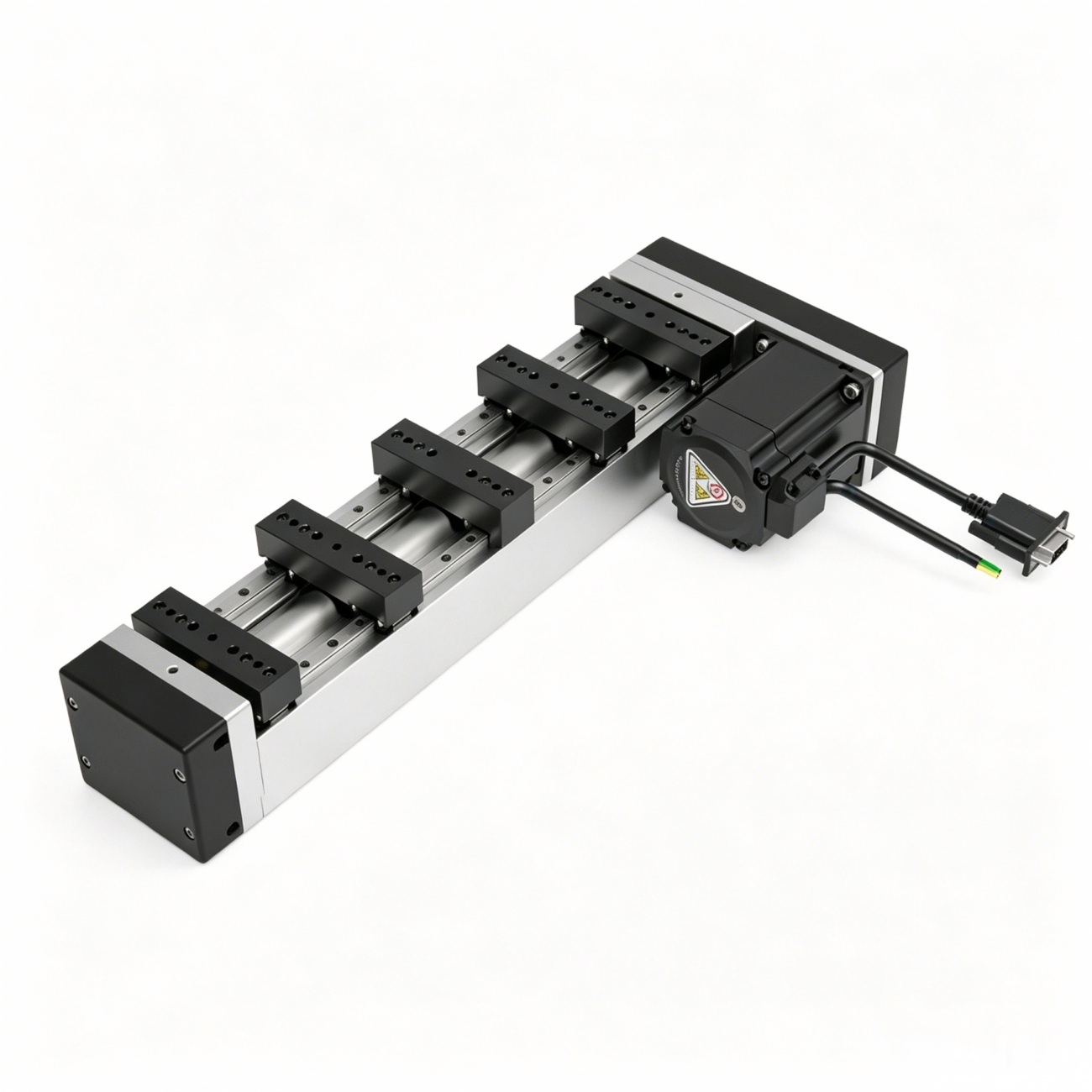
Unlike a conventional rotary motor combined with a ballscrew or belt, a linear motor can generate motion directly along a straight axis.
A typical ironless linear motor system consists of:
Ironless coil assembly
Permanent magnet track
Linear guide
Linear encoder
Servo drive
Motion controller
The absence of an iron core significantly changes the motor’s electromagnetic and mechanical characteristics.
This is why ironless linear motors are often selected for applications where motion quality and dynamic performance are more important than maximum force density.
How Does an Ironless Linear Motor Work?
An ironless linear motor works according to the principle of electromagnetic force.
When electrical current passes through the coil, it interacts with the magnetic field produced by the permanent magnets.
This interaction generates a force along the direction of travel.
The coil assembly moves relative to the permanent-magnet track, producing controlled linear motion.
Unlike screw-driven actuators, there is no need to convert rotary motion into linear motion through:
Gearboxes
Lead screws
Ball screws
Belts
Couplings
This direct-drive structure reduces the number of mechanical transmission components between the motor and the load.
As a result, an ironless linear motor can provide:
High acceleration + smooth motion + low mechanical transmission error + fast dynamic response
Advantages of Ironless Linear Motors
1. High Acceleration and Dynamic Response
One of the most important advantages of an ironless linear motor is its low moving mass.
Because the moving coil does not contain an iron core, the moving assembly can be relatively lightweight.
This is especially valuable in applications where the axis must repeatedly accelerate, decelerate, stop, and reverse.
For a given motor force, reducing moving mass can increase acceleration.
A simplified relationship is:
F = ma
where:
F = force
m = moving mass
a = acceleration
Therefore, reducing moving mass can help a system achieve higher acceleration when sufficient motor force is available.
This makes ironless linear motors attractive for:
High-speed automation
Pick-and-place machines
Electronic assembly
Inspection equipment
Precision stages
Semiconductor equipment
For high-cycle manufacturing, faster acceleration and deceleration can also contribute to shorter machine cycle times.
2. Very Low Cogging Force
One of the most important benefits of an ironless linear motor is its very low cogging force.
Cogging force is a periodic force variation associated with the interaction between permanent magnets and ferromagnetic structures in certain motor designs.
Because the moving coil of an ironless linear motor does not contain an iron core with teeth, the conventional tooth-to-magnet interaction responsible for cogging is largely eliminated.
This can result in:
Smoother motion
Lower velocity ripple
More stable low-speed movement
Reduced mechanical disturbance
Easier precision servo control
This characteristic is particularly valuable in:
Semiconductor manufacturing
Optical inspection
Metrology
Microscopy
Laser processing
Precision positioning
For a precision motion system, achieving high positioning accuracy is not only about encoder resolution. Unwanted force ripple and mechanical disturbance can also affect the final result.
3. Minimal Normal Magnetic Attraction Force
Another major advantage of an ironless linear motor is its minimal normal magnetic attraction force.
In many iron-core linear motor designs, the iron core is strongly attracted toward the permanent magnets.
This creates a magnetic force perpendicular to the direction of motion.
That normal force must be supported by the machine’s mechanical guide system.
An ironless design eliminates the conventional iron-core attraction mechanism in the moving coil.
This can provide significant benefits for precision machinery.
For example, the system may experience:
Lower guide loading
Less mechanical deformation
Lower bearing preload requirements
Easier mechanical integration
Greater flexibility in guideway design
This is particularly useful for applications using precision guideways or air bearings.
Why Does This Matter?
Imagine a precision stage moving along a horizontal axis.
If a large additional magnetic force is continuously pulling the moving assembly toward the magnet track, the mechanical guide has to withstand that load.
With an ironless design, this normal magnetic attraction can be greatly reduced.
For ultra-precision equipment, reducing unwanted forces can be just as important as increasing motor thrust.
4. Excellent Motion Smoothness
Ironless linear motors are known for smooth motion.
The combination of:
Very low cogging
Low moving mass
Direct drive
Minimal normal magnetic attraction
makes them well suited to applications where motion quality is critical.
For example, an optical inspection system may need to move at a constant velocity while a camera or sensor collects data.
Any significant velocity ripple or mechanical vibration could affect measurement quality.
An ironless linear motor can help create the smooth motion required for these applications.
5. High Positioning Precision
An ironless linear motor can be used in high-precision positioning systems.
However, it is important to understand that the motor itself does not determine the complete system accuracy.
Final positioning performance depends on the entire motion system, including:
Motor
Linear encoder
Servo drive
Controller
Linear guide
Mechanical structure
Thermal conditions
Installation accuracy
With a high-resolution linear encoder and properly tuned servo system, an ironless linear motor can support demanding precision positioning applications.
Potential applications include:
Semiconductor inspection
Wafer handling
Precision measurement
Optical equipment
Laboratory automation
Microscopy
Precision assembly
6. Excellent for High-Speed Motion
Because ironless linear motors eliminate many mechanical transmission components, they can achieve excellent dynamic performance.
There is no ballscrew rotating at high speed.
There is no gearbox between the motor and load.
There is no belt elasticity in the direct-drive force path.
This can make linear motors particularly attractive for high-speed applications.
Potential applications include:
High-speed scanning
Automated inspection
Pick-and-place
Electronic component handling
Packaging
Laser processing
For long-stroke, high-speed applications, a linear motor can also avoid certain mechanical limitations associated with long rotating screws.
Disadvantages of Ironless Linear Motors
Despite their advantages, ironless linear motors are not the best solution for every machine.
Several factors need to be carefully evaluated.
1. Lower Force Density in Some Applications
The absence of an iron core is one of the biggest advantages of an ironless linear motor—but it can also be a limitation.
Iron can help concentrate magnetic flux and improve electromagnetic coupling.
Without an iron core, achieving very high force density can require:
A larger active motor area
More permanent magnet material
Higher current
Larger coil dimensions
Advanced cooling
Therefore, if an application requires very high continuous thrust from a compact motor package, an iron-core linear motor may be more appropriate.
This does not mean that ironless linear motors cannot generate high thrust.
Rather, the motor needs to be properly sized according to the required:
Continuous force
Peak force
Acceleration
Payload
Duty cycle
2. Thermal Management Requires Careful Design
Thermal management is another important consideration.
When current passes through the motor winding, electrical losses generate heat.
At high current or high duty cycle, the generated heat must be removed effectively.
The challenge is not simply whether the motor can produce a high peak force.
The more important question is:
How much force can the motor produce continuously without exceeding its allowable temperature?
This is why engineers should distinguish between:
Peak Force
The maximum force the motor can produce for a limited period.
Continuous Force
The force the motor can maintain under specified thermal conditions.
An ironless motor may have excellent peak dynamic performance, but its continuous-force capability must be evaluated carefully for high-duty-cycle applications.
Depending on the motor design, thermal management may include:
Natural convection
Forced-air cooling
Heat sinks
Heat-conductive mounting structures
Liquid cooling
The appropriate solution depends on the motor construction and operating conditions.
3. Higher System Cost in Some Applications
The initial cost of an ironless linear motor system can be higher than a conventional motor-and-screw solution.
A high-performance linear motor system may require:
Permanent magnet track
Linear encoder
Servo drive
Precision guideway
Motion controller
Thermal management
Precision mechanical assembly
However, comparing only the purchase price of the motor can be misleading.
The total machine cost should also consider:
Cycle time
Maintenance
Mechanical wear
Positioning performance
Productivity
Energy consumption
Machine lifetime
For high-speed production equipment, improved cycle time may justify a higher initial investment.
The motor must dissipate the heat generated during the entire cycle.
Therefore, motor selection should be based on the actual duty cycle rather than peak force alone.
This is especially important for:
High-speed automation
Semiconductor equipment
Long-duration scanning
Continuous production
High-frequency positioning
Are Ironless Linear Motors Better for Precision Applications?
In many cases, yes.
The combination of:
Very low cogging
Minimal normal magnetic attraction
Low moving mass
Direct drive
High-resolution feedback
makes ironless linear motors particularly attractive for precision motion.
However, motor technology alone does not guarantee precision.
The entire system must be engineered correctly.
A high-performance precision stage may require:
Ironless Linear Motor + Linear Encoder + Precision Guide + Servo Drive + Rigid Mechanical Structure + Thermal Control
The weakest part of the system can ultimately limit the overall accuracy.
Frequently Asked Questions About Ironless Linear Motors
What is an ironless linear motor?
An ironless linear motor is a direct-drive linear motor that uses a coil assembly without an iron core. It generates linear electromagnetic force through interaction with a permanent magnetic field.
What are the main advantages of an ironless linear motor?
The main advantages include:
Low moving mass
Very low cogging force
Minimal normal magnetic attraction
Smooth motion
High acceleration
Excellent dynamic response
High positioning performance
What are the disadvantages of an ironless linear motor?
The main challenges include:
Lower force density in some designs
Thermal management requirements
Potentially higher system cost
Permanent magnet handling
Mechanical alignment requirements
Does an ironless linear motor have cogging?
An ironless design largely eliminates the conventional cogging mechanism associated with iron teeth interacting with permanent magnets.
This is one of its most important advantages for precision motion applications.
Does an ironless linear motor have magnetic attraction?
The conventional normal magnetic attraction associated with an iron-core structure is largely eliminated in an ironless design.
This can reduce loading on the mechanical guide system.
Are ironless linear motors suitable for high-speed applications?
Yes.
Their low moving mass and direct-drive architecture make them well suited to high-speed and high-acceleration applications.
The actual achievable speed depends on the motor design, load, guideway, encoder, servo drive, and thermal conditions.
Are ironless linear motors suitable for heavy loads?
They can be, but the motor must be appropriately sized.
For applications requiring extremely high continuous thrust and high force density, an iron-core linear motor may provide a more efficient solution.
Are ironless linear motors suitable for semiconductor equipment?
Yes.
Their smooth motion, low cogging, low normal force, and high dynamic response make them attractive for many semiconductor and precision inspection applications.
Conclusion: Are Ironless Linear Motors Right for Your Application?
An ironless linear motor is not simply a smaller or lighter version of an iron-core linear motor.
It is a different motor architecture designed around different engineering priorities.
If your application prioritizes:
Low cogging + smooth motion + low moving mass + high acceleration + precision positioning
an ironless linear motor can be an excellent choice.
If your application prioritizes:
High continuous thrust + high force density + heavy payload + compact motor dimensions
an iron-core linear motor may be a better option.
The best choice should always be based on the complete motion profile and machine requirements.
Before selecting a motor, evaluate:
Payload
Stroke
Speed
Acceleration
Continuous force
Peak force
Positioning accuracy
Repeatability
Duty cycle
Cooling
Encoder
Mechanical guide
Operating environment
Looking for an ironless linear motor for your automation or precision motion application? Contact HCY Automation Hub with your motion requirements, and we can help you evaluate the appropriate motor and system configuration
HCY Automation delivers integrated solutions across motion control, linear motion, robotics, machine vision, pneumatic systems, and precision gearboxes to help global manufacturers build smarter, faster, and more reliable production lines. Our engineering team helps you select and integrate the right motion control, robotics, and automation components for your specific application.