Ironless vs Ironcore Linear Motor : Differences, Advantages, How to choose right linear motor?
The Ultimate Selection Guide for Precision Automation
Linear motors eliminate ball‑screw backlash to deliver direct‑drive motion for high‑end automation. The two mainstream types, ironcore linear motors and ironless linear motors, behave dramatically differently in thrust density, acceleration, positioning repeatability, heat generation and total cost. Choosing the correct model directly determines equipment productivity, precision stability and long‑term operating expense. This guide breaks down structural principles, performance benchmarks, typical use cases and common selection mistakes for machine builders, automation engineers and system integrators.
the Core Difference: Structure Dictates Performance
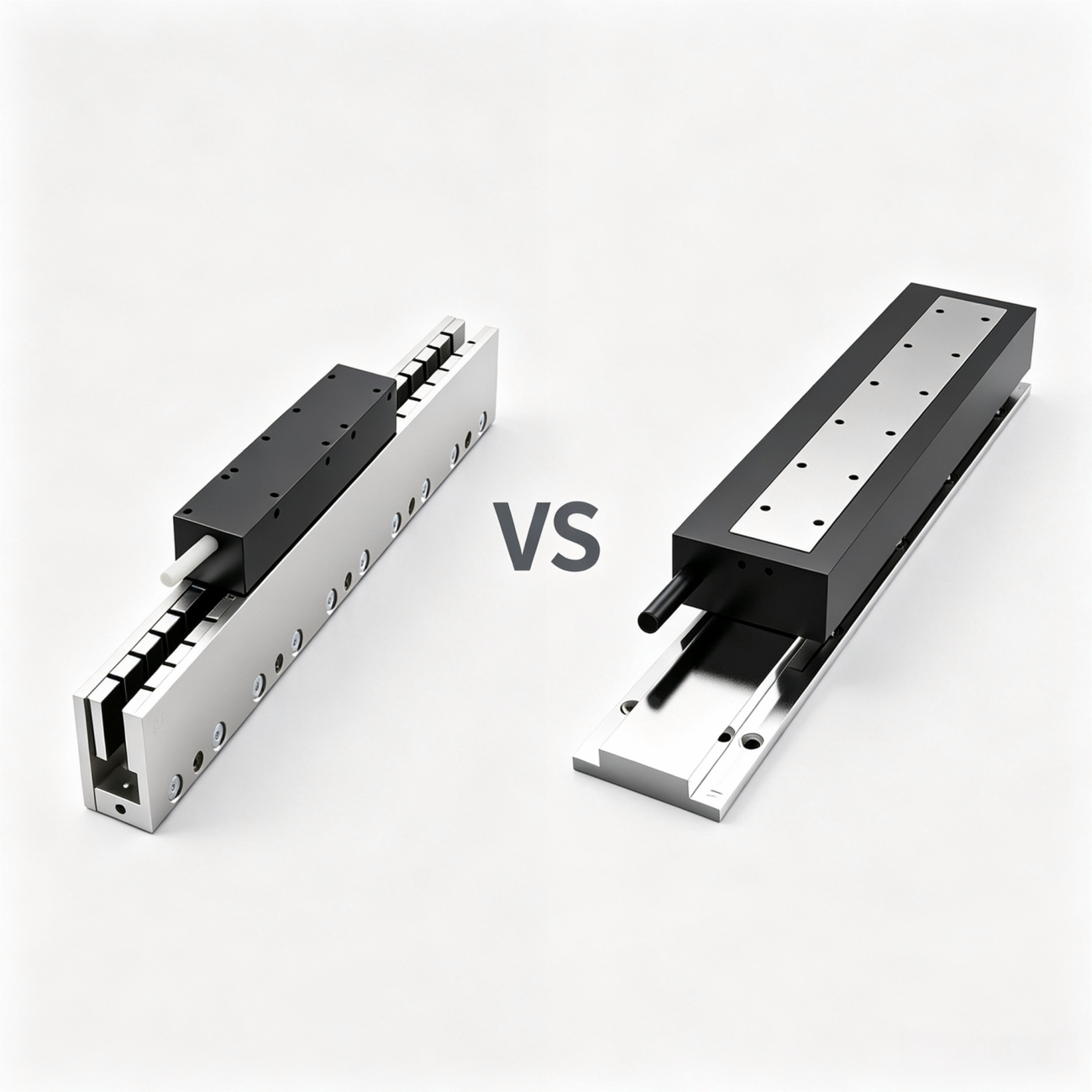
The distinction between iron core and ironless linear motors is rooted in a single design choice: does the motor use a ferromagnetic core in its primary part?
Ironcore Linear Motors: Power at a Price
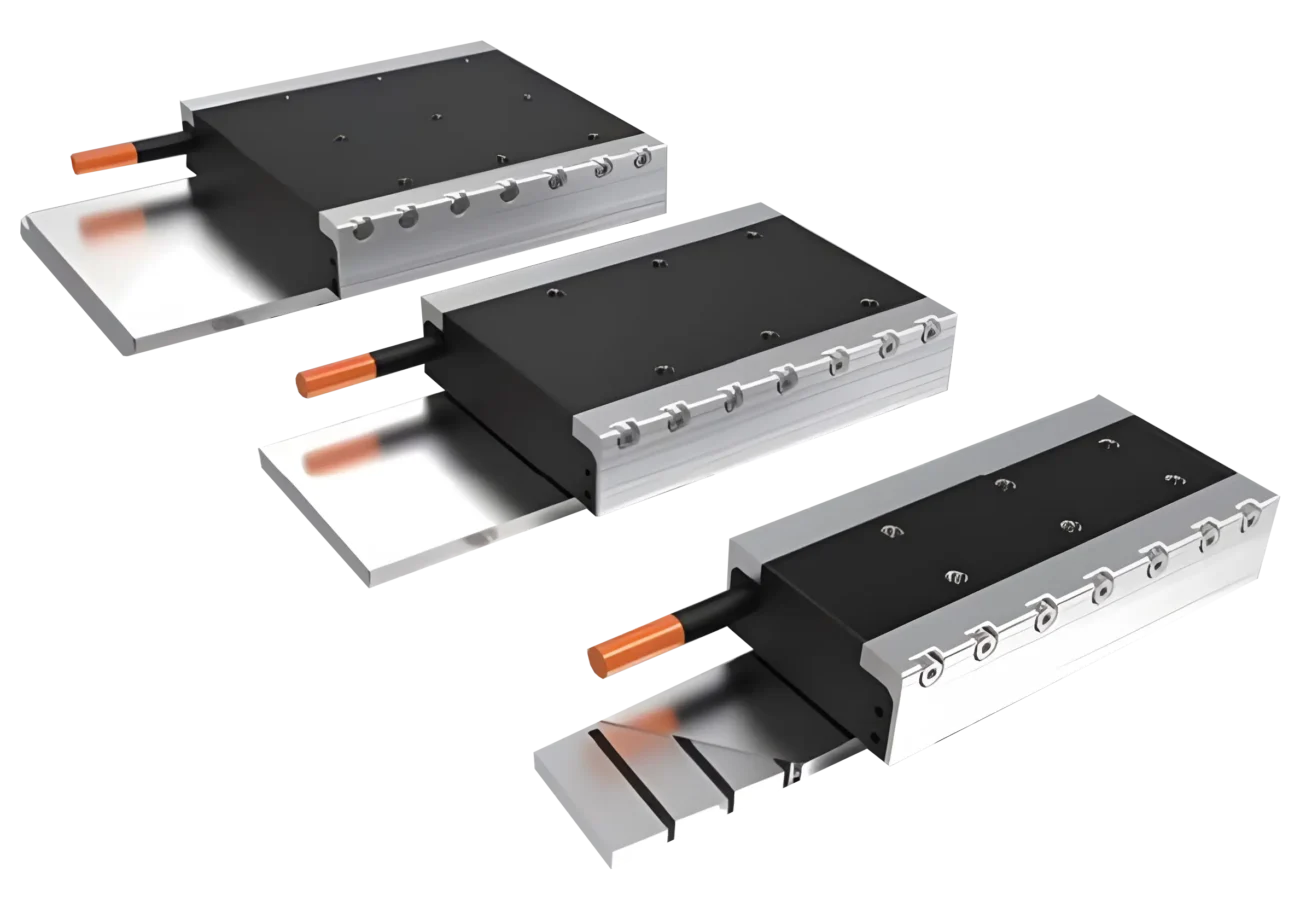
Iron core linear motors (also called “ironcore” or “slotted” motors) feature copper coils wound around laminated silicon steel teeth. This ferromagnetic structure concentrates the magnetic flux, creating a closed magnetic circuit that significantly boosts force output -1-6.
Key characteristics include:
High force density: Typically 100-300 N/kg, enabling substantial thrust in compact form factors -1
Normal force: The magnetic attraction between the core and the magnet track creates a normal force that must be supported by the linear bearings -1-6
Cogging force: The interaction between the iron teeth and permanent magnets creates a periodic force ripple known as cogging -1-10
Heat generation: Eddy currents and hysteresis losses in the iron core produce heat during operation
Ironless Linear Motors: Precision Without Compromise
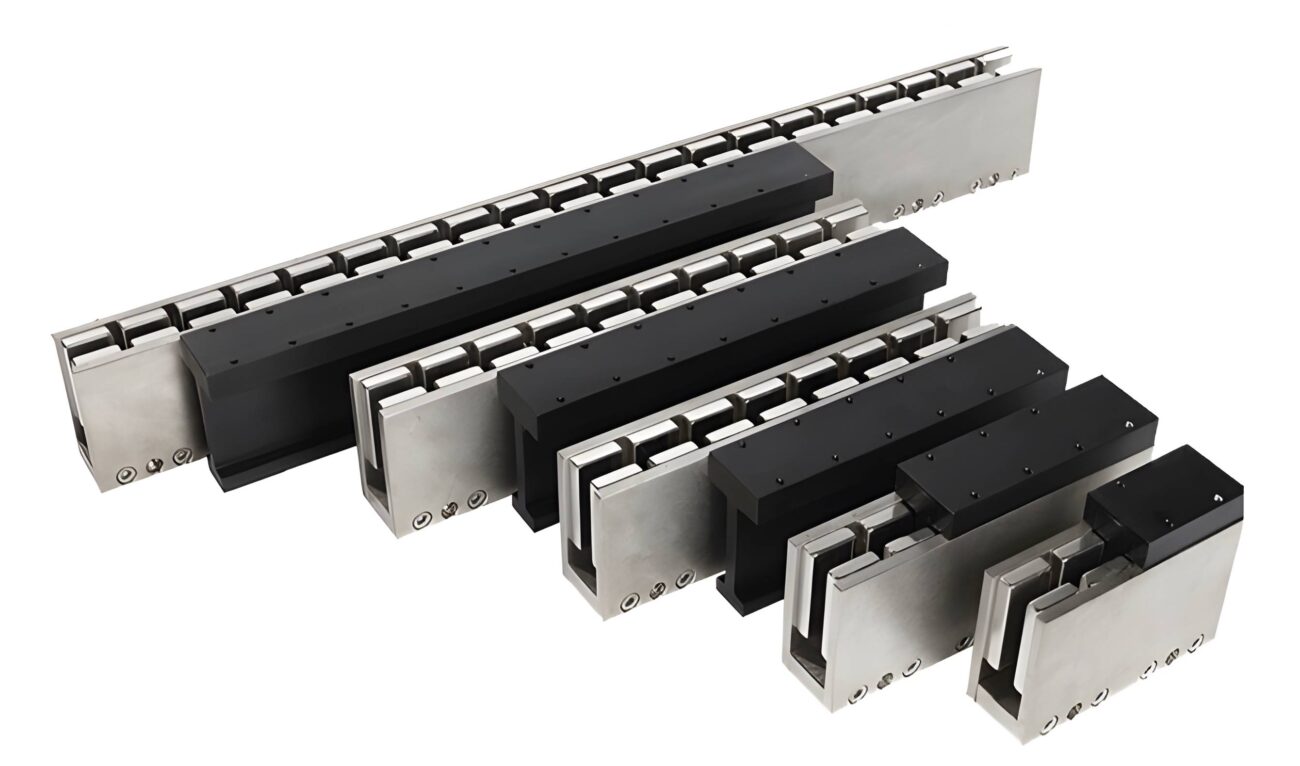
Ironless linear motors (also known as “ironless,” “coreless,” or “U-channel” motors) have no ferromagnetic core. The coils are wound in a non-magnetic carrier, typically epoxy or aluminum, and move through a magnetic field created by two parallel magnet tracks -1-6.
Key characteristics include: Zero cogging: Without iron teeth, there are no periodic force variations, enabling ultra-smooth motion
No normal force: The coil assembly experiences no magnetic attraction to the magnet track, reducing bearing stress
Lighter moving mass: Enables exceptional dynamic response and high accelerations (5-10G typical)
Lower heat output: No iron losses mean greater efficiency (90%+) and less thermal distortion
Higher speed capability: Can exceed 5-10 m/s, with some models reaching up to 10 m/s
Iron core linear motors (also called “ironcore” or “slotted” motors) feature copper coils wound around laminated silicon steel teeth. This ferromagnetic structure concentrates the magnetic flux, creating a closed magnetic circuit that significantly boosts force output.
Key characteristics include:
High force density: Typically 100-300 N/kg, enabling substantial thrust in compact form factors
Normal force: The magnetic attraction between the core and the magnet track creates a normal force that must be supported by the linear bearings
Cogging force: The interaction between the iron teeth and permanent magnets creates a periodic force ripple known as cogging
Heat generation: Eddy currents and hysteresis losses in the iron core produce heat during operation
Speed limitations: Generally limited to below 2-5 m/s due to iron losses
Ironless vs Ironcore Linear Motor Comparison Table
Performance Factor
Ironless Linear Motor
IronCore Linear Motor
Thrust Density
Moderate (50-150 N/kg)
High (100-300 N/kg)
Force Range
1-1000 N
10-5000 N
Speed Capability
Can exceed 5-10 m/s
Generally < 2-5 m/s
Acceleration
5-10 G typical
3-5 G typical
Cogging Force
None (zero cogging)
Present (challenging for smooth motion)
Normal Force
None
High (affects bearing life)
Positioning Accuracy
±0.1-1 μm typical
±1-5 μm typical
Repeatability
±50 nm achievable with premium designs
±1-5 μm typical
Efficiency
90%+ (IE3 standard)
70-85% (IE2-IE3 with optimization)
Heat Generation
Lower (copper losses only)
Higher (eddy currents + copper losses)
Initial Cost
Higher (30-50% premium)
Lower (30-50% less than ironless)
Maintenance
Minimal (no normal force)
Moderate (bearing wear from normal force)
Service Life
Long (no contact wear)
Moderate (bearing-related)
Application Selection: When to Choose Each Type
Choose Ironless For:
Ultra-High Precision Positioning Semiconductor manufacturing, wafer inspection, optical alignment, and metrology applications demand the zero-cogging performance that only ironless motors provide. With repeatability down to ±50 nm, ironless motors are the gold standard for sub-micron positioning.
High-Speed, Dynamic Motion Laser cutting, high-speed sorting systems, scanning stages, and similar applications benefit from the low moving mass and rapid acceleration capability (up to 10G). Speed-hungry applications requiring 3+ m/s are best served by ironless designs.
Long-Term Accuracy Critical Because there’s no mechanical wear pathway and no normal force to stress bearings, ironless motors maintain positional accuracy over extended periods—often outlasting ball screw alternatives by 2.5×.
Ultra-Smooth Motion Required Applications with stringent constant velocity requirements, such as photolithography reticle stages, depend on the elimination of force ripple that only ironless motors can deliver.
Low-Heat, Thermally Sensitive Environments When thermal stability is paramount—in metrology equipment, medical devices, or precision inspection systems—the minimal heat output of ironless motors preserves accuracy without expensive cooling systems.
Choose Iron Core For:
Heavy Load Applications Iron core motors excel where significant force is required. Applications like heavy-load transfer systems, CNC machine tool feed axes, and injection molding machines benefit from the high thrust density (100-300 N/kg).
General Automation Material handling, packaging machinery, conveyor systems, and other industrial automation tasks that prioritize force over sub-micron precision are ideal candidates.
Cost-Sensitive Projects When the budget is constrained and precision requirements are moderate (±1-5 μm), iron core motors offer exceptional value—typically 30-50% lower initial cost than ironless alternatives.
Rugged Environments With robust construction and available IP67 ratings, iron core motors handle dusty workshop conditions and oil-contaminated environments well.
Battery Manufacturing & Heavy Industry High-volume production of EV battery components demands both force and durability. Iron core motors handle the material handling and heavy assembly operations efficiently.
The Practical Reality: Debunking Common Myths
Myth 1: “Ironless Motors Are Always Better”
Reality: Ironless motors offer superior precision and dynamics but sacrifice force density. Selecting an ironless motor for a heavy-load application (>500N continuous) leads to undersizing, poor performance, and unnecessary cost.
Myth 2: “Ironcore Motors Lack Precision”
Reality: Advanced design techniques—including skewing magnets, optimizing tooth geometry, and implementing sophisticated commutation algorithms—can reduce cogging to ±1 μm repeatability, satisfying many high-end applications.
Myth 3: “Ironless Motors Are Fragile”
Reality: While standard ironless motors have lower ingress protection ratings (IP54 typical), custom configurations can achieve IP65 or higher, making them suitable for demanding environments.
Myth 4: “Ironcore Efficiency Is Poor”
Reality: While eddy current losses exist, many modern iron core motors achieve IE3 efficiency ratings (90%+ in some configurations), the highest classification under IEC 60034-30 standards with advanced design optimization.
Reality: With custom enclosures and protective coatings, ironless motors can be deployed in cleanrooms, vacuum environments, and even some industrial settings where their precision advantages outweigh environmental concerns.
Selection Framework: 4 Steps to the Right Choice
Step 1: Define Your Load Profile
Calculate required peak and continuous forces by considering:
Total moving mass (including payload)
Maximum acceleration and deceleration
Friction and external process forces
Duty cycle
Load Condition
Recommendation
Continuous force < 200 N
Consider ironless
Average force 200-500 N
Either type viable
Continuous force > 500 N
Ironcore preferred
Peak force > 1000 N
Ironcore required
Step 2: Evaluate Motion Profile Requirements
Motion Characteristic
Recommendation
Ultra-smooth constant velocity
Ironless required
Speed > 3 m/s
Ironless strongly preferred
Frequent start/stop cycles
Ironless (less heating, higher acceleration)
Constant velocity < 1 m/s
Either type viable
Heavy roughing operations
Ironcore preferred
Step 3: Consider Accuracy and Repeatability
Requirement
Recommendation
Sub-micron positioning
Ironless required
Repeatability ±0.1-1 μm
Ironless preferred
Repeatability ±1-5 μm
Ironcore adequate
±5 μm or looser
Ironcore viable
Step 4: Factor in Environmental and Economic Considerations
Condition
Consideration
Cleanroom or vacuum
Ironless preferred (no outgassing from insulation, minimal particle generation)
Beyond the Motor: Total Cost of Ownership Considerations
Cost Factor
Ironless
IronCore
Initial Investment
Higher (30-50% premium)
Lower by 30-50%
Energy Consumption
Lower by 10-20% (90%+ efficiency)
Higher (70-85% efficiency)
Maintenance
Minimal (no normal force, less bearing wear)
Moderate (bearing wear from normal force)
Service Life
Long (no contact wear)
Moderate (bearing-related)
Replacement Cost
Higher
Lower
Cooling Requirements
Minimal to none
Often required for high-duty cycles
Total Cost of Ownership Insight: While the initial cost of ironless motors is higher, the reduced maintenance requirements, lower energy consumption, and extended service life can make them more economical over the system lifecycle—particularly in high-duty-cycle applications where energy costs and downtime carry significant weight.
Special Considerations for High-End Applications
Photonics & Optical Communications
Fiber alignment, lens positioning, and optical inspection rely on 1 µm/s ultra-smooth low-speed control combined with nanometer-level stability
Semiconductor Manufacturing
The photolithography industry represents the pinnacle of precision motion control. Reticle stages require zero-cogging motors with sub-nanometer error budgets, making ironless motors the only viable option. With repeatability down to ±50 nm, ironless designs dominate this sector.
High-Speed Precision Machining
When evaluating linear motors for machining centers, the choice between ironless and iron core significantly impacts performance. Iron core motors provide the stiffness and force required for heavy roughing cuts, while ironless motors excel in finishing operations requiring ultra-smooth motion and rapid direction changes.
Battery Manufacturing
High-volume production of EV battery components demands both force and speed. Iron core motors handle the material handling and heavy assembly operations, while ironless motors serve the inspection and precision positioning stations where sub-micron accuracy ensures quality control.
Medical Device Manufacturing
Surgical robotics and diagnostic equipment demand both precision and reliability. Ironless motors are increasingly specified for their smooth, cogging-free motion and minimal heat generation—critical factors in patient-facing and thermally sensitive applications.
Making the Final Decision
If Your Priority Is…
Choose…
Ultimate precision and smoothness
Ironless
Maximum force output per dollar
Ironcore
Fast acceleration of light loads
Ironless
Heavy-duty industrial environment
IIroncore
Minimal maintenance and long service life
Ironless
Strict budget constraints
Ironcore
High-duty-cycle operation with low energy cost
Ironless
Speed > 5 m/s
Ironless
Sub-micron repeatability
Ironless
High-thrust, rugged applications
Ironcore
Frequently Asked Questions(FAQ)
Q1: What is the fundamental difference between ironless and iron core linear motors? Iron core motors use laminated steel teeth to concentrate flux for high force; ironless motors have no iron in the coil carrier, eliminating cogging and normal force for superior smoothness and precision.
Q2: How do I know which type is right for my application? Choose ironless for high speed (>3 m/s), sub-micron precision, and ultra-smooth motion; choose iron core for heavy loads (>500N continuous), rugged environments, and cost-sensitive general automation.
Q3: What is cogging, and why does it matter? Cogging is a periodic force ripple from magnetic attraction between iron teeth and magnets, causing velocity fluctuations—ironless motors have zero cogging, making them essential for constant-velocity and scanning applications.
Q4: What about normal force / magnetic attraction? Why does it matter? Iron core motors generate a strong normal force (5-10× thrust) that adds bearing load and wear; ironless motors have zero normal force, simplifying mechanical design and extending system life.
Q5: What are typical applications for each type? Ironless dominates semiconductor, medical, optical, and laser processing; iron core serves CNC machining, heavy material handling, battery manufacturing, and packaging.
Q6: Which type works better for high-speed applications? Ironless, with lower moving mass and no iron losses, reaches 5-10 m/s; iron core is generally limited to below 2-5 m/s due to eddy current and hysteresis losses.
Q7: What about vacuum and cleanroom environments? Ironless is preferred for low outgassing, minimal particle generation, and low heat output; standard ironless has lower IP ratings (IP54) but custom vacuum-rated versions are available.
Q8: Can I use multiple forcers on a single magnet track? Yes, multiple coil assemblies can operate independently on the same track for multi-head processing.
Q9: Do you offer customization for specific environments? Yes, including IP ratings, vacuum-ready versions, structural dimensions, and force tuning—consult an applications engineer for details.
Q10: What happens if the system loses power? The system loses all stiffness; moving payloads coast until friction or a stop halts them—vertical axes require counterbalances or safety brakes since linear motors are not self-locking.
Q11: Do the magnets ever lose their strength? Rare-earth magnets (neodymium) retain strength under normal conditions but can permanently demagnetize above ~100°C—always check the maximum operating temperature.
Q12: Is water cooling available? Yes, for both types—especially recommended for iron core motors in high-duty-cycle applications due to higher heat generation
HCY Automation delivers integrated solutions across motion control, linear motion, robotics, machine vision, pneumatic systems, and precision gearboxes to help global manufacturers build smarter, faster, and more reliable production lines. Our engineering team helps you select and integrate the right motion control, robotics, and automation components for your specific application.