Modern automation relies on controlled motion. Machines need to move tools, products, sensors, and fixtures quickly, consistently, and accurately. People searching for “linear modulator” are often not looking for an electronic device. In industrial automation, they usually mean a linear module—a compact motion unit designed to move a load along a straight path. Using the right term makes it easier to find suitable products, compare specifications correctly, and communicate clearly with suppliers and engineers.
In most factory and machinery settings, “linear modulator” is best understood as a linear module or linear module system. This is an integrated linear-motion unit that combines structure, guidance, and drive in one assembly. Depending on the application, the drive may be a ball screw, timing belt, or linear motor. Linear modules are widely used in assembly, packaging, electronics manufacturing, robotics, inspection, and machine building because they simplify design while delivering dependable straight-line movement.
To keep the topic practical, this guide explains what a linear module is, how the system works, where it is used, how to choose one, and what to check before buying.
What Is a Linear Module?
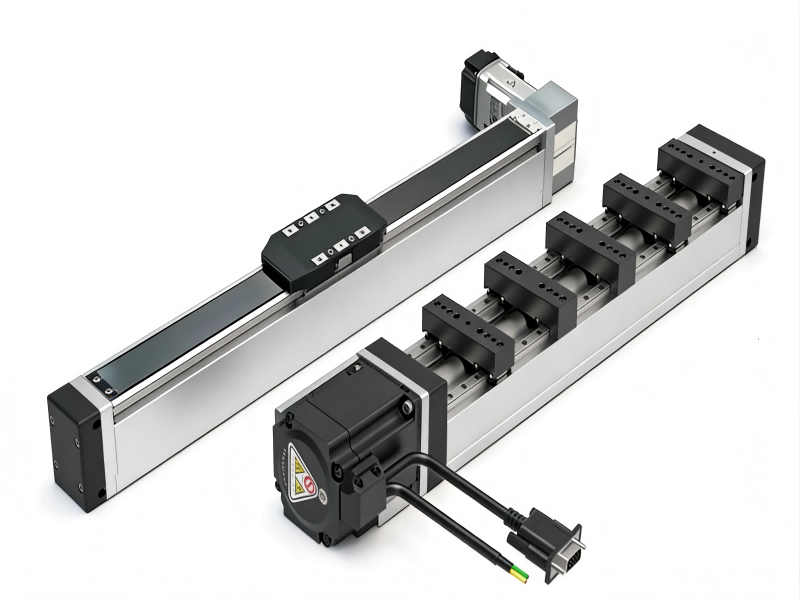
A linear module is a pre-engineered mechanical component that moves a load in a straight line using an integrated guide-and-drive system. By combining these parts in one unit, it gives machines controlled linear motion without requiring engineers to build the axis from separate components.
A linear module is, in simple terms, a ready-made motion axis. Instead of designing and assembling individual rails, bearings, plates, couplings, and transmission parts, a machine builder can install one integrated unit that already contains the essential motion structure.
That is why the linear module has become so widely used in industrial automation. It cuts engineering time, reduces alignment risk, and makes machine designs easier to repeat across projects.
The basic elements of a linear module system are shown below:
Element
Purpose
Importance
Base frame
Holds the assembly together
Provides rigidity and mounting stability
Linear guide
Keeps motion straight and controlled
Affects smoothness, accuracy, and load capacity
Carriage or slider
Supports the moving load
Determines how tools or parts are attached
Drive mechanism
Generates the motion
Determines speed, thrust, and precision
Motor interface
Connects the module to a motor
Influences control options
Cover or seal
Protects internal components
Important in dusty or sensitive environments
This is what makes a linear module more than a simple collection of parts. The drive and guide are designed to work together from the beginning, removing much of the trial and error involved in building a custom axis.
For a broad category overview, see the linear motion module category. It shows the main industrial formats used in different applications.
Why people use the term “linear modulator”
“Linear modulator” is not the standard term in mechanical motion control. In electronics, modulation means something completely different. Still, many online users do not search with technical precision. In most cases, they are looking for a motion product that moves back and forth along a straight line.
Here is how the common terms usually compare:
Search Term
What the User Often Means
Common Context
Linear modulator
Linear motion product
General industrial search
Linear module
Integrated linear motion axis
Standard automation term
Linear actuator
Broader motion device category
Machinery and automation
Linear stage
Precision motion platform
Testing, optics, inspection
Linear axis
Motion axis in a machine
Gantries and transfer systems
For procurement and SEO, making this distinction clear helps readers understand that a linear module is usually the product category they need.
How Does a Linear Module System Work?
A linear module system converts motor power into controlled straight-line movement. The drive mechanism produces force, while the guide system supports the carriage and keeps it traveling along one defined axis.
At the functional level, the working principle is simple. A motor receives a motion command and turns a screw, drives a belt, or powers a direct-drive linear motor. That force moves the carriage along a guide structure inside the module. Because the carriage is mechanically constrained, its movement stays straight rather than free-moving.
That simple principle is what makes a linear module system useful in industrial automation. Machine builders get predictable motion without having to design a fully custom axis.
Basic operating sequence
Step
Action
Outcome
1
The controller issues a move command
Desired motion is set
2
A motor generates force
Power is delivered to the module
3
The drive system transfers motion
Force becomes linear travel
4
The guide structure supports the carriage path
Motion remains straight and stable
5
Sensors or feedback verifies travel
Position and repeatability are maintained
Although the sequence looks simple, performance depends strongly on module design. Load behavior is influenced by drive type, guide quality, rigidity, sealing, and motor control.
Main drive methods used in linear modules
Ball screw drive
A ball screw module converts rotary motion into linear travel through a screw-and-nut assembly, making it a strong choice for positioning accuracy, thrust, and rigidity.
In a ball screw system, the motor rotates the screw. The ball nut moves along the screw thread and carries the slider. Recirculating balls reduce friction and help the system move efficiently.
Ball screw modules are common in equipment that needs controlled stopping points, high repeatability, and higher force. They are widely used in assembly machines, inspection platforms, CNC support axes, and precision handling systems.
When stable positioning and protected movement matter most, a dust-free ball screw linear stage is a common option.
Belt drive
A belt-driven module uses a timing belt and pulley system to move the carriage, making it ideal for longer travel and higher-speed transfer applications.
In this design, the motor turns a pulley that drives the belt and carries the attached carriage along the guide. Belt systems are particularly suitable where fast motion and long stroke are more important than maximum positioning accuracy.
These modules are common in packaging, sorting, transfer lines, and general material handling. When an application requires both speed and long travel, a high-speed belt linear stage is a strong choice.
Linear motor drive
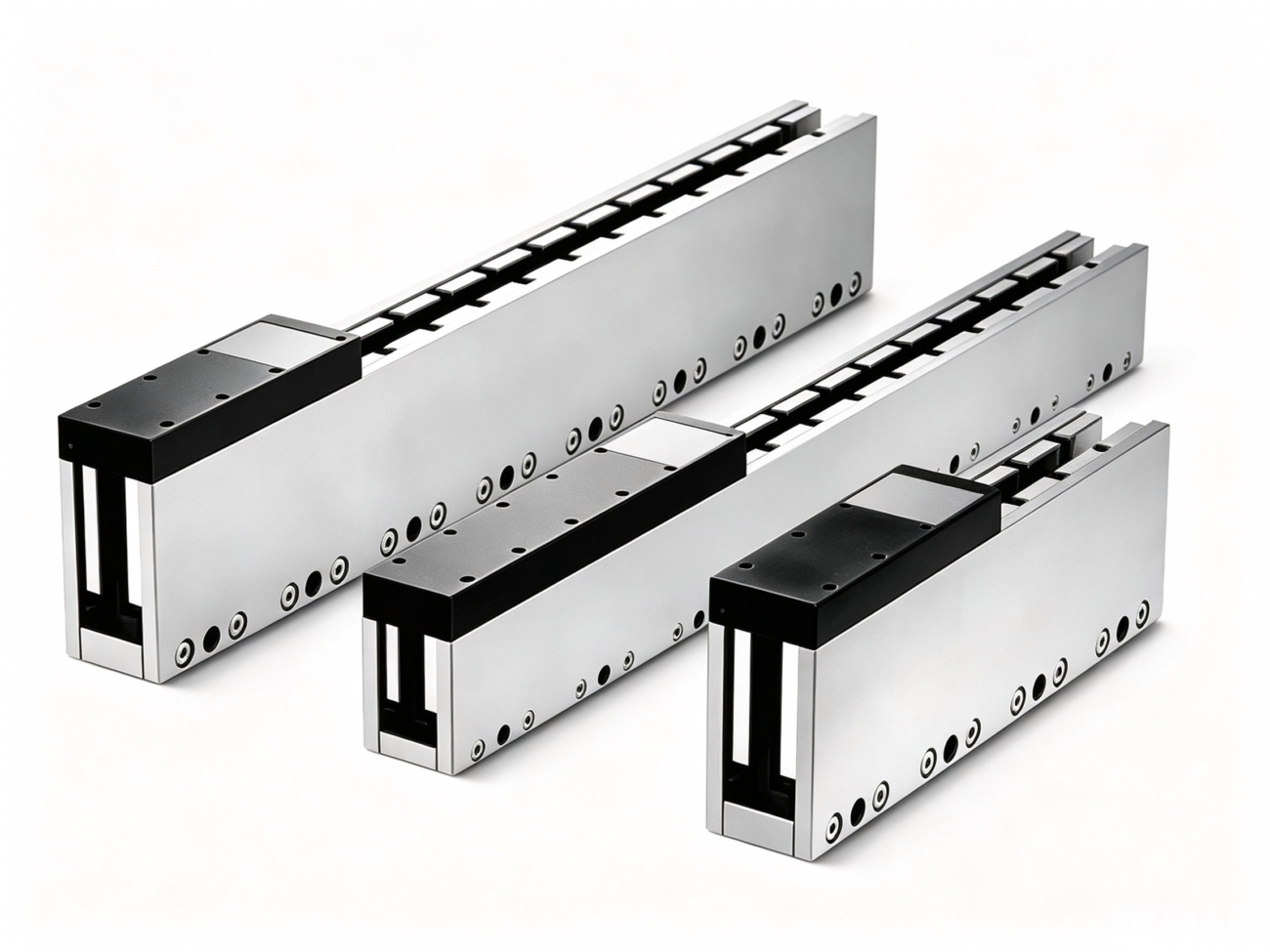
A linear motor module generates direct linear force without using a screw or belt, allowing smooth motion, fast acceleration, and reduced wear in the transmission system.
With direct drive, linear motor systems can respond quickly and operate with very little mechanical backlash. They are often used in high-end automation, electronics manufacturing, vision equipment, and other applications where strong dynamic performance is required.
A direct-drive linear motor stage is typically selected when a machine needs fast response and smooth motion.
Why integrated design saves time
A machine builder can create a custom axis from separate rails, screws, plates, and supports. But that approach takes longer and creates more opportunities for misalignment, uneven assembly, and tolerance problems. A pre-engineered linear module avoids many of those risks.
That is one reason OEMs and integrators prefer linear modules: they speed machine development and support standardization.
What Are the Main Types of Linear Modules?
The main types of linear modules are ball screw modules, belt-driven modules, and linear motor modules. Each one suits a different balance of speed, stroke, load, precision, and budget.
No single option is best for every application. A module that works well in packaging may be a poor match for precision inspection. The decision should always be based on the actual motion requirement.
Main types at a glance
Module Type
Best For
Main Strength
Main Limitation
Ball screw module
Precision positioning and force applications
High rigidity and repeatability
Lower speed over long strokes
Belt-driven module
Fast transfer and long travel
High speed with efficient long stroke
Less precise than screw systems
Linear motor module
High dynamics and smooth direct motion
Fast acceleration and low transmission wear
Higher cost and greater control demands
Compact embedded module
Tight machine layouts
Space-saving integration
More application-specific sizing
Ball screw modules
Ball screw modules are often the best choice when positioning accuracy and force generation matter more than maximum travel speed.
Typical applications include the following:
Typical Use
Why Ball Screw Fits
Assembly systems
Reliable stop positions
Dispensing equipment
Controlled, repeatable movement
CNC-related motion
Rigidity and consistent travel
Inspection stages
Precise positioning under load
Vertical axes
Effective force transmission when properly sized
Ball screw systems offer precise mechanical control. The direct relationship between motor rotation and linear movement makes them well suited to applications where reliable positioning is essential.
Belt-driven modules are ideal for moving loads quickly over longer distances without requiring the highest possible positioning accuracy.
Typical applications include the following:
Typical Application
Why Belt Drive Works
Packaging
Repeated transfer at high speed
Pick and place
Travel over medium- to long strokes
Material handling
Good speed-to-cost ratio
Product indexing
Practical cycle time
Multi-station automation
Long travel with lower system cost
Belt-driven modules are generally more cost-effective than screw-driven modules for long strokes. They are especially attractive where throughput matters more than ultra-fine positioning.
Linear motor modules
Linear motor modules are built for high-end motion tasks that demand fast response, smooth travel, and direct-drive performance.
Common uses include:
Typical Use
Why Linear Motor Fits
Electronics production
Smooth high-speed motion
Vision systems
Fast response with stable travel
Precision inspection
Reduced mechanical transmission effects
Laboratory automation
Clean and controlled movement
Advanced assembly
High dynamic motion profiles
These modules can deliver strong performance, but they also require closer attention during control integration and system setup.
Compact and embedded modules
Compact embedded modules are suited to machines with limited installation space, where the motion system must fit into a smaller layout.
Space for linear travel systems is often limited in smaller equipment. A compact slide table addresses that problem without forcing the designer to give up guidance quality. For this kind of application, an embedded screw slide table can be a practical choice.
Where Are Linear Modules Used in Industry?
Linear modules are used anywhere a machine must produce controlled straight-line movement. They appear in assembly and packaging systems, robotics, electronics manufacturing, inspection equipment, machine tools, and many other forms of factory automation.
Their widespread use comes from a basic mechanical need. Machines often have to push, pull, lift, align, scan, transfer, or position something, and a linear module is frequently the most efficient way to create that motion.
Common industry applications
Industry
Typical Application
Key Requirement
Packaging
Product transfer and indexing
Speed and long stroke
Electronics
Component handling and test positioning
Precision and clean movement
Assembly
Tool or fixture positioning
Repeatability
Robotics
Cartesian axes and gantries
Modularity and control
Inspection
Camera or sensor movement
Smooth travel
CNC support
Loading, feeding, and probing
Rigidity and stable positioning
Laboratory systems
Sample handling
Clean compact motion
Assembly automation
In assembly systems, linear modules position tools or parts in the required place with consistent accuracy. Typical operations include fastening, dispensing, press-fitting, positioning, and part transfer. Because these tasks run continuously, the motion system must remain reliable over long production cycles.
Packaging and material handling
In packaging and transfer applications, linear modules help products move quickly between stations while maintaining predictable cycle times.
These systems usually favor speed, efficiency, and long travel. That is why belt-driven modules are common in these environments.
Gantries and robotic systems
Linear modules are often combined into multi-axis systems that form gantries or Cartesian robots.
By stacking or linking modules along X, Y, and Z axes, machine builders can create flexible handling systems for pick-and-place tasks, loading, sorting, and part transfer. That scalability is a major reason linear modules matter in modern automation.
Precision and cleaner environments
Enclosed module structures can help protect both the process and the motion system in cleaner or dust-sensitive production environments.
This is especially important in electronics, medical-device production, and other precision manufacturing settings. For contamination control, a dust-free linear stage solution may be the better fit.
What Are the Key Advantages of a Linear Module?
The main advantages of a linear module are simpler design, faster installation, better alignment control, and easier reuse across different machines. Instead of assembling an axis from separate parts, builders can usually save time and reduce risk with a linear module.
For machine builders, the appeal goes beyond technical performance. Much of the value comes from reducing engineering work and making projects run more smoothly.
Engineering advantages
Advantage
What It Means in Practice
Integrated structure
Fewer parts to source and assemble
Better alignment
Drive and guide are matched in advance
Faster build time
Less time required for installation and setup
Compact design
Easier machine layout
Reusable platform
Simpler standardization across projects
Production advantages
Advantage
Why It Helps
Repeatable motion
Supports process consistency
Stable performance
Makes machine tuning easier
Lower installation risk
Reduces assembly mistakes
Simpler maintenance planning
Helps control downtime
Multi-axis compatibility
Useful in automation cells and gantries
Business advantages
Advantage
Value for B2B Buyers
Faster machine development
Better delivery scheduling
Standardized components
Easier procurement and spare planning
Lower integration cost
Less design and assembly time
Better repeat orders
More consistency across machine builds
Scalable sourcing
Useful for OEM growth
These advantages explain why companies compare more than size and price when evaluating linear module manufacturers.
How Do You Choose the Right Linear Module?
The right linear module depends on the application, not on choosing the largest or fastest model. Load, stroke, speed, precision, mounting method, environment, and duty cycle should all be evaluated together.
Selection mistakes often begin when a buyer focuses on a single catalog figure. A module may meet the stated load capacity but still prove unsuitable once off-center loading, vertical mounting, contamination, or cycle frequency is considered.
Key selection criteria
Criterion
What to Verify
Why It Matters
Payload
Total moving mass
Sets basic sizing
Load moment
Center of gravity and offset
Influences carriage stress
Stroke
Required travel length
Helps determine drive type
Speed
How fast it must move
Affects motor and transmission choice
Acceleration
How quickly it must start and stop
Impacts, forces, demand, and stability
Accuracy
How close it gets to target position
Important for precision processes
Repeatability
How consistently it returns
Often more important in production
Environment
Dust, temperature, humidity
Determines protection needs
Mounting orientation
Horizontal, vertical, or side-mounted
Changes force safety requirements
Duty cycle
How often it operates
Influences wear and maintenance
Matching needs to module type
Application Need
Best-Fit Module Type
High precision with strong thrust
Ball screw module
Fast travel over long distance
Belt-driven module
Very smooth dynamic motion
Linear motor module
Limited installation space
Compact embedded module
Dust-sensitive process
Protected or enclosed module
Accuracy versus repeatability
For many industrial applications, repeatability matters more than absolute accuracy. Knowing the difference can help avoid unnecessary cost.
Accuracy describes how close the system comes to the position it was commanded to reach. Repeatability is its ability to return to the same point consistently, cycle after cycle. In production equipment, that consistency often matters more because the machine repeats fixed actions at known locations.
Why environmental conditions matter
A module that works reliably in a clean room may struggle in a dusty factory unless it has proper protection. That is why the operating environment should be considered from the start. Where contamination is a concern, enclosed designs and suitable sealing become much more important.
How Do Linear Module Manufacturers Differ?
Linear module manufacturers differ in product quality, engineering support, customization ability, delivery reliability, and documentation. In many cases, supplier capability influences project success as much as the product itself.
Products can appear almost identical in dimensions and layout, yet the ownership experience may be very different. A strong supplier supports sizing, customization, documentation, and repeat-order consistency. A weaker supplier may create delays, integration issues, and uneven quality.
What to compare between suppliers
Supplier Attribute
Why It Matters
Product range
More options to match the application
Technical support
Helps avoid selection mistakes
Customization options
Important for OEM and special machines
Quality consistency
Critical for repeat orders
Lead time management
Keeps projects on schedule
Documentation quality
Helps with design and maintenance
Service response
Supports users after delivery and installation
Questions buyers should ask suppliers
Question
Reason
Can you size the module from load and stroke data?
Confirms technical capability
Can the module be customized?
Important for machine-specific designs
What documentation is provided?
Helps integration and maintenance
How stable are repeat-order lead times?
Important for production planning
What maintenance guidance is included?
Supports lifecycle management
When comparing linear module suppliers, the lowest quote is not always the lowest total cost. Dependable support and consistent quality often save more money over time.
What Is the Linear Module HS Code?
The linear module HS code is the customs classification used in international trade. However, the applicable code can differ depending on the product structure, included components, declared function, and the rules of the destination country. No single universal code applies to every linear module.
That is why sourcing discussions often mention the keyword linear module HS code. Buyers need to know how customs will classify the product and what duties may apply. Classification is not always fixed, because it can depend on how the module is built and how it is declared.
Factors that influence HS code classification
Factor
Effect on Classification
Product design
A simple mechanical assembly may differ from a powered unit
Presence of a motor
With or without a motor can affect tariff treatment
Function declaration
A machine component and a self-contained unit may be classified differently
Target market
Customs rules vary by country
Documentation detail
Clear technical descriptions reduce disputes
Best practices for buyers
Action
Benefit
Prepare a technical datasheet
Explains product structure clearly
Provide drawings
Helps customs understand the item
State whether a motor is included
Avoids classification confusion
Check destination tariff rules
Reduces reliance on generic online data
Confirm with a customs broker
Minimizes compliance risk
For dependable information, consult official customs sources such as the World Customs Organization and the customs authority of the importing country.
How Should You Maintain a Linear Module System?
A linear module system should be maintained through regular inspection, cleaning, lubrication when needed, and observation of motion behavior. Good maintenance extends service life and helps prevent unexpected downtime.
Maintenance should not be treated as an afterthought. Even a properly sized module may fail early if it operates in poor conditions without proper care.
Core maintenance tasks
Maintenance Task
Purpose
Visual inspection
Identifies damage, contamination, or loose parts
Cleaning
Removes dust and debris
Lubrication
Limits friction and wear
Fastener checking
Maintains structural stability
Motion observation
Detects noise, vibration, or uneven travel
Performance monitoring
Reveals repeatability drift early
Maintenance focus by module type
Module Type
Main Maintenance Focus
Ball screw module
Lubrication and contamination control
Belt-driven module
Belt condition and tension
Linear motor module
Cleanliness and feedback integrity
Compact module
Inspection access and seal condition
Warning signs to watch
Only a few warning signs matter most in daily use:
Unusual noise during travel
Uneven or rough motion
Position inconsistency
These signs often point to contamination, wear, poor lubrication, or mounting issues. Catching them early can prevent larger failures.
What Trends Are Shaping the Future of Linear Modules?
Linear modules are becoming more compact, easier to integrate, cleaner in operation, and better suited to modular automation systems. Buyers increasingly want motion solutions that can be installed quickly and reused across different machines.
As automation demand grows, it is reshaping the priorities of motion-system design. Factories want equipment that can be standardized more easily, deployed faster, and trusted in continuous operation.
Key market trends
Trend
Practical Meaning
More compact modules
Better use of machine space
Cleaner structures
Better fit for precision production
Easier system integration
Faster setup with motors and controls
Better modularity
Simpler multi-axis machine building
Higher performance expectations
More speed and better repeatability
As production continues moving toward flexible systems, the linear module system becomes even more important. For machine builders, it provides a practical motion platform that can be adapted across different product lines and automation tasks.
FAQ
Is a linear module the same as a linear actuator?
Not exactly. “Linear actuator” is a broader category that may include rod actuators, electric cylinders, and other devices that produce linear motion. A linear module usually refers to a guided motion unit with its own carriage and support structure.
When should I use a belt-driven module instead of a ball screw module?
A belt-driven module is usually better for longer travel and faster transfer. A ball screw module is usually better when you need higher thrust, stronger rigidity, and more precise positioning.
Can a linear module be used in a gantry system?
Yes. Linear modules are often combined into X-Y or X-Y-Z structures to create gantries and Cartesian robots for handling, inspection, dispensing, and transfer applications.
When evaluating a machine’s motion system, begin with the real requirement: what must move, how far, how fast, how accurately, and in what environment. Once those points are clear, selecting the right linear module becomes much more straightforward.
HCY Automation delivers integrated solutions across motion control, linear motion, robotics, machine vision, pneumatic systems, and precision gearboxes to help global manufacturers build smarter, faster, and more reliable production lines. Our engineering team helps you select and integrate the right motion control, robotics, and automation components for your specific application.