Modern automation calls for motion systems that do more than move quickly. They also need to remain stable, deliver repeatable results, and fit readily into actual production lines. When engineers and purchasing teams assess equipment for assembly, packaging, inspection, robotics, semiconductor handling, or CNC support, they often encounter the term linear module. That label sounds straightforward, yet it may refer to many different mechanical designs, drive methods, and performance levels. Knowing what it actually describes matters to buyers: choosing the wrong motion platform can reduce precision, shorten service life, and create integration expenses that could have been avoided.
A linear module is a compact, pre-engineered motion unit that moves a load along a straight path using a guided structure and an internal drive mechanism. Typically, the guide rails, carriage, base, and transmission element are integrated into a single assembly. That makes installation simpler and performance more predictable than constructing a linear axis from separate parts. In practical terms, it is an automation building block for machines that require controlled linear travel.
Linear modules are widely used because of how they are structured and operate, as well as the range of categories and applications they cover. Choosing the right one, though, depends on several key factors.
What Is a Linear Module?
A linear module is an integrated mechanical motion unit designed to move a payload along a straight path with controlled speed, precision, and repeatability.
In industrial settings, a linear module is not simply a sliding component; it is a complete axis solution. Rather than sourcing a guide rail, bearing blocks, screw or belt mechanism, support frame, and motor-mounting components separately, the user receives an assembled motion platform ready to integrate into a machine. That helps explain why the term appears so frequently in B2B automation sourcing: it simplifies the design and reduces the time between the initial concept and machine commissioning.
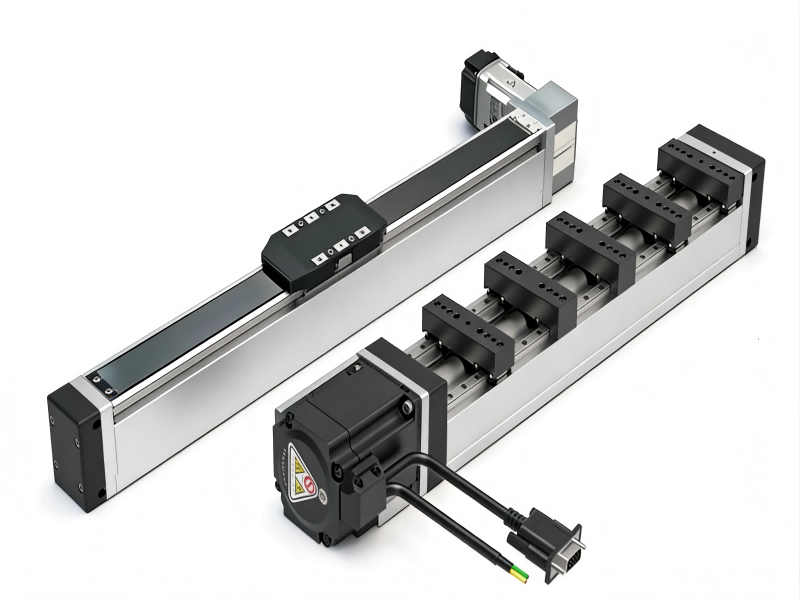
A standard linear module generally has three main parts: a rigid base, a guided platform that moves, and a way to transmit force. That transmission can be provided by a ball screw, timing belt, or linear motor, with the choice depending on whether the application calls for thrust, long travel, or dynamic response. The carriage carries the working payload—perhaps a gripper, fixture, sensor, dispensing head, or tool. Manufacturers may also equip the module with limit sensors, covers, cable management, motor interfaces, and sealing solutions to make installation easier and improve reliability.
This integrated design is more than a basic sliding part; it functions as a complete motion unit. That distinction matters. Users expect known load capacity, repeatability, stroke options, and service life, not a component that leaves them calculating every interface from the ground up.
For a practical look at how these products are commonly arranged within industrial supply, see this category of linear motion modules, which covers the standard forms used in automation systems.
Why the term is so important in machine building
The term’s popularity reflects a basic reality of industrial design: most machines require at least one controlled axis for straight-line motion. A packaging machine might use a transfer slide, while an inspection system could need a stage for positioning its camera. In a robotic cell, the required motion may come from an overhead gantry axis; on a battery production line, precise cell transfer may be essential. Across these applications, engineering teams generally seek motion systems that are compact, dependable, and easier to standardize.
A linear module addresses the problem by putting motion functions into a consistent, predictable format. For machine builders, that can mean shorter assembly times, simpler spare-parts planning, and machine architectures that are easier to reproduce across production lines. This has made the linear module system a central idea in automation planning.
How Does a Linear Module Work?
A linear module works by converting input drive force into guided straight-line movement while supporting a defined load and maintaining positional stability.
Although the design may differ, the underlying idea is simple: a motor or another source of direct electromagnetic force produces motion, which reaches a carriage through either a mechanical transmission or a direct-drive system. Guided along its path, the carriage moves while sensors or encoders track its position. A controller handles acceleration and deceleration, regulates speed, and determines how accurately it stops.
The design’s real strength is how its parts are integrated. In a traditional custom-built axis, the guide and transmission components have to be aligned with care. A linear module comes with much of that work engineered into the unit, reducing variation and the effort required during installation. That consistency is especially valuable in multi-machine production environments, where the same performance must be repeated.
Core working structure
In a typical linear module, the base provides the main structural support. It must be rigid enough to withstand bending and vibration, particularly when loads change rapidly or the center of gravity is offset from the mounting point. The guide system stabilizes the moving carriage and limits unwanted play. Depending on the design, it can consist of recirculating ball rails, profile guides, built-in guideways, or, in high-precision stages, cross-roller mechanisms.
The transmission mechanism is what produces the physical motion. With a screw-driven design, the motor spins a screw, while the nut converts that rotation into linear movement. A belt-driven system works differently: the motor turns pulleys, which move a belt loop and pull the carriage along. Linear motors generate thrust directly, with no screw or belt in the power path, so they can provide a faster dynamic response and less mechanical backlash.
Position feedback ranges from basic to advanced, depending on the application. In some systems, home sensors and end limits provide simple indexing. For finer control, particularly in precision automation and semiconductor applications, encoders are used.
In a real production environment, that integrated motion behavior is what makes a linear module valuable. What the user is buying is not movement alone, but controlled, repeatable motion that fits into a machine process.
What Is a Linear System, and How Is It Different from a Linear Module?
A linear system is a broader motion setup that may include one or more linear modules together with motors, controllers, sensors, frames, and software coordination.
People often search for what a linear system is when what they really want to understand is how one motion axis functions within a complete machine. That distinction matters. A linear module is generally one physical motion unit, while a linear system can contain the module along with the supporting hardware and control logic required for an industrial task.
A screw-driven slide that moves a camera between inspection points is, by itself, a linear module. Add servo drives, PLC logic, safety functions, cables, HMI control, and a machine frame, though, and the slide becomes one element of a larger linear system. When two or three modules combine for X-Y or X-Y-Z motion, many suppliers call the arrangement a linear module system.
Why buyers should care about the difference
This difference shapes the planning, quoting, and discussion of the project with suppliers. A standard module might be sufficient when only one positioning axis is required. The scope expands considerably, though, when the system must be a synchronized multi-axis gantry with coordinated motion and software integration. At that point, performance calculations, cable routing, frame rigidity, and control requirements all demand more attention.
That is why buyers need to be precise when they speak with linear module manufacturers. A quotation can come back incomplete if the supplier thinks you need only a module but you actually require a complete system. The opposite creates a different problem: asking for a full solution when you want just one axis may result in an unnecessarily complicated proposal. Using clear terminology helps avoid delays and mismatched specifications.
What Is a Linear Power Module?
A linear power module usually means an electrical power module that uses linear regulation. In industrial purchasing discussions, though, the term is sometimes used incorrectly for a powered linear motion unit.
This term can be confusing because its meaning shifts with the context. In electronics, a linear power module generally refers to power conversion or voltage regulation, with attention focused on electrical performance, stability, and low noise. Some people in automation use the term “automated” to mean a motorized linear stage or an integrated motion axis that has a power-driven mechanism.
The electronics meaning
In power electronics, linear regulation controls voltage in a manner that typically delivers a stable output with relatively little electrical noise. This makes it useful for measurement systems, noise-sensitive signals, and specialized power supplies. Its main drawback is energy efficiency: compared with switching-based alternatives, it generally wastes more energy because the excess is dissipated as heat.
The motion-control misunderstanding
When industrial users ask what a linear power module is, they may not be asking about electronics at all. In some cases, they mean a linear motion assembly driven by a servo or stepper motor. What they usually have in mind then is a self-contained motion module, not a product for voltage regulation. The wording is imprecise, yet it appears often enough in search behavior and sourcing discussions to merit clarification.
Start by identifying what the device is meant to do. When the discussion centers on movement, stroke, payload, repeatability, and positioning, it is almost certainly describing a motion module—not an electrical power unit.
What Is a Linear Power Module Blower?
A linear power module blower is not a conventional term in linear motion engineering. In most industrial settings, it probably describes a blower connected to a power or motion system, not an established type of linear module.
The meaning of this phrase seems to depend heavily on its context. It could reflect a translation difference, an internal name for equipment, or terminology combined from mechanical and electrical systems. Since the expression is not widely standardized, the safest course is to confirm exactly what the buyer needs before choosing a product.
Occasionally, the phrase refers to a blower that cools a power module, motor drive, or electronic control enclosure. It may instead describe an airflow component installed near a machine containing linear motion hardware. Alternatively, it could simply be a mistaken variation of the term “powered linear module.”
Cooling and contamination management matter in automation for practical reasons. In some linear motion applications, airflow must be controlled to protect electronics or maintain process stability. In others, the priority is reversed: the structure needs to be sealed so dust stays out and particles cannot reach the drive mechanism. Under those conditions, a sealed precision stage may be more relevant than blower-related hardware. A dust-free linear stage fits clean, precise motion control far better than a loosely defined blower concept.
What Are the Main Types of Linear Modules?
The main types of linear modules are belt-driven, ball screw-driven, and linear motor-driven, and each type serves a different balance of speed, stroke, load, and precision.
Choosing among these types is a major automation-design decision. The choice affects performance, service life, maintenance, energy behavior, machine footprint, and the project’s total cost—not just one or two of those factors. What works best depends on the machine’s required movement, cycle speed, supported weight, and positioning accuracy.
Belt-driven linear modules
For applications involving long travel and higher speeds, a belt-driven linear module is usually the strongest choice. It moves efficiently across extended strokes and supports relatively rapid motion without excessive cost. That combination suits transfer, packaging, and general automation tasks, particularly when cycle time matters more than ultra-fine positioning.
Belt-driven systems, however, are rarely the first choice when the highest precision is required. As the belt stretches and wears, performance may change over time, particularly under demanding load changes or during repeated fine-positioning tasks. They are not inherently inaccurate; their strengths are better suited to applications that prioritize dynamic movement and a wide travel range.
A practical example is a belt linear stage, particularly suited to high-speed movement and efficient transfer tasks.
Ball screw linear modules
When positioning accuracy, repeatability, and thrust matter most, ball screw linear modules are a common choice. The motor turns a screw, while the nut converts that rotation into controlled linear movement. Their mechanical efficiency gives ball screw transmission excellent control and strong axial force.
As a result, ball screw systems are widely used in dispensing equipment, inspection machines, assembly systems, and CNC motion applications, all of which depend on stable, consistent positioning. They are also a frequent choice for vertical or heavily loaded setups, where their stiffness and thrust characteristics suit them well.
Their main limitation is that, for extremely long travel at very high speed, they are generally less suitable than belts. Practical use is shaped by several factors: screw critical speed, the possibility of whip across long lengths, and other mechanical constraints. Even so, the ball screw is still the most balanced option for many industrial applications.
A typical ball screw actuator illustrates this category well in robotics and CNC support motion.
Linear motor modules
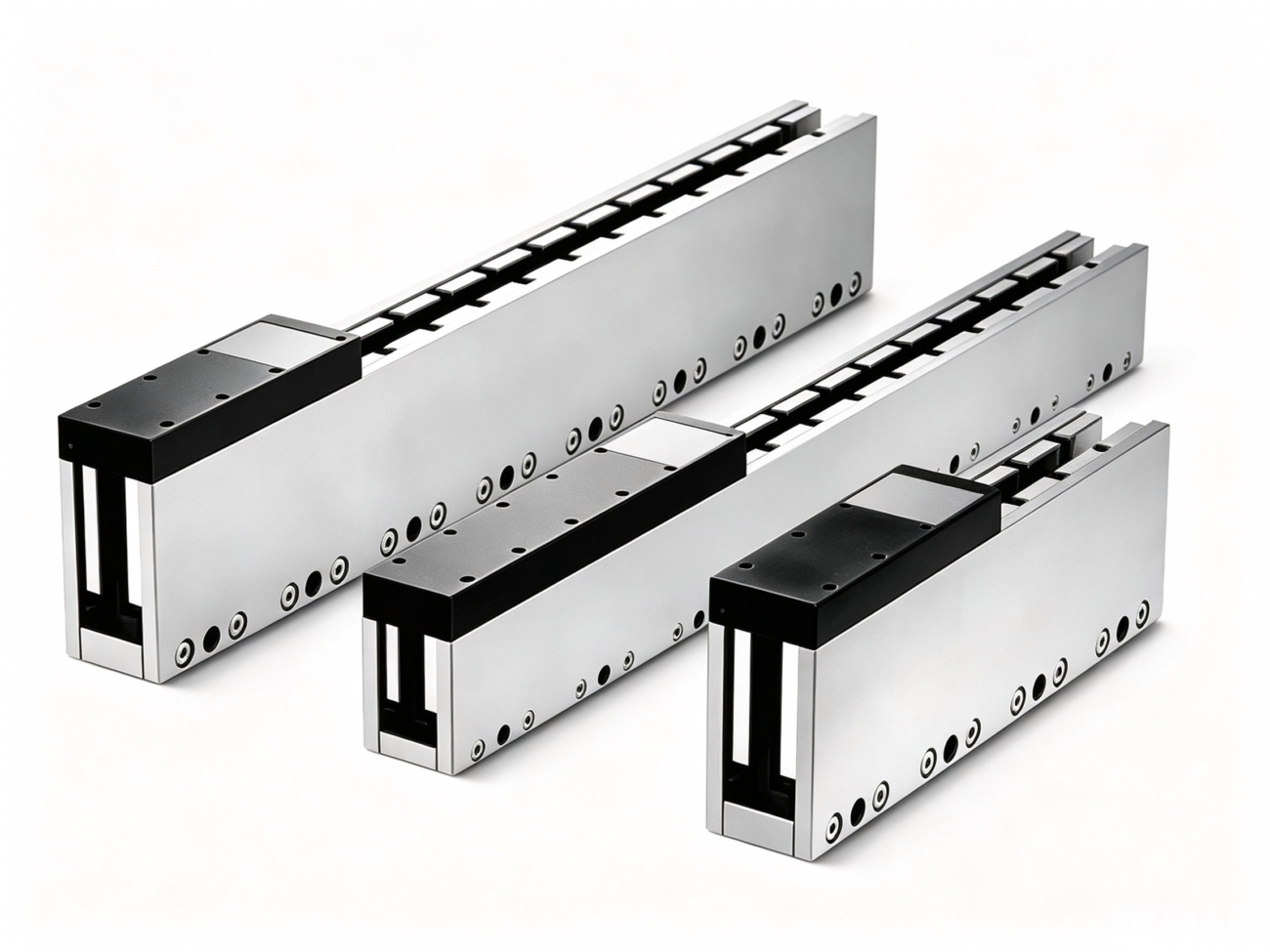
Linear motor modules produce motion through direct electromagnetic force, with no screw or belt carrying the main thrust. As a result, they respond exceptionally quickly, which makes them well suited to high-end automation applications that demand high acceleration and speed along with smooth movement.
With fewer mechanical transmission components in between, direct-drive systems can limit backlash and respond more quickly. That makes them common in semiconductor manufacturing, optical inspection, advanced assembly, laser processing, and other precision settings where speed and control quality are both important.
The tradeoff comes in the form of cost and added system complexity. Linear motor modules typically demand more sophisticated control tuning, careful management of thermal behavior, and a larger upfront investment. Still, when an application genuinely needs that level of performance, they may be the most effective option.
What Are the Benefits of Using a Linear Module System?
A linear module system helps shorten engineering time, improve installation consistency, and make machine performance more predictable.
For OEMs and industrial integrators, this is very important. Building an axis from separate components can offer flexibility, but it also creates more design work, more alignment risk, and more variables during assembly. A linear module system reduces those variables by offering a tested architecture. That often leads to faster machine development and easier standardization across projects.
Maintainability is another benefit. With a system organized around consistent module families, planning for spare parts is simpler, and replacing components takes less effort. That matters especially in high-output production settings, where even a short period of downtime can become costly.
The modular design also makes it easier to scale. As process requirements shift, a single-axis system can be extended into a two- or three-axis arrangement. Because the motion platform already uses standard integrated units, adapting it to a gantry or Cartesian structure is often more manageable than starting the design over.
In practice, the benefit extends well beyond the mechanical side. Procurement, assembly scheduling, installation quality, and after-sales service all benefit from this approach. For that reason, many automated machines use a modular approach instead of a fully custom-built linear axis.
Where Are Linear Modules Used?
Linear modules are used in almost every industry where a machine needs controlled straight-line motion.
The applications are wide-ranging because the need exists across industries. In electronics assembly, a linear module might position a camera, support a soldering mechanism, or index a test fixture. Packaging systems may use one to transfer products, move a labeling head, or guide a sorting element through repeated cycles. Medical automation relies on them for sample movement, instrument positioning, and precision handling, especially when repeatability matters more than manual flexibility.
CNC environments make extensive use of linear modules. They can load and unload workpieces, move measuring devices, or position auxiliary mechanisms that support machining. Robotics and gantry systems use them too, especially when Cartesian movement suits the application better than motion from an articulated arm.
Battery manufacturing and other new-energy sectors have taken on greater importance in recent years. Within these industries, modules can support transfer, stacking, inspection, welding-positioning tasks, and cell handling. Semiconductor production and precision assembly depend on them as well, since consistent motion is essential to maintaining yield and process consistency.
For applications that need push-pull movement, force, and controlled extension, a linear actuator solution can be a better choice than a wide horizontal stage—particularly when the process resembles replacing a cylinder more than translating a platform.
How Do You Choose the Right Linear Module?
The right linear module is selected by matching the application’s load, stroke, speed, precision, environment, and control requirements to the most suitable module design.
Many selection mistakes begin when buyers judge a module by one performance figure—price, speed, or stated precision. Linear motion performance is shaped by how several factors interact. Even a module with excellent repeatability can be the wrong choice when the load creates a large moment. Speed can also be a drawback if inspection or dispensing requires the system to settle rigidly first. The process should guide the selection; the catalog comes afterward.
Load and moment considerations
Payload weight is only part of the calculation. What matters just as much is how that load acts on the carriage. An offset tool can create dynamic moment loads that outweigh the influence of its static weight, which affects guide life, motion stability, and the risk of premature wear. Proper selection must account for mounting geometry and the acceleration profile, not mass alone.
Stroke and travel behavior
Travel length strongly influences the choice of drive. For long strokes, belt-driven designs are often the better fit; shorter or medium-length precision travel more commonly points to ball screw systems. When an application requires both extended travel and a fast dynamic response with fine control, a linear motor may be preferred—provided the budget and control system can support it.
Speed, acceleration, and cycle time
These factors are easy to underestimate. A module may be capable of moving quickly in theory yet still perform poorly when the process involves frequent stops, sharp acceleration, or a low settling time. Top speed is only part of the picture; the motion profile matters just as much. For that reason, the application should be described by its actual cycle behavior, not simply by its maximum travel velocity.
Precision and repeatability
Some applications need nothing more than dependable indexing from point A to point B. Others demand precise positioning for measurement, dispensing, or optical alignment. It is also important to separate accuracy from repeatability: repeatability is the ability to return consistently to the same point, whereas accuracy describes how closely the module reaches the commanded target in absolute terms. That distinction matters when a process depends on calibration.
Environment and protection
Environmental conditions often decide whether a module that looks suitable in theory will actually last inside a machine. Dust, oil mist, humidity, and chemical exposure may damage guides, belts, and screws. Where particles are a concern, such as in a cleanroom, the design may need sealed structures or special materials. A standard open design can cost less initially, but contamination-related failures or maintenance problems may make it far pricier over time.
Motor and control integration
The module also needs to fit the planned control architecture. A stepper-based system may work for some applications, but others call for servo performance with closed-loop feedback. Early in the project, the user should verify compatibility with the motor interface, available feedback options and sensors, cable-routing needs, and communication requirements—before choosing the mechanical components.
What Technical Specifications Matter Most?
The most important technical specifications are load capacity, moment rating, stroke, speed, repeatability, rigidity, duty cycle, and environmental suitability.
These specifications should never be evaluated in isolation. A module can look ideal on one line of a datasheet and still be unsuitable once the full process demands are considered. Rigidity, for example, may not seem as prominent as speed in a catalog, yet it can have a greater effect on inspection stability, dispensing quality, and settling time. Similarly, a module with sufficient static load capacity may still fail if the dynamic duty cycle is too demanding.
A module can repeat a position reliably without being absolutely accurate. Buyers sometimes treat strong repeatability as proof that the module will remain accurate under every condition, but that conclusion does not hold. The mechanical structure, installation quality, encoder configuration, and system calibration all shape its actual positional performance.
Lifetime is another concern. An expected operating profile needs to account for cycles per hour, hours per day, variations in load, acceleration behavior, and maintenance intervals. Without those details, it is difficult to know whether the module will stay stable or quietly become a source of downtime. In high-duty industrial applications, estimating service life matters as much as measuring initial performance.
What Is the HS Code for Linear Modules?
The linear module HS code is not universal and must be confirmed according to product function, declaration method, and destination-country customs rules.
This issue matters in international B2B trade. Buyers often search for a linear module hs code as if there were one fixed answer, but the correct classification can depend on how the product is described in the trade documents. For example, customs may classify a motorized actuator differently from a non-motorized mechanical assembly. Likewise, a module sold as a machine part may belong to a different customs category than a standalone automation device.
Since customs practices differ, exporters need to prepare technical descriptions with care. They should state whether the module contains a motor, identify its principal function, and describe its industrial use. Drawings, product photographs, and datasheets may make the classification clearer. It is strongly recommended that exporters work with a licensed customs broker or consult official customs resources.
For broad classification guidance, the World Customs Organization provides a helpful reference, but the final classification must follow the destination market’s legally applicable tariff framework.
How Do Linear Module Manufacturers Add Value?
Good linear module manufacturers add value not only through the product itself, but also through application support, customization capability, and long-term supply consistency.
In B2B purchasing, the quality of technical support may matter just as much as the hardware itself. When a manufacturer understands load calculations, motor matching, risks tied to specific environments, and installation constraints, it can catch design errors before they occur. This helps avoid project delays and makes it easier for machine builders to move from prototypes into stable production.
Customization is another significant consideration. Machines do not all share the same stroke, mounting interface, or sensor layout. A capable supplier can modify structural components, motor interfaces, cover styles, and other features to suit the application more closely. That matters particularly in industries with limited floor space or strict contamination-control requirements.
Documentation matters, too. Clear dimensional drawings, load charts, maintenance recommendations, and integration details can save engineering time. When a supplier communicates effectively, the benefits extend beyond choosing a product; they can improve the machine development process as a whole.
Common Mistakes When Selecting a Linear Module
The most common mistakes are underestimating dynamic loads, ignoring environmental conditions, and choosing a module based on one headline performance metric.
A buyer may focus on speed because cycle time is important, but if the module lacks the stiffness needed for the actual process, the final machine may vibrate, settle slowly, or lose repeatability. Another common error is selecting an open structure for an environment full of dust or fine debris. In theory, the module works. In reality, contamination shortens service life and raises maintenance frequency.
Some projects run into trouble because they don’t plan for cable movement and tubing up front. Even a well-chosen axis doesn’t solve the problem if unmanaged cable drag impacts motion quality and reduces long-term reliability. Other times, teams specify the stroke but don’t detail the actual motion profile, leaving the supplier without enough information to size the axis for acceleration, duty cycle, and the force needed during operation.
The message is clear: application details do matter. When the process is well defined, the selected module is more likely to be robust over time.
Final Thoughts
A linear module is among the most practical and widely used motion components in industrial automation, bringing guidance, transmission, and structural support together in a compact axis. Knowing what a linear module is involves more than memorizing a definition; it means understanding how modern machines produce stable, repeatable linear motion without requiring engineers to assemble each axis from separate components.
The surrounding concepts matter too. A linear module system can have several coordinated axes, while a linear system generally refers to the larger machine architecture built around them. Confusion can arise with terms such as what is a linear power module and what is a linear power module blower. Their meaning should be clarified in context so that electrical products are not mistaken for motion hardware.
For most industrial buyers, the decision is really about fit. Belt-driven modules are suited to speed and long travel, while ball screw modules provide thrust, control, and precision. Linear motor modules are intended for advanced dynamic performance. No single rule determines the right choice; the process does. Once those requirements are clearly understood and reviewed with capable suppliers, a linear module becomes more than a product category. It provides a reliable foundation for machine performance, scalability, and long-term production efficiency.
FAQ
Can a linear module replace a pneumatic cylinder?
In some applications, yes. A linear module or electric actuator may be a strong alternative when the process requires programmable position control, adjustable speed, smoother movement, and greater repeatability. The right choice still depends on the required stroke, force, available installation space, and control complexity.
Is a linear module suitable for vertical installation?
Yes, but vertical applications need to be assessed carefully, including thrust, braking requirements, behavior when power is lost, and how the load is supported. Because they provide suitable force characteristics and stable control, ball-screw and electric-cylinder designs are often favored for this type of motion.
How long does a linear module typically last?
A linear module’s service life is shaped by its load, speed, duty cycle, surroundings, lubrication, and alignment. When the application is well matched and maintenance is handled properly, the module may operate for a long time. Poor matching or contamination can speed up wear considerably; sizing therefore needs to reflect the actual application.