Why does a gear reducer need a motor? Discover the 4 critical reasons — torque multiplication, inertia matching, speed control, and precision positioning — that make the motor-gearbox partnership the backbone of industrial automation.
What Is a Gear Reducer?
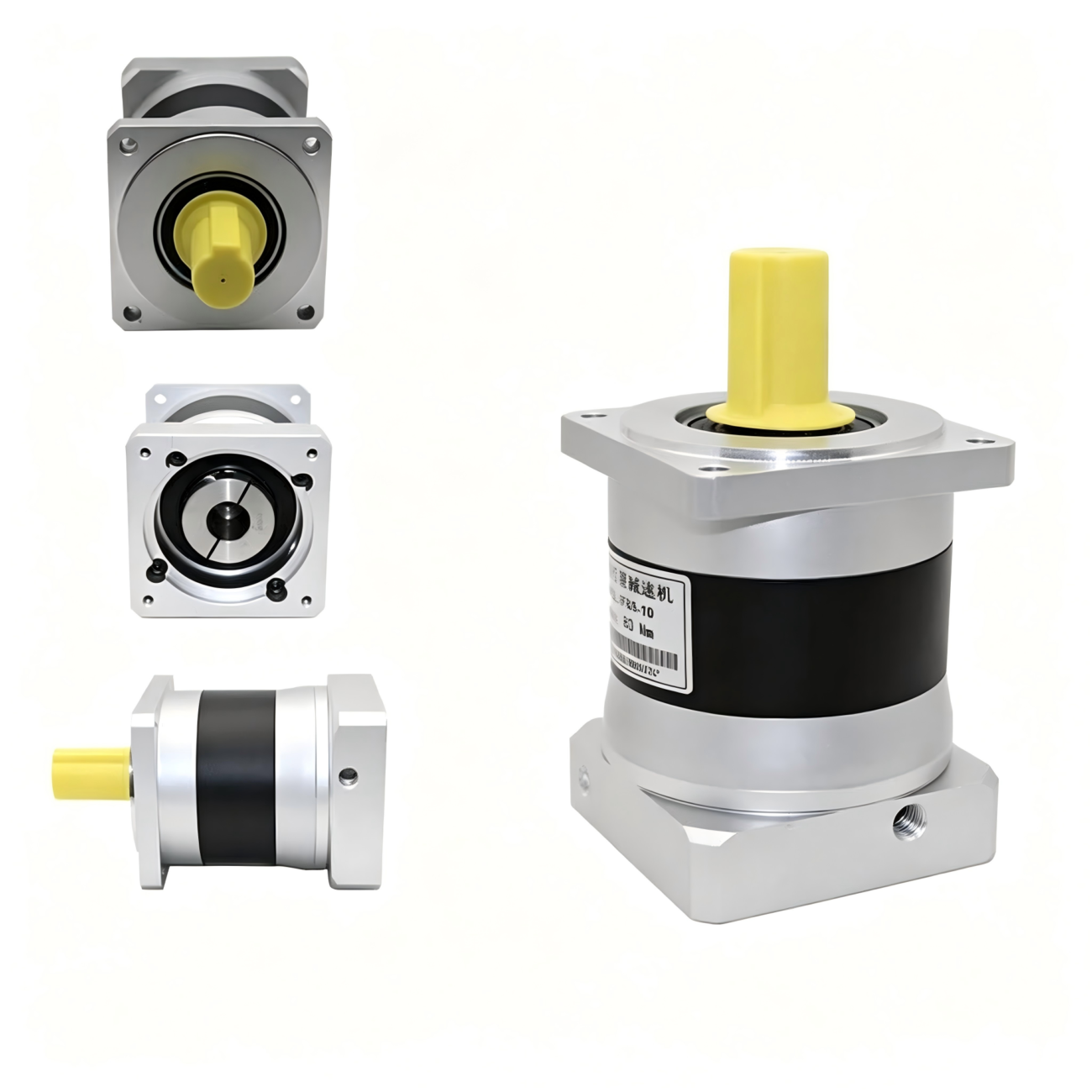
A gear reducer — also called a gearbox, gearhead, or speed reducer — is a mechanical device that uses interlocking gears to reduce input rotational speed while multiplying output torque. It is, in essence, a torque amplifier and speed regulator.
But a gear reducer has no power source of its own. It contains no stator, no rotor, no windings, and no magnetic field. It is a passive mechanical system. Without a motor to provide the initial rotation, a gear reducer is nothing more than an inert assembly of metal — precision-machined, yes, but fundamentally motionless.
This is why the motor-gearbox partnership is not optional. It is the foundational architecture of virtually every industrial motion system on Earth.
Reason 1: Motors Are Naturally High-Speed, Low-Torque Devices
Electric motors are optimized for speed. A standard AC induction motor operates at 1,000–3,000 rpm. A servo motor can spin at 3,000–6,000 rpm or higher. But here is the critical constraint: torque and speed are inversely related at constant power.
Power (W) = Torque (N·m) × Angular Speed (rad/s)
At a fixed power rating, the faster a motor spins, the less torque it produces at the shaft. For example:
A 1 kW motor at 1,500 rpm produces approximately 6.4 N·m of torque.
The same motor at 3,000 rpm produces only 3.2 N·m.
6.4 N·m is not enough to drive most industrial loads. Consider what real machines require:
A conveyor belt moving 500 kg pallets needs 50–200 N·m to overcome friction and inertia.
A mixer agitating viscous fluid needs 100–500 N·m of continuous torque.
A hoist lifting a 1-ton load needs 1,000+ N·m at the drum.
A robotic arm joint accelerating a 20 kg payload needs 30–100 N·m with dynamic responsiveness.
Without a gear reducer, connecting a motor directly to these loads creates one of two failure modes:
The speed is too high — the conveyor runs at 1,500 rpm instead of the required 50 rpm, throwing products off the line.
The load is too heavy — the motor stalls, draws 3× rated current, overheats, and trips the drive protection — or burns out entirely.
The motor provides the energy. The gear reducer converts that energy into usable mechanical force.
Reason 2: The Core Function — Speed Reduction for Torque Multiplication
Inside a gear reducer, gear sets — planetary gears, helical gears, or worm gears — mesh to reduce output speed while amplifying torque.
The fundamental equation is:
Output Torque = Input Torque × Gear Ratio × Efficiency
Example:
Input: 1 kW motor, 1,500 rpm, 6.4 N·m torque
Gear reducer: 30:1 ratio, 95% efficiency
Output speed: 1,500 / 30 = 50 rpm
Output torque: 6.4 × 30 × 0.95 = 182.4 N·m
A 28× torque multiplication — from 6.4 N·m to 182 N·m — transforms a motor that can barely turn a bicycle wheel into a drive system that can pull a conveyor belt, lift a hoist, or drive a machine tool axis.
This is the essential value proposition of the gear reducer: it trades speed for torque, making it possible for a compact, high-speed motor to perform heavy-duty industrial work. Without this conversion, industrial automation as we know it would not exist.
Reason 3: Inertia Matching and System Protection
Every rotating mass resists changes in speed. This property is called inertia. When a motor attempts to accelerate a large, heavy load directly — such as a steel drum, a rotary table, or a centrifuge — the load’s inertia fights back.
The Problem: Inertial Shock
During startup and stopping, the load’s inertia generates a shockwave that travels back to the motor shaft. This can cause:
Encoder damage in servo systems (the feedback device cannot handle mechanical shock)
Premature bearing wear (excessive radial and axial loads)
Drive overcurrent alarms (the motor draws surge current to overcome inertia)
Mechanical fatigue in couplings, shafts, and mounts
The Solution: Reflected Inertia Reduction
A gear reducer with ratio N reduces the reflected inertia seen by the motor by a factor of N²:
Reflected Inertia = Load Inertia / N²
Example:
Load inertia: 0.5 kg·m²
Gear ratio: 10:1
Reflected inertia at motor shaft: 0.5 / 100 = 0.005 kg·m²
The motor now “feels” only 1% of the actual load inertia. It can accelerate and decelerate aggressively without overcurrent, overshoot, or mechanical stress. The gear reducer acts as a mechanical buffer — isolating the motor from the load’s inertial violence and extending the lifespan of the entire drivetrain.
Reason 4: Precision and Controllability
In modern automation — CNC machine tools, industrial robots, photovoltaic tracking systems — motors must control position and velocity with extreme accuracy. But a motor’s encoder measures motor shaft position, not the load’s position. Any mechanical free play or compliance between motor and load creates a dead zone where the controller commands motion, but the load does not respond.
A servo motor with a 17-bit encoder delivers 131,072 pulses per revolution. At 3,000 rpm, each pulse corresponds to a large mechanical displacement. But through a 30:1 gear reducer, the same number of pulses controls 30× finer mechanical movement at the output shaft. The motor’s digital precision is amplified into mechanical precision.
When the motor reverses direction, the load reverses within 0.05° — no dead zone, no lost motion.
Repeatability is maintained across millions of cycles.
Closed-loop servo systems remain stable without oscillation.
3. Torsional Rigidity
High-precision gear reducers exhibit torsional stiffness of 10–150 Nm/arcmin. Under load, the gearbox twists only microscopically — preserving the commanded position even when cutting forces, gravitational loads, or process pressures are applied.
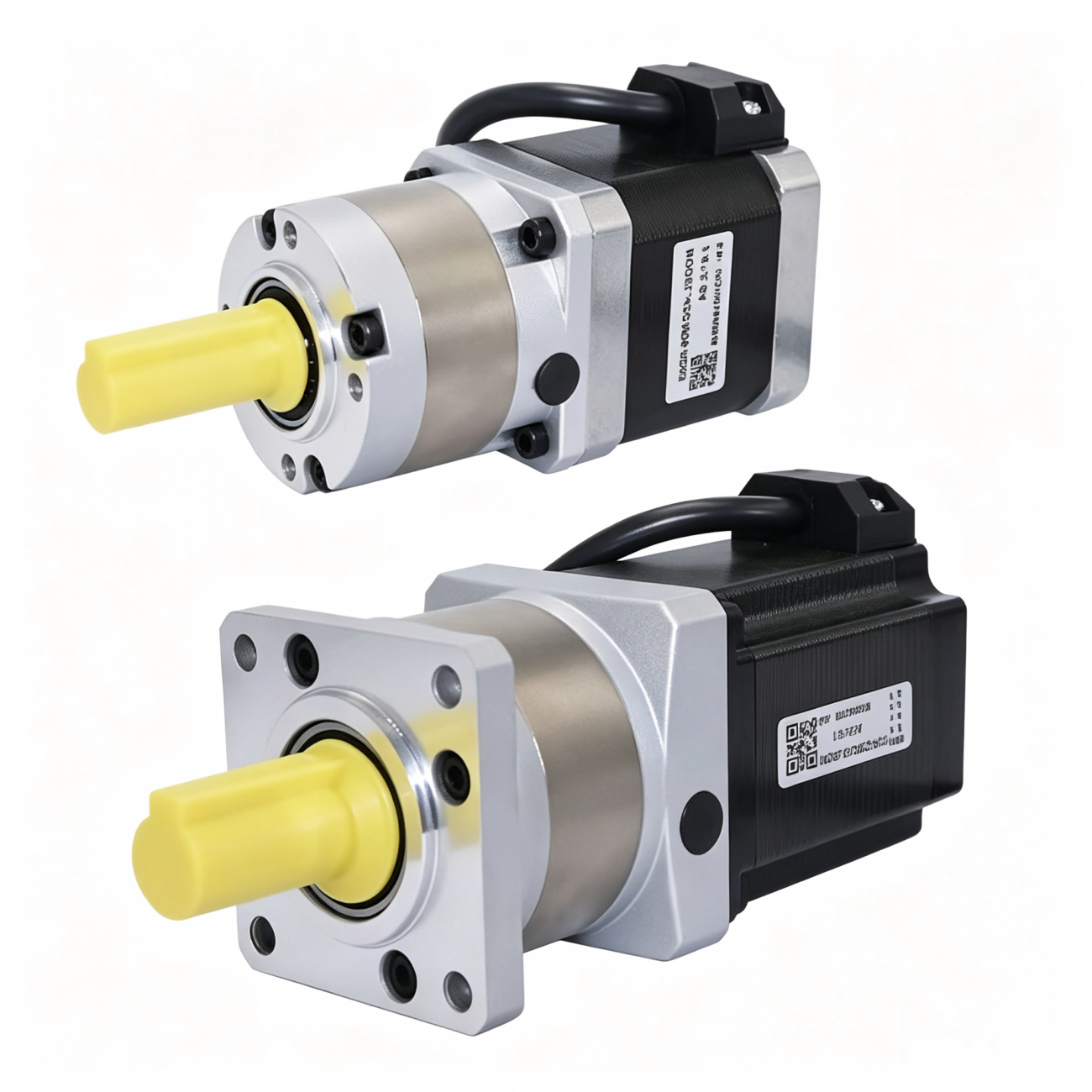
This is why gear motors (integrated motor-reducer units) and servo motor + gearbox paired configurations have become the industry-standard drivetrain for industrial automation.
The Motor-Gearbox Partnership: A Summary
What the Motor Provides
What the Gear Reducer Provides
The Result
High-speed rotation (1,000–6,000 rpm)
Speed reduction (3:1 to 100:1)
Optimal load speed (10–500 rpm)
Low torque (3–50 N·m)
Torque multiplication (ratio × efficiency)
High torque (50–5,000 N·m)
Precise angular position (encoder feedback)
Low backlash (< 3 arcmin)
Precise load positioning
Fast dynamic response
Inertia reduction (ratio²)
Stable, controllable motion
Electrical energy
Mechanical conversion
Usable industrial power
The motor is the brain and heart. The gear reducer is the muscle. Neither can do the job alone.
Frequently Asked Questions (FAQ)
Why does a gear reducer need to be paired with a motor?
A gear reducer is a passive mechanical device with no internal power source. It requires a motor to provide the initial rotational energy. The motor supplies high-speed, low-torque rotation; the gear reducer converts this into low-speed, high-torque output suitable for industrial loads. Without a motor, the reducer cannot move. Without a reducer, the motor cannot generate sufficient torque for most mechanical tasks.
Can a motor work without a gear reducer?
Yes, but only for very light, high-speed applications such as fans, pumps, or small blowers where the load inertia is low and the required torque is minimal. For any industrial application involving conveyors, hoists, machine tools, or robotics, a gear reducer is essential to match the motor’s output characteristics to the load’s requirements.
What happens if I connect a motor directly to a heavy load without a reducer?
Three failure modes are likely: (1) The motor stalls — the load requires more torque than the motor can produce, causing overcurrent and thermal shutdown; (2) The speed is too high — the load runs at unsafe or uncontrollable speeds; (3) Inertial shock damages the motor — startup and stopping shocks destroy bearings, encoders, or drive electronics.
How does a gear reducer multiply torque?
Through mechanical advantage. A gear ratio of N:1 means the input shaft must rotate N times for the output shaft to rotate once. The input torque is multiplied by N (minus efficiency losses). For example, a 30:1 reducer multiplies input torque by approximately 28–29×, transforming 6 N·m into 170+ N·m.
What is reflected inertia, and why does it matter?
Reflected inertia is the load inertia as “seen” by the motor through the gear reducer. A gear ratio of N reduces reflected inertia by N². This matters because servo motors can only control loads effectively when the inertia ratio (load-to-motor) is within a stable range — typically 1:1 to 10:1. Without a reducer, heavy loads would have inertia ratios of 100:1 or more, making the system unstable and prone to oscillation.
Do servo motors always need gear reducers?
Not always, but very often. Servo motors are optimized for speed and dynamic response, not torque. When the application requires (1) high torque at low speed, (2) precise positioning with minimal backlash, or (3) inertia matching for stable control, a servo planetary gearboxor harmonic drive is essential. Direct-drive servo motors exist but are limited to light-load, high-speed applications.
What is the difference between a gear motor and a motor + separate gearbox?
A gear motor is an integrated unit where the motor and gearbox share a common housing and shaft — compact, pre-aligned, and factory-lubricated. A separate motor + gearbox offers more flexibility in ratio selection, motor brand compatibility, and maintenance access. Gear motors are ideal for OEM volume production; separate configurations are preferred for custom machinery and R&D.
How do I choose the right gear ratio for my motor?
Calculate the ratio based on your application’s speed and torque requirements:
Ratio = Motor Rated Speed / Required Output Speed
Verify that the resulting motor-side torque (output torque ÷ ratio × efficiency) is within the motor’s continuous rating.
Check that the reflected inertia ratio (load inertia ÷ ratio² ÷ motor inertia) is < 10:1, ideally < 5:1.
What types of gear reducers are used with servo motors?
The most common are: (1) Planetary gearboxes — high torque density, low backlash, coaxial design; (2)Harmonic drives— zero backlash, ultra-compact, for precision robotics; (3) Worm gearboxes — high reduction ratios, self-locking, for lifting; (4) Hypoid gearboxes — right-angle output, for space-constrained layouts.
Is a gear reducer the same as a gearbox?
Essentially yes. “Gear reducer” emphasizes the function (speed reduction). “Gearbox” emphasizes the form factor (enclosed gear train). In industrial contexts, the terms are often used interchangeably, though “reducer” is more common in North America and “gearbox” in Europe.
Conclusion
The Motor-Gearbox Pair Is Non-Negotiable
The question is not whether a gear reducer should be paired with a motor. The question is whether your application can afford not to pair them.
Every industrial motion system — from a humble conveyor to a precision surgical robot — depends on this partnership. The motor provides the energy. The gear reducer converts that energy into the speed, torque, and precision that the mechanical world actually needs.
In the $28.5 billion gear reducer market and the $16.8 billion servo motor market, the winners are not those who buy the best motor or the best reducer in isolation. The winners are those who engineer the partnership correctly — matching speed to load, torque to demand, and inertia to stability.
The motor and the gear reducer are not two components. They are one system.
HCY Automation delivers integrated solutions across motion control, linear motion, robotics, machine vision, pneumatic systems, and precision gearboxes to help global manufacturers build smarter, faster, and more reliable production lines. Our engineering team helps you select and integrate the right motion control, robotics, and automation components for your specific application.