In industrial automation, many production challenges come down to one simple question: how can motion be made more predictable, repeatable, and easy to control? Whether a machine is positioning a sensor, moving a cutting head, transferring a workpiece, or adjusting spacing in a packaging line, engineers often prefer systems that behave in a stable and measurable way. This is where the idea of a linear model becomes valuable—not only in mathematics or data analysis, but also in mechanical design, motion control, and the selection of linear actuators for automated equipment.
A linear model is good because it makes system behavior easier to understand, predict, control, and optimize. In motion applications, a well-designed linear module converts input commands into straight-line movement with high repeatability, which helps engineers reduce uncertainty, simplify programming, improve accuracy, and scale automation systems more efficiently.
To understand why linear models matter in real industrial environments, we need to look at the connection between modeling, mechanical motion, actuator design, and practical purchasing decisions.
What Does “Linear Model” Mean in Automation?
A linear model in automation describes a system where input and output have a predictable relationship, often making machine behavior easier to calculate, simulate, and control.
In data science, a linear model may refer to a mathematical equation used to estimate outcomes. In engineering, the term can also describe a mechanical or control system whose response is proportional, repeatable, and easy to map. For example, when a controller sends a command to move 100 mm, the actuator should move as close to 100 mm as possible under defined conditions. The more predictable that relationship is, the easier it becomes to build reliable automation.
For manufacturers selecting linear actuators, the value of a linear model is not abstract. It affects real operating results, such as:
Positioning accuracy
Repeatability
Cycle time
Load stability
Maintenance planning
Control-system tuning
Production consistency
Mathematical Linear Models vs. Mechanical Linear Motion
The term “linear model” can create confusion because it appears in both analytical and mechanical contexts. The two meanings are different, but they are related in automation.
Context
Meaning
Industrial Example
Mathematical linear model
A simplified equation that predicts behavior
Estimating actuator travel time based on speed and stroke
Good linear regression model
A statistical model with reliable predictive performance
Predicting motor current under different loads
Mechanical linear model
A motion system designed for straight-line travel
A slide table moving a workpiece from point A to point B
Linear module system
A complete mechanical axis with guide, drive, and carriage
Cartesian robot axis for pick-and-place automation
A mathematical model helps engineers predict how the equipment will behave. A mechanical linear system helps the equipment move in a controlled, physical direction. When both are well designed, the result is a machine that is easier to commission and more reliable in production.
Why Predictability Matters
In factory automation, unpredictability creates cost. If an actuator overshoots its target, vibrates under load, or changes performance as speed increases, the machine may require additional compensation. That can lead to:
Longer programming time
More complex servo tuning
Increased rejection rates
Higher wear on mechanical parts
More downtime for troubleshooting
A good linear model reduces these problems because the relationship between command, motion, force, and position is easier to define.
Why Is a Linear Model Good for Motion Control?
A linear model is good for motion control because it allows engineers to predict movement, tune controllers faster, and maintain consistent positioning across repeated cycles.
In motion control, accuracy is not only about the actuator itself. It also depends on the interaction between the mechanical structure, drive method, motor, controller, feedback device, and load. A system that behaves linearly gives the control algorithm a stable foundation. This is especially important in applications such as dispensing, inspection, cutting, welding, semiconductor handling, medical device assembly, and automated testing.
Easier Controller Tuning
When a system has predictable behavior, it is easier to tune parameters such as the following:
Acceleration
Deceleration
Velocity
Position loop gain
Torque limit
Jerk control
Settling time
A controller does not need to compensate for large unknowns. Instead, it can follow a defined motion profile. This improves response and reduces vibration.
For example, if a linear actuator moves a constant load over a fixed stroke, the relationship between input pulse, motor rotation, screw lead, and carriage displacement can be modeled accurately. This allows the engineer to estimate travel distance and speed before the machine is even assembled.
Better Repeatability
Repeatability is often more important than absolute accuracy in production. If a system repeats the same position within a narrow tolerance, calibration can correct the offset. A stable linear model supports repeatability because the actuator responds consistently to the same command.
Common factors that affect repeatability include:
Backlash
Guideway rigidity
Screw lead accuracy
Belt tension
Motor resolution
Load direction
Environmental contamination
Thermal expansion
By selecting the right actuator type and structure, engineers can reduce these variables and build a more reliable machine.
More Efficient Diagnostics
When equipment behaves predictably, abnormal behavior becomes easier to detect. If a linear module normally reaches its target in 0.8 seconds but suddenly requires 1.2 seconds, the system may have friction, overload, contamination, or motor-performance issues.
A good model creates a performance baseline. Maintenance teams can compare real operating data against that baseline to detect early signs of failure.
How Do Linear Actuators Support a Good Linear Model?
Linear actuators support a good linear model by converting rotary or electromagnetic energy into controlled straight-line motion with defined speed, stroke, load, and positioning characteristics.
An actuator is more than a moving part. It is a mechanical system designed to produce predictable linear displacement. Depending on the application, it may use a ball screw, timing belt, linear motor, rack and pinion, or electric cylinder structure. Each design has different strengths, but all aim to create controlled motion along a straight axis.
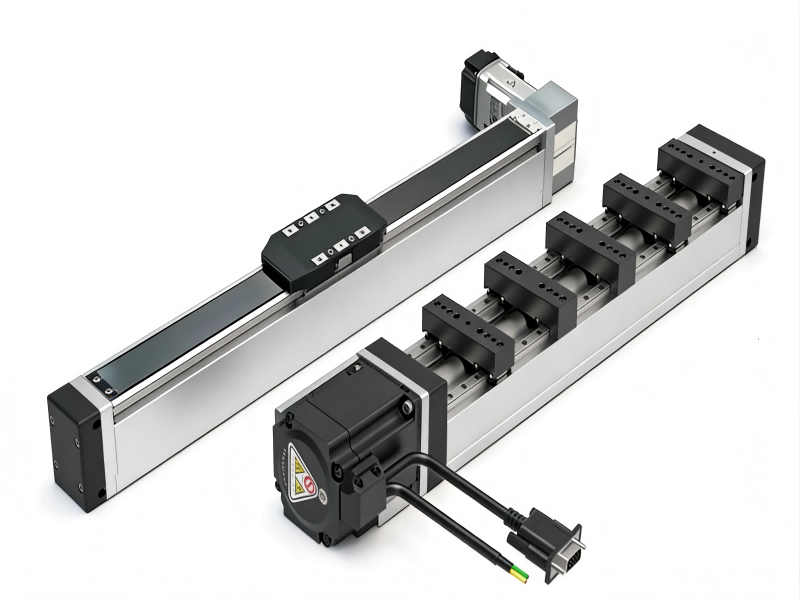
Main Components of a Linear Module
A typical linear module system may include the following:
Component
Function
Why It Matters
Drive element
Converts motor power into motion
Determines speed, thrust, and accuracy
Guide rail or guideway
Supports the moving carriage
Improves rigidity and load capacity
Carriage or slide table
Holds the workpiece or tool
Affects stability and mounting options
Motor interface
Connects servo or stepper motor
Influences control performance
Sensors
Detect home or limit positions
Improves safety and repeatability
Cover or seal
Protects internal components
Reduces dust and maintenance problems
A strong design combines these elements into a compact axis that can be integrated into larger automation equipment.
Ball Screw, Belt, and Linear Motor Options
Different actuator types produce different linear behavior.
Ball Screw Actuators
Ball screw actuators are commonly used where precision, thrust, and repeatability are important. The screw converts motor rotation into linear travel. Because the lead of the screw is fixed, the position relationship is easy to calculate.
Advantages include:
High positioning accuracy
Strong axial thrust
Good repeatability
Suitable for vertical or heavy-load applications
Stable low-speed movement
A ball screw actuator is often selected for CNC equipment, inspection systems, dispensing machines, and precision assembly lines.
Belt-Driven Linear Stages
Belt actuators are commonly used for long-stroke and high-speed applications. A timing belt transfers rotary motion from the motor pulley to the carriage.
Advantages include:
High travel speed
Long stroke capability
Lower cost for extended travel
Simple structure
Good performance for transfer and handling tasks
A belt linear stage can be a practical choice for packaging, material handling, labeling, and pick-and-place systems.
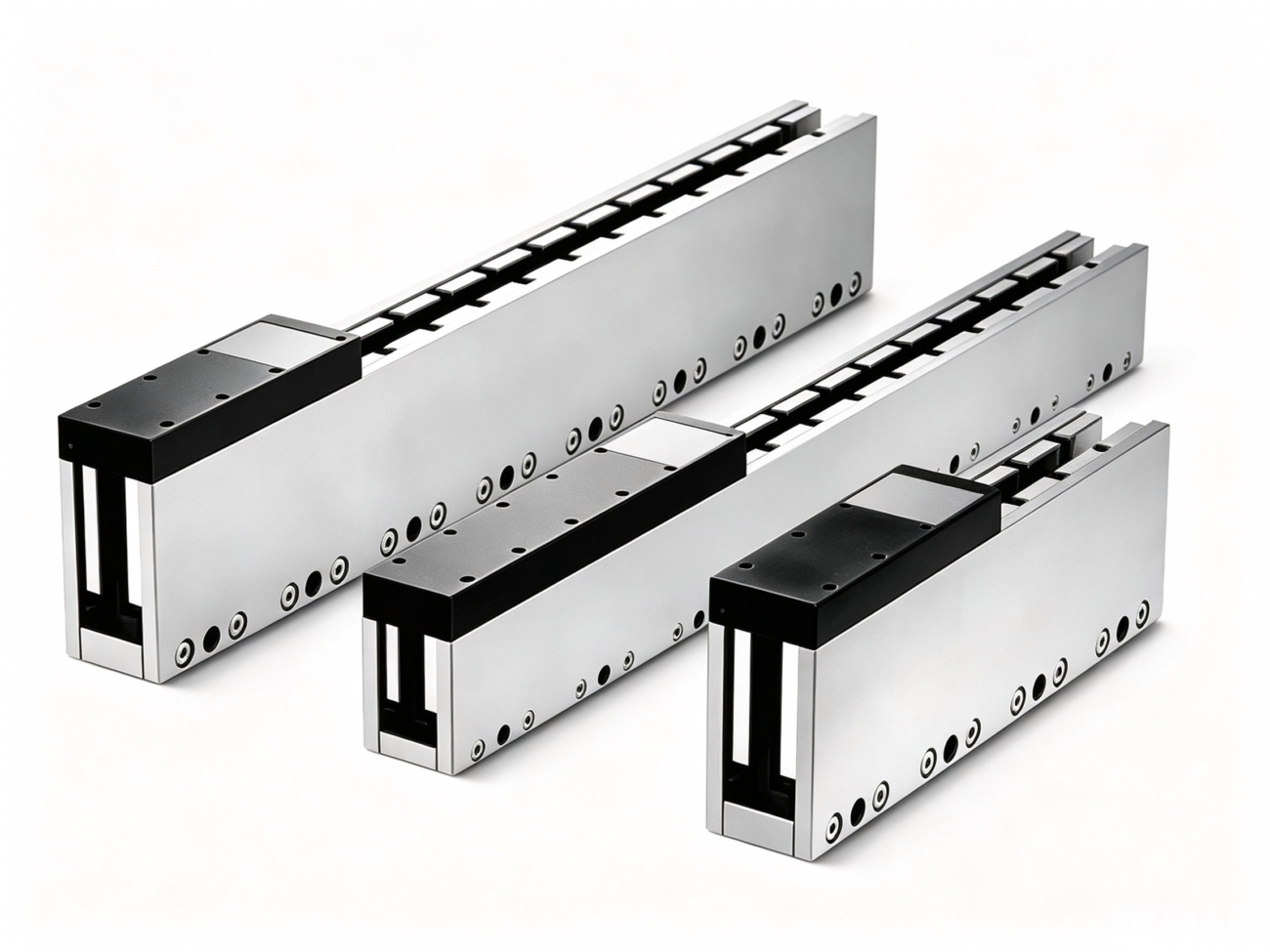
Linear Motor Stages
Linear motor stages use direct-drive electromagnetic force. Because there is no mechanical transmission such as a screw or belt, they can achieve high speed, smooth motion, and low mechanical wear.
Advantages include:
High acceleration
Excellent dynamic response
No backlash from mechanical transmission
Smooth motion
Reduced maintenance in suitable environments
A linear motor stage is suitable for advanced inspection, electronics assembly, laser processing, and high-speed precision systems.
What Makes a Good Linear Regression Model Useful for Actuator Selection?
A good linear regression model is useful for actuator selection because it helps engineers estimate performance trends, compare design options, and reduce uncertainty before building the final machine.
Although mechanical engineers may not always use regression in daily purchasing, statistical modeling can support better decision-making. When historical machine data is available, regression can help estimate how actuator behavior changes with load, stroke, speed, duty cycle, and operating environment.
Using Data to Predict Motion Performance
A good linear regression model can help answer practical questions such as the following:
How does cycle time change as stroke length increases?
How does motor current change as payload increases?
How does positioning error vary with speed?
How does temperature affect repeatability?
How does vibration increase under different acceleration settings?
These questions are important because actuator selection is not only about catalog values. Real machine performance depends on how the product is used.
Example of Regression-Based Evaluation
Suppose an engineer collects data from several test runs. The goal is to estimate cycle time based on stroke length and payload.
Stroke Length
Payload
Average Cycle Time
200 mm
5 kg
0.75 s
400 mm
5 kg
1.15 s
600 mm
5 kg
1.55 s
400 mm
10 kg
1.32 s
600 mm
10 kg
1.78 s
A regression model can identify the relationship between stroke, load, and cycle time. If the model is accurate enough, engineers can estimate whether the actuator will meet a target takt time before ordering multiple units.
Characteristics of a Good Model
A useful regression model should have:
Relevant variables It should include factors that truly affect actuator performance, such as stroke, speed, load, and acceleration.
Reliable data Test data should be collected under consistent conditions.
Low prediction error The model should predict results close to measured values.
Practical interpretation Engineers should be able to use the model to make real decisions.
Awareness of limits A linear regression model may not describe nonlinear effects such as resonance, overload, backlash growth, or lubrication failure.
In other words, statistical modeling is useful, but it should be combined with mechanical knowledge.
Why Are Linear Modules Popular in B2B Automation Projects?
A linear module is popular in B2B automation because it offers a ready-to-integrate motion axis that saves engineering time, improves reliability, and supports modular machine design.
For machine builders, system integrators, and equipment manufacturers, time is critical. Designing a custom linear axis from separate rails, screws, bearings, couplings, motors, plates, covers, and sensors can take significant effort. A pre-engineered linear module reduces this workload.
Benefits for Machine Builders
Linear modules provide several advantages:
Faster mechanical design
Easier procurement
More predictable performance
Compact structure
Reduced assembly time
Simplified maintenance
Scalable multi-axis configuration
A linear module system can also be combined into XY, XZ, XYZ, or gantry arrangements. This makes it suitable for many automated platforms.
Common Industrial Applications
Linear modules are used in a wide range of industries:
Industry
Typical Application
Common Actuator Type
Electronics
PCB handling, inspection, dispensing
Ball screw or linear motor
Packaging
Pushing, sorting, labeling
Belt-driven actuator
Automotive
Assembly, testing, welding support
Ball screw or electric cylinder
Medical devices
Precision assembly, test positioning
Ball screw or clean-type stage
CNC and machining
Tool positioning, auxiliary axis
Ball screw actuator
Logistics
Transfer, lifting, spacing
Belt or electric cylinder
Photovoltaic
Wafer handling, panel positioning
Linear motor or screw module
Modular Design and Scalability
Modern automation systems often need to be upgraded over time. A modular linear axis makes this easier. Instead of redesigning the entire machine, engineers can change stroke length, motor size, drive type, or axis configuration.
This modularity also supports product variations. A machine builder may use the same basic design for multiple production lines, changing only the actuator stroke or payload capacity.
How Do Linear Module Manufacturers Influence System Quality?
Linear module manufacturers influence system quality through mechanical design, machining accuracy, component selection, assembly process, testing standards, and technical support.
Not all linear modules are equal. Two products may look similar in a catalog but perform very differently in real operation. For B2B buyers, the manufacturer’s engineering capability is often as important as the product specification.
Key Factors to Evaluate
When comparing linear module manufacturers, buyers should consider:
Machining precision The straightness, flatness, and alignment of the base affect motion quality.
Guideway quality A rigid guide system improves load capacity and reduces deflection.
Drive-system selection Ball screws, belts, and motors must match the load and duty cycle.
Assembly control Proper preload, belt tension, coupling alignment, and lubrication all affect performance.
Testing process Reliable manufacturers verify repeatability, noise, smoothness, and travel accuracy.
Customization ability Many automation projects require special stroke lengths, mounting holes, covers, sensors, or motor adapters.
Technical documentation Drawings, 3D models, load charts, and installation instructions reduce integration risk.
Questions B2B Buyers Should Ask
Before choosing a supplier, ask:
What is the rated payload in horizontal and vertical installation?
What is the maximum speed under real load?
What repeatability can be achieved?
What motor options are supported?
Can the stroke be customized?
Is the actuator suitable for dusty, clean, or high-cycle environments?
Are CAD files and technical drawings available?
What maintenance schedule is recommended?
These questions help ensure that the selected actuator fits the actual project rather than only the catalog description.
What Role Does Linear Module HS Code Play in Global Procurement?
A linear module HS code is important in international trade because it helps classify products for customs declaration, tariff calculation, import documentation, and logistics compliance.
For companies importing or exporting automation components, product classification can affect cost and delivery time. An HS code, or Harmonized System code, is used by customs authorities to identify goods. However, classification may vary depending on product structure, function, drive method, and country-specific rules.
Why HS Code Accuracy Matters
Incorrect classification can cause the following:
Customs delays
Unexpected duties
Documentation corrections
Compliance risks
Additional logistics costs
Shipment holds
A linear module may be classified differently depending on whether it is considered a mechanical transmission component, actuator, machinery part, or complete motion unit. Because rules can vary, buyers and exporters should confirm classification with customs professionals or freight partners.
Documentation Buyers May Need
For global procurement, suppliers may be asked to provide:
Document
Purpose
Commercial invoice
Declares product value and transaction details
Packing list
Shows package quantity, weight, and dimensions
Technical datasheet
Helps customs understand product function
HS code reference
Supports import classification
Certificate of origin
May affect tariff treatment
Product drawing
Clarifies structure and intended use
While engineers focus on performance, procurement teams must also consider documentation. A good supplier should understand both technical and trade requirements.
How Do You Choose the Right Linear Module System?
A linear module system should be selected by matching load, stroke, speed, accuracy, duty cycle, environment, mounting orientation, and control requirements.
The best actuator is not always the most precise or the fastest. It is the one that fits the application with enough margin for safe and stable operation. Over-specification increases cost, while under-specification causes performance problems.
Step-by-Step Selection Process
Use the following process when choosing a linear module system:
Define the motion task Identify whether the axis needs to move, lift, push, press, scan, transfer, or position.
Calculate payload and external forces Include the workpiece, tooling, brackets, cables, and any process forces.
Determine stroke length Add safety margin for acceleration, deceleration, and limit positions.
Set speed and cycle-time targets Consider takt time, acceleration, settling time, and dwell time.
Define accuracy and repeatability requirements Inspection and dispensing need higher precision than simple transfer.
Select the drive type Choose a ball screw, belt, linear motor, or electric cylinder according to performance needs.
Check mounting orientation Horizontal, vertical, wall-mounted, and gantry installations create different load conditions.
Choose motor and control method Servo motors provide high dynamic control, while stepper motors can be cost-effective for simpler tasks.
Verify service life and maintenance needs Confirm lubrication intervals, belt replacement, screw life, and bearing capacity.
Selection Comparison Table
Requirement
Recommended Option
Reason
High speed, long stroke
Belt-driven actuator
Efficient for fast transfer
High precision, high thrust
Ball screw actuator
Strong mechanical positioning
Ultra-smooth direct drive
Linear motor stage
No screw or belt transmission
Vertical lifting
Ball screw or electric cylinder
Better holding force
Clean environment
Covered or dust-free stage
Reduces particle exposure
Low maintenance
Linear motor or sealed design
Fewer wear points
Cost-sensitive transfer
Belt module
Practical price-to-performance ratio
Avoiding Common Selection Mistakes
Many actuator problems come from incomplete application data. Common mistakes include:
Ignoring moment loads on the carriage
Selecting based only on maximum speed
Forgetting vertical holding force
Underestimating cable carrier weight
Choosing insufficient stroke margin
Ignoring vibration at high acceleration
Using a product not suitable for dust or debris
Failing to confirm motor compatibility
A careful selection process reduces commissioning issues and improves long-term reliability.
When Is a Linear Model Not Enough?
A linear model is not enough when the system includes nonlinear friction, vibration, backlash, changing loads, thermal expansion, flexible structures, or complex dynamic behavior.
Linear models are useful because they simplify reality. However, real machines are not perfectly linear. At high speeds, under heavy loads, or in demanding environments, nonlinear effects become more important.
Common Nonlinear Factors in Actuator Systems
Nonlinear behavior may come from the following:
Static friction at startup
Belt elasticity
Screw whip at high speed
Backlash from worn parts
Guideway deflection
Resonance in long-stroke axes
Temperature-related expansion
Lubrication changes
Load shifts during motion
These factors can cause a system to behave differently from the ideal linear model.
How Engineers Handle Nonlinear Behavior
Engineers manage nonlinear effects through:
Safety factors Selecting components with capacity above the minimum requirement.
Feedback control Using encoders, sensors, and servo loops to correct position errors.
Mechanical stiffness Improving base rigidity, guide support, and mounting structure.
Motion profile optimization Reducing jerk, vibration, and sudden load changes.
Testing under real conditions Verifying performance with actual payloads and cycle times.
Preventive maintenance Maintaining lubrication, tension, alignment, and cleanliness.
A linear model is a powerful starting point, but high-performance automation still requires practical testing.
How Can Linear Actuators Improve Production Efficiency?
Linear actuators improve production efficiency by increasing positioning consistency, reducing manual handling, shortening cycle time, and enabling repeatable automated workflows.
In many factories, manual movement is one of the main sources of inconsistency. Operators may position parts slightly differently each time. Automated linear motion reduces this variation and allows the production process to run with higher repeatability.
Efficiency Gains in Real Applications
Linear actuators can improve the following:
Throughput by moving parts faster and more consistently
Quality by positioning tools and products accurately
Safety by reducing manual lifting or repetitive handling
Traceability by producing repeatable motion data
Flexibility by supporting programmable positions
Labor efficiency by allowing operators to supervise multiple machines
Multi-Axis Automation
One actuator provides motion along one axis. Multiple actuators can create a complete system:
Configuration
Motion Capability
Example Application
Single axis
One-dimensional travel
Pusher, feeder, positioning slide
XY system
Two-dimensional positioning
Inspection table, dispensing platform
XZ system
Horizontal and vertical movement
Pick-and-place unit
XYZ system
Three-dimensional motion
Assembly robot, testing platform
Gantry system
Large-area motion
Loading, palletizing, laser processing
By combining axes, manufacturers can build scalable automation solutions without designing every component from zero.
What Should Buyers Look for Before Purchasing Linear Actuators?
Buyers should look for the right balance of performance, reliability, customization, documentation, delivery capability, and after-sales support before purchasing linear actuators.
A good actuator purchase is not only about unit price. In B2B projects, the total cost includes design time, integration effort, downtime risk, replacement cost, and maintenance. A low-cost actuator that causes unstable operation can become expensive very quickly.
Technical Checklist
Before placing an order, confirm:
Stroke length
Payload capacity
Speed and acceleration
Repeatability
Drive type
Motor mounting interface
Sensor requirements
Cable routing
Environmental protection
Installation orientation
Lubrication requirements
Expected service life
CAD drawing availability
Commercial Checklist
Also evaluate:
Lead time
Customization options
Packaging quality
Export documentation
Technical response speed
Spare parts availability
Warranty terms
Long-term supply stability
Application Data to Provide to Suppliers
To receive an accurate recommendation, provide:
Installation orientation
Required stroke
Payload weight
Target speed
Required repeatability
Cycle frequency
Working environment
Motor preference
Space limitations
Special requirements such as cleanroom, dust protection, or multi-axis assembly
The more complete the application information, the better the actuator selection.
Building Better Automation with Linear Thinking
A linear model is good because it gives engineers a clear way to predict, control, and improve motion. In industrial automation, this idea becomes especially powerful when paired with well-designed linear actuators. A predictable actuator helps reduce programming complexity, improve repeatability, simplify diagnostics, and support scalable machine design.
The best results come from combining theory and practice. Mathematical modeling can estimate performance, while mechanical design ensures that the real system behaves as expected. Ball screw actuators, belt-driven stages, linear motor stages, and complete linear module systems all have their place. The right choice depends on load, speed, stroke, accuracy, duty cycle, environment, and integration requirements.
For B2B buyers, the goal is not simply to purchase a moving axis. The goal is to build a motion system that supports stable production, lower downtime, and long-term automation efficiency. When engineers and procurement teams evaluate both the technical model and the physical actuator, they make better decisions and create more reliable machines.
FAQ
What is the difference between a linear actuator and a linear module?
A linear actuator is a device that creates straight-line motion. A linear module usually refers to a more complete motion unit that includes a guide structure, carriage, drive mechanism, and mounting features. In many automation projects, the terms overlap, but a module often implies easier integration into a machine.
Can linear actuators be used in clean or dusty environments?
Yes, but the actuator design must match the environment. Clean applications may require covered, low-particle, or dust-free structures. Dusty environments may need seals, covers, or protective installation methods to prevent contamination from affecting guideways, screws, belts, or sensors.
Are electric linear actuators better than pneumatic cylinders?
Electric linear actuators are better when programmable positioning, speed control, repeatability, and data feedback are important. Pneumatic cylinders are often simpler and lower cost for basic push-pull motion, but they usually offer less precise control and fewer positioning options.
HCY Automation delivers integrated solutions across motion control, linear motion, robotics, machine vision, pneumatic systems, and precision gearboxes to help global manufacturers build smarter, faster, and more reliable production lines. Our engineering team helps you select and integrate the right motion control, robotics, and automation components for your specific application.