8 Common Variable Pitch Module Designs for Industrial Automation
In automated production lines, the distance between products is not always the same from one process to the next.
A conveyor may run products at one pitch, while a packaging machine, inspection station, assembly fixture, or robot requires another. When several products need to be handled at the same time, changing the spacing between them becomes a mechanical design problem.
This is where variable pitch modules are commonly used.
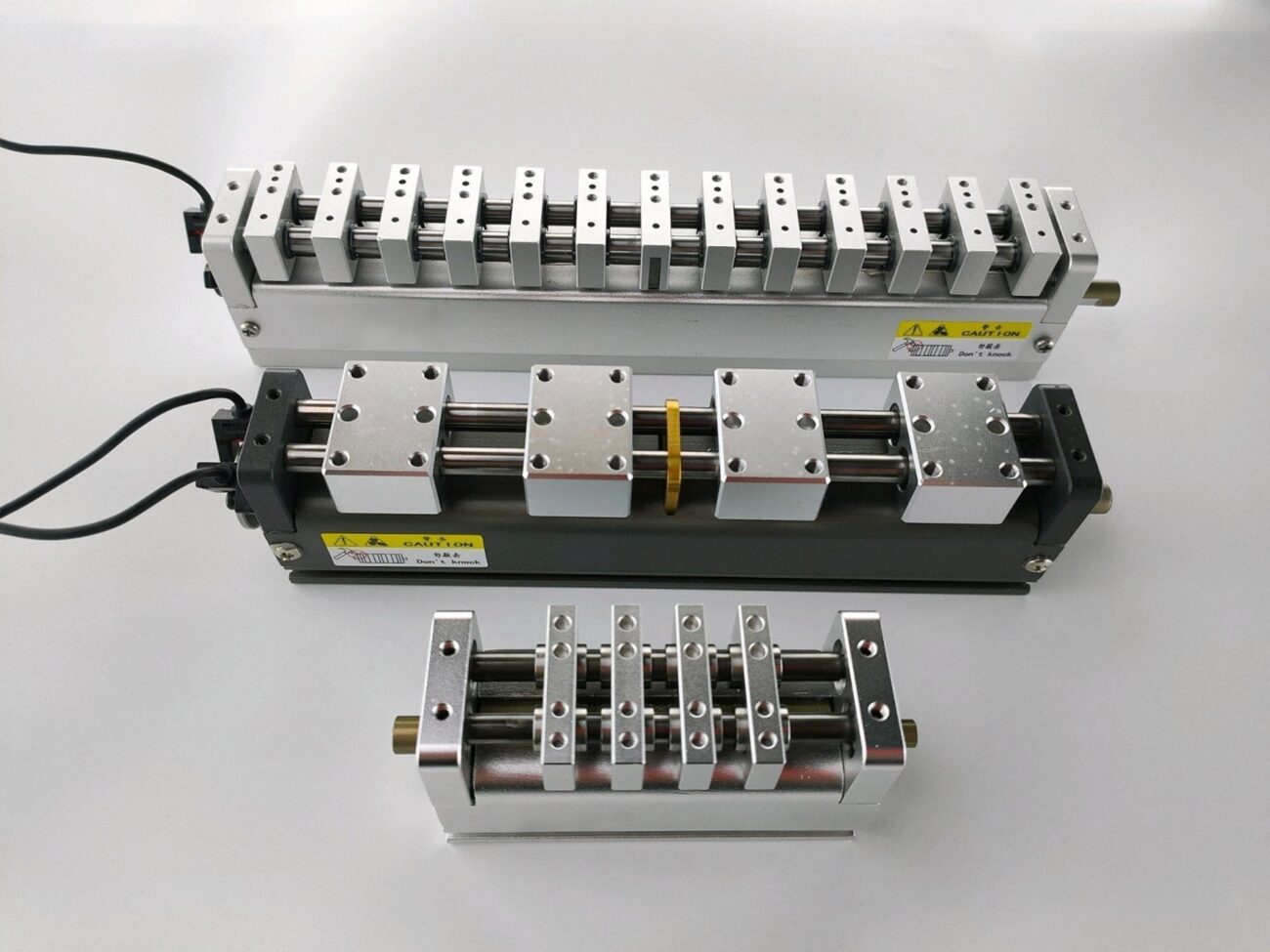
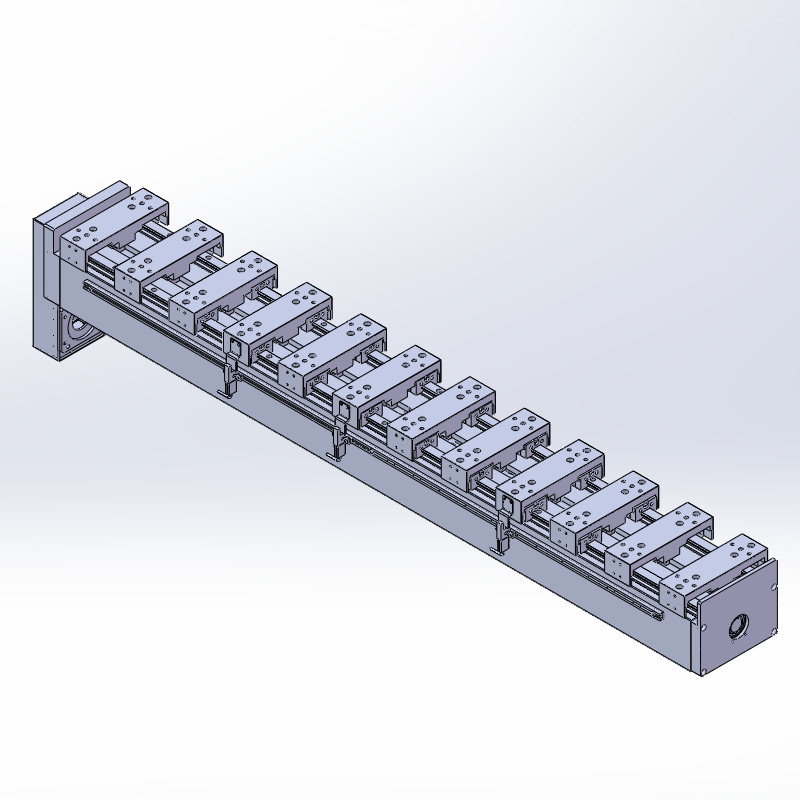
A variable pitch module changes the distance between multiple sliders, grippers, workpieces, or tooling positions in a controlled way. Depending on the application, the pitch can be changed mechanically, pneumatically, or through servo-driven motion.
The mechanism you choose depends mainly on number of positions, payload, pitch range, cycle time, positioning accuracy, and how often the pitch needs to change.
This article covers eight common variable pitch structures used in automation equipment and explains where each design makes sense.
1. Cam-Slot Plate Variable Pitch Module
A cam-slot plate is one of the more compact ways to control several positions from a single drive.
The basic idea is straightforward: each slider follows a machined cam slot. As the cam plate moves, the geometry of the slot determines how far each slider travels.
This means several positions can be synchronized mechanically with one servo motor.
Why engineers use a cam-slot design
The main advantage is mechanical synchronization.
Instead of controlling every slider with an individual servo axis, one drive can generate the complete pitch-changing movement.
That can reduce:
Servo motor quantity
Servo drives
Control complexity
Wiring
Machine footprint
The cam profile can also be designed around the required acceleration, deceleration and pitch change.
For a high-cycle machine running the same motion repeatedly, this can be a practical approach.
Typical applications
Cam-slot pitch mechanisms are often considered for:
High-speed pick and place
Packaging machinery
Multi-position transfer
Assembly automation
Electronic component handling
Automated loading and unloading
High-cycle production equipment
Main limitation
The motion profile is determined largely by the mechanical cam geometry.
If the product pitch changes frequently, a mechanically fixed cam may become less convenient than a programmable servo system.
Best fit: high-speed, repeatable pitch changes with a defined motion profile.
2. One-Belt-Linked Variable Pitch Module
A timing belt can also be used to connect multiple sliders into one pitch-changing mechanism.
The concept is relatively simple: a common belt links the moving positions, allowing them to move together as the belt travels.
Compared with a multi-axis servo system, there are fewer drive components.
Advantages
The main attraction is the simple mechanical architecture.
A belt-driven pitch module can offer:
Low component count
Simple transmission
Fast response
Relatively low cost
Easy integration
Low moving mass
For applications where the payload is relatively small and extremely tight positioning accuracy is not required, a belt mechanism can be sufficient.
Typical applications
Packaging
Sorting
Lightweight pick and place
Product alignment
Conveyor transfer
General material handling
Engineering consideration
Timing belt elasticity, belt tension and slider friction need to be considered when positioning accuracy becomes important.
For high precision applications, a ball screw, linear motor or mechanically constrained cam mechanism may provide better control of position repeatability.
Best fit: lightweight products, relatively simple pitch changes and cost-sensitive automation.
3. Sliding-Plate Variable Pitch Module
A sliding-plate design uses multiple sliders moving along guides or plates.
The mechanical arrangement can be customized according to the required number of positions and pitch range.
Unlike a fixed mechanical cam, the geometry can often be configured for different spacing requirements.
This makes the sliding-plate structure particularly useful in custom automation.
What can be customized?
Depending on the design, engineers can specify:
Number of sliders
Slider spacing
Initial pitch
Final pitch
Pitch stroke
Single-side movement
Symmetrical movement
Equal pitch
Unequal pitch
For example, the system may need to change six positions from 20 mm pitch to 50 mm pitch.
Another machine may require an unequal arrangement such as:
20 / 30 / 40 / 60 / 80 mm
The mechanism needs to be designed around the actual motion requirement.
Typical applications
Custom assembly machines
Packaging automation
Product alignment
Inspection systems
Multi-position transfer
Electronic assembly
Best fit: custom automation where standard pitch modules do not provide the required spacing pattern.
4. Spring-Loaded Slider Variable Pitch Module
For applications where the pitch movement is relatively simple, a pneumatic cylinder and spring mechanism can provide a low-cost solution.
The pneumatic cylinder moves the sliders in one direction, while springs provide the return force.
There is no need for a servo motor and ball screw for every moving position.
Advantages
The structure is simple and easy to integrate into pneumatic automation.
Typical advantages include:
Low equipment cost
Simple control
Few electrical components
Fast mechanical response
Easy maintenance
Suitable for dusty or demanding production environments
Where is it used?
This type of pitch-changing mechanism can be considered for:
Packaging equipment
Food processing machinery
Carton handling
Logistics automation
Simple sorting systems
Product grouping
Where it is not ideal
A spring-based mechanism is generally not the first choice when the application requires independently programmable positions or high positioning accuracy.
The spring force also needs to be considered when calculating the required pneumatic cylinder force and system dynamics.
Best fit: simple repeatable pitch changes where low cost and mechanical simplicity are priorities.
5. Cam-Driven Variable Pitch Slide
A cam-driven pitch slide is designed for machines where cycle time, rigidity and repeatability are important.
Instead of relying on independent servo axes, the cam converts rotary motion into a predefined linear movement.
The cam profile controls the motion of the slider.
Why use a cam?
For a machine performing the same movement millions of times, a mechanical cam can be very effective.
The designer can control:
Stroke
Pitch change
Acceleration
Deceleration
Dwell
Timing
Return movement
A rigid cam mechanism can also handle high acceleration without depending entirely on electronic synchronization between multiple servo axes.
Typical applications
Lithium battery production
Automotive automation
High-speed assembly
Automatic feeding
Transfer machinery
Multi-station automation
Important design factors
Cam life, follower contact stress, lubrication, bearing selection and machining accuracy all affect long-term performance.
For this reason, the cam profile should be designed according to the actual cycle time and load rather than simply selecting a standard cam mechanism.
Best fit: high-cycle machines with fixed and repeatable motion.
6. Timing-Belt Pulley Variable Pitch Module
Timing-belt transmission is widely used in linear automation because it can provide high speed over relatively long travel distances.
A pitch-changing mechanism can use a combination of timing belts and pulleys to generate the required relative movement between multiple positions.
Main advantages
High linear speed
Long travel
Smooth transmission
Low inertia compared with some screw-driven systems
Simple belt replacement
Low maintenance requirements
For applications involving long strokes or high-speed product transfer, a belt-based system can be more practical than a ball screw.
Typical applications
High-speed material handling
Packaging lines
Conveyor automation
Product spacing
Transfer systems
Long-stroke automation
Belt vs. ball screw
This is an important engineering trade-off.
A timing belt is often attractive for high speed and long stroke.
A ball screw is generally selected when positioning accuracy, stiffness and controlled motion are more important.
The correct choice depends on the actual machine requirements.
Best fit: high-speed, longer-stroke variable spacing and transfer applications.
7. Scissor-Link Variable Pitch Module
A scissor-link mechanism uses interconnected mechanical links to expand or contract several positions simultaneously.
When the central mechanism moves, the linked sliders change their spacing together.
This provides a simple mechanical relationship between all positions.
Main advantages
The load can be distributed across multiple links rather than being concentrated on one slider.
A properly designed scissor mechanism can provide:
Synchronized pitch change
Stable product orientation
Distributed load
Compact expansion/contraction
Multi-position movement
Typical applications
This structure can be considered for:
Glass handling
Wafer handling
Sheet handling
Large workpieces
Tray loading
Multi-product transfer
For fragile products, maintaining the relative orientation of each product during pitch adjustment can be more important than simply achieving a particular pitch.
Engineering consideration
The link geometry changes the mechanical advantage throughout the stroke.
Therefore, force requirements should be checked at both the minimum and maximum pitch positions.
Best fit: synchronized expansion/contraction of multiple positions, especially when product orientation needs to remain stable.
8. Ball-Screw Independent Variable Pitch Module
When every position needs to move independently, a servo-driven ball screw system provides a different approach.
Each slider can have its own controlled movement.
Instead of defining the pitch entirely through mechanical geometry, the PLC or motion controller can define the target positions.
For example:
20 mm → 30 mm → 50 mm → 75 mm
can be programmed as different production recipes.
Why use independent servo control?
The biggest advantage is flexibility.
A servo-controlled pitch module can potentially handle:
Multiple product sizes
Different pitch patterns
Frequent format changes
Unequal spacing
Recipe-based production
Independent slider positioning
Automatic changeover
This is particularly useful in high-mix manufacturing.
Typical applications
Semiconductor equipment
Chip packaging
Electronics manufacturing
Precision inspection
Battery assembly
Flexible packaging
Multi-format automation
Ball screw vs. linear motor
For higher-end applications, a linear motor can also be used instead of a ball screw.
A ball screw offers mechanical stiffness and established transmission technology.
A linear motor removes the mechanical screw transmission and can provide very fast, direct motion.
The appropriate choice depends on stroke, payload, acceleration, accuracy and overall machine architecture.
Best fit: applications requiring programmable and independently controlled pitch adjustment.
8 Variable Pitch Structures at a Glance
Variable Pitch Structure
Drive Method
Main Advantage
Typical Application
Cam-slot plate
Servo + cam plate
Mechanical synchronization
High-speed transfer
One-belt linked
Timing belt
Simple and economical
Lightweight handling
Sliding plate
Slider/guide mechanism
High customization
Custom automation
Spring-loaded slider
Pneumatic + spring
Low cost
Packaging
Cam-driven slide
Mechanical cam
High rigidity and repeatability
High-cycle machines
Timing-belt pulley
Belt + pulley
High speed / long stroke
Material transfer
Scissor-link
Mechanical linkage
Synchronized expansion
Glass / wafer handling
Ball-screw independent
Servo + ball screw
Programmable positioning
Precision automation
How Do You Select a Variable Pitch Module?
The mechanism should be selected after the motion requirements are defined.
Before contacting a variable pitch module manufacturer, it is useful to prepare the following information.
1. Number of positions
How many products or grippers need to move?
For example:
4 / 6 / 8 / 12 / 16 positions
The number of positions directly affects the required drive force, guide configuration and overall module length.
This is particularly important when several products are moved simultaneously.
4. Cycle time
How quickly does the pitch need to change?
A machine running 20 cycles/min and a machine running 200 cycles/min can require completely different mechanisms.
For high-speed automation, acceleration and deceleration often become more important than simply specifying maximum speed.
5. Positioning accuracy and repeatability
The required specification should distinguish between:
Positioning accuracy
and
Repeatability
These are not the same parameter.
For example, an inspection machine may require a much tighter repeatability specification than a general packaging machine.
6. Frequency of pitch adjustment
Ask how often the pitch changes.
Fixed pitch during production
A cam or mechanical linkage may be sufficient.
Pitch changes between product batches
An adjustable mechanical design may be practical.
Pitch changes every cycle
A programmable servo-driven pitch module is usually worth considering.
7. Product geometry
Product dimensions can influence the mechanism considerably.
Consider:
Product length
Product width
Product height
Product weight
Product center of gravity
Surface condition
Required gripping method
A variable pitch module for rigid metal parts is mechanically different from one designed to handle flexible packaging or fragile glass.
8. Available installation space
Provide the available:
Length × Width × Height
A compact cam or linkage mechanism may fit where an independent servo system does not.
Mechanical Variable Pitch or Servo Variable Pitch?
This is one of the most common questions in automation system design.
Mechanical variable pitch
A cam, linkage, belt, or other mechanical transmission defines the movement.
Advantages include:
Simple motion relationship
Mechanical synchronization
High repeatability
Potentially high cycle rate
Fewer servo axes
The trade-off is flexibility.
Once the mechanical geometry is defined, changing the motion profile may require mechanical modification.
Servo variable pitch
Each position can be controlled through the motion system.
Advantages include:
Programmable pitch
Recipe management
Independent positioning
Unequal pitch
Easy product changeover
Greater flexibility
The trade-off is increased system complexity and cost.
For this reason, high-volume fixed-format production and high-mix flexible production often lead to different pitch module designs.
Equal Pitch, Unequal Pitch and Free Pitch Adjustment
Not every variable pitch application requires the same type of movement.
Equal pitch
Every position changes according to the same spacing relationship.
Example:
10 → 20 → 30 → 40 mm
Unequal pitch
Each position can have a different target distance.
Example:
10 → 20 → 35 → 60 mm
Free or independent pitch
Each slider can move to a programmable position.
This is useful when the same machine handles several product sizes.
The distinction is important when discussing requirements with a variable pitch module manufacturer, because “variable pitch” alone does not fully describe the required motion.
Other Variable Pitch Mechanisms Used in Automation
In addition to the eight structures discussed above, variable pitch systems can also be classified by their motion architecture.
Common categories include:
Rotary variable pitch
Used when products are arranged around a rotary axis.
Roller-type pitch adjustment
Suitable for continuous product handling and spacing.
Pitch-and-transfer integrated mechanism
Combines pitch adjustment and product transfer into one motion system.
XY variable pitch
Changes product spacing in both X and Y directions.
For example:
4 × 4 array → 2 × 8 array
This type of array transformation is particularly relevant to semiconductor, electronics, battery and packaging automation.
Variable Pitch Module Applications
Variable pitch mechanisms are used across many automation industries.
Packaging Automation
Change product spacing before filling, sealing, labeling, cartoning or case packing.
Pick and Place Automation
Multiple products can be picked simultaneously and then repositioned to match the downstream machine.
Semiconductor Automation
Precise pitch adjustment can be used for wafer, die and semiconductor component handling.
Battery Manufacturing
Cell and component spacing can be adjusted during transfer and assembly processes.
Electronics Assembly
Multiple components can be transferred from one pitch to another between process stations.
Vision Inspection
Products can be separated to provide sufficient clearance for cameras, lenses and lighting.
Automotive Automation
High-cycle mechanical pitch mechanisms can be integrated into assembly and material transfer equipment.
Logistics Automation
Products can be grouped, separated or rearranged according to downstream conveyor requirements.
Custom Variable Pitch Modules for Automation Equipment
A standard module does not always match the actual machine design.
An OEM automation project may require:
5, 7 or 10 positions
Custom pitch range
Unequal spacing
High-speed movement
Large payload
Compact installation
Integrated grippers
Integrated linear motion
Custom mounting holes
Special sensors
Servo-controlled positioning
XY pitch adjustment
In these cases, it is often more practical to design the variable pitch module around the machine.
This is particularly important for OEMs and system integrators developing custom automation equipment.
HCY Automation Variable Pitch Solutions
HCY Automation develops customized motion and automation modules for applications that require controlled product spacing and multi-position movement.
The design can be evaluated according to:
Number of positions + Product size + Payload + Pitch range + Cycle time + Accuracy + Installation space
Depending on the application, the system can be developed around different transmission principles, including cam mechanisms, timing belts, mechanical linkages, ball screws and servo-driven motion.
If you are designing a:
Pick and place machine
Packaging machine
Assembly line
Inspection system
Semiconductor handling system
Battery production line
Electronics automation system
Custom material handling system
and need to change the spacing between multiple products or grippers, a customized variable pitch mechanism may be a suitable solution.
Send HCY Automation your product dimensions, number of positions, required pitch, payload and cycle time.
Our engineering team can evaluate the motion requirements and develop a custom variable pitch module for your automation equipment.
Frequently Asked Questions
What is a variable pitch module?
A variable pitch module is a mechanical or servo-driven automation mechanism that changes the distance between multiple products, grippers, sliders or tooling positions.
What is a pitch changing mechanism?
A pitch changing mechanism changes the spacing between multiple objects or tooling positions during an automated process.
What is a variable pitch gripper?
A variable pitch gripper is a multi-gripper system that can change the distance between individual gripping points to match different product arrangements.
What is the difference between a fixed pitch and variable pitch system?
A fixed pitch mechanism maintains a predetermined spacing. A variable pitch mechanism allows the spacing to change mechanically, pneumatically or through programmable servo motion.
Which variable pitch module is suitable for high-speed automation?
Cam-driven and belt-driven mechanisms are commonly considered for high-speed repetitive applications. The final selection depends on payload, acceleration, cycle time and required repeatability.
Which variable pitch mechanism is suitable for flexible production?
Independent servo-driven systems can provide programmable pitch positions and are useful when different product formats or pitch patterns need to be handled on the same machine.
Can a variable pitch module handle unequal spacing?
Yes. Depending on the mechanical design, unequal spacing can be achieved through customized cam profiles, linkage systems or independently controlled servo axes.
Can variable pitch modules be customized?
Yes. The number of positions, pitch range, payload, stroke, speed, accuracy, mounting dimensions and drive method can all be customized for OEM automation equipment.
Conclusion
Variable pitch is not simply a matter of moving several sliders closer together or farther apart.
The mechanism has to match the actual production requirements.
For high-speed repetitive motion, a cam-based system can provide mechanical synchronization and a compact structure.
For simple and cost-sensitive handling, belt, pneumatic or spring-based mechanisms can be practical.
For custom pitch patterns, sliding and linkage mechanisms offer greater mechanical flexibility.
For frequent product changeover and programmable spacing, servo-driven ball-screw or linear motor systems provide much greater flexibility.
The right design starts with the application data:
Number of positions → Pitch range → Payload → Cycle time → Accuracy → Product format → Changeover frequency
If you are looking for a custom variable pitch module, variable pitch gripper, pitch changing mechanism or multi-position automation solution, contact HCY Automation with your application requirements.
Frequently Asked Questions
1. What is a variable pitch module?
A variable pitch module changes the spacing between multiple products, grippers, or tooling positions during an automated process.
2. What is a variable pitch gripper?
A variable pitch gripper allows multiple gripping points to change their spacing to match different product layouts or machine stations.
3. What types of variable pitch mechanisms are available?
Common designs include cam, timing belt, sliding plate, pneumatic, scissor-link, and servo-driven ball screw mechanisms.
4. How do I choose a variable pitch module?
Consider the number of positions, pitch range, payload, cycle time, accuracy, installation space, and required changeover flexibility.
5. Can a variable pitch module handle unequal spacing?
Yes. Custom cam profiles, linkage mechanisms, or independent servo axes can provide unequal or individually controlled spacing.
6. Can the pitch be changed automatically?
Yes. Servo-driven systems can change pitch through programmed motion profiles, while mechanical systems typically use a fixed or manually adjustable pitch pattern.
7. Can variable pitch modules be customized?
Yes. Position quantity, pitch range, stroke, payload, drive method, mounting dimensions, and gripper configuration can be customized.
8. Where are variable pitch modules used?
They are commonly used in packaging, pick and place, semiconductor, battery, electronics, inspection, assembly, and material handling automation.
HCY Automation — Custom Motion Solutions for Industrial Automation.
HCY Automation delivers integrated solutions across motion control, linear motion, robotics, machine vision, pneumatic systems, and precision gearboxes to help global manufacturers build smarter, faster, and more reliable production lines. Our engineering team helps you select and integrate the right motion control, robotics, and automation components for your specific application.