Key operational benefits of variable pitch module in Industrial Automation
In automated pick-and-place systems, a common challenge is that the incoming part pitch does not match the spacing required by the next process. Battery cells, electronic components, or other precision parts may need to be picked at one pitch and placed at another.
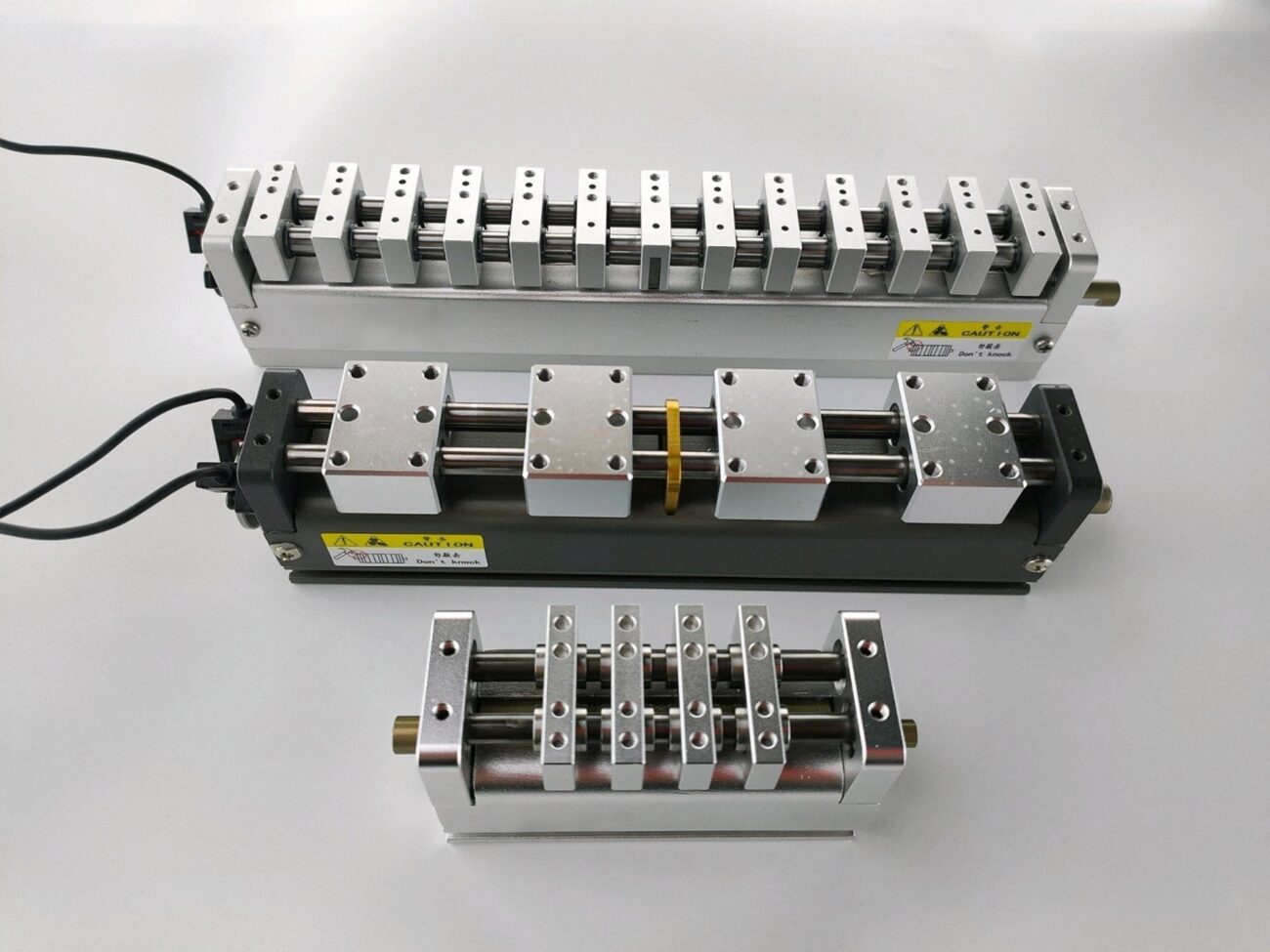
A vhttps://hcyautomation.com/product-category/linear-motion-module/variable-pitch-modules/ariable pitch module solves this problem by allowing multiple grippers or suction cups to automatically adjust their spacing during robotic pick and place, making it particularly useful for battery automation, electronics assembly, tray loading, and multi-part handling. Traditional solutions rely on individual robot movements, pneumatic mechanisms, or manual tooling changes. In high-speed industrial automation and flexible manufacturing, however, these methods can increase cycle time, changeover time, and system complexity.
A variable pitch slide module provides a more direct solution.
The module changes the spacing between multiple grippers, suction cups, carriers, or tooling positions in one coordinated motion. Depending on the design, it can perform equal-pitch expansion, contraction, unequal spacing, or independently controlled positioning.
For automation engineers, the main benefit is not simply that the pitch can change. The real value is being able to combine part handling and spacing conversion within the same automation cycle.
What Is a Variable Pitch Module?
A variable pitch module is a mechanical motion unit used to adjust the relative spacing between two or more moving stations.
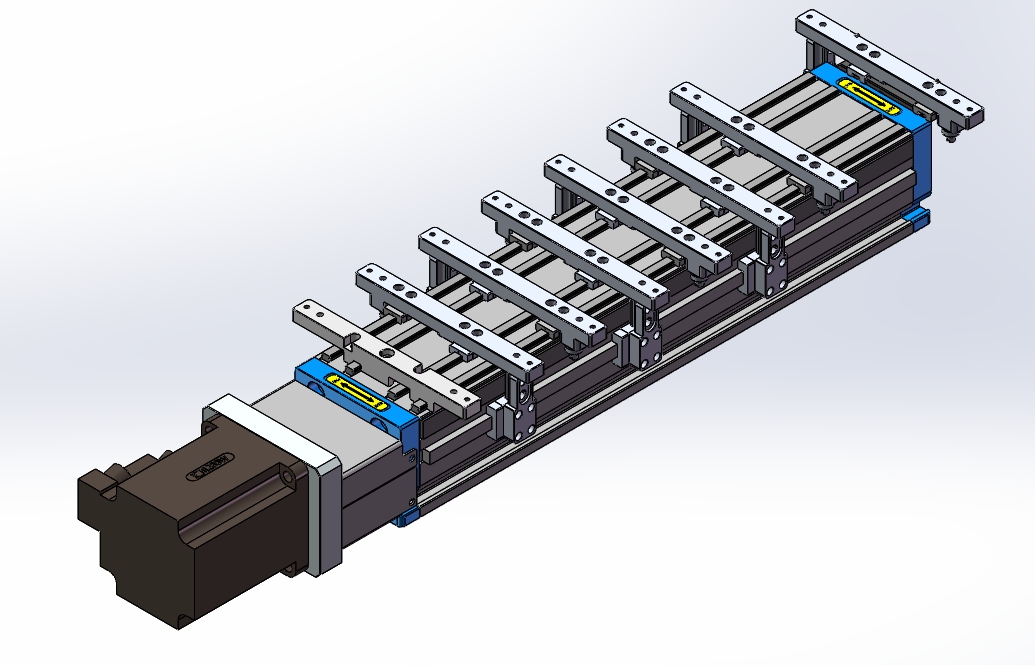
A typical servo-driven design consists of:
Servo motor
Linear guide rail
Ball screw, cam, linkage, belt, or other transmission mechanism
Multiple moving sliders
Home and limit sensors
Grippers or vacuum suction cups
PLC or motion controller
The motor drives the transmission mechanism, while the sliders move along the linear guide.
Instead of moving all sliders by the same distance in the same direction, the mechanism converts the motor input into a controlled change in spacing.
A simple application may look like this:
Pick: 20 mm → 20 mm → 20 mm → 20 mm
Place: 50 mm → 50 mm → 50 mm → 50 mm
The robot does not need to place four parts separately. It can pick all four parts, change the pitch, and place them together.
This operating principle is why variable pitch mechanisms are frequently used in robotic pick and place, automated assembly, tray loading, sorting, inspection, packaging automation, battery manufacturing, and semiconductor handling.
1. Multiple Parts Can Be Re-Spaced in One Motion
This is usually the first reason we consider a variable pitch mechanism during machine design.
Suppose an application has eight workpieces.
If a robot needs to pick and position every workpiece individually, the robot must perform repeated X-Y-Z movements. As the number of parts increases, the handling time becomes a larger part of the total machine cycle.
With a multi-station variable pitch module, all eight parts can be picked together.
The sequence becomes:
Pick → Change Pitch → Transfer → Place
Instead of:
Pick → Place → Return → Pick → Place → Return…
The cycle-time improvement depends on robot travel, number of parts, pitch distance, acceleration, settling time, and the surrounding process.
In general, the advantage becomes more noticeable as the number of simultaneously handled parts increases.
For high-speed pick-and-place automation, this is often more important than the maximum speed specification of the module itself.
2. Product Changeover Can Be Handled by a Recipe
Fixed tooling works well when a machine produces the same part for years.
The problem appears when one production line has to handle several product sizes.
With conventional tooling, changing a product may require operators to loosen mounting screws, reposition suction cups, replace fixtures, adjust mechanical stops, check sensors, and run a test cycle.
That is acceptable for an occasional changeover. It becomes inconvenient when product variants change several times per shift.
A servo-driven variable pitch module can store different pitch positions in the PLC or motion controller.
For example:
Product
Pickup Pitch
Placement Pitch
Model A
25 mm
40 mm
Model B
30 mm
50 mm
Model C
35 mm
60 mm
When the production recipe changes, the controller sends the corresponding positioning command.
No mechanical pitch adjustment is required, provided that the gripper or vacuum tooling itself is compatible with the different products.
This is particularly useful in high-mix manufacturing, where reducing mechanical changeover work is often more valuable than simply increasing maximum machine speed.
3. Better Repeatability Than Manual Adjustment
Manual adjustment has one unavoidable issue: consistency depends on the operator and the adjustment method.
If eight suction cups have to be repositioned individually, even small errors can accumulate across the tooling.
For some packaging applications, this may not matter.
For electronics assembly, semiconductor handling, lithium battery production, inspection equipment, and precision automation, it can matter a great deal.
A variable pitch mechanism constrains the slider movement mechanically. When combined with a servo motor and closed-loop position control, the same programmed pitch can be repeated automatically.
Actual repeatability depends on the complete mechanical system, including:
Guide accuracy
Screw or cam accuracy
Backlash
Structural rigidity
Bearing clearance
Motor resolution
Servo tuning
Load
Acceleration
Tooling rigidity
This point is important when evaluating supplier specifications.
A motor with very high encoder resolution does not automatically mean that the complete variable pitch mechanism has the same positioning accuracy.
For machine builders, system-level repeatability under actual load is a more useful specification than motor resolution alone.
4. One Drive Can Control Multiple Stations
Another practical advantage is the ability to drive several moving stations from one mechanical input.
For an equal-pitch application, one servo motor may control four, eight, twelve, or more sliders through a common transmission mechanism.
This can be simpler than installing an independent actuator for every station.
Consider a 10-station handling head.
Using ten individual electric actuators means ten motors or drive mechanisms, additional cables, more I/O or fieldbus nodes, more control logic, and more components that have to fit inside the machine.
A mechanically synchronized variable pitch system can reduce this complexity.
It does have a limitation: mechanically linked stations cannot provide the same freedom as fully independent servo axes.
If every station needs a completely different position, an independent-axis variable pitch system may be required.
The correct design depends on whether the application needs equal pitch, unequal pitch, or fully independent positioning.
5. Variable Pitch Modules Work Well with Robot EOAT
Variable pitch modules are commonly installed as part of robot end-of-arm tooling (EOAT).
This arrangement allows the robot to handle several parts as one group while the EOAT controls the relative spacing between them.
It is especially useful when the pickup and placement layouts are different.
Examples include:
Conveyor to tray
Tray to fixture
Fixture to packaging
Compact array to expanded array
Production line to inspection station
Battery cell loading
Electronic component transfer
The pitch change does not always need to occur while the robot is stationary.
If the mechanical design, payload, control logic, and safety conditions allow it, the pitch movement can be performed during robot transfer.
This reduces dead time between operations.
For high-speed robotic automation, overlapping these motions can make a significant difference to overall cycle time.
6. It Supports Flexible Manufacturing Without Rebuilding the Tooling
One of the recurring challenges in flexible automation is the balance between dedicated tooling and universal tooling.
Dedicated tooling is usually simpler, lighter, and easier to optimize for one product.
Universal tooling is more adaptable but often more complex.
Variable pitch tooling sits somewhere between the two.
The end effectors can remain mechanically optimized for a defined family of parts, while the spacing between them remains programmable.
This makes the approach useful for product families that have similar geometry but different center distances.
A battery manufacturer, for example, may handle several cell or tray configurations. An electronics line may process different PCB or component layouts. A packaging machine may need to handle different container sizes.
Instead of designing a completely new EOAT for every SKU, the machine builder can sometimes accommodate the variation through programmable pitch adjustment.
That is a practical form of flexible manufacturing.
7. Compact Mechanism for Multi-Station Handling
Machine space is another consideration.
Putting several independent linear actuators next to each other can quickly increase the size and weight of a robot gripper.
A mechanically linked variable pitch module can package multiple moving stations into a relatively compact assembly.
This is particularly useful for robot EOAT because tooling weight directly affects robot payload and dynamic performance.
When designing the module, engineers still need to consider:
Module weight
Workpiece weight
Center of gravity
Robot wrist moment
Acceleration
Cable and pneumatic tube routing
Gripper height
Collision envelope
A compact variable pitch mechanism can help, but the complete EOAT should always be checked against the robot manufacturer’s payload and moment limits.
8. Servo Control Provides More Than Simple Open/Close Motion
A pneumatic pitch-changing mechanism is still a good choice for many machines.
If the requirement is only:
Position A → Position B
then a pneumatic cylinder and mechanical stops may be the simplest solution.
Servo control becomes more useful when the machine requires multiple pitch values.
For example:
25 mm → 35 mm → 50 mm → 65 mm
With a servo motor, these positions can be programmed rather than mechanically defined.
The controller can also adjust:
Position
Speed
Acceleration
Deceleration
Motion profile
Dwell time
This allows the pitch motion to be tuned for the product.
Fragile electronic parts may require slower acceleration. A high-speed packaging application may prioritize cycle time. Battery cells may require controlled motion to prevent impact between adjacent parts.
This is why servo-driven variable pitch modules are increasingly used where product flexibility and motion control are both important.
9. Easier Integration with PLC, Motion Control, and Machine Vision
In most machines, the variable pitch module does not operate independently.
It becomes one axis or one functional unit within the overall automation system.
A typical sequence might be:
Machine vision detects parts → PLC confirms position → robot picks parts → variable pitch module adjusts spacing → robot moves to target → module reaches commanded pitch → parts are placed
The same concept can be integrated with:
Industrial robots
SCARA robots
Cartesian robots
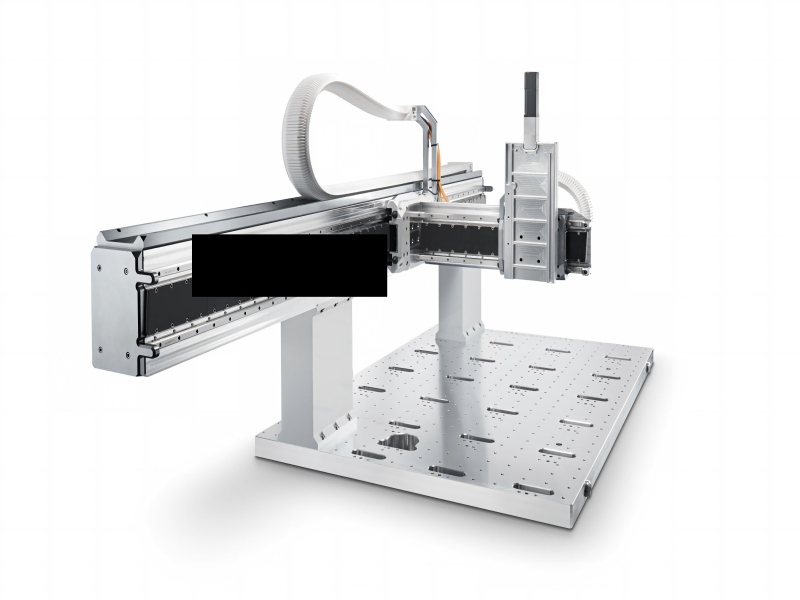
Gantry systems
Machine vision
PLC systems
Motion controllers
Servo drives
Vacuum systems
Electric grippers
For machine builders, standard communication and straightforward control logic are often more valuable than adding unnecessary functions to the module.
The variable pitch axis should behave predictably and be easy to diagnose from the main machine controller.
Pneumatic vs. Servo vs. Linear Motor Variable Pitch Modules
There is no single drive method that is best for every application.
Pneumatic Variable Pitch Mechanism
A pneumatic design is usually suitable when the application requires two fixed pitch positions.
Advantages include simple construction, relatively low cost, and straightforward control.
The limitation is that intermediate positions are difficult to control accurately without additional hardware.
Servo-Driven Variable Pitch Module
A servo motor combined with a screw, cam, linkage, or other mechanical transmission provides programmable pitch control.
This is often the most practical choice when several product recipes are required.
The main considerations are backlash, transmission rigidity, speed, motor sizing, and overall mechanism complexity.
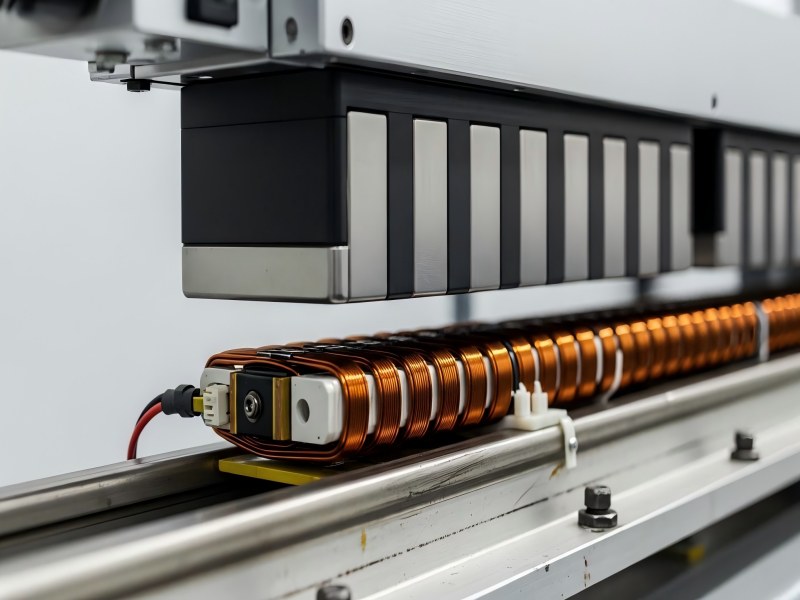
Linear Motor Variable Pitch System
Linear motors can provide fast response and remove some conventional transmission components.
They are attractive for applications requiring high dynamic performance or independent control.
The trade-offs are typically higher cost, more demanding control requirements, heat management, and increased system complexity.
For most applications, the correct question is not:
“Which technology has the highest specification?”
It is:
“Which mechanism meets the required cycle time, accuracy, payload, and pitch range with sufficient margin?”
Where Are Variable Pitch Modules Used?
Lithium Battery and EV Automation
Battery production contains many operations where cells or components must move between different fixtures, trays, and processing stations.
Variable pitch modules can be used for:
Battery cell handling
Cell loading and unloading
Tray transfer
Cell sorting
Inspection
Module assembly
For this type of equipment, payload, cycle time, collision prevention, and long-term repeat
Frequently Asked Questions About Variable Pitch Modules
1. What is a variable pitch module?
A variable pitch module automatically changes the spacing between multiple grippers, suction cups, or sliders, allowing parts to be picked at one pitch and placed at another.
2. How does a variable pitch module work?
It typically uses a servo motor with precision guides and a transmission mechanism to move multiple stations simultaneously. Pitch positions can be programmed through a PLC or motion controller.
3. What is the difference between a variable pitch module and a fixed-pitch gripper?
A fixed-pitch gripper maintains constant spacing, while a variable pitch gripper automatically expands or contracts to match different pickup and placement pitches.
4. Can a variable pitch module be used with industrial robots?
Yes. It can be integrated into robot EOAT for six-axis, SCARA, Cartesian, and gantry robots used in automated pick-and-place applications.
5. What accuracy can a variable pitch module achieve?
Accuracy depends on the drive system, transmission, payload, and travel. Servo and linear-motor designs are commonly used when high positioning accuracy and repeatability are required.
6. Servo or pneumatic variable pitch module: which should I choose?
Pneumatic systems are suitable for simple fixed-position changes, while servo variable pitch modules are better for programmable multi-position adjustment and frequent product changeovers.
7. What industries use variable pitch modules?
They are widely used in EV battery automation, electronics assembly, semiconductor handling, automotive, solar, medical, and packaging automation.
8. Can one variable pitch module handle different product sizes?
Yes. Multiple pitch positions can be programmed for different product sizes, making the module suitable for flexible and high-mix manufacturing.
9. How do I select the right variable pitch module?
Check the number of stations, pitch range, stroke, payload, cycle time, repeatability, mounting orientation, and control method based on your application.
10. Can the pitch be adjusted while the robot is moving?
Yes. Pitch adjustment can be synchronized with robot movement to shorten cycle time, provided payload, acceleration, vibration, and collision clearance are properly considered.
11. What are the main benefits of a variable pitch module?
The main benefits are fast pitch adjustment, shorter changeovers, multi-part handling, precise positioning, and greater automation flexibility.
12. What information is needed to customize a variable pitch module?
Provide the number of stations, initial and final pitch, payload, stroke, cycle time, accuracy, and installation requirements. A pickup-and-placement layout is also helpful.
HCY Automation delivers integrated solutions across motion control, linear motion, robotics, machine vision, pneumatic systems, and precision gearboxes to help global manufacturers build smarter, faster, and more reliable production lines. Our engineering team helps you select and integrate the right motion control, robotics, and automation components for your specific application.