Key Applications of Variable Pitch Modules in Industrial Automation
In industrial automation, product spacing is not always fixed.
A production line may handle different product sizes, multiple SKUs, or changing layouts during the same production cycle. When several grippers, suction cups, or tooling positions need to move together, a fixed-pitch mechanism can quickly become a limitation.
A variable pitch module allows the distance between multiple working positions to be adjusted automatically during machine operation. Instead of manually repositioning grippers or replacing dedicated fixtures, the automation system can change the pitch according to the product size, process requirement, or programmed recipe.
The idea is simple, but its applications are surprisingly broad.
Today, variable pitch modules are increasingly used in industrial automation, robotic pick and place, electronics manufacturing, semiconductor handling, battery production, packaging, sorting, automotive manufacturing, and flexible manufacturing systems.
The following are some of the most common applications.
1. Electronics Assembly and Testing
Electronics manufacturing often requires multiple small components to be picked, transferred, tested, or assembled at the same time.
The challenge is that product dimensions and component layouts can vary between different models.
A fixed-pitch gripper may work well for one product but require manual adjustment when the production line changes to another model. A variable pitch module allows the spacing between multiple grippers or vacuum suction cups to be changed automatically.
For example, a pick-and-place system can use one pitch for one PCB configuration and switch to another pitch for a different product without replacing the complete tooling assembly.
Typical applications include:
PCB handling
Electronic component pick and place
Connector assembly
Display and panel handling
Small-part transfer
Automated inspection
Precision component positioning
For these applications, compact design, high repeatability, fast pitch adjustment, and precise positioning are usually more important than simply maximizing the adjustment range.
2. Semiconductor and Precision Handling
Semiconductor and precision manufacturing place strict requirements on positioning accuracy and repeatability.
When multiple wafers, substrates, or precision components need to be handled simultaneously, their spacing may need to change according to the process or equipment layout.
A precision variable pitch module can be integrated into robotic tooling or automated handling equipment to provide synchronized spacing adjustment.
Depending on the application, engineers may need to consider:
Positioning accuracy
Repeatability
Payload
Cycle time
Mechanical rigidity
Tooling weight
Environmental conditions
The advantage is that one handling system can potentially support several product configurations without requiring completely different mechanical tooling.
3. Battery and New Energy Manufacturing
The rapid development of battery manufacturing has created increasing demand for flexible automated handling.
Battery cells, modules, trays, and related components can have different dimensions and arrangements depending on the production process.
During cell handling, sorting, transfer, stacking, and tray loading, the distance between multiple gripping or vacuum points may need to change.
A variable pitch module can adjust the spacing between these working points to match different battery formats.
Common applications include:
Battery cell handling
Cell sorting
Battery module transfer
Cell tray loading
Battery component pick and place
Stacking and alignment
Automated material handling
For battery automation, engineers typically need to evaluate payload, acceleration, cycle time, positioning repeatability, tooling weight, and product-contact requirements together.
4. Packaging and Case Packing
Packaging is another area where variable pitch technology can make a noticeable difference.
A single packaging machine may need to process bottles, cartons, trays, pouches, or other products in different sizes.
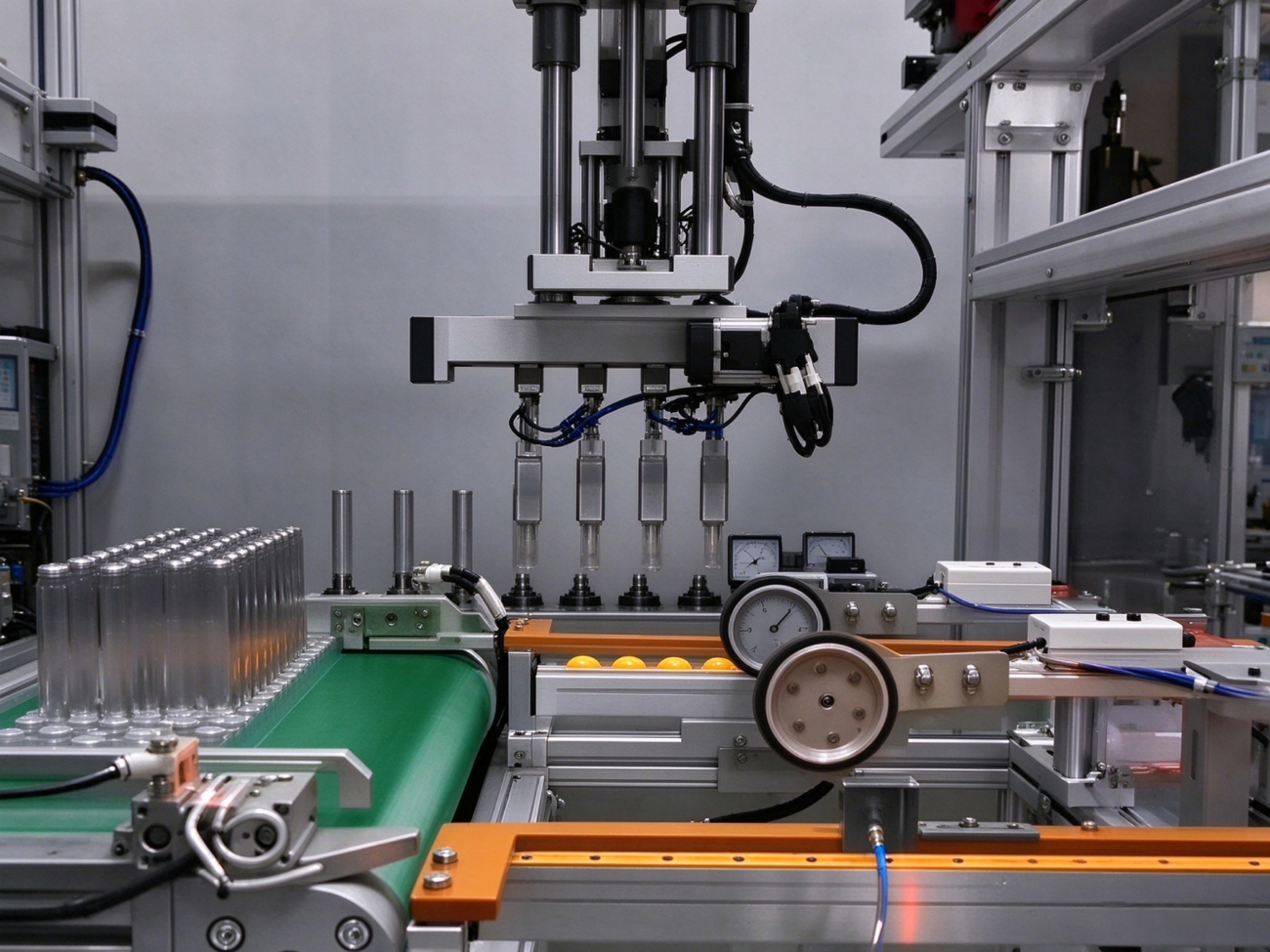
Consider a multi-head vacuum gripper picking products from a conveyor. If the product diameter or product spacing changes, a fixed suction-cup arrangement may no longer match the incoming products.
An adjustable pitch module allows the suction cups or grippers to move closer together or farther apart automatically.
This can help manufacturers handle multiple SKUs with the same basic pick-and-place tooling.
Typical applications include:
Bottle handling
Carton packing
Case packing
Tray loading
Pouch handling
Product grouping
Secondary packaging
Robotic palletizing
For packaging automation, fast format changeover is often one of the main reasons to consider a variable pitch solution.
5. Sorting and Product Distribution
In automated sorting systems, products do not always arrive at the spacing required by the next process.
Products may need to be grouped, separated, or redistributed before packaging, inspection, assembly, or palletizing.
A variable pitch mechanism can change the spacing between multiple products during the transfer process.
A typical sequence may look like this:
Pick → Adjust Pitch → Transfer → Place
The pitch adjustment can be programmed according to the production recipe, allowing the same mechanism to handle different product arrangements.
This makes variable pitch technology useful for:
Automated sorting
Conveyor transfer
Product grouping
Product distribution
Robotic handling
Automated packaging
6. Automotive Parts Handling
Automotive production involves large production volumes but also an increasing number of product variants.
Different components may require different gripping positions or different spacing between tooling points.
A multi-position variable pitch module can be integrated into robotic end-of-arm tooling to handle several parts or product variants with one adjustable mechanism.
Potential applications include:
Component loading
Part transfer
Machine tending
Robotic assembly
Inspection
Multi-station handling
Automated component positioning
Instead of designing completely separate tooling for every product variant, manufacturers can use programmable pitch adjustment where the application allows it.
7. Flexible Automation and Machine Building
Perhaps the most important application of variable pitch technology is flexible automation.
Machine builders increasingly need to design equipment that can accommodate product changes throughout its service life.
A fixed fixture is optimized for one configuration.
A variable pitch module provides an adjustable mechanical interface that can support multiple configurations within a defined range.
This can be particularly useful for:
High-mix production
Low-volume manufacturing
Multi-SKU production
Quick changeover systems
Modular automation
Robotic end effectors
Custom automation equipment
For automation integrators, this flexibility can simplify machine design and reduce the number of dedicated fixtures required.
Variable Pitch Module vs. Fixed-Pitch Tooling
A fixed-pitch tooling system maintains a constant distance between grippers or suction cups, making it suitable for stable, high-volume production with consistent product dimensions. A variable pitch module allows the spacing to be adjusted automatically, providing greater flexibility for multi-SKU production, quick changeovers, and robotic pick-and-place applications.
Feature
Variable Pitch Module
Fixed-Pitch Tooling
Pitch adjustment
Automatic
Fixed
Product flexibility
Multiple sizes and layouts
Mainly one specification
Changeover
Fast and programmable
Usually requires manual adjustment or tooling change
Production type
High-mix, flexible production
Stable, high-volume production
Tooling flexibility
High
Limited
Automation integration
Servo/PLC/robot control
Simple mechanical setup
Best application
Flexible automation and multi-SKU handling
Dedicated production lines
In short, fixed-pitch tooling is often the simpler choice for consistent products, while variable pitch modules are better suited to flexible automation where product dimensions or spacing frequently change.
Why Are Variable Pitch Modules Important for Modern Automation?
The main value of a variable pitch module is not simply that it can change spacing.
Its real value is adaptability.
Traditional automation often relies on dedicated fixtures designed around one product specification. This approach remains effective for stable, high-volume production.
However, when product sizes change frequently, manual fixture adjustment can become a source of downtime and positioning errors.
Variable pitch technology moves this adjustment into the machine’s automated motion system.
The machine can determine the required pitch, move the tooling to the programmed position, and continue the production cycle.
This is particularly relevant to modern manufacturing trends such as:
Flexible manufacturing
Smart manufacturing
Industry 4.0
Robotic automation
High-mix, low-volume production
Automated changeover
Modular tooling
Intelligent machine design
What Should Engineers Consider When Selecting a Variable Pitch Module?
Not every variable pitch application requires the same mechanism.
Before selecting a module, engineers should consider several basic parameters.
Pitch Range
The required minimum and maximum spacing should be defined first.
Number of Working Positions
Two-axis and multi-axis applications have different mechanical requirements. More working positions generally require careful consideration of synchronization and structural rigidity.
Payload
The total moving load includes the product, grippers, suction cups, brackets, sensors, and other tooling.
Positioning Accuracy
Electronics, semiconductor, and precision assembly applications may require tighter repeatability than general packaging applications.
Cycle Time
For high-speed pick-and-place systems, pitch adjustment must be fast enough to avoid becoming the bottleneck of the production cycle.
Installation Space
A compact mechanism can be especially valuable when the module is mounted directly on a robot end effector.
Control Compatibility
The pitch adjustment mechanism should work smoothly with the machine’s PLC, servo system, robot controller, or motion-control architecture.
The Future of Variable Pitch Automation
As manufacturers continue moving toward flexible production, automated changeover, and multi-product manufacturing, the demand for adjustable mechanical systems is likely to increase.
Variable pitch modules provide a relatively simple way to introduce this flexibility into automated tooling.
They can help one machine handle multiple product formats, reduce manual adjustment, and simplify the design of multi-gripper and multi-suction-cup systems.
The next generation of variable pitch solutions will likely focus on higher positioning accuracy, faster response, greater payload capacity, compact mechanical design, lower noise, longer service life, and smarter motion control.
For machine builders and automation engineers, the key is not simply choosing a module with the largest pitch range. The better approach is to match the mechanism to the actual product, tooling, cycle time, and production environment.
Customized Variable Pitch Solutions from HCY Automation
Every automation application has different requirements.
The number of working positions, pitch range, payload, cycle time, tooling configuration, installation dimensions, and control method can all affect the design of the variable pitch mechanism.
From multi-gripper pick-and-place systems to multi-suction-cup handling, sorting, transfer, packaging, electronics, battery, and other precision automation applications, HCY Automation can develop a variable pitch solution based on the actual requirements of the machine.
If your application requires automatic pitch adjustment, synchronized multi-position movement, or customized variable spacing, HCY Automation can help develop the appropriate multi-position variable pitch module for your automation system.
Frequently Asked Questions About Variable Pitch Modules
1. What is a variable pitch module?
A variable pitch module is an automation mechanism that automatically adjusts the distance between multiple grippers, suction cups, tooling positions, or other working points. It is commonly used in pick-and-place, material handling, packaging, assembly, and flexible automation systems.
2. How does a variable pitch module work?
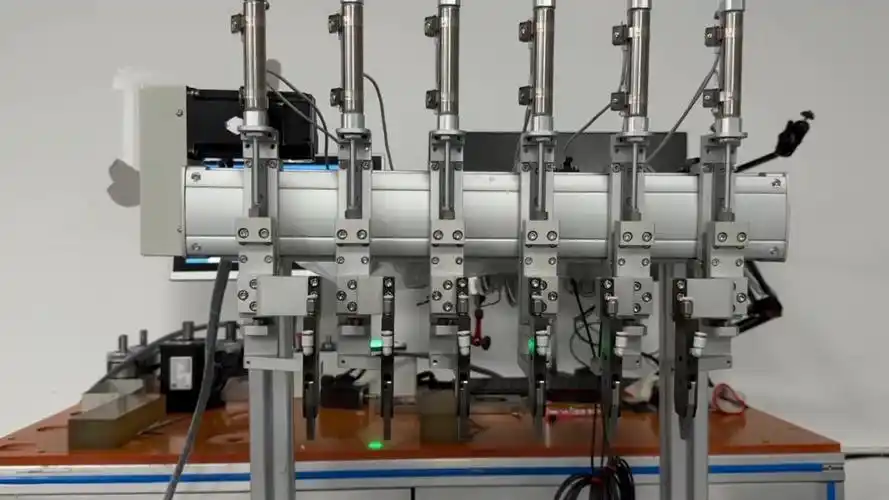
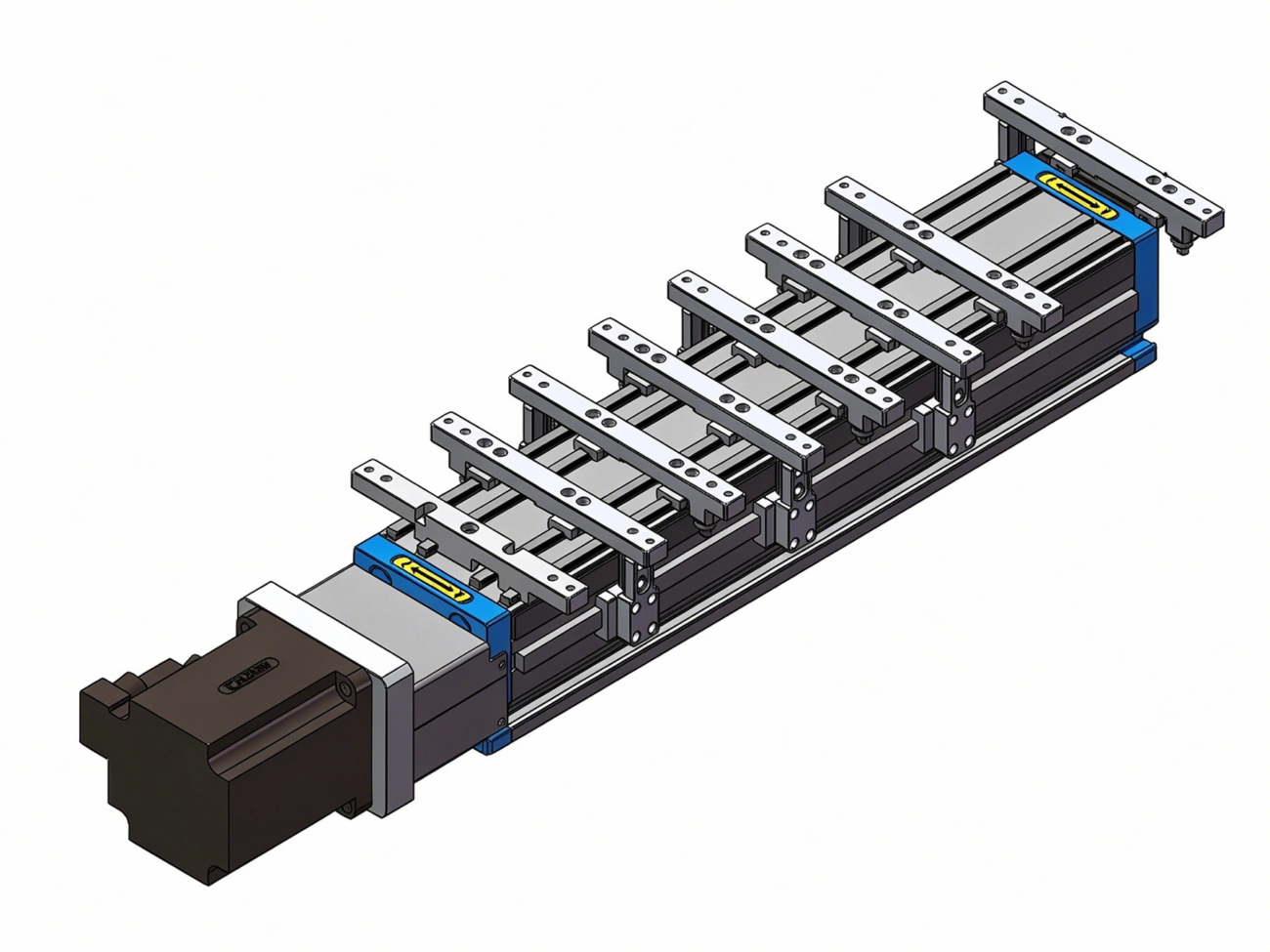
A variable pitch module typically uses a servo motor or other actuator to drive a precision transmission mechanism. Multiple pitch slides move simultaneously to increase or decrease the spacing between working positions according to programmed commands.
3. Where are variable pitch modules used?
Variable pitch modules are widely used in electronics manufacturing, semiconductor handling, battery production, packaging automation, automotive manufacturing, sorting, robotic pick and place, and automated material handling.
4. What are the advantages of a variable pitch module?
The main advantages include automatic pitch adjustment, faster product changeover, reduced manual adjustment, high positioning repeatability, improved tooling flexibility, and the ability to handle multiple product formats with one automation system.
5. What is the difference between a variable pitch module and fixed-pitch tooling?
Fixed-pitch tooling maintains a constant distance between working positions. A variable pitch module can automatically change that distance during operation, making it more suitable for multi-SKU production, flexible automation, and applications requiring frequent product changeovers.
6. Can a variable pitch module be used for robotic pick and place?
Yes. Variable pitch modules can be integrated into robotic end effectors to adjust the spacing between multiple grippers or vacuum suction cups. This allows one robot tooling system to handle products with different dimensions or layouts.
7. Can variable pitch modules be customized?
Yes. A variable pitch module can be customized according to the application requirements, including pitch range, number of positions, payload, stroke, speed, positioning accuracy, installation dimensions, motor configuration, and gripper or suction-cup interface.
8. How do I choose the right variable pitch module?
Important factors include required pitch range, number of working positions, payload, cycle time, positioning repeatability, tooling weight, available installation space, operating environment, and control-system compatibility.
9. What industries use variable pitch automation?
Common industries include 3C electronics, semiconductor manufacturing, battery and new energy, automotive, packaging, medical equipment, plastics, metalworking, and general industrial automation.
10. Can HCY Automation provide customized variable pitch solutions?
Yes. HCY Automation provides customized multi-position variable pitch module solutions for industrial automation applications. The solution can be configured around the required pitch range, number of working positions, tooling, payload, speed, accuracy, and machine layout.
HCY Automation delivers integrated solutions across motion control, linear motion, robotics, machine vision, pneumatic systems, and precision gearboxes to help global manufacturers build smarter, faster, and more reliable production lines. Our engineering team helps you select and integrate the right motion control, robotics, and automation components for your specific application.